

All things Archaeology, History and Art🏺 • Greece & Rome 🏛️ • Former Archaeologist • History MA • Trainee Teacher • Formerly The Classical Compendium
Northern Ireland
Joined January 2021
- Tweets4.8K
- Following252
- Followers58.5K
- Likes13.9K





Symmachus 📜🏺 retweeted

The head of an ancient Egyptian alabaster cat-shaped cosmetic vessel with eyes made of rock crystal. 12th Dynasty, Middle Kingdom, 1990–1900 BCE. The Metropolitan Museum of Art, New York (1990.59.1) metmuseum.org/art/collection…

Symmachus 📜🏺 retweeted

A museum worker cleans the spectacular Lod mosaic prior to the opening of the purpose-built Lod Mosaic Archaeological Centre in 2022. The Roman mosaic covering an area of 1,900 sq ft was first discovered in the central city of Lod in 1996 though the Israel Antiquities Authority only fully unearthed and preserved the enormous artwork in 2009. The 3rd century mosaic featuring a wide menagerie of exotic animals was then taken on a decade-long tour of world museums before returning to its new permanent exhibition space in Israel. (Image: AP, Oded Balilty)

Symmachus 📜🏺 retweeted

#FrescoFriday - Fragment of wall painting depicting a satyr and a maenad. From the House of Caecilius Jucundus in Pompeii.
Naples National Archaeological Museum.

Happy September everyone! 🎉
Originally the seventh (from the Latin 'septem') month of the Roman calendar, it was dominated by the Ludi Romani ('Roman games') and grape harvesting. It was also the birth month of four major emperors!
📷 Ad Meskens
#Roman #History #September

An adorable ancient Egyptian otter statue!
Dating to c. 640 - 30 BCE, it depicts a bronze otter on its hindlegs, forepaws raised in praise of the sun. The solar disc of Ra rests upon its head.
🏛️@metmuseum
#Egypt #Archaeology #Art #Classics #History


The oldest doors in Rome.
Nearly 2,000 years old, these massive bronze doors once belonged to the Roman senate house during the reign of Domitian. Now part of the church of St John Lateran.
📷 Walks in Rome
#History #Roman #Art #Archaeology #Rome

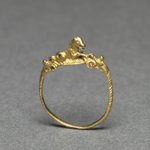
An adorable gold Roman ring featuring a hippocamp riding the waves. Dated to c. 1st - 2nd century CE.
🏛️@ClevelandArt
#Roman #Art #History #Classics

Given the popularity of the fantastic #baldursgate, here's a D20 from 2,200 years ago!
This greenstone die is inscribed with the Greek alphabet, from alpha to upsilon.
Whilst its purpose is unknown, it may relate to board games or religious divination.
🏛️@metmuseum
#History

Symmachus 📜🏺 retweeted

This beautiful #Roman enamelled copper alloy flask in hexagonal shape was found in Welzheim at the Limes, the Roman frontier. The small vessel was a product of a workshop in Britain or Gaul and was presumably used to hold perfume.
#romanarchaeology
Photo: @ALM_BaWue

Symmachus 📜🏺 retweeted
Roman gold ring supporting a square bezel set with an amethyst and a cabochon emerald, c.3rd century AD.

Symmachus 📜🏺 retweeted
🏛 The Treasury of the Athenians, Delphi, Phocis, Greece. Built between 510-480 BCE to house the offerings from Athens and its citizens to the god Apollo at his sanctuary. 📷My own.


A bizarrely bent ancient bronze sword from Oss in the Netherlands.
Found in the urn burial of a 'prince', it dates to c. 800 - 500 BCE. It may have been bent to deter graverobbers, or simply to fit in the urn.
🏛️@RM_Oudheden
#Celtic #Netherlands #Art #History #Archaeology


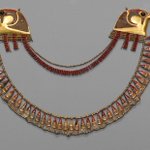
An exquisite Egyptian broad collar, worn by one of the three wives of Pharaoh Thutmose III.
Dating to the New Kingdom (c. 1,479 – 1,425 BCE), it is made of gold, carnelian and obsidian, and adorned with falcon-headed terminals.
🏛️@metmuseum
#Ancient #Egypt #History #Art

A 2,000 year-old Roman mosaic that has slowly been eroded by the waters of the Euphrates.
Discovered in 2000 in Zeugma, Turkey, it is thought to date to c. 1st century CE.
📷 Ali Korkmaz
#History #Roman #Art #Archaeology #Turkey

Symmachus 📜🏺 retweeted

#OnThisDay in 30 BCE (also sometimes given as August 10th), Cleopatra VII Thea Philopator commits suicide in Alexandria. From the Altes Museum in #Berlin, a bust of Cleopatra from along the Via Appia near Genzano. Dated to 40-30 BCE.
#Archaeology #RomanArchaeology

Symmachus 📜🏺 retweeted

In Hierapolis, Turkey, an ancient Roman tomb is gradually being concealed by calcium carbonate deposits.
Hierapolis is renowned for its thermal spas and became part of the Roman Empire around 133 BC when King Attalus III of Pergamon bequeathed his kingdom to Rome upon his death.

A stunning ancient Egyptian agate bowl. Around 2,300 years old, the agate may have come from India!
It was discovered near Qift in southern Egypt, which lay on a trade route that connected the Mediterranean to the Arabian Sea.
🏛️@GettyMuseum
#History #Egypt #Art #India

