
Professor of machine learning. Structural bioinformatics, deep probabilistic programming. Grumpy Girardian. Opinions are my own.
Copenhagen
Joined February 2022
- Tweets136
- Following318
- Followers122
- Likes877





Thomas Hamelryck retweeted

I had a great time presenting the "Foundations of Modern AI" at the Berkeley Deep Learning for Science Summer School. The talk covered a prescriptive theory of generalization and epiplexity. Video now online! youtube.com/watch?v=lKoJJxjU…

Thomas Hamelryck retweeted

'There is a strong [yet rare] moral intuition that speculative understanding for its own sake is one of the ultimate elements in a good life.
The passionate claim for freedom of thought is based upon it.'
– A. N. Whitehead
(FR, II)

Thomas Hamelryck retweeted

🏹 Job Alert: Postdoc in Mechanistic Understanding of AI Reasoning
📍 Copenhagen 🇩🇰
⏰ 30 September
🔗 bit.ly/4c1sqoe
Thomas Hamelryck retweeted

Happy to share a rather unusual new preprint of mine, arxiv.org/abs/2608.15337 My interest was sparked by stimulating discussions with colleagues, that made me think how imprecise probabilities can be beneficial in settling a question in the field of combustion. 1/10

Thomas Hamelryck retweeted

Ordinary Abundance. This is the greatest thing I've read in weeks. No kidding. This should win a Pulitzer in a category not yet invented. ordinaryabundance.com/

Thomas Hamelryck retweeted

New article outlining some of the core ideas from the first half of Singularity Summer with @THamelryck, as well as setting context for our second month with Nikola Danaylov @singularityblog, see: philosophyportal.substack.co…

Thomas Hamelryck retweeted

Those who remain literate will be the one-eyed among the countless blind in the new digital era.

“The world that these theorists foresaw half a century ago is now here. The literate era will prove to be a brief interlude between the oral and digital ages.” A fascinating read.
theatlantic.com/magazine/202…

Thomas Hamelryck retweeted
A new interview with machine learning expert @THamelryck focused on the basics of machine learning in relation to philosophy.
youtu.be/0ADTazRIeUI?si=ULwT…
To learn more about Singularity Summer, see:
philosophyportal.online/sing…

Thomas Hamelryck retweeted

FAQ:
NeurIPS Europe is an official NeurIPS 2026 satellite event taking place in Paris, France, alongside the main conf in Sydney and the other satellite event in Atlanta.
NeurIPS authors can present their papers at any of the three locations, subject to space availability.


Thomas Hamelryck retweeted
This is your annual reminder that we don’t need to speculate about whether we will have a “theory of deep learning” and what form it might take, because we already have a basic understanding of generalization in deep learning: arxiv.org/abs/2503.02113

Thomas Hamelryck retweeted

🌿 mutwillab.com just got a refresh — organised around our three research pillars (gene function prediction · stress resilience · evolution of regulatory circuits), with all our open tools, papers, and team in one place.
And we're hiring 5 PhDs + 1 postdoc 👇

"AlphaFold's Bayesian roots in Probability Kinematics," co-authored with directional statistics pioneer Prof. Kanti V. Mardia on his 90th birthday, is now published by AISTATS 2026.
In 2018, CASP13 (the 13th edition of the "olympic games" of protein structure prediction) reported "[...] unprecedented progress in the ability of computational methods to predict protein 3D structure. The reasons are not yet fully clear [...]". DeepMind's AlphaFold, version 1, had changed protein structure prediction forever!
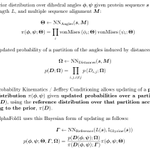
AlphaFold1 was published as “Improved protein structure prediction using potentials from deep learning” by Nature in 2020. It uses deep networks to parameterize potentials over dihedral angles and pairwise distances, combining the two using a third reference potential. This approach was heuristically justified by referring to the classic work by the physicist John Kirkwood from 1935 on potentials of mean force for liquids. But there’s more to the story, and it builds on some fascinating work done well after 1935.
First, AlphaFold1 formulates a potential that corresponds to a prior distribution over protein dihedral angles (phi, psi) using directional statistics (which deals with angles, directions, orientations and so on). This goes back to the classic work of David L. Dowe at the end of the 90ies, and our joint work with Kanti V. Mardia around 2010 on generative models based on directional Bayesian networks.
Second, a non-local potential concerning pairwise distances D between amino acids is added. Why? In principle, the dihedral angles are enough to parameterize the 3D structure, but small errors quickly propagate, rendering them only accurate on a local scale.
Third, a reference potential on D is subtracted. Why? Correctly combining distance and angular potentials requires taking into account the signal concerning distances already present in the angular potential. This approach was pioneered as a heuristic by Manfred Sippl in the 1990s, and in the 2010s formalized by us as a surprising application of generalized Bayesian updating called probability kinematics or Jeffrey’s updating (referring to the probability theorist Richard C. Jeffrey, 1926-2002).
AlphaFold1 powered the whole probabilistic setup based on directional statistics and probability kinematics outlined above with deep networks, obtained a maximum a posteriori estimate using simple gradient descent, and subsequently aced CASP13.
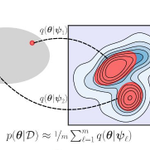
Our article connects a paradigm shift in protein structure prediction with the classic work by Richard C. Jeffrey (1950s, probability kinematics), Manfred Sippl (1990s, knowledge based potentials), and our joint work with Kanti V. Mardi (2010s, probability kinematics applied to directional priors), revealing generalised Bayesian updating as a potentially powerful method to formulate compositional deep models from simpler components. The figure shows the AlphaFold1 potential reformulated as a joint probabilistic model.
Article:
virtual.aistats.org/virtual/…

Give this man a cigar. LLMs are heuristic induction only - no deduction, no abduction (ie. model building based on a world representation, including causality and memory). They are eminently useful but not conscious, sentient or intelligent, and they will never be.

Thomas Hamelryck retweeted
🇩🇰 Built a tool to help find research collaborators across Denmark.
1,300+ faculty from KU, AU, DTU, CBS, SDU. Describe your project in plain English → Claude ranks the best fits with a "why" for each.
Free, public. plen-collab-finder.vercel.ap…
The world of Bayesian statistics looks upon the terminology drift in the world of machine learning with increasing horror...

Thomas Hamelryck retweeted

The Bayesian Workflow book is coming!
statmodeling.stat.columbia.e…
New paper on arxiv! Tiny yet effective neural networks from using circulant weight matrices and spectral priors.

Compact Circulant Layers with Spectral Priors
Joseph Margaryan, Thomas Hamelryck
arxiv.org/abs/2602.21965 [𝚌𝚜.𝙻𝙶]

Thomas Hamelryck retweeted
Born on this day, 1861: Alfred North Whitehead
Video summary: youtu.be/yIj2-lSnQ5M?si=uGP1…
Thomas Hamelryck retweeted

I am excited to announce our Workshop on Causality in the Age of AI Scaling in AISTATS 2026!
- Is scaling sufficient for intelligent systems?
- Can causal abilities emerge from scale?
- What can causal modeling bring that scale cannot?
causcale.github.io/
RTs appreciated
AGI crowd, listen and learn.

New interview:
‘Meet the Philosopher questioning Everything…About Consciousness’:
youtu.be/atCKrCvxkdQ?si=6Hbh…
