

The official X account for https://teapaw.org/t.co/U0VTweIKF3, a historical resource dedicated to the life and legacy of Thomas Jefferson.✍️
Virginia
Joined March 2025
- Tweets1.1K
- Following0
- Followers213
- Likes744




Pinned Tweet
Understanding Jefferson and this Page
The purpose of this post is to answer common questions I see in the many comments on this page and to spell out my overall mindset. At ThomasJefferson [.] com, the philosophy is built on five core principles. Primary source evidence (such as his letters) is valued over modern assumptions, the rule of innocent until proven guilty is strictly upheld, historical figures are not judged by modern standards, respectful and informed debate is welcomed while drive-by insults are blocked, and Thomas Jefferson is treated with basic human empathy for the massive personal sacrifices he made for this country.
Before diving deeper into those points, let me first set the scene. When it comes to Thomas Jefferson, there are three major types of people. First, there are his admirers. Second, there are his haters. Third, there are the people in the middle who love his accomplishments, just not the other parts of his life.
First of all, this page is for Thomas Jefferson admirers. This is not a blind love for him, but rather a well-researched admiration built on many years of study and reflection. Serious students of history dismiss uninformed attacks because arguments built on myths rather than primary sources are simply not worth debating. Conversely, if you happen to be an admirer who has not done all the research yet, maybe because you simply trusted the opinion of someone you respect, you still ended up on the right side of history. As the old saying goes, it is better to be lucky than good.
Because of this, haters have a short leash here. They are welcome if they come in genuinely wanting to understand. However, if they come into the comments repeating the same tired misinformation without any backup or proof, and refuse to consider and read the materials offered here, they will be blocked. Those old complaints are easily resolved by reading original source documents, which the critics rarely do. That is why they all sound the same, simply parroting talking points from an author or academic with an agenda, accepting everything blindly without any skepticism, critical thinking, or effort to verify if it is actually true. There are better things to do than to entertain amateur, surface-level attacks.
For example, recently a gentleman here was told that Jefferson actually wrote letters denying the Hemings charges, and he replied that he had been reading about Jefferson for over 40 years and had never heard that. Do not assume you know Thomas Jefferson just because you have read poor (usually modern liberal) biographies or have never dug deeper, settling instead for the historical equivalent of junk food. But more often than not, critics are simply everyday readers who were misled by biased academics pushing an agenda to fuel resentment toward Jefferson. If you have seen this irrational hostility firsthand in the academic world, you know exactly what I mean.
On the other hand, if you are a critic who takes the time to read the articles on this page and wants to question specific points or debate the issue respectfully, you are welcome to stay. The fact is, the more you learn the real history surrounding Jefferson, the more you realize he was a good and great man. Serious students of Jefferson and thus admirers determined this to be true a long time ago. There is a reason why some of America's greatest presidents, including Lincoln, FDR, and JFK, deeply admired Thomas Jefferson, and it is because they understood the facts.
Now we come to the people in the middle. They do not particularly love Jefferson, nor do they hate him. They usually understand that we should not judge historical figures by modern standards, yet they struggle to understand why a great man would own slaves, especially when he openly wrote that slavery was wrong.
For this concern, I suggest you start with this post: teapaw.org/TJeffersonCom/status/2… . I have received countless messages thanking me for this piece because it bridges that disconnect. It explains in logical detail, based on real historical facts and Virginia law, why Thomas Jefferson remained a slaveholder. Hint: it was not because he wanted to be.
Another common question from people in the middle is about the rumors of Jefferson having a relationship with an enslaved woman. They often ask what would be so wrong with that. Honestly, if a relationship were based on mutual love, there would be nothing wrong with it, and today it would even be celebrated. The issue here is simply about truth and evidence.
Jefferson himself denied the rumor, and many people close to him backed up his word. Why should anyone accept an accusation that he denied when there is no solid proof? A basic principle of fairness is innocent until proven guilty.
Even today, there is no conclusive proof from DNA to confirm those claims. In fact, DNA even exonerated Jefferson in a major historical rumor, a detail rarely publicized or shared by progressive academics. For over two centuries, many people suspected that a man named Thomas Woodson was Jefferson's son conceived during his time in France, largely because the timeline fit the boy's age perfectly and they shared a first name. The circumstantial evidence was extremely convincing. Yet the 1998 DNA study definitively proved that Jefferson was not his father. Jefferson was telling the truth all along.
Finally, people in the middle often say that Jefferson was just a man who did great things, but also had flaws. That is true of every human being who has ever lived. Saying it is like pointing out that the sun is bright. It is so obvious that it does not need to be said. Nobody feels the need to remind everyone that Thomas Edison was a flawed and hypocritical man, even though he was, just like anyone else. It is completely unnecessary, and it is just as ridiculous to constantly repeat it about Jefferson.
People do this because Jefferson is larger than life, and cynics always want to knock great figures down a peg to feel balanced. They say he was extraordinary, yet in the same breath insist he was complex, a paradox, or a hypocrite. No, Jefferson was a benevolent genius who gave and gave without asking for anything in return. People label him incorrectly simply because they do not understand him. How can you balance out an extraordinary individual by reducing them to ordinary? That goes against the very definition of extraordinary.
When people make flippant, careless remarks about Jefferson, it is wrong. Even though he passed away 200 years ago, people should still show basic human empathy. In his farewell letter to James Madison, Jefferson famously asked his friend to "take care of me when dead." That proves he cared deeply about how future generations would remember him. Given how much he sacrificed for this country, including his family fortune, his personal peace, and his own life, Jefferson deserves to be honored and respected by all Americans.
Thank you, Mr. Jefferson, for all you have done for us. Now it is our responsibility to continue your work and principles.


Why Thomas Jefferson did not free his slaves
Many people wonder why Thomas Jefferson, a man who wrote that "all men are created equal," did not free his slaves. The short answer is he wanted to free them. Looking closely at his life, however, shows that doing so was legally and financially impossible for him, due mostly to his unwavering sense of duty to his family, his creditors, and his young country.
Early on, when his finances were healthy, Virginia law prohibited slaveholders from freeing their slaves, and lawmakers repeatedly rejected Jefferson’s efforts to build a legal, supportive path to freedom. Later in life, when the law finally allowed emancipation, Jefferson was trapped by a mountain of inherited debt, strict creditor laws, and the heavy personal cost of public service.
As a young man, Jefferson managed his money well and had no major debts. His balance sheet was strong, backed by 5,000 acres of land. During this financially stable period, Jefferson actively fought through the courts and the legislature to make emancipation possible. Throughout his life, he discussed freeing his slaves in letters to Thomas Cooper (1814), Thomas Humphreys (1817), and John Holmes (1820), alongside a 1789 description of a limited sharecropping plan.
At the same time, as he famously explained in his 1814 letter advising neighbor Edward Coles against freeing his own slaves unilaterally, Jefferson believed that simply turning slaves loose without legal protection, education, or state support would subject them to severe hardship under hostile Virginia laws. Instead, he argued that owners had a duty to care for and protect their slaves until the legal system itself could be reformed.
Under colonial Virginia law at the time, private slaveholders were banned from freeing their own slaves without special permission from the governor and council. In 1769, during his very first term in the Virginia House of Burgesses, the 26-year-old Jefferson helped introduce legislation to allow slaveholders to free their slaves at will, but the legislature overwhelmingly rejected it. He also took on pro bono legal cases to argue for the freedom of slaves. In the late 1770s, he drafted a plan for gradual emancipation in Virginia that included education and training so freed people could succeed, though fellow lawmakers warned him it had no chance of passing.
Imagine what would have happened if early Virginia lawmakers and the voters they represented had backed Jefferson’s 1769 bill. At that time, Jefferson’s estate was completely solvent, debt-free, and unmortgaged. Had Virginia legalized private emancipation in 1769, Jefferson still had the personal wealth and unencumbered land to provide the support he believed freed slaves needed. He could have legally freed his slaves and used his own resources to transition them into paid laborers and tenant farmers before his assets were ever locked up as bank collateral. Instead, lawmakers rejected his bill, locking his slaves under strict colonial laws just as his financial fortune was about to turn.
That financial turn began in 1773, when Jefferson’s father-in-law, John Wayles, died. Jefferson inherited land, which ballooned his holdings to roughly 16,000 acres, along with dozens of slaves. Along with that property, however, he inherited massive debts to British merchants. Driven by a sense of honor and duty to pay off what was owed, Jefferson sold thousands of acres of inherited land during the Revolutionary War.
He accepted payment in American paper money, but rampant inflation soon made those bills practically worthless. By 1782, when Virginia finally passed a law allowing slaveholders to free their slaves, Jefferson’s financial window had slammed shut. When the war ended the following year, the Treaty of Paris required Americans to pay British creditors in hard gold and silver coin, not paper currency. Because British merchants refused the worthless paper bills, Jefferson lost his land for almost nothing and still owed the entire original debt, plus years of growing interest.
What about his salaries as Minister to France, Secretary of State, Vice President, and President? Unlike today, when politicians often leave office wealthier than when they entered, Jefferson was an incorruptible public servant. He entered public life as a rich man and left it impoverished. Serving his country out of a deep sense of civic duty cost him dearly.
Being away from Virginia for years meant his farms were poorly managed and rarely turned a profit, especially since he spent more than many other plantation owners to provide better food, clothing, and living conditions for his slaves. On top of that, his government pay never covered his steep out-of-pocket expenses for entertaining diplomats and representing the nation. Even his massive collection of nearly 6,500 books, which critics often dismiss as a personal luxury, was a working library that directly served the country. When British troops burned the U.S. Capitol in 1814, Jefferson sold his beloved books to Congress to rebuild the Library of Congress, using the money to pay down his creditors.
Refusing to use his powerful public offices to enrich himself, Jefferson was forced to refinance his loans repeatedly just to stay afloat. Under the laws and banking practices of his day, land and slaves were used as collateral to secure credit. Because banks and foreign lenders held mortgages on Jefferson’s property, he did not own his slaves free and clear. You cannot legally give away or free property that is pledged to a bank.
Even more importantly, Virginia law strictly forbade slaveholders from freeing anyone if doing so left their estate unable to pay its debts. If Jefferson had tried to free everyone in his will, Virginia courts would have overturned it, and creditors would have seized the freed slaves and sold them anyway. Furthermore, an 1806 Virginia law required newly freed slaves to leave the state within a year or be returned to slavery. That meant Jefferson would have needed large sums of cash to help them relocate, which was money he simply did not have.
Jefferson also felt a deep duty to protect his surviving daughter, Martha, and her eleven children. Martha’s husband was bankrupt, leaving Monticello as the only safety net keeping Jefferson’s grandchildren from complete poverty.
Any remaining hope Jefferson had of clearing his debts was destroyed in 1818, when he co-signed a $20,000 loan, the equivalent of over $530,000 today, for his friend Wilson Cary Nicholas. When Nicholas went bankrupt and died two years later, banks came after Jefferson for the entire loan and its crushing interest. He went from struggling to completely broke. By the time Jefferson died in 1826, he owed more than $107,000, the equivalent of over $3 million today. He was only able to free five men from the Hemings family in his will, and he had to beg the Virginia legislature for special permission to let them stay in the state.
In the end, history clears up the paradox. When Jefferson had the wealth to free his slaves, the law forbade it. When the law finally allowed it, duty and debt made it impossible. Thomas Jefferson did not fail to free his slaves because he lacked the will. He failed because he was trapped by a system he spent his life trying to change.

Thomas Jefferson and the Pursuit of a Happy, Healthy Life
Thomas Jefferson lived to the remarkable age of 83, dying on July 4, 1826, the 50th anniversary of the Declaration of Independence. To understand how unusual his longevity was, one has to look at the life expectancy of his era. In the late 1700s and early 1800s, the average life expectancy at birth in America was only about 35 to 40 years, meaning Jefferson lived more than double that average, or roughly 108 to 137 percent longer than expected from birth. Even when accounting for high infant and childhood mortality rates, an adult man who survived his early years could usually only expect to reach his early sixties, putting Jefferson roughly 35 percent ahead of his adult peers.
Out of the 56 men who signed the Declaration of Independence, Jefferson outlived 53 of them. He stood as one of the last three surviving signers alongside John Adams, who died just hours after him that very same day, and Charles Carroll of Carrollton, who lived until 1832. Jefferson stayed trim, active, and mostly healthy well into his eighties, relying on extraordinary personal discipline and practicing habits that modern science would not fully prove for another two centuries.
That unwavering discipline started at the dinner table long before nutritionists promoted plant-based diets. Jefferson practiced strict moderation with every meal, treating meat not as the main dish, but as a side condiment used simply to flavor his food. Instead, he filled his plate with fresh vegetables and fruits grown in his own gardens. Modern nutrition science now confirms that plant-rich diets lower inflammation, protect blood vessels, and sharply reduce the risk of chronic disease.
When it came to drinking, Jefferson avoided hard spirits altogether, preferring fine wines that he often watered down. He drank wine regularly with meals, never to the point of drunkenness, a pattern that modern cardiovascular studies have linked to heart health and longevity.
Remarkably, despite growing up on a Virginia plantation where tobacco was everywhere, his self-control kept him from ever smoking, chewing, or using snuff. Medical research has long since proven that avoiding tobacco is one of the single biggest factors in preventing heart disease and cancer. Combined with his clean diet, this lifelong discipline helped him keep all of his natural teeth, and at age 76 he proudly noted that he had never lost a single tooth to old age.
Jefferson brought that same steady discipline to his daily sleep schedule, mastering healthy body rhythms long before anyone had a smartwatch or fitness tracker to monitor their rest. He famously shared that for 50 straight years, the sun had never caught him in bed, waking up the moment there was enough morning light to read the clock across his room. Modern sleep researchers know that waking up consistently with natural morning light anchors the body's internal clock, balancing hormones and boosting daytime energy. At night, he protected his rest by refusing to let political stress follow him to bed, keeping a strict rule to spend 30 to 60 minutes reading calming moral philosophy before turning in, a wind-down routine that sleep doctors still recommend today to quiet the nervous system.
Physical movement was the cornerstone of Jefferson's waking routine, and he never let a busy schedule break his habit. He famously wrote that of all exercises, walking is the best, and he made sure to spend at least two hours outside every single day. Whether he was walking his Virginia estate while humming his favorite tunes, riding his beloved horses Caractacus and Eagle, or going shooting in the woods, he prioritized breathing fresh country air over the crowded, smoky air of cities. Modern public health studies show that regular daily walking strengthens the heart, regulates blood sugar, and adds years to human life, while avoiding polluted urban air protects the lungs and brain.
Modern cognitive science also confirms that Jefferson's daily habit of walking in the woods was one of the smartest things he could do for his mind. Researchers studying attention restoration have found that walking in natural, wooded spaces rests the part of the brain responsible for heavy focus and decision-making. Brain scans and memory tests show that spending even 40 to 50 minutes walking among trees lowers stress hormones, quiets anxious thoughts, and sharpens working memory and problem-solving far better than walking on a busy city street.
Jefferson understood this connection intuitively long before brain scans existed. In a 1785 letter to his nephew Peter Carr, he advised taking a two-hour walk every day without bringing a book, telling him not even to force himself to think, but simply to let the surrounding woods and nature refresh his mind.
To keep his body just as resilient as his mind, Jefferson also maintained the daily discipline of bathing his feet in cold water every morning for 60 years. He credited this habit partly for catching a bad cold only once every eight or ten years and having a lasting fever only two or three times in his life. Modern cold-water therapy research echoes his experience, showing that brief cold exposure stimulates circulation, strengthens the nervous system, and supports immune response. Even during the coldest winter months, Jefferson refused to stay cooped up inside, wrapping himself in his favorite wolfskin pelisse so he could keep enjoying the fresh outdoor air.
Later leaders recognized how vital this physical discipline was to Jefferson's brilliance. On December 5, 1961, President John F. Kennedy spoke about the ancient Greeks and their belief that the mind and body must develop together in harmony. Kennedy pointed directly to Jefferson, noting that a man who wrote the Declaration of Independence, served as Secretary of State, and was twice President still had the discipline to give two hours to daily exercise. Kennedy used Jefferson's example to argue that modern children could certainly spare ten or 15 minutes a day for physical fitness.
When it came to medical care, Jefferson stayed disciplined against the popular trends of his day. 18th-century doctors routinely used harsh treatments like bloodletting and toxic mercury pills, which Jefferson deeply distrusted. Modern medical history confirms his instincts were right, as those aggressive treatments often weakened patients more than the illnesses themselves. Instead, he believed in letting nature, rest, fresh air, and gentle nursing heal the body whenever possible.
At the same time, he was a fearless champion of preventive science. In 1766, at just 23 years old, he traveled all the way to Philadelphia to undergo the early smallpox inoculation himself, even when it was frowned upon back home in Virginia. Decades later, in the summer of 1801, he enthusiastically embraced the safer new cowpox vaccine, arranging for around 200 people, including his own family, slaves, and neighbors, to be vaccinated to prevent deadly outbreaks. Modern immunology stands on the exact principle he championed, proving that community-wide vaccination stops infectious diseases before they can spread.
Modern science also confirms that strong social ties and an active mind are essential for a long life, and Jefferson excelled at both. Landmark longevity studies show that close relationships protect against cognitive decline and early mortality just as powerfully as diet and exercise. Jefferson surrounded himself with a tight circle of family and friends, deeply cherishing his wife Martha, his children and grandchildren like Patsy, Jeff, Ellen, Cornelia, and Francis, and loving to buy toys and gifts for them.
He also treasured deep, enduring friendships with his youth best friend Dabney Carr, Maria Cosway, the Marquis de Lafayette, and fellow thinkers and statesmen like Benjamin Franklin, James Madison, James Monroe, Meriwether Lewis, and John and Abigail Adams. He learned from and corresponded with mentors and peers such as George Wythe, William Small, Peyton Randolph, Francis Fauquier, Dr. Benjamin Rush, Spencer Roane, Joseph Cabell, and Wilson Cary Nicholas.
To nurture these friendships and share ideas across the world, Jefferson dedicated hours every single morning from dawn until midday to writing letters, producing more than 19,000 over his lifetime. Modern psychology and brain research show that regular expressive writing organizes complex thoughts, lowers emotional stress, and strengthens memory and verbal sharpness well into old age. Even when arthritis in his right wrist made writing painful later in life, Jefferson used a polygraph copying machine and eventually trained himself to write with his left hand rather than give up his daily habit. Neuroscientists today note that using the non-dominant hand forces the brain out of autopilot, activating new neural connections across both hemispheres and boosting brain plasticity well into old age.
When Jefferson was not writing at his desk, outdoors, or with loved ones, he kept his mind constantly engaged at home, often wearing comfortable clothes and slippers. Neuroscientists today call this building cognitive reserve, noting that lifelong reading, learning new languages, and solving complex problems keep brain pathways strong into old age. Jefferson's curiosity knew almost no bounds. He read ancient classics in Greek and Latin, studying thinkers like Tacitus, Epicurus, and Epictetus alongside Enlightenment minds like John Locke, Francis Bacon, Isaac Newton, and William Shakespeare. After losing his early book collection in a 1770 fire, he built a massive library of 6,487 volumes that he sold to establish the Library of Congress, and then immediately began collecting a brand-new library for himself.
His daily hobbies also aligned with what modern psychology links to emotional well-being and healthy aging. Through his work with the American Philosophical Society, he studied natural science, botany, horticulture, architecture, and even prehistoric fossils like the Megalonyx. He loved playing chess, practicing the violin, cooking, inventing practical household gadgets, keeping pet mockingbirds, and studying Native American languages. He also held a deep affection for Paris and French culture from his time serving abroad. Today, researchers recognize that playing musical instruments, gardening, and hands-on creative problem-solving reduce stress, improve coordination, and keep the aging brain sharp.
All of these personal habits and his lifelong self-discipline fed directly into his devotion to public service and advancing American interests. Modern behavioral science has found that having a strong sense of purpose in life is one of the strongest predictors of healthy aging and longevity. Even after retiring from the presidency, Jefferson poured his energy into founding the University of Virginia and remaining an active thinker until the very end. Through steady discipline in his body, his mind, and his purposeful service to others, Thomas Jefferson showed that the daily pursuit of mental and physical exercise is the true secret to a long, happy, and healthy life.

300
The reason I love Thomas Jefferson so much is that reading his writings always empowers me and lifts my spirits, no matter what is happening in my day. 💌✍️

1
13
Let us separate fact from fiction when it comes to Thomas Jefferson and Alexander Hamilton. In the earliest days of the United States, while the young nation was still fragile and uncertain of its survival, two brilliant men sat across from each other at President George Washington's cabinet table.
Behind closed doors, Thomas Jefferson, serving as Secretary of State, and Alexander Hamilton, serving as Secretary of the Treasury, waged a quiet war over what kind of country America would actually become. The stakes could not have been higher, because the winning vision would decide whether power belonged to ordinary people or to a select few at the top.
At first, their disagreements seemed like simple arguments over policy, but beneath the surface lay a deep divide over who could be trusted with freedom. Jefferson placed his faith in everyday citizens, family farmers, and local communities to govern themselves. He believed that when people own their own land and manage their own affairs, they stay independent and free from the control of powerful elites.
Hamilton and his fellow federalists saw things very differently. They quietly harbored deep doubts about ordinary voters, believing that a strong central government needed to be tied closely to a wealthy ruling class. In fact, the federalists openly attacked Jefferson as a man of the people, using it as an insult and branding him a dangerous demagogue because they genuinely believed that trusting everyday citizens would lead to mob rule and chaos.
Just how far apart their minds truly were came to light during a private dinner party hosted by Jefferson in 1791. Hanging on the dining room wall were portraits of three men Jefferson considered the greatest figures in human history: Francis Bacon, Isaac Newton, and John Locke. Each of those three thinkers had changed the world by advancing science, reason, and individual liberty.
During a lull in the evening, Hamilton noticed the portraits and asked who they were. Jefferson explained why he admired them so deeply, then waited for Hamilton's reaction. According to Jefferson's later account of the evening, Hamilton paused and gave a chilling answer, stating that the greatest man who ever lived was Julius Caesar, the Roman general who marched his army into Rome and ruled as an absolute dictator.
That admiration for strong, top-down rule was not just a passing dinner-table remark. Four years earlier, in the summer of 1787, delegates from across the states had gathered in Philadelphia for the Constitutional Convention to design a new government for the United States. On June 18 of that year, Hamilton stood on the convention floor and delivered a massive, six-hour speech laying out his ideal system.
According to James Madison's detailed notes from the convention, Hamilton openly praised the British monarchy as the best government in the world. He argued that every society naturally divides into two groups, the wealthy few and the common many, and claimed that ordinary citizens were too turbulent and changing to be trusted with real power. To solve this, Hamilton proposed that the American president and senators should serve for life, much like the British king and House of Lords, so the rich and well-born could hold a permanent share of power to keep the common people in check.
Although the other delegates rejected lifetime rulers, that same distrust of everyday citizens shaped everything Hamilton built once he became Secretary of the Treasury. Soon after taking office, Hamilton pushed through a massive national bank modeled on the British system, along with an excise tax on whiskey passed in 1791 to pay off Revolutionary War debts.
Under Hamilton's financial system, wealthy city speculators who had bought up war bonds from desperate soldiers for pennies on the dollar were paid back at full value. Meanwhile, struggling frontier farmers in western Pennsylvania were hit with a tax that punished small producers far harder than large eastern distillers. Because cash was scarce on the frontier, farmers turned their surplus grain into whiskey so they could transport it over the mountains and use it as money to trade for basic supplies. Hamilton's law demanded they pay the tax in hard cash, and anyone accused of falling behind faced trial in a federal court 300 miles away in Philadelphia.
By 1794, frustration boiled over into what became known as the Whiskey Rebellion, and blood was soon spilled. Angry farmers tarred and feathered tax collectors, and in July 1794, around 500 armed men surrounded the home of regional tax inspector John Neville. During the gunfight that followed, rebel leader James McFarlane, a respected Revolutionary War veteran, was shot and killed after stepping out during what he believed was a ceasefire, along with a few other protesters and a soldier defending the house.
Soon after, nearly 7,000 protesters gathered near Pittsburgh. Instead of fixing the unfair tax, Hamilton urged the use of overwhelming military force to crush the resistance. In the fall of 1794, nearly 13,000 militia troops were mobilized and marched into western Pennsylvania, with Hamilton riding alongside the army to supervise the crackdown.
To many Americans who had just fought for independence, the sight of an armed force marching into communities to enforce an unpopular tax and haul citizens to distant courts felt painfully reminiscent of the British crown they had only recently overthrown. By the time the soldiers arrived, the protesters had already scattered without a battle, yet troops occupied the region, arrested around 150 men, and accidentally killed two local civilians during the occupation.
As Hamilton's system took hold, Jefferson sounded the alarm, warning that the government was using heavy taxes and armed force to enrich the few at the expense of the many. Jefferson insisted that federal officials only held the powers clearly written in the Constitution, and nowhere did that document allow Congress to create a giant banking monopoly. As a republican (written with a lowercase r, as people of that era used the word for their movement, completely separate from the modern-day Republican Party), Jefferson fought to keep taxes low, pay off the national debt instead of using permanent debt to bind wealthy bondholders to the state, and protect the rights of individual citizens and states from distant rulers.
The true test of both men's ideas finally arrived when Jefferson became president in 1801, giving him the chance to put his principles into action. He quickly abolished all federal internal taxes, including the hated whiskey tax, relying instead on customs duties on foreign imports so federal tax collectors no longer knocked on the doors of ordinary families.
At the same time, Jefferson slashed unnecessary government spending, cut the national debt by more than 31 percent during his eight years in office, and doubled the size of the country through the Louisiana Purchase so generations of American families could own their own farms.
Defenders of Hamilton often push back against this picture by pointing out that both men were wealthy elites, that Hamilton helped ratify the Constitution through the Federalist Papers, and that he even backed Jefferson over Aaron Burr in 1800 because he feared Burr was a dangerous opportunist. They also argue that Hamilton's 1787 convention speech was only a theoretical sketch, and that his financial system deserves credit for establishing strong public credit, creating a reliable money supply, and helping the young nation borrow money abroad to grow its economy.
Yet even when we credit Hamilton with strengthening public borrowing, Jefferson's presidency proved that America did not need permanent debt, internal taxes, or a wealthy banking elite to prosper and maintain strong credit. Under Jefferson, the United States paid down its debts ahead of schedule, kept its international credit rock solid, and funded the largest peaceful land expansion in American history without taxing a single farmer's whiskey or wages. Hamilton's approach always asked ordinary people to shoulder taxes and debt so wealth and credit could flow down from the top, whereas Jefferson proved that a nation thrives best when citizens keep what they earn and build prosperity from the ground up.
Furthermore, Jefferson respected strict constitutional boundaries even when facing the biggest decision of his presidency. When Jefferson wondered whether a constitutional amendment was needed to buy Louisiana, he did not simply grab power on his own. Instead, he consulted with his cabinet and with Secretary of State James Madison, the Father of the Constitution himself, who confirmed that the treaty power already written in the Constitution allowed the purchase, before submitting the treaty to the Senate for approval so working families could gain millions of acres of land.
When that contrast is placed alongside the Sedition Act of 1798, which Hamilton's federalist allies used to fine and imprison republican newspaper editors, printers, and critics simply for speaking out against the government, the real divide of the 1790s comes into sharp focus. One of the most famous targets was Matthew Lyon, an Irish-born Revolutionary War veteran and sitting Congressman from Vermont who was sentenced to four months in a freezing jail cell and fined $1000, a staggering sum equal to more than $27,000 today, for publishing a letter criticizing President John Adams, yet still won re-election to Congress from behind bars.
As soon as Jefferson took office, he pardoned every single person convicted under that unconstitutional law, supported refunding their fines, and never once used federal law to prosecute a newspaper editor despite facing vicious personal attacks in the press throughout his entire presidency.
When the record is laid side by side, the choice between a vision built around wealthy bondholders, permanent debt, and top-down control versus a vision built around free speech, low taxes, and trust in everyday citizens speaks for itself. What the federalists meant as an insult was actually Jefferson's greatest strength. Unlike those who feared the public and sought permanent shields for the wealthy elite, Jefferson truly was the man of the people, and he offered the stronger foundation for a free nation.

1
220

Thomas Jefferson's Mammoth Gift
In the winter of 1801, a wild rumor started making the rounds across the young United States. Word spread from town to town that something huge and mysterious was slowly heading south toward Washington, D.C., aimed right at the front door of the new President Thomas Jefferson. Nobody outside of one small farming town in Massachusetts knew what was coming, yet the trip alone was already turning the capital upside down.
To see why this mystery meant so much to Thomas Jefferson, you have to look at the political fight swirling around his presidency. Jefferson had just made it through the bitter election of 1800, standing up for smaller government, everyday farmers, and total religious freedom. Back in Massachusetts, where the federalist party ran the show and the state still had an official government-backed church, Jefferson's supporters were treated like outsiders. Behind closed doors, a local Baptist preacher named Elder John Leland decided the folks in Cheshire needed to send Jefferson a message so bold that his political enemies could not ignore it.
For months, the whole town worked in secret on a project nobody in America had ever tried before. With Leland leading the charge, local farmers pooled the daily milk from about 900 cows. Staying fiercely loyal to Jefferson and the republicans, they refused to use a single drop of milk from any cow owned by a federalist, making sure the entire gift came straight from hardworking local families.
Using a reinforced wooden hoop over four feet wide and a heavy cider press, they squeezed the curds into a massive 1,235-pound wheel of cheddar cheese. Before sending it out, they stamped the red crust with Jefferson's personal motto, which read, "Rebellion to tyrants is obedience to God."
As the half-ton wheel started its rough 500-mile winter trip across the country, the excitement only grew. A driver first hauled it across the snow on a horse-drawn sleigh to the Hudson River in New York. From there, it floated down the river on a barge, moved onto a ship headed for Baltimore, and finally rolled toward the capital on a heavy wagon pulled by six horses. All along the way, big crowds gathered just to get a look at the giant mystery load.
Opposing newspapers made fun of the president nonstop, sarcastically calling the delivery the Mammoth Cheese to tease Jefferson about his famous hobby of collecting prehistoric woolly mammoth bones. Instead of getting mad, Jefferson and his fellow republicans owned the nickname right away, accidentally giving the English language a brand-new word for anything gigantic.
The suspense finally broke on New Year's Day in 1802, when the heavy wagon rolled up to the White House. While critics waited to see if the new president would act like a stuck-up king, Thomas Jefferson walked out to the doorway in his usual plain black suit to warmly greet Elder John Leland and the 1,235-pound gift. Jefferson had the giant wheel rolled straight into the East Room, which visitors quickly started calling the Mammoth Room.
Standing right next to the cheese, Jefferson listened as Leland praised the Constitution for banning religious tests for public office. Touched by the moment, Jefferson sat down that very same day and wrote his famous letter to the Danbury Baptists in Connecticut, giving America the lasting phrase about a wall of separation between church and state.
Even in the middle of all the celebrating, Jefferson refused to bend his personal rules. Because he had a strict policy against taking free gifts while in office so nobody could accuse him of corruption, he surprised everyone three days later by insisting on paying John Leland $200 out of his own pocket. Back in 1802, $200 was a small fortune, worth more than $6,300 today and way above what the cheese actually cost to make.
Even though big gestures and public moments like this kept piling onto Jefferson's growing personal debt, he gladly paid the bill himself rather than stick taxpayers with the tab or look like he owed favors to supporters. He then put the giant wheel right at the center of his laid-back White House hospitality, slicing off pieces for visiting politicians and dinner guests for the next three years.
Of course, a half-ton wheel of cheddar could not stay fresh forever. By March 1804, Senator William Plumer ate at the White House and wrote in his diary that the aging cheese was still on the menu, though it had gone way past its prime. Congressman Samuel Mitchill noted that the very last of the wheel was finally cut up at a White House party on New Year's Day in 1805, while reports from the time say the leftover spoiled chunks had to be hauled out and dumped into the Potomac River.
Still, for Thomas Jefferson, the Cheshire Mammoth Cheese had already done its job. What started as a mysterious winter delivery from a small farm town ended up showing what his presidency was all about, highlighting his real bond with everyday working people, his willingness to pay out of his own pocket to protect the integrity of the presidency, and his lifelong fight for religious freedom.

96
The very last words Thomas Jefferson ever put to paper were not a grand political statement or a public letter, but a quiet, eight-line farewell poem written to his eldest daughter just two days before he died.
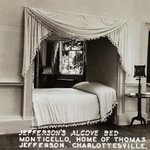
On July 2, 1826, Jefferson was 83 years old, confined to his alcove bed at Monticello, and suffering from severe physical decline. He had taken to his bed the day before, and his doctor noted that he drifted in and out of a stupor for most of his final days.
Around him, the nation was preparing to celebrate the 50th anniversary of the Declaration of Independence. Meanwhile, his own household was quietly bracing for his death and the crushing financial debt he would leave behind.
Knowing he had very little time left, Jefferson summoned his remaining strength on July 2 to compose the farewell poem titled A death-bed Adieu, shortly before slipping into a deep stupor later that night. He addressed it with the initials Th. J. to MR for his eldest and only surviving child, Martha Jefferson Randolph, whom he and the family affectionately called Patsy.
Rather than handing the note directly to Patsy while she wept at his bedside, he told her on July 2 that he had left a farewell paper for her inside a small box. She found the note there after he passed away two days later on July 4.
Here is the full text of the poem he left for her.
A death-bed Adieu.
Life’s visions are vanished, it’s dreams are no more.
Dear friends of my bosom, why bathed in tears?
I go to my fathers; I welcome the shore,
which crowns all my hopes, or which buries my cares.
Then farewell my dear, my lov’d daughter, Adieu!
The last pang of life is in parting from you!
Two Seraphs await me, long shrouded in death
I will bear them your love on my last parting breath.
Several details make this brief note stand out from the rest of Jefferson's massive body of work. First, Jefferson spent his entire life writing tens of thousands of letters, legal drafts, and political papers, yet this is the only surviving poem of definite authorship he ever wrote, even though he was deeply interested in poetic rhythm and had written a formal 1786 essay titled Thoughts on English Prosody.
Second, unlike most of Jefferson's letters and papers, which are housed in major public archives like the Library of Congress, the original handwritten sheet of A death-bed Adieu remains privately owned. His biographer Henry S. Randall was shown the poem by Patsy's family in the 1850s, but he refused to print the full text out of respect for her private grief. It remained unpublished until Jefferson's great-granddaughter, Sarah N. Randolph, finally included it in her 1871 book on his domestic life.
Finally, while Jefferson rarely spoke openly about religion in public, these private lines show him embracing a comforting spiritual image. He wrote of reuniting in the afterlife with two Seraphs, referring to his late wife, Martha Wayles Skelton, whom he affectionately called Patty and who had died 44 years earlier, and his younger daughter, Maria Jefferson Eppes, born Mary and nicknamed Polly in childhood before adopting the name Maria in France, who had died in 1804.
His devotion to Patty remained visible right up to the end. Even in his final days, Jefferson kept a gold watch key locket containing a braided lock of her hair, along with a small secret drawer beside his bed holding another lock of her hair wrapped around the final lines they had written together before her death.
Yet at the heart of his final written words was his deep love for Patsy, the child who had stayed by his side through decades of public triumph and private sorrow. By leaving this poem specifically for her, Jefferson sought to ease the pain of their parting and reassure his devoted daughter that her love would travel with him to the very end.

4
118
Federalism
“I consider the foundation of the Constitution as laid on this ground: That ‘all powers not delegated to the United States, by the Constitution, nor prohibited by it to the States, are reserved to the States or to the people.’”
At the core of Jefferson's political beliefs is a simple idea that often gets forgotten today. That idea is federalism, which means splitting up government power between the national government in Washington and the individual states. Today, people often expect the federal government to step in and fix every big issue, which goes against how the country was actually set up to run.
The Constitution did not put one central government in total charge of everything. Instead, it built a clear wall to protect the independence of the states, leaving any powers not specifically given to Washington in the hands of the states and the people. That setup is not just an old tradition. It is the law, and it stops the country from turning into a system run entirely from the top down unless major changes are made to the Constitution.
We need to bring back a clear understanding of why government power was meant to stay close to local communities. If we forget how this works, people will keep asking Washington to solve local problems it was never meant to touch, moving further away from the vision Thomas Jefferson fought to protect.
“The true theory of our Constitution is surely the wisest and best, that the States are independent as to everything within themselves, and united as to everything respecting foreign affairs.”

20
This is the type of dishonest and malicious smear woke people launch without knowing the facts. Delusional historian Heather Cox Richardson is a hateful woman who dismisses Thomas Jefferson as "smarmy" and accuses him of playing mind games with George Washington. While her story may be entertaining to an ignorant audience, it leaves out key facts about early American history. Looking at the actual record shows that Jefferson was acting out of genuine conviction and loyalty, not spite.
First, Jefferson's desire to go home to Virginia was completely sincere, not a cruel joke aimed at Washington. Jefferson never wanted to be Secretary of State in the first place and only took the job in 1790 out of a sense of duty. By 1793, he was exhausted by constant arguments in the cabinet, harsh attacks in the press, and the administration's push toward centralized control. Far from abandoning Washington, Jefferson actually delayed his retirement when the president asked him to stay on through the end of the year to handle a crisis with France. When Jefferson finally stepped down, Washington praised his integrity and talents with sincere regret.
Second, Jefferson did not hypocritically invent political parties while pretending to hate them. Every major leader of that era, including Washington and Alexander Hamilton, openly spoke out against the danger of political factions. The first organized political network actually grew out of Hamilton's Treasury Department, which used government jobs, banking power, and friendly newspapers to control votes in Congress. Jefferson and James Madison organized the republican opposition not to play dirty politics, but to defend the Constitution against what they saw as a dangerous push toward tyranny and British-style rule. Jefferson's fears were soon proven right during the 1794 Whiskey Rebellion, when Hamilton and Washington marched 13,000 militia troops against frontier farmers over an unfair tax and tried to silence political clubs that criticized the government.
Finally, reducing the tense dynamics of the first administration to Jefferson simply being two-faced misses the bigger picture. Washington was stuck between two brilliant, stubborn men in Jefferson and Hamilton who held completely different visions for the country's future. Both men lobbied the president, backed rival newspapers, and threatened to quit when things went against them. Cheapening a monumental battle over the survival of American liberty into shallow gossip is not real scholarship -- it is pure historical malpractice. Avoid Heather Cox Richardson.
5
179
John Adams and Thomas Jefferson
Very few friendships in American history started as strong or ended as painfully as the bond between John Adams and Thomas Jefferson. One was a short, balding, blunt lawyer from Massachusetts, and the other was a tall, red-haired, quiet planter from Virginia.
Even though they had completely different personalities, these two men built a partnership that helped create a new country. Neither of them could have imagined the wild twists, bitter betrayals, and unforgettable ending that waited ahead for their bond.
Their story started in the summer of 1775 at the Second Continental Congress in Philadelphia. Adams was already pushing hard for independence from Great Britain, and he quickly noticed the quiet 32-year-old from Virginia who rarely gave speeches but wrote better than anyone else in the room.
Their respect for each other turned into deep trust the next year when Congress picked both of them to help write the Declaration of Independence and set up the rules for the new American army. Most people know Adams asked Jefferson to write the first draft, but few know how brutally honest Adams was about why. Adams flatly told Jefferson that he himself was unpopular and disliked by many delegates, whereas Jefferson was well-liked and could write ten times better. Together, they fought to get the document approved and risked their lives for American freedom.
By the mid-1780s, their work partnership grew into a close personal friendship while both served as American representatives in Europe. Living in Paris and London, they worked side by side to set up trade deals for the young United States. Adams was thrilled to have Jefferson join him overseas, writing to a friend in August 1784 that Jefferson was an old friend with whom he had tackled many knotty problems and in whose abilities and steadiness he always placed great trust.
A few months later, Adams praised Jefferson's industry, integrity, and talents, telling another colleague he was very happy with his new partner. By December 1785, Adams told General Henry Knox that Jefferson was a wise and steady patriot whose only flaw was an unquenchable thirst for knowledge that might hurt his health.
During a spring trip in 1786, the two friends took a fun break to tour the English countryside and visit William Shakespeare's childhood home in Stratford-upon-Avon. According to Abigail Adams, Jefferson was so thrilled when they arrived that he actually dropped down and kissed the ground. Acting like excited tourists, the two men walked through the famous writer's house and even chipped off a small piece of wood from Shakespeare's chair to keep as a souvenir.
The whole Adams family grew to love Jefferson during their time in Europe. Young John Quincy Adams, who was a teenager working as a secretary, looked up to Jefferson's sharp mind and loved walking and talking with him in Paris like a student with a favorite teacher. Years later, Adams fondly reminded Jefferson of those Paris days, telling him that Jefferson had been like another father to the boy and calling him "our John" because John Quincy seemed almost as much Jefferson's son as his own. Adams even admitted he had often wondered what would have happened if he had taken Jefferson's advice to send John Quincy to Virginia to attend the College of William and Mary.
Abigail Adams liked Jefferson just as much, writing to her sister that he was "one of the choice ones of the earth." Jefferson treated the Adams family like his own, sharing meals, music, and warm talks that brought their families close together.
Still, the good times in Paris could not survive the harsh world of American politics in the 1790s. As the new country argued over how to run its government, Adams and Jefferson ended up on opposite sides. Adams led the federalists, who wanted a strong national government, while Jefferson led the republicans, who wanted states to keep more power.
Anyone who truly knows Jefferson recognizes one clear pattern about his character. By nature, Jefferson was remarkably quiet and avoided speaking badly about other people, even when they arguably deserved it. Whenever he did clash with someone, it was inevitably because he believed that person was actively harming fellow Americans and threatening their freedoms.
That exact principle drove his break with Adams in 1798 when Adams signed the Alien and Sedition Acts into law. Under these laws, Adams's government arrested more than two dozen newspaper editors, printers, and critics simply for writing against the president or Congress. One victim was Vermont Congressman Matthew Lyon, who was thrown in a freezing cell for mocking Adams's love of pomp, yet still won reelection to Congress from behind bars. Jefferson hated these arrests, viewing them as a tyrannical attack on free speech that crushed the First Amendment and harmed ordinary citizens.
Their rivalry exploded during the nasty presidential race of 1800, where Jefferson beat Adams after months of ugly newspaper attacks and personal insults from both sides. The Sedition Act had been written to expire right at the end of Adams's term in March 1801, and once Jefferson took office, he deliberately let the law expire rather than trying to extend it to use against his own political enemies. He declared the law completely unconstitutional and issued full pardons to every person convicted under it, freeing prisoners and wiping away their hefty fines.
What truly hurt Jefferson on a personal level, though, happened in the last hours of Adams's presidency. Right before leaving office in March 1801, Adams signed a new law and rushed to appoint dozens of federalist judges, known as midnight judges, to keep his party in control of the courts. To make things worse, Adams skipped Jefferson's inauguration and left town early in the morning. Jefferson felt stabbed in the back and believed Adams was trying to ruin his presidency before it even started, so he stopped talking to his old friend completely.
For 11 long years, a cold silence stretched between them, broken only once by a secret attempt at peace that backfired badly. In 1804, when Jefferson's young daughter died, Abigail Adams secretly wrote him a kind sympathy note without telling her husband. Jefferson was deeply moved and wrote back, but their letters quickly turned into a fierce argument over Adams's late-night judge appointments. When John Adams eventually found out about the secret letters, he simply wrote at the bottom of the page that he approved of his wife's loyalty, and the silence returned even colder than before.
Neither man was willing to take the first step again until their mutual friend, Dr. Benjamin Rush, stepped in. Rush had signed the Declaration of Independence with them, and in 1809 he wrote to Adams claiming he had a vivid dream that the two former presidents would become friends again. Two years later, in the summer of 1811, two brothers from Virginia named Edward and John Coles visited Adams in Quincy, Massachusetts, and heard the old man say warmly, "I always loved Jefferson, and still love him." Rush quickly passed that quote along to Jefferson, urging both men to let go of their pride.
On New Year's Day in 1812, Adams finally broke the ice by sending Jefferson a short, friendly note along with what he playfully called two pieces of homespun. Instead of actual fabric, Adams was making a clever joke about two printed volumes of speeches written by his son, John Quincy Adams. Jefferson caught the joke, wrote back warmly before the package even arrived, and their friendship roared back to life.
Even though the two men never saw each other face to face again after 1801, they exchanged 158 amazing letters over the next 14 years. By 1813, Adams was happily teasing his old pal, warning Jefferson to expect plenty more friendly arguments from a man who had loved and respected him for 38 years.
That October, they traded some of their most famous letters, debating the difference between a natural aristocracy of talent and virtue versus an artificial one built only on wealth and family name. Jefferson argued that if society provided public education and free elections, everyday voters would naturally see through fake elites and choose truly wise leaders. Adams pushed back, insisting that humans are always dazzled by riches, beauty, and famous names, so the government needed strict checks and balances to keep powerful elites from taking control. In the end, neither man backed down, yet they happily agreed to disagree without a hint of bitterness.
As they grew older, their letters turned deeply personal, touching on books, religion, aging, and the true meaning of the Revolution. When Abigail Adams died in October 1818, Jefferson sent a tender note hoping to mingle his tears with his friend's and reminding him that "time and silence are the only medicines" for such grief, prompting a weeping Adams to call him a "fellow sufferer" who truly understood his heartbreak. In 1821, Adams admitted that without faith and acceptance, even his sincere, burning friendship for Jefferson would be clouded by the fear of losing him to death. By April 1825, after losing a comforting letter from Jefferson, Adams begged for a copy and signed off with the moving words, "Your friend to all eternity."
The way their lives ended shocked the entire country. On July 4, 1826, exactly 50 years to the day after the Declaration of Independence was approved, both men were dying hundreds of miles apart. At his home in Virginia, an 83-year-old Jefferson passed away just after noon.
Five hours later in Massachusetts, a 90-year-old Adams whispered his famous last words, "Thomas Jefferson survives," not knowing his dear friend had already died. Across America, amazed citizens, including President John Quincy Adams, saw the timing of their deaths as a clear sign from God. Two men who had built a country together, lost each other to politics, and found their way back to each other died on the exact birthday of the freedom they helped create.

5
472
An Unbreakable Bond of Thomas Jefferson and Thomas Paine
Today, Americans celebrate Thomas Paine as a brilliant Founding Father whose words sparked a revolution. However, that widespread love and respect were not always there, especially during the final years of his life.
When Thomas Jefferson last saw his old friend, Paine was a despised social outcast, hated by almost the entire country he had helped create. Standing beside such a controversial figure carried severe political risks for anyone in power, especially a sitting president surrounded by ruthless enemies. In a divided young nation quick to turn on its former heroes, Paine found himself completely alone, facing intense public hostility with almost nowhere left to turn.
Born in England in 1737, Thomas Paine struggled through several failed careers before immigrating to Philadelphia in 1774. Everything changed in January 1776 when he published a 47-page pamphlet titled Common Sense. Written in plain, fiery language that everyday people could understand, the pamphlet convinced ordinary colonists to break away from British rule.
Later that same year, Paine began writing The American Crisis, a series of inspiring essays that General George Washington ordered to be read aloud to his freezing, discouraged troops. At the height of the American Revolution, Paine was one of the most famous and beloved figures in the colonies.
Unfortunately, Paine's intense popularity did not last. After the war ended, he traveled back to Europe and became deeply involved in the French Revolution during the 1790s. While imprisoned in Paris during the Reign of Terror, Paine wrote a controversial book called The Age of Reason, which criticized organized religion and the Bible.
At the same time, he published a bitter public letter attacking George Washington, accusing the beloved president of abandoning him in a French prison. When these writings reached the United States, Americans were outraged. Almost overnight, the hero of the Revolution was branded an atheist, a traitor, and a dangerous radical.
Throughout these turbulent years, Thomas Jefferson maintained a steady, respectful bond with Paine. The two men had become close friends while Jefferson was serving as a diplomat in Paris during the late 1780s, bonding over their shared passion for liberty, science, and human rights.
Even when Paine's radical ideas caused uproar in America, Jefferson continued to admire Paine's brilliant mind and his unmatched contribution to American independence. While other Founding Fathers distanced themselves to protect their reputations, Jefferson remained virtually the only leader in power who still appreciated Paine.
In 1801, shortly after becoming president, Jefferson showed just how far he was willing to go for his friend. Trapped in Europe and fearing capture by the British navy, Paine asked Jefferson for help returning home.
Despite knowing it would ignite a political firestorm, Jefferson generously offered to bring Paine back to America aboard a United States warship, the USS Maryland. Although Paine eventually chose to sail on a private ship to spare the president some political trouble, Jefferson's bold offer spoke volumes about where his loyalties lay.
When Paine finally arrived in Baltimore in October 1802, he was greeted with hostility by the American press and public. Ignoring the furious protests of his political enemies, President Jefferson warmly welcomed Paine to the White House for dinner and lively conversation. Federalist newspapers attacked Jefferson mercilessly for hosting a man they called a dangerous infidel, and many politicians in Washington refused to be seen near Paine. Even a minister in New York was fired from his church simply for shaking Paine's hand.
Observers in the capital were also shocked by how casually Paine treated the president. Witnesses watched in disbelief as Paine strolled down the street arm-in-arm with Jefferson, wearing plain, worn clothes and speaking with a blunt familiarity that critics viewed as deeply disrespectful to the presidency. Jefferson, who hated aristocratic pomp and believed all citizens were equals, walked proudly beside his friend without a hint of embarrassment.
Paine even tested Jefferson's patience behind closed doors during that visit. Frustrated that the president was not asking for his advice on government policy or spending more daytime hours with him, Paine sent Jefferson a sharp, impatient note in January 1803 accusing him of acting shy out of fear of Federalist criticism.
Most leaders would have been insulted by such ingratitude after risking their reputation to help a friend. Instead, Jefferson replied on January 13, 1803, with remarkable grace and humility. He calmly explained that his mornings and early afternoons were packed with official duties, leaving only the evenings to relax with his closest friends, and he reassured Paine that he would never let political attacks stop him from showing respect to an old ally.
Thomas Paine lived out his final years in relative poverty and isolation, dying in New York City on June 8, 1809, at the age of 72. His funeral was a heartbreaking reflection of how far he had fallen in the public eye, with only six mourners attending and not a single prominent political leader present.
Jefferson was not there, nor did he know about the funeral beforehand. Having retired from the presidency just three months earlier, Jefferson was living hundreds of miles away at his Monticello home in Virginia, where news from New York took days to arrive by horse and carriage. Because local Quakers refused to bury Paine in their cemetery, he was laid to rest quickly on his own farm in New Rochelle before any word could reach his old friend.
When Jefferson later learned of Paine's death, his loyalty never wavered. In an 1813 letter to Marguerite Bonneville, the woman who had cared for Paine during his final illness, Jefferson expressed pride that he had stood by his friend against unfair attacks while Paine was alive. Years later, in an 1821 letter to his grandson Francis Eppes, Jefferson continued to praise Paine as a dedicated champion of human rights.
Notably, Jefferson cautioned both recipients not to make his letters public, warning that expressing open affection for Paine would only stir up bitter attacks from old enemies. That quiet caution proves Jefferson was completely aware of how fiercely the public despised Paine, yet he still possessed the inner strength and integrity to honor a man who truly deserved respect while he was still alive.
History has proven that Jefferson was on the right side all along. Today, Paine is once again honored as an essential voice of American independence, while the angry critics who tried to erase his legacy have largely been forgotten. Even as the rest of the nation turned its back on Paine, Thomas Jefferson never forgot what his friend had done for freedom. By standing beside a hated outcast when he had everything to lose and nothing to gain, Jefferson demonstrated a rare kind of courage and loyalty, showing that true greatness is measured not by following the crowd, but by standing faithfully by a friend until the very end.
This story speaks volumes about Jefferson's character. First, he is an absolute outlier, and historians should not be so arrogant as to claim they know what was inside his head. Second, he had the vision to recognize what held real value, regardless of what others thought. Third, Jefferson refused to abandon people, even when the rest of the world did. We need more Jeffersons in the world.

Why Thomas Jefferson Is Our Greatest President
For decades, major surveys of historians and political scientists, including the Siena College Research Institute polls, the C-SPAN Historians Survey, and the Presidential Greatness Project, have graded every president on categories like crisis leadership, economic management, and moral authority. Across these polls, Thomas Jefferson almost always lands in fourth or fifth place, sitting behind Abraham Lincoln, George Washington, Franklin D. Roosevelt, and often Theodore Roosevelt.
That consensus misses the single most important measure of presidential greatness: the impact on the American people. When judged by raw, foundational reach and a lasting influence that spans every generation and still shapes everyday life today, Jefferson does not belong in fourth or fifth place. He stands alone at number one, and no other president even comes close.
Consider the monumental achievements of those other leaders. George Washington led the Continental Army to victory and anchored the survival of the new republic. Abraham Lincoln preserved the Union through the furnace of the Civil War, and Franklin D. Roosevelt steered the nation through the Great Depression and World War II. Largely shaped by the crises of their times, those triumphs were extraordinary. Each of those leaders responded brilliantly to save the nation during an urgent, specific emergency.
Saving a house from a fire is heroic, yet drawing the blueprint, pouring the foundation, and raising the walls are what make a great nation even possible and worth saving in the first place. That requires a level of intelligence, foresight, and political savvy that few presidents possess. Jefferson's influence is not confined to a single war or economic emergency. It is architectural and built to drive the future.
Because his presidency served as the executive culmination of the democratic blueprint he spent his life building, his achievements before, during, and after his time in office form one continuous foundation that defines our country best and makes him the most American president. Simply put, Thomas Jefferson is synonymous with America. As the historian James Parton famously observed, "If Jefferson was wrong, America is wrong. If America is right, Jefferson was right."
At the core of that foundation was a revolutionary idea that shattered the old world order: self-governance. In the late 18th century, nearly every nation on earth bowed to kings, emperors, or hereditary aristocrats who believed ordinary people were fit only to be ruled. Even among America's founders, powerful elites feared popular democracy and fought to keep authority locked in the hands of a wealthy few.
Jefferson crushed that worldview. He insisted that citizens were not helpless infants needing paternal guardians, declaring that the people themselves are the only safe depository of a nation's ultimate power and that public education is the key to sharpening their judgment. The closer power stays to the people, the better. In the Declaration of Independence, he proclaimed the radical truth that governments derive their just powers from the consent of the governed. He staked the survival of the United States on his fierce confidence that educated citizens could govern themselves without monarchs or masters, launching a democratic experiment that permanently altered human history and toppled thrones across the globe.
Skeptics often dismiss Jefferson as an armchair theorist rather than a decisive executive, yet his presidential record destroys that myth. Rather than micromanaging like a monarch, he commanded through disciplined, collaborative leadership, empowering top minds like Secretary of State James Madison and Treasury Secretary Albert Gallatin to shape policy before bringing final decisions to him. He held his administration to one uncompromising rule: the sole object of good government is to protect human life and secure the happiness of its citizens.
That clarity produced staggering results, supported by strict personal integrity. In 1803, he seized the Louisiana Purchase for $15 million, doubling the size of the United States overnight through peaceful diplomacy rather than military conquest, and dispatched Meriwether Lewis and William Clark to chart the continent through treaty-making and scientific discovery. Even while financing that continental expansion, he slashed the national debt by more than 30 percent, wiped out every federal internal tax, and left the presidency with zero scandals, sacrificing his family finances rather than ever enriching himself in public service. He would not even hire his own cousin for a government position out of a self-imposed rule against nepotism.
While critics often charge that Jefferson abandoned his strict-constructionist principles by purchasing the Louisiana Territory without a constitutional amendment, they overlook that his decision reflected careful constitutional counsel rather than hypocrisy. Jefferson initially drafted an amendment to authorize the deal and circulated it to his cabinet, consulting directly with his Secretary of State, James Madison, the primary architect of the Constitution. Madison advised that the treaty-making power already implied the authority to acquire new territory. When the Father of the Constitution assures you the power is there, few can argue otherwise. Meanwhile, urgent intelligence warned that Napoleon was experiencing seller's remorse and might revoke the offer if ratification dragged on. Faced with a fleeting opportunity to secure the Mississippi River and eliminate a European empire on America's doorstep, Jefferson heeded Madison's counsel and submitted the treaty directly to the Senate for swift ratification.
His resolve extended just as forcefully to foreign affairs. While European empires bled each other dry in the Napoleonic Wars, Jefferson kept the United States out of continental war and economically surging. Yet peace never meant weakness, and he refused to tolerate maritime extortion when even naval superpowers like Great Britain and France paid regular tribute and ransoms to the Barbary states to protect their merchant ships. When Tripoli demanded higher tribute payments in 1801, Jefferson answered with steel instead of gold, sending the young Navy and Marines across the Atlantic to blockade and defeat Tripoli's forces. His decisive action forced a peace treaty that ended annual tribute payments to the Barbary state and proved to the world that a free republic would fight to defend its commerce.
Nonetheless, some historians fault Jefferson for shrinking the army and navy, arguing that his budget cuts left the country vulnerable before the War of 1812. In reality, trimming a bloated peacetime military was central to his vision of a debt-free republic safe from domestic tyranny and foreign entanglements. Rather than squandering tax dollars on idle warships, he founded the United States Military Academy at West Point in 1802 to cultivate a professional officer corps and freed up the financial resources needed to deploy decisive force abroad, making his successful campaign against the Barbary pirates possible without bankrupting the treasury. His disciplined approach relieved the nation of crippling debt while building the institutional foundation for future defense.
Even his most controversial decision, the Embargo Act of 1807, was a calculated effort to protect a young, vulnerable nation from a catastrophic war. With Britain and France locked in conflict, both superpowers routinely seized American merchant ships and forced thousands of American sailors into British naval service. Going to war against either empire with a tiny navy and minimal standing army risked national ruin, while submitting to foreign decrees meant surrendering American independence. Instead, Jefferson chose peaceful economic pressure, keeping American ships and sailors safely in port while cutting off vital American crops and goods to force European powers to respect neutral rights. Although the measure caused real economic hardship at home, it avoided bloodshed, spurred early American manufacturing, and bought the United States nearly five critical years to strengthen its defenses before the War of 1812.
His commitment to peaceful diplomacy also shaped his approach to Native American nations amid rapid westward expansion. Recognizing that surging settler populations would inevitably push into western lands, Jefferson sought to prevent bloody frontier wars by relying on formal treaties, trade, and voluntary land sales rather than military conquest. He instructed federal agents to respect tribal occupancy rights while encouraging Indigenous communities to adopt settled agriculture and livestock farming, arguing that transitioning from vast hunting grounds to smaller farms would allow tribes to prosper alongside American settlers and voluntarily sell surplus territory. While critics point to later administrations that resorted to forced military expulsions and tragic marches like the Trail of Tears, Jefferson pursued negotiated agreements and peaceful coexistence to manage a volatile frontier without bloodshed.
Beyond expanding and defending the nation, Jefferson also forged the legal and moral framework of American freedom. Modern critics often reduce his legacy to the contradiction between his ideals and his life as a Virginia slaveholder, ignoring the fact that Jefferson did not invent slavery, nor was he a dictator who could abolish it by decree. The institution had existed across the world for thousands of years and had been entrenched in Virginia for more than a century before he was even born. Against that ancient consensus and apathy, Jefferson represented a bold turning point for humankind, repeatedly drafting legislation and using his public power to attack the system he inherited even when fellow lawmakers refused to supply the votes.
As a young Virginia legislator in 1769, he backed an early effort to legalize freeing enslaved workers, only to see the slaveholding assembly angrily reject it. In 1778, he helped draft and secure the passage of a Virginia law banning the importation of enslaved Africans into the state. In 1784, he wrote an antislavery ban for all western territories that failed in Congress by a single vote, yet laid the groundwork for the 1787 Northwest Ordinance that kept slavery out of the Midwest, and his exact words banning slavery and involuntary servitude were later written directly into the 13th Amendment to abolish slavery nationwide.
Even his contemporaries and political rivals recognized that his anti-slavery convictions were no empty rhetoric. During the 1796 and 1800 presidential campaigns, Southern federalist newspapers and pamphleteers deliberately reprinted Jefferson's condemnations of slavery from Notes on the State of Virginia alongside his gradual emancipation proposals to alarm slaveholders that electing him would endanger their slave property.
Decades later, staunch anti-slavery champion John Quincy Adams likewise attested that ending slavery was "a darling project of Thomas Jefferson from his first entrance into public life to the last years of his existence." Jefferson carried that lifelong commitment into the presidency with executive determination, strategically using his December 1806 message to urge Congress to outlaw the transatlantic slave trade at the earliest constitutional moment. He signed the federal ban into law in March 1807, and it took effect on January 1, 1808, the very first day the Constitution allowed.
Above all, by declaring in the Declaration of Independence that all men are created equal, Jefferson placed a ticking moral time bomb under slavery. He handed Abraham Lincoln and civil rights leaders from Frederick Douglass to Martin Luther King Jr. the exact moral weapon and patriotic cover they needed to destroy the institution and demand equal citizenship.
At the same time, Jefferson actively fortified everyday liberties and built a fiercely democratic political culture. From his post as minister to France, he relentlessly pressured James Madison through letters until Madison agreed to add a Bill of Rights to the Constitution. Upon taking office as president, he saved the First Amendment by immediately pardoning citizens jailed under the Sedition Act for criticizing the government, reinforcing the wall of liberty he had first built through the Virginia Statute for Religious Freedom. True to his famous declaration that he would prefer newspapers without a government over a government without newspapers, Jefferson endured relentless, often vicious attacks from opposition editors throughout his presidency without ever prosecuting a single critic, cementing freedom of the press as an untouchable pillar of American democracy.
Following the bitter election of 1800, he engineered the world's first peaceful transfer of executive power between rival political parties, unifying a fractured nation by declaring that we are all republicans and we are all federalists. Eight years later, he cemented the two-term presidential precedent by refusing to run for a third term, explicitly warning that without a strict limit on tenure, the presidency could degenerate into a lifetime monarchy.
That anti-monarchical spirit earned him one of his most enduring nicknames, "Man of the People." Supporters embraced the label during his lifetime to celebrate his devotion to ordinary farmers, everyday citizens, and decentralized self-government. Ironically, his political opponents tried to weaponize the exact same phrase as an insult, with federalist writers warning voters that being a "man of the people" made him a dangerous demagogue. Yet Jefferson turned their attack into a badge of honor, proving that trusting ordinary citizens was the true strength of the republic rather than a threat to it.
He even stripped the presidency of aristocratic pomp so the office would belong entirely to the people. He abolished royal-style ceremonies, walked on foot to and from his own inauguration, and enforced a strict rule of egalitarian seating at White House dinners where guests sat wherever they pleased rather than being ranked by title or social status. That democratic simplicity set the benchmark for future populist leaders, a point Andrew Jackson underscored in 1825 after watching John Quincy Adams escorted to his inauguration with what Jackson dismissed as a "pomp and ceremony of guns & drums." Contrasting that spectacle with Jefferson's unpretentious 1801 induction, Jackson prayed that the nation's leadership would remain "based upon the sovereignty of the people and adorned with no forms or ceremonies save those which their happiness and freedom shall command."
That relentless drive to empower ordinary citizens reshaped the daily mechanics of American life. His 1784 plan for coinage persuaded Congress to establish our decimal currency system of dollars and cents, making the United States the first nation in the world to adopt decimal money. In Virginia, he dismantled feudal inheritance laws like entail and primogeniture so land and wealth could not remain hoarded by a permanent aristocracy.
As the nation's first Secretary of State, he served as the original patent examiner under the Patent Act of 1790, enforcing a 14-year limit on patents so breakthroughs would flow to the public rather than create permanent monopolies. That policy reflected his lifelong devotion to science, which spearheaded a national culture of American ingenuity and objective inquiry. Serving simultaneously as President of the United States and president of the American Philosophical Society, Jefferson championed evidence over superstition, engineered an improved moldboard plow to boost farming, and embraced the smallpox vaccine in 1801, personally vaccinating roughly 200 people and sending the vaccine west with Lewis and Clark.
His devotion to public knowledge and national strength raised permanent institutions and ideas that still anchor the country today. Believing that an educated citizenry was the ultimate safeguard against tyranny, Jefferson drafted a pioneering 1779 bill for tax-funded public primary schools to teach every free child reading, writing, and arithmetic regardless of wealth, laying the philosophical foundation for universal public education in America. When British troops burned the Capitol and destroyed the congressional library in 1814, he sold his personal collection of 6,487 books to Congress, creating the core of the modern Library of Congress. Alongside West Point, which he established to train American engineers and officers, he later designed and founded the University of Virginia to champion public higher education.
Because his breakthroughs transformed every pillar of American life, Jefferson commands an unmatched ideological reach. Across the political spectrum, every major American tradition claims him as its own. Progressives champion his crusade for universal public education, human equality, and his insistence that laws must advance with the progress of the human mind. Conservatives champion his fierce defense of limited federal government, religious liberty, free speech, and fiscal discipline. Moderates rally around his call for national unity and peaceful self-government.
That universal force is why Jefferson stands as the ultimate president's president, respected and studied by every commander in chief who followed him. He directly mentored James Madison and James Monroe, and his political philosophy served as the guiding star for Andrew Jackson and Martin Van Buren. In fact, Jefferson's direct reach touched every single one of the nation's first 12 presidents, from George Washington all the way through Zachary Taylor. He personally knew every president through John Tyler, whose father was Jefferson's college roommate, inspired James K. Polk as a devout Jeffersonian following in the footsteps of his father and grandfather, and even signed Zachary Taylor's first army commission while in the White House. Such was the unstoppable momentum of this ideological influence at America's founding, laying the territorial, democratic, and institutional bedrock that enabled the United States to rise into the world's greatest superpower today.
Even leaders from rival traditions bowed to his stature. George Washington, a famously stoic figure who rarely offered lavish praise, wrote to the Marquis de Lafayette that he had early imbibed the highest opinion of Jefferson. Washington later told Jefferson that no other person could better execute the duties of Secretary of State, urged him not to retire because he could not see where he would find another character to replace him, and insisted even after their political paths diverged that he had never discovered anything in Jefferson's conduct to raise suspicions of insincerity.
Similarly, Theodore Roosevelt, despite his fierce loyalty to Alexander Hamilton, acknowledged to historian Frederick Jackson Turner the inadvisability of taking a negative tone toward Jefferson and praised Jefferson's genius in securing the Louisiana Purchase, which established the United States as the greatest nation of the Western Hemisphere. Speaking before Chicago's Hamilton Club, Roosevelt even admitted that Hamilton lacked the one great quality Jefferson possessed: trust and belief in the people. After all, how could an American president be great without submitting to the will of the people?
More remarkably, generations of opposing contenders battled not to reject Jefferson, but to claim his mantle as their own. In the bitter presidential contests of 1824 and 1828, both John Quincy Adams and Andrew Jackson ran under Jefferson's banner, with Jackson championing Jeffersonian populism and limited government while Adams carried forward his vision for science, internal progress, and national education. A generation later, Abraham Lincoln and Stephen A. Douglas clashed over Jefferson's legacy on the campaign trail, as Douglas appealed to Jefferson's faith in local self-government while Lincoln anchored the Republican Party in Jefferson's Declaration of Independence, declaring that "the principles of Jefferson are the definitions and axioms of free society." In the modern era, opposing standard-bearers Ronald Reagan and Bill Clinton both claimed Jefferson as their guiding inspiration. Reagan invoked Jefferson's warnings against big government and high taxes, while Clinton, who carried Jefferson's name and began his 1992 inaugural journey at Monticello, championed Jefferson's vision of public education and democratic opportunity.
Across every era and party, from Lincoln, Franklin D. Roosevelt, and John F. Kennedy to Nixon, Ford, Carter, Reagan, both Bush presidents, Clinton, Obama, and Biden, commanders in chief have continually drawn strength from his vision. That unbroken chain of reverence continues in the current administration, as President Donald Trump opened his 2026 State of the Union address by celebrating the 250th anniversary of the independence Jefferson authored and closed by proudly invoking Jefferson's name.
Despite wielding more lasting influence over the presidency and the nation than any other leader, Jefferson refused to cling to the trappings of power. When designing his own tombstone, he deliberately left off the title of President because he viewed political office as temporary compared to ideas that liberate the human mind. Instead, Jefferson chose to be remembered for three immortal achievements, serving as author of the Declaration of Independence, author of the Virginia Statute for Religious Freedom, and father of the University of Virginia.
Most presidents maintained our freedom, while a few exceptional presidents bravely defended the house of liberty when it caught fire. Yet Jefferson stands alone as the one who drew the plans, laid the stone, strengthened the foundation, expanded the yard, doused fires of his own, and instilled the timeless, empowering principles that modern Americans still live by and cherish today. Just as he once declared, "We are all republicans, we are all federalists," we can now proudly say, "We are all Jeffersonians." Therefore, Thomas Jefferson is the most American president, and that makes him our greatest not only in history, but for our present and future.

1
4
773
The Love Story of Thomas and Martha "Patty" Jefferson
When people think of Thomas Jefferson, they usually picture a famous president, a brilliant writer, or one of the founding fathers. What gets overlooked a lot of the time is just how deeply, fiercely, and completely he loved his wife, Martha Wayles Skelton. Back in the 1700s, it was common to use pet names, so Jefferson affectionately called his Martha "Patty," and just hearing that nickname softened his memories for the rest of his life.
⠀
To Jefferson, Patty was not just someone standing in the background of his busy career. She was the main focus of his whole life, the bright center of everything, and without her, the rest of the picture felt faded and incomplete.
⠀
Their love story actually started with music. Patty was a wonderful harpsichord player with a sharp mind and a love for reading, and while they were dating, she would sit and sing while Jefferson played along on his violin. Family stories still talk about the day two other men showed up at her door hoping to win her over. When they heard how effortlessly Thomas and Patty's music blended together from the parlor, they quietly grabbed their hats and left, knowing they did not stand a chance against a bond like that.
⠀
Beyond music, the two of them loved horseback riding, good books, and long, lively talks. They got married on January 1, 1772, at her father's estate, The Forest, in Charles City County, starting a marriage that Jefferson later described in his own words as "ten years of unchequered happiness."
⠀
Right from the start, their bond proved stronger than any hardship. About two weeks after their wedding, the newlyweds set off from The Forest on the 100 mile trip northwest to Monticello, only to run straight into one of the worst snowstorms Virginia had ever seen. When the snow piled up nearly two feet deep and blocked their carriage, they unhitched the horses and rode the final eight miles up the dark mountain trail on horseback. They arrived late at night to find the fires completely out, the servants fast asleep in their quarters, and only a single small brick cottage finished on the property. Rather than feeling miserable in the freezing cold, Jefferson found part of a bottle of wine tucked behind some books on a shelf, and the two of them laughed, sang, and warmed themselves simply by being in each other's company while three feet of snow piled up outside.
⠀
At their home at Monticello, Jefferson treasured every little side of his wife's gentle, creative personality. She ran their household smoothly and with real grace, keeping track of daily supplies alongside her sewing and favorite recipes. During the tough years of the Revolutionary War, she also stepped up as First Lady of Virginia from 1779 to 1781, helping care for her family and community through dangerous times.
⠀
Still, some of Jefferson's favorite memories were the quiet, playful ones. By pure luck, he stumbled across little doodles she had drawn inside the pages of his old law notebook, which she had reused to track household expenses. Those casual sketches, like a sprig of lavender on one page or a little bird flying across another, captured her personality so well that they still made him smile years later.
⠀
Even as his political career took off, Patty always came before ambition or public glory. By all accounts, she was a delicate woman. Isaac Granger Jefferson, an enslaved blacksmith at Monticello, later recalled in his memoirs that Mrs. Jefferson was "small," and family history remembers her as petite, physically fragile, and often sick throughout their marriage. Because her health was so precarious, Jefferson refused to let work pull him away when she needed him most. In 1781 and 1782, when national leaders like George Washington, James Madison, and Robert Livingston repeatedly asked him to take on major diplomatic missions to Europe or seats in Congress, Jefferson turned them down flat. Caring for his frail wife meant everything to him, so prestigious jobs and history making roles easily took a back seat to staying home by her side.
⠀
Their ten years together were full of love, even though they went through heartbreaking losses side by side. They had six children, and only two daughters, Martha, whom they called Patsy, and Mary, whom they called Polly and later Maria (pronounced ma RYE uh), lived to grow up. Having children took a massive toll on Patty's fragile health, and after their youngest baby was born in May 1782, she never got her strength back.
⠀
For four long months while she lingered in bed, Jefferson never left her side, working in a tiny room right behind the head of her bed whenever she slept so he was always within earshot. During those painful final days as she was slipping away, husband and wife sat together and copied out a poetic passage on a single piece of paper, borrowing lines from Laurence Sterne's book Tristram Shandy that matched what they were feeling.
⠀
In Mrs. Jefferson's neat handwriting, the note says, "time wastes too fast, every letter I trace tells me with what rapidity life follows my pen. The days and hours of it are flying over our heads like clouds of a windy day never to return, more everything presses on."
⠀
Right underneath her lines, in Jefferson's own handwriting, he finished the thought, "and every time I kiss thy hand to bid adieu, every absence which follows it, are preludes to that eternal separation which we are shortly to make!"
⠀
On September 6, 1782, Patty passed away at just 33 years old. Right there at her bedside, Jefferson promised her he would never get married again, and he kept that promise through the stress of being president, all through his quiet retirement, and even through his years as a diplomat in Paris (it was close though!).
⠀
For a man who was famously stoic and always kept his emotions under tight control in public, the moment she died broke him completely. His grief hit so hard that he nearly collapsed on the spot. His sister had to practically carry him out of the room to his library, where he fainted and stayed unconscious for so long that his family worried he might never wake up.
⠀
For three full weeks after her death, Jefferson locked himself inside his room and refused to speak or see anyone. He paced back and forth almost nonstop day and night, only dropping onto a pallet brought into the room when pure exhaustion forced him down.
⠀
His daughter Patsy, who was almost ten years old at the time, remembered those weeks vividly for the rest of her life. Even decades later, Patsy wrote that the raw violence of his sorrow when she quietly slipped into his room at night was something she still could not bear to put into words. When he finally walked out of that room after three weeks, he turned to long, solitary horseback rides through the secluded woods where no one else could hear him, with young Patsy riding beside him as what she called "a solitary witness to many a violent burst of grief."
⠀
It took months before the worst of that shock began to ease enough for him to accept a diplomatic post in France later that fall. When he laid Patty to rest in the graveyard at Monticello, he had lines from Homer's Iliad carved in Greek onto her white marble tombstone as an eternal promise, which translate to, "If in the House of Hades men forget their dead, yet will I even there remember you, dear companion."
⠀
For the remaining 44 years until his own death, Jefferson never really let her go, keeping small pieces of her close to him every single day. He carried a braided lock of her silken hair tucked inside a gold watch key attached to his pocket watch, looking at it not just to tell the time, but to feel like she was still right there with him right up until his final days.
⠀
And in the quiet days after Jefferson died, Patsy found that shared poetic passage tucked away inside a secret drawer of his bedside table, folded around another lock of Patty's hair. The paper was tattered and worn along its creases, clear evidence that Jefferson had gone back to it over and over across the decades, carefully unfolding and refolding it in quiet remembrance on countless lonely evenings when he missed her most, only stopping when it grew so fragile from his touch that he feared it would fall apart.
⠀
Jefferson also guarded their love from the outside world with fierce devotion. Even in his business letters, he kept his marriage strictly private, and right after Patty died, he burned every single letter they had ever written to each other so their intimate thoughts belonged to them alone and never to the public record. To a man with his sky high standards of loyalty, what mattered was the sacred bond between him and Patty, not what outsiders might think or say. That was the kind of deep, unshakable love that endured through 44 long years of separation right up until the day he died.
⠀
Time is supposed to heal all wounds, yet for Jefferson, the years never filled the empty space she left behind. Like the Bible says, "For where your treasure is, there will your heart be also," and Jefferson's heart stayed locked with his Patty forever. When you see just how deep and real his grief was, it makes sense why cruel rumors accusing him of being unfaithful even after her death say a whole lot more about the people spreading them than they ever could about him (looking at you, historians).
⠀
History remembers Thomas Jefferson for shaping a nation, yet the truest measure of his character might just be the quiet promise he kept behind closed doors. Even after 44 years apart, a tattered sheet of shared poetry, a few sweet doodles saved in an old notebook, and a lock of hair carried to his very last breath say everything you need to know. Those who do not understand that kind of devotion will never truly understand him. Even that "eternal separation" he once dreaded never broke his word to Patty, proving that when Thomas Jefferson gave his heart, he gave it for good.

Thomas Jefferson advises you to think for yourself. Don't mindlessly follow along with any particular party.

Today, movies, documentaries, and even Monticello repeat the story that Thomas Jefferson had a secret romance with Sally Hemings in Paris. Yet when you look closely at the actual historical record, that famous story rests on shaky secondhand claims, not solid proof.
The entire Paris romance tale comes from a single article printed in a small partisan Ohio newspaper, the Pike County Republican, in 1873, nearly 50 years after Jefferson died. That article claimed to tell the life story of Sally's son, Madison Hemings, who grew up enslaved at Monticello and later moved to Ohio. However, Madison did not even write the piece himself. Instead, it was written entirely by the paper's editor, Samuel F. Wetmore, a fierce abolitionist and partisan activist who hated Southern plantation owners and slaveholders and used the story to attack the Southern elite. Wetmore put his own words to an interview where Madison repeated rumors he had only heard secondhand about events in France that happened 16 years before he was even born.
Even the setting of Paris makes the story hard to believe. In the late 1780s, Paris was packed with royal spies and secret police who closely watched foreign diplomats, opened mail, and wrote down every rumor or scandal they could find. If an American minister had been carrying on a secret affair with a teenage servant, French spies would have recorded every detail. Yet modern researchers digging through those surviving French police archives have come up with nothing at all.
What the historical record actually shows is that Jefferson's romantic focus in Paris was on a completely different woman: Maria Cosway. Born in Italy to English parents, Maria was a brilliant, sophisticated painter, musician, and composer who spoke multiple languages and moved easily through Europe's highest intellectual circles. Jefferson was deeply infatuated with her, famously writing his emotional Head and Heart letter to her in 1786. Comparing Maria Cosway to young Sally Hemings, an uneducated, childish teenage servant who couldn't even read or write, shows the exact kind of cultured, intellectual equal that truly drew Jefferson's affection.
Before that 1873 article, the rumor was started in 1802 by James Callender, a bitter political writer who turned on Jefferson after being denied a government job. Callender couldn't even get the basic facts right, claiming Sally went to France with Jefferson when she actually arrived three years later in 1787 as a maid for his young daughter Maria.
Callender also claimed in his 1802 articles that Sally had a 10 or 12-year-old son named Tom, later known as Thomas Woodson, whom Callender insisted was fathered by Jefferson, placing his conception right in Paris just before they returned home. For generations, writers repeated Callender's claim about Tom as proof of a Paris affair. Yet in 1998, a major DNA test proved Thomas Woodson had zero Jefferson blood in him at all, showing how Callender's centerpiece story was false and how fast people jump to conclusions just because a boy was named after Jefferson.
The people who actually lived with Jefferson and knew him best flatly rejected the rumor. His own daughter Martha, who knew his daily habits inside out, insisted on her deathbed that the story was a lie. Longtime overseer Edmund Bacon also denied it, stating he personally saw another man leaving Sally's quarters early in the morning.
Jefferson's oldest grandson, Thomas Jefferson Randolph, who ran the estate and knew everything happening behind the scenes at Monticello, positively declared the rumor false and pointed to other male relatives instead. His granddaughter, Ellen Randolph Coolidge, wrote in an 1858 letter that the family met the charges with horror and contempt, noting that no female servant ever entered Jefferson's private rooms while he was there.
Former Monticello slave Isaac Granger Jefferson left detailed memories of life on the mountain without ever claiming Thomas fathered Sally's children, pointing instead to Jefferson's younger brother Randolph, who loved visiting the slave quarters at night to play his fiddle. Even outside Monticello, Abigail Adams described young Sally in London as a childish girl who acted more like a seven-year-old, while John Adams dismissed Callender's gossip as the lies of a desperate slanderer.
Best of all, Jefferson refuted these attacks himself in private letters to close friends. On October 10, 1802, just weeks after Callender printed his smear, Jefferson wrote to his friend Robert R. Livingston in Paris, calling Callender a lying renegado and noting that every decent man revolted at his filth.
Then, on July 1, 1805, Jefferson wrote privately to Secretary of the Navy Robert Smith and Attorney General Levi Lincoln to set the record straight with his closest allies. He owned up to a single youthful mistake involving a friend's wife decades earlier and stated flatly that it was the only one founded in truth among all the charges against him, ruling out the Sally Hemings rumor completely.
When modern critics ignore these firsthand witnesses and force a sensational romance onto Jefferson's life, they miss who he really was. Jefferson was a rare outlier, a deeply disciplined genius whose mind worked nothing like ordinary people. Trying to judge a man of his stature through modern gossip says far more about the minds of his critics than it ever will about Thomas Jefferson.

Whenever I hear people repeat these blatant falsehoods, it is immediately clear they have only a surface-level understanding of Jefferson. They rely on biased historians who skip original research and simply recycle old, inaccurate narratives. Repeating a story does not make it true. Genuine students of Jefferson know the importance of going straight to the primary sources. Think critically, dig deeper, and do not take modern "experts" at face value. Unfortunately, contemporary academia can be deeply flawed. Furthermore, Jefferson was extraordinary precisely because he stood far above ordinary people. For run-of-the-mill academics to level these distorted allegations against him is both laughably arrogant and deeply misguided.
21
Thomas and Dabney, best friends, Part 2
Earlier, we talked about the deep friendship between Thomas Jefferson and Dabney Carr [ teapaw.org/TJeffersonCom/status/2… ]. Their story had big political ideas, a serious teenage promise under a Monticello oak tree, and a heartbreaking goodbye. Yet when we only picture them as serious Virginia lawmakers, we forget they were once just two fun-loving young guys in a slower, simpler world. Long before colonial tensions turned into war and the heavy weight of a revolution fell on Jefferson's shoulders, these two loved to laugh, pull pranks, and just enjoy life.
Their best prank happened around 1760 while they were classmates at Reverend James Maury's boarding school. Carr had a super fast horse, while young Jefferson rode a famously slow pony. Knowing he had the easy win, Carr challenged Jefferson to a race. Jefferson knew his sluggish pony didn't stand a chance, so he agreed on one strict rule: he got to pick the date. Once Carr said yes, Jefferson set the big race for the 30th of February. Since that date doesn't exist on the calendar, Carr could never collect. The Maury family loved that comeback so much they kept telling the story for decades.
Between school breaks, Carr often visited Jefferson at his family home at Shadwell. They spent lazy afternoons riding horses up what they called Tom's mountain, the wooded hill that would later become Monticello. Those hangouts under their favorite oak tree weren't about big historical destiny. They were just two best friends escaping the world with a stack of books and easy talk.
That same lively energy followed them to Williamsburg at the College of William and Mary. During his first year in town, Jefferson jumped right into college life. He blew way too much money on nice horses, danced all night in the Apollo Room at the Raleigh Tavern, and placed small bets on card games, backgammon, and horse races. True to his detail-loving brain, he wrote down every gambling win and loss to the penny in his personal notebook. He also joined a secret campus club called the F.H.C. Club, or the Flat Hat Club, which met at that same tavern for drinks and lively debates.
Years later, Jefferson joked that the six-member club had no real point at all. Since the two friends were so close during their Williamsburg days, it's easy to picture Carr joining right in on the fun, even if old records only show Jefferson's side of things. Feeling guilty about how much time he wasted partying and dancing, Jefferson flipped his routine in year two and forced himself to study 15 hours a day. Even with that tough schedule, Williamsburg still left plenty of room for music, laughs, and good times.
After college, their lives took a quick turn into real frontier toughness before settling into the courtroom. In 1763, Carr put his law studies on hold to fight in the French and Indian War with the Louisa County Volunteer Rangers under Captain Phillips, earning a land reward for his service. Soon after, he started practicing law in Louisa County and quickly got sharp enough that even Patrick Henry saw him as a top rival. Outside of court, though, Carr was totally down-to-earth. After marrying Jefferson's younger sister Martha in July 1765, he moved into a tiny, simple house in Goochland County with very little money or fancy stuff. Visiting them there, Jefferson was amazed by his friend's joy, writing that in a tiny house with just a table, half a dozen chairs, and one or two servants, Dabney was the happiest man in the universe.
By early 1773, their easy teamwork carried straight into politics. In March, they met quietly with Patrick Henry and the Lee brothers at the Raleigh Tavern, the exact same tavern from Jefferson's wild college nights, to write a plan uniting the colonies by setting up a communication network so they wouldn't have to stand alone. After Carr gave his famous speech in the House of Burgesses on the 12th of March, he and Jefferson rode home together, buzzing with excitement over how their plan would spark a meeting of all the colonies.
When a fever took Carr just two months later, it left an empty space Jefferson never filled. Decades later, in an 1816 letter to Carr's younger son, Dabney, Jefferson grieved losing a strong partner right as the colonies were coming together. He admitted that the memory of his old friend, much like losing Dabney's older brother Peter at age 45 just a year earlier in 1815, never came back without a deep sigh, remembering Carr's kindness, warmth, and easygoing company most of all.
History books tend to freeze great men like statues, leaving behind only speeches, laws, and monuments. Yet the laughs behind a fake February horse race and a joyful life in a tiny Virginia house tells a much better truth. Before Jefferson became a Founding Father and Carr died way too young, they were two best friends who knew how to enjoy the ride.

Thomas Jefferson's best friend
Almost everyone grows up with that one special friend, a best buddy who knows all your secrets and shares your biggest dreams. For Thomas Jefferson, that person was Dabney Carr. Born in October 1743, just six months after Jefferson, Dabney grew up right alongside him in Virginia.
Their bond started in the late 1750s at Reverend James Maury's log cabin boarding school. Both boys loved books, history, and big ideas, and they later went off to the College of William and Mary together. On summer breaks, they loved riding their horses up a steep wooded mountain near Jefferson's childhood home. They would stretch out under a huge oak tree, read all day, and talk about the future.
One afternoon, they made a serious promise that whoever died first would be buried under that exact oak tree, and the other would eventually be buried beside him. Remember this, because I will come around to it again.
As young men, their lives locked together even tighter. Both became Virginia lawyers, and in July 1765, Dabney married Jefferson's younger sister, Martha.
Now officially brothers, they jumped into politics side by side. When Dabney joined the Virginia legislature in 1771, he was still in his 20s and barely known outside his county. Yet on March 12, 1773, he stood up and gave a speech so powerful that even Patrick Henry's supporters were amazed.
Dabney suggested creating committees to connect the colonies, a network that helped the American colonies talk and work together during the Revolution. Before Dabney's speech, the 13 colonies mostly faced British crackdowns alone. His plan linked them together to share news and directly led to the First Continental Congress. Had Dabney lived longer, he almost certainly would have signed the Declaration of Independence right next to Jefferson.
Then tragedy hit out of nowhere. In May 1773, while Jefferson was away on legal work, Dabney caught a terrible fever at Shadwell, Jefferson's childhood home. He died on May 16, 1773, at just 29, leaving behind a heartbroken wife and six young kids, including a baby boy born 19 days earlier.
Because Jefferson was out of town and May heat sets in fast, the family went ahead and buried Dabney down in the valley at Shadwell.
When Jefferson rode back and found his best friend buried somewhere else, he refused to leave it that way. Determined to keep their teenage promise, he right away told workers to dig up Dabney's coffin, carry it up the steep mountain to Monticello, and bury him again right under their favorite oak tree.
Even through deep sadness, Jefferson could not turn off his number-loving brain. While enslaved workers dug the new grave, Jefferson sat nearby with a watch and notebook, timing how long it took two men to dig through Virginia clay. He wrote down that it took three and a half hours and jotted down a math problem showing that one man could dig up an acre of dirt in four days. Measuring things around him was how Jefferson kept himself from falling apart.
Jefferson also wrote the words on Dabney's gravestone himself, calling him a friend who "of all men, loved him most." (See photo.) By burying Dabney under that oak, Jefferson officially started the Monticello graveyard, making his best friend the first person buried on the mountain.
Jefferson kept his promise to Dabney's family too. He stepped in to raise all six children, eventually moving his sister Martha and the kids right into Monticello. He picked out their books, paid for their schooling, and treated them as his own. His oldest nephew, Peter Carr, became like an adopted son, while the newborn baby grew up to sit on Virginia's highest court as Judge Dabney Carr.
53 years later, on July 4, 1826, Thomas Jefferson died at 83. True to the promise two teenagers made in the Virginia woods, he was buried at Monticello right beside Dabney Carr. Today, Dabney's grave still sits next to Jefferson's stone monument, showing that behind one of America's greatest Founding Fathers stood a young best friend he never stopped missing.

3
321