







fern holds half a million lines of code in one go, which is basically the repo you're working in. congrats behnam, i'd point that at my own codebase the day it opens


qwen open-sourced a benchmark that runs the same agent tasks in 23 languages. one shopping job took 25 tool calls in english, 201 in telugu, both passed. rough if your eval only ever looks at the final answer

Our latest open-source research has a pretty interesting name, inspired by the story of the Tower of Babel. What interests us about that story is how language barriers can get in the way of people working toward the same goal
And when it comes to agents, there are a few more places for that understanding to break, like tool arguments, database entries, and search queries
One example from BabelArena (yes that's the name, surprise) stuck with me: Qwen-3.8-Max completed the same shopping task in English and Telugu, getting the same four products. But it took 25 tool calls in English and 201 in Telugu, with repeated empty searches against the localized catalog.
Even though both runs passed, we’d still want to see that difference before shipping.
Sorry for the long story, hope you guys are still here. What I want to share is that we’ve open-sourced BabelArena to study these workflows across 23 languages. Code, datasets, and paper in the comment
the IDE is dead, per reason: connect a repo, assign it an issue, and its cloud agents come back with the pull request plus a video of them running the thing. bold opener, but that half is exactly the bit i'd want

The IDE era is dead.
Introducing Reason, the AI Teammate for work and code
We made Reason manage customers, build itself and also make this video.
Pareto-frontier on Terminal Bench 4.0 and DeepSWE
Now you can try it for free -> reasonmachines.com
ripple is letting companies earn yield on cash that used to sit dead overnight and on weekends, RLUSD in a ripple wallet. american airlines, subway, adecco already on it. this is how stablecoins actually land in real companies

Corporate treasury is going always-on. 🌐
Today, we're introducing new Ripple Treasury capabilities that bring together AI-powered automation, liquidity management, and digital asset infrastructure to help businesses manage and move money around the clock.
More on what's new: on.ripple.com/4zSO8UM

tencent open-sourced a live chinese↔english interpreter that translates while you're still talking, in your own cloned voice, ~3s behind. free weights and an app. want to try this


Hy-SimulMT is now open source! 🚀
Tencent HY’s real-time Chinese ↔ English Simultaneous Interpreting Model.
Key features:
⚡ Low latency (~3s)
🎯 High accuracy
🎙️ Real-time voice cloning
🏆 Outperforms most open-source models and commercial APIs
Download, try, and build with it! 👇:
Hugging Face: huggingface.co/collections/t…
ModelScope: modelscope.cn/collections/Te…
GitHub: github.com/Tencent-Hunyuan/H…

eric put the boring half of running an llm (batching, caching, the server) into one rust library, so an agent only has to write the model part for your chip. it built engines for two brand-new models overnight, within 5-10% of the hand-tuned one. congrats eric


Alright I finally have more to share on my personal project!
Resin is a runtime for building fast LLM inference engines.
The idea is to make all the generic parts of inference reusable, and leave only the model-specific forward pass + kernels to be written for each architecture / hardware target.
To build an engine:
1. Import Resin's core.
2. Have an agent write a forward pass for the model you’re interested in, for your specific hardware (GPU or TPU or AMD), any kernels you want.
Then, boom, you have a standalone inference engine.
—
I've been hacking over the past month (early post: xitter.cf/ekzhang1/status/208950…), and recently this week I got a lot of features + parallelisms working, inspired by DeepInfer.
For DeepSeek-V4.1-Flash, it's nearly as fast as DeepInfer (within 5-10%), while being self-contained and supporting other models, plus metrics + HTTP server + prefix cache.
Yesterday I wrote a skill for authoring models and put Codex to work on it overnight. The agent built a GLM-5.3-Flash engine with MTP, reaching up to 60,000 input tok/s and 16,000 output tok/s on B200 (EP4).
So far inference "vibe coding" has not been very reliable or successful. I think it's because people start from scratch each time and reinvent lots of tricky things on the scheduler and server layers. But with a shared core, we can automate lots of inference work.
The tricky bit is writing a fast forward pass. But Resin turns that into a standalone engine by just importing a library, and it becomes a verifiable goal for the AI.
Code: github.com/ekzhang/resin


kali 2026.3 is out: you can now build kali in a container instead of needing kali to build kali, and the wardriving runs off a smartwatch now, obviously. nice work team


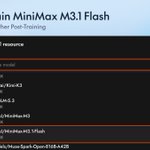
together put minimax m3.1 flash up for post-training: your data, your rewards, your own python training loop, their gpus. and you can download the tuned weights after, which is the part that actually matters


minimax m3.1 flash is now available for post-training on together ai
run sft or rl with your own data, rewards + environments, while keeping the training loop in your own python code
take m3.1 flash and shape it for the agentic workload you need
together.ai/post-training

fastlane built an ad agent that takes your website and makes and posts the ads for you. naming it "Claude for Ads" with anthropic nowhere in sight is bold as hell


the compression almost everything on the web uses has a 9.2 hole and it's already being exploited. patching node isn't the fix, brotli also ships bundled inside apps and as a system lib. go find every copy and get it to 1.2.1

🚨 Brotli2Shell goes beyond HTTP2Shell.
CVE-2026-111497 is a CVSS 9.2 out-of-bounds write in Google’s Brotli decoder that has been exploited for RCE and impacts far beyond HTTP.
JFrog reproduced RIP control in FFmpeg via a crafted JPEG XL file and identified additional attack paths in ClickHouse, .NET, and Apache Arrow, where some fixes were still unavailable at the time of writing.
We’ve also released an open-source scanner to uncover potential exposure beyond vulnerable package versions.
Full research and technical details in our blog 👇
morgan shipped a drop-in kit so your coding agent writes actual idiomatic rust, and now it ports your old C or Python over. tests go first so you can prove the rewrite matches. i'd use that today


🎉 BeautifulRust v1.3.0 is now live!
The last 24 hours have been wild, amazing to see the interest in this, so I thought, why not take the most-requested feature and just build it, today.
And it's done, now live on Github. It really is amazing how fast you can iterate when so many people start using something within the first 24 hours.
Here's what’s new in this release 🔽
- a new skill that ports C, C++, Python, Go, and JS/TS to idiomatic Rust
- it ports your tests first, so the Rust version is checked against the original’s own behavior
- NULL and None become Option, error codes and exceptions become real error types, and magic strings become enums
- every port ships with a PORTING.md that maps the old API to the new one and lists every deliberate difference
Keep calm and Rust on 🤘 🦀
github.com/morganlinton/Beau…

a week of quota back for every subscriber, that's how you apologize

We're sorry for the rate limits and unnecessary quota consumption on the K3.1 Pro subscription plan. These were our issues, and we should have fixed them sooner.
Today, every subscriber on every plan gets a one-time usage reset, restoring 25% of their monthly quota (usage below 25% resets to zero), equal to one week of usage. Your usage bar will reflect this adjustment by end of day PST.
We've also adjusted the plan's parameters and are reducing unnecessary subagent calls and output length, so your quota goes further.
Thank you for your patience while we put this right.

researcher published 11 unfixed tailscale bugs instead of telling the company first. one approved laptop gets root on your other servers. tailscale says the ssh issues are real, fixes are coming, and no you don't have to rip it out yet


‼️ Researcher Erica Windisch skipped coordinated vulnerability disclosure and published 11 unpatched Tailscale flaws.
In her lab, Tailscale SSH race conditions let one hacked device get root on other servers and add a rogue node.


Readers added context they thought people might want to know
The Tailscale SSH findings require prior authorized access on the tailnet per the researcher's report; Tailscale stated issues concern post-authorization behavior only and did not recommend disabling SSH for everyone.
tailworm.com
x.com/IntCyberDigest…