

Discovery team co-lead @GoogleDeepMind, building creative agents. AlphaProof, AlphaZero_db, PuzzleGen, Convex RL, meta gradients.
London, England
Joined December 2018
- Tweets636
- Following196
- Followers4.5K
- Likes2.3K


Pinned Tweet
Excited to announce our recent @GoogleDeepMind paper, AlphaProof, out in @Nature today!
It has been over a year since AlphaProof achieved silver-medal standard solving International Mathematical Olympiad (IMO) problems, by teaching itself mathematics in LEAN (@leanprover). This milestone was special to me because it was often hard to believe we would reach it.
You’re crazy until you're successful
Blog: tomzahavy.com/post/how-we-ac…
Paper: nature.com/articles/s41586-0…

Over the past year, the Discovery team at @GoogleDeepMind, in a project led by student researcher @dsantosmarco, has made new discoveries in one of the most beautiful open problems at the edge of computation: Finding the 6th Busy Beaver (BB) number.
While most AI math systems solve human-generated problems, like theorems, this work tackles a different aspect of mathematical creativity: Discovering hidden problems.
For years, the BB Community has pursued one of theoretical computer science’s most captivating collaborative quests: finding the simplest programs that run the longest before halting. Because determining whether these programs ever stop is uncomputable, no universal algorithm can solve it, meaning new mathematical techniques need to be found and invented to make progress.
In this way, the BB challenge serves as an open ended domain for mathematical creativity and, in particular, a generator of hard math problems called Cryptids. These are tiny programs whose halting behavior is governed by and equivalent to deep, unsolved math problems in number theory, similar to the Collatz or Goldbach conjectures. Historically, the BB community had recognized ~20 Cryptids in BB(6), and the best problems were selected for the Busy Math Olympiad (BMO).
Building on their work, Marco built a pipeline powered by Gemini 4 Argon that:
1️⃣ Simulates raw Turing machine traces to compress recurring patterns.
2️⃣ Conjectures mathematical transition rules & runs synthetic experiments to test edge cases.
3️⃣ Proves the equivalence formally in Lean 4.
Using this pipeline, Marco and the team discovered 20 new potential Cryptids and verified 33 more machines previously studied in the BB community. All the proofs were open sourced and shared in the community discord channel and we hope that they will help the community to make progress towards resolving BB(6). We also contributed related halting/non-halting proofs directly to the community GitHub repository.
Finding these Cryptids shows hidden links between simple programs and number theory, and helps mathematicians map the limits of computation. I'm also excited about Gemini 4 Argon's ability to help researchers both solve hard problems and accelerate scientific discoveries, of which Busy Beaver is just one example.
Work led by our student researcher @dsantosmarco with paper contributions from @vivek_veeriah, @Dahoas1 , Andrew Bolt, @zuza777 , Satinder Singh, and myself with additional contributions from Hussain Masoom, @maxencefaldor , @MoritzFirsching and Petar Sirkovic.
Read more about it in our paper: arxiv.org/abs/2610.22603

If you want to learn more about the Busy Beaver challenge, these are useful resources:
📐Lean 4 Repo: github.com/google-deepmind/c…
👾Cryptids Wiki: wiki.bbchallenge.org/wiki/Cr…
🦫Busy Beaver Challenge Wiki: wiki.bbchallenge.org/wiki/Ma…
🏆Beaver Math Olympiad: wiki.bbchallenge.org/wiki/Be…
💻BB(6) coq github: github.com/ccz181078/busycoq…

I was fortunate to advise @AatuSelkee on this and to collaborate with @ericmalmi , Severi and @Xidong_Feng . Aatu did a fantastic work on building a puzzle generator that you can condition by theme, partial board position or best move.
This extends our earlier puzzle generation work, and big parts of that are now open source, including the first open-weights models for chess puzzle generation. We're excited to see what the community will do with it.
Paper and demo in Eric's post below 👇

🚨 New preprint on creative chess puzzle generation with diffusion models is out! ♟️
In his exceptional MSc thesis, @AatuSelkee introduced a new RL recipe on top of a masked diffusion model improving the previous SOTA.
We're open-sourcing the model and releasing a demo 🚀
1/n




Tom Zahavy retweeted
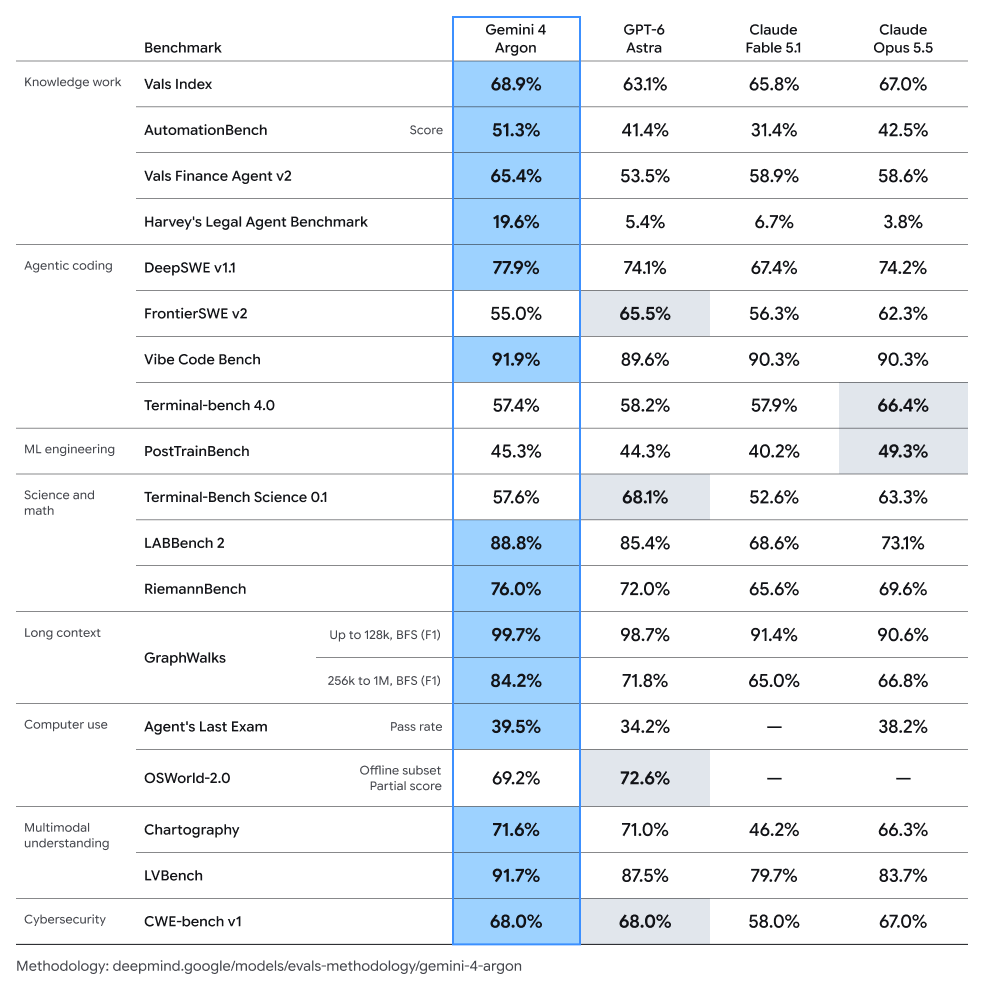
Introducing Gemini 4 Argon – our new frontier model.
It’s built for complex workflows across coding, enterprise knowledge work, and cybersecurity defense – rolling out today to a set of trusted testers through our Fairwind Program.
Tom Zahavy retweeted

1/ Today we’re launching an open letter calling on the government to end unfair restrictions that stop Britain’s best switching jobs or starting companies.
UK AI companies that have raised $5bn agree: our best should be free to start and scale. 🧵
@downingstreet @biztradegovuk


Tom Zahavy retweeted

Scientists are probing whether language models trained on historical data can reproduce creative breakthroughs
go.nature.com/3Tld1sG



Tom Zahavy retweeted

This isn't the most notable aspect of today's news, but on the user data issue, there are different kinds of *training on user data* with very different privacy/IP implications. Sadly, AI cos don't like to disclose what they're doing.
- pretrain on user data, with users' tokens as prediction targets: high regurgitation risk, improper
- use user prompts to distill large models into small ones: low regurg. risk, some companies probably do this
- use user traces to construct RL tasks: low regurg. risk, because RL has low memorization abilities, but can extract customer IP, depending on how it's done. Ranges from benign "use explicit user feedback in reward model training" to invasive "upload user's coding environment and commit history to turn into rl envs"
"De-identification" is weak -- you can identify someone with a small number of bits, and long traces have more than enough. And it doesn't affect IP leakage concerns.

Tom Zahavy retweeted

everyone getting sniped by the personal drama, but missed the more interesting unanswered question:
can these labs see all your work and scoop you when the stakes are "high enough"?
🤷🏻♀️

Tom Zahavy retweeted

Congratulations to Sir Roger Penrose and colleagues from Oxford, Ulm and Ben-Gurion Negev Universities for experiments linking Einstein’s gravity with quantum mechanics. They proved equivalence theory which extends spacetime curvature to tiny quantum scales, as Penrose predicted. With larger superpositioned masses they can test Penrose Objective Reduction at times t=h/E, also proposed as the origin of consciousness. Preparations for those experiments are underway.
eurekalert.org/news-releases…
Tom Zahavy retweeted

We’re proud to announce Swish III, a $250M early fund, bringing Swish Ventures to $800M in total AUM.
I started this firm to spend my career supporting the artists who build and shape the future.
The technology shift underway is unlike anything we’ve seen. We plan to stay true to our colors: few investments a year, real concentration and partnership.
Grateful to the founders we get to work with, who inspire so much of how we work, and to our LPs for walking this path with us.
We are more locked in than ever.
Omri

Tom Zahavy retweeted

Sir, I can confirm this is a good model, much better than its predecessor 🤩
Two new Gemini models are here to help scale your AI agents and secure code:
🔘 3.8 Flash: our most intelligent model yet with significant gains from 3.7 Flash across software engineering, agentic tasks, and multi-step reasoning.
🔘 3.8 Flash Cyber: our most capable cybersecurity model with frontier-level vulnerability detection and automated patching.
Tom Zahavy retweeted

Introducing Gemini 3.8 Flash, another jump in Gemini's agentic + coding capabilities, and our 3rd updated Flash model in only 6 weeks...
This model has been a ton of fun to work with, excited to see what you all think!


Tom Zahavy retweeted

February: no frontier model could solve Irregular's hardest exploitation task.
By April: the best one could, occasionally, for ~$2,000.
By June: several could, reliably, for ~$20.
Over the next year, we will likely enter a period where AI's offensive capability outpaces defense at scale.
@dan_lahav and the @Irregular team are truly at the frontier of AI security, as major partners to the frontier labs.
This is the most detailed and thoughtful account of where AI security is today, where it's headed, and what we can do now so defenders don't fall behind.

𝗧𝗵𝗲 𝗘𝗻𝗱-𝗦𝘁𝗮𝘁𝗲 𝗙𝗮𝗹𝗹𝗮𝗰𝘆: 𝗪𝗵𝗲𝗿𝗲 𝗜𝘀 𝗔𝗜 𝗦𝗲𝗰𝘂𝗿𝗶𝘁𝘆 𝗚𝗼𝗶𝗻𝗴?
Frontier AI models had a giant performance gain in coding in the Fall of 2025
Then with cybersecurity in April
This is now happening with open-weight models
We are optimistic about the long-term
But outside of a few players, we believe the world is not ready in the short-term


