

Reverse Engineer, Stargazer, Gardener, exploring the wonders of the universe and beyond | TEAM HEART CEO | @texillect
TrueNorth
Joined October 2010
- Tweets1K
- Following569
- Followers10.8K
- Likes85.9K






Every counted vote must be from a legal, living American citizen.
There are now detailed Federal databases by county that can surface election fraud cases for investigation.
And @TheJusticeDept previously committed to doing so.
Was this a mousetrap election?
1
1
59

MUTUAL OCCULTATION OF JUPITER'S MOONS
What would Galileo think? When the great astronomer discovered Jupiter's moons 400 years ago, they were no more than pinpricks of light in his primitive telescope. Fast-forward to 2026, and they are fully-resolved spherical worlds.
This rare movie shows Europa partially eclipsing Ganymede on Nov. 7th. Günther Strauch recorded the event from Borken, Germany, using a 16-inch Meade telescope.
Galilean moons can only eclipse and occult each other near Jupiter’s equinox--or about once every 6 years. This season’s equinox falls on Dec. 16th. Observers who try to record these events typically see no more than unresolved points of light. Strauch actually resolved both disks: Ganymede at 1.34" and Europa at 0.80". A 16-inch telescope's theoretical resolution limit (the Dawes limit) is about 0.29 arcseconds, so he was working near the edge of what the instrument can do
In the video, Europa is the smaller, brighter dot. Its icy surface reflects much more light than Ganymede’s darker landscape. Europa's higher surface brightness makes it easy to follow as it passes in front of Ganymede, which is larger than the planet Mercury.
Answer: "I think I'd like a Meade"

FAST SOLAR WIND FOR DAYS -- AURORAS AT NIGHT
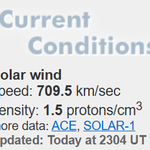
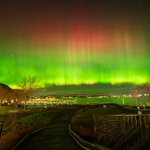
Earth has entered a stream of fast-moving solar wind (700+ km/s), and this is causing bright auroras around the Arctic Circle. Robbin Gälliner photographed the display from Frösön, Sweden.
"I wasn't planning to go out tonight, but a friend sent me a text, so I decided to give it a try," says Gälliner. "After over an hour of waiting, this really intense substorm came from nowhere."
This is just the beginning. The solar wind stream is flowing from a wide hole in the sun's atmosphere--so wide that we will be inside it for days. G1-class geomagnetic storms are likely on Nov. 8th and 9th, with a chance of escalating to category G2.


RETURN OF 21 -- CHANCE OF X-FLARES
PLAYER21 has doubled in size this weekend since returning to the board, and is directly facing Earth and considered "unstable".
With a 'beta-gamma-delta' magnetic field, P21 harbors energy for strong explosions. NOAA forecasters estimate a 60% chance of M-class solar flares and a 20% chance of X-flares.

The air is electric ⚡️
The solar wind speed is 6 9 3 ⚡️


TeX retweeted

Active geomagnetic conditions (Kp4)
Threshold Reached: 19:20 UTC
Follow live on spaceweather.live/l/kp


