

Advancing Lady Thatcher’s visionary legacy.
Joined May 2024
- Tweets1.8K
- Following1.5K
- Followers1.8K
- Likes18.4K





"Some socialists seem to believe that people should be numbers in a State computer. We believe they should be individuals. We are all unequal. No one, thank heavens, is like anyone else, however much the socialists may pretend otherwise.
We believe that everyone has the right to be unequal but to us, every human being is equally important."
― Margaret Thatcher

"Here in America, I have followed the controversy about immigration and ethnicity, which has preoccupied many, and which has even divided some, in the conservative camp.
In Britain, we too know the consequences of mass immigration in past years.
In both our countries, we must recognise the priceless asset of a common language which forges national unity out of the multi-ethnic variety, and so makes democratic debate possible–the more so because the English language is soaked in the values of liberty."
― Speech to the First International Conservative Congress (1997)
"And really, you know, politicians, I think should sometimes just be a little bit more modest about their abilities than they are. We can't run everything - and we shouldn't try."
― Interview for Canadian TV (1983)
"In a free country everyone has to choose.
And the overwhelming majority of our fellow citizens—black or white, in or out of work, living in the suburbs or city centres—freely make their choice.
They respect the law; and they will have no truck with crime masquerading as social protest."
— Speech to Conservative Party Conference (1985)
"I was brought up to believe it was unforgivable to acquire debts you can't repay, and dishonest to make promises you can only keep at other people's expense.
To my mind, there is no essential difference between that old-fashioned family morality and the way in which Governments ought to conduct business.
That is the policy of my party, too.
We believe in thinking hard about creating wealth, before getting down to the more agreeable task of spending it. To us, the only honest idealism is based on wealth we are already creating.
We don't finance our ideals with dud cheques.
No doubt the Labour leaders would like to do the honest thing, too.
Their difficulty is that they genuinely do not know how wealth is really created.
They are obsessed by the belief that wealth flows from the State, and that if the State only pumps enough money into a business it will flourish.
So when the first dollop of aid fails, they supply another, bigger one. They are continually reinforcing failure.
Tories, by contrast, know that the business of wealth-creation is essentially a human process.
It is based on the ideas of individual men and women, their skills, energy and inventiveness—and the sheer risk-taking courage—with which they turn those ideas into factories, providing genuine jobs.
Real economic growth occurs when a small business is original and efficient enough to turn itself into a medium-sized business; and when a medium-sized business, by mastering the techniques of mass-production and marketing expands into a big one.
That's when the new jobs mount up, and the new wealth accumulates."
― Article for Daily Express ("We cannot prosper with dud cheques") 1979

"I grew up in the 1930s with an unemployed father. He didn't riot. He got on his bike and looked for work—and he kept looking until he found it."
— Norman Tebbit

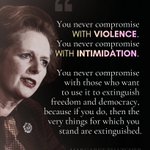
"You never compromise with violence. You never compromise with intimidation. You never compromise with those who want to use it to extinguish freedom and democracy, because if you do, then the very things for which you stand are extinguished."
— Interview for Channel 4 A Week in Politics (1985)

The state cannot generate compassion; it can and must provide a “safety net” for those who, through no fault of their own, are unable to cope on their own.
There is need for far more generosity in our national life, but generosity is born in the hearts of men and women; it cannot be manufactured by politicians, and assuredly it will not flourish if politicians foster the illusion that the exercise of compassion can be left to officials. And so, I repeat, it is on the individual that the health of both church and state depends.
Perhaps we have lost the idea that is inherent in Christ's parable of the talents. The steward who simply did not use the resources entrusted to him was roundly condemned. The two who used them to produce more wealth were congratulated and given more.
To put up with the mediocre, to flinch from the challenge, to mutter “the Government ought to be doing something about it” is not the way to rekindle the spirit of the nation.
― Speech at St Lawrence Jewry (1981)

"Too often the democratic peaceful nations let slip their guard because they assumed that the danger had gone, assumed that the future would be one of peace and progress. And too often they were wrong.
For the course of history is not predictable.
Great plans for peace can precede great wars.
Cool-headedness, common sense and vigilance are never more important than when Europe is convulsed by change."
― Speech to Young Conservative Conference (1990)

"Our weaknesses are not inevitable. Our errors are not irreparable. Our sickness is not terminal.
It is a crisis of the spirit, not a depletion of resources, that cripples us.
Ours is the superior system, the victorious creed, the best, indeed the only, hope for a free and just, peaceful and prosperous world.
Let us recall our principles — and live up to them."
― Speech to the Aspen Institute ("Managing conflict - the role of international intervention") 1995

"Some people, for perfectly honourable reasons, I am sure, want the European Community to become a European super-state. That means that the Community would have to acquire, one by one, all the attributes of state sovereignty—including a single currency and a single defence and a single foreign policy.
It also means that national distinctions and loyalties would have to be submerged because people will not respect—and ultimately would not obey—authority to which they felt no allegiance.
Such a super-state would not only be difficult and costly to construct, it would also be inherently unstable. History has surely demonstrated, at the end of the last century and in this, that states put together artificially will not endure. We have seen this with the fall of one empire after another—most recently with the fall of the Soviet Union.
We have also seen it in Yugoslavia. Conscious of that instability, the new super-state's rulers would have to intervene heavily and repeatedly to hold the state together.
This would have the most damaging consequences, not just for the European Community—or its successor body—but for the wider international community.
All of this must be clearly addressed by those who currently use every new opportunity which arises to argue for an extension of Community powers, whether in political, military, social or economic spheres.
To my mind, this qualifies as more—or perhaps less—than a vision.
To me, it would be a nightmare.
Unlike any other state in the European Community, I repeat, unlike any other state in the European Community, we in Britain have not been conquered for over nine centuries, and our taste for managing our own affairs is strong indeed. For me, politics is about power given to us through the ballot box for which we are accountable to the people.
To me, it is unthinkable, that a politician can come into office and then, using the power with which the people have entrusted him, seek to vote away not only that very power, but the powers of the generations that must follow."
— Speech to Bank Julius Baer, Zurich (17 October 1991)

"So we have robots which will put their hands into a furnace. Robots which will check a lorry for an unexploded bomb. Robots which will clean skyscraper windows and explore the sea floor. Not the sort of job for which there would be a flood of applicants if they were advertised.
But there is another fear that robots will replace jobs. Indeed the heart of what this conference is about is the differing roles of man and machine.
What would many Victorians have replied if you had asked them what could be the employment consequences of the replacement of the horse by the internal combustion engine?
Disastrous, they would have said. Look at all the coachmen, saddlers, blacksmiths, and stable boys who'd be put out of jobs.
Only a few highly skilled people were going to be needed to make car engines.
How could you have explained what a traffic light was? Or a motorway service station? Or the extra jobs in tourism, the extra pleasure in travel?
It is always possible to identify jobs at risk; it is never possible to predict the creation of jobs which are by definition unimaginable."
― Speech opening Automan ’81

"We must encourage people to take charge of their own lives, and to live honestly and openly, fulfilling their duties and respecting the rights of others.
More: we must encourage people to see that they are the property of no earthly master, not even of the State; that they are answerable for what they do in a Higher Court than the courts of this world, and that every attempt to relieve them of the burden of responsibility and to treat them like cattle in a comfortable collective farm, is an act of spiritual insolence."
— Speech at Jagiellonian University in Krakow (1991)
Remembering Margaret Thatcher's eternal principles on what would have been her 101st birthday.

"I think there are times when it would be difficult to carry on unless one had a faith, and I have, and I am very grateful I was brought up that way..."
“Israel must never be expected to jeopardise her security: if she was ever foolish enough to do so, and then suffered for it, the backlash against both honest brokers and Palestinians would be immense — ‘land for peace’ must also bring peace.”
— Statecraft: Strategies for a Changing World (2002)
#MargaretThatcher #Israel

"In modern societies, success depends on openness, on free discussion and on easy access to information. We in the West could never have experienced the great surge of technological advance without them."
— Speech to the Canadian Parliament (1988)
"The story of how Europeans explored and colonised—and yes, without apology—civilised much of the world is an extraordinary tale of talent, skill and courage."
The Grocer's Daughter retweeted

Shabana Mahmood’s incredibly dangerous and nefarious plan to bring Palestinian and Afghan “refugees” to the UK makes a great deal of sense when you look at her ties to Muslim Brotherhood linked organizations. The British people need to stand up to this madness.

UK Home Secretary Shabana Mahmood has previously worked and appeared with Islamic Relief UK, an organization linked to the Muslim Brotherhood.
In September 2010, shortly after becoming an MP, Mahmood and fellow Labour politician Sadiq Khan visited Islamic Relief field operations in Pakistan following devastating floods.
Islamic Relief also documented Mahmood joining its representatives, police, local-government officials and members of the community at a Birmingham solidarity event following the 2019 Christchurch mosque attacks.
Islamic Relief has historical links to senior Muslim Brotherhood figures: its co-founder and former chairman Essam El-Haddad was a member of the Muslim Brotherhood’s Guidance Bureau and later became an adviser to Muslim Brotherhood-backed Egyptian President Mohamed Morsi.

"Our top tax rates are the highest in the Western world.
To take 83 per cent is sheer confiscation.
It is ridiculous to leave a man with only 17 pence out of a pound of his own earnings.
Britain must stop driving its most able and best qualified people abroad. We need them here.
[...] Skilled and professional people have gone abroad in their thousands, sometimes as a direct result of the British tax system.
How foolish we are.
How much better it would be for Britain if these people applied their skills and talents here.
We cannot all be top people.
But none of us can do without them. Top countries have got to have top people.
They are the one export we cannot afford. We want them working for us, not for our competitors.
A country's top rate of tax is a symbol.
Very little revenue is collected from people in this country who pay tax at the highest rates.
A top rate of 83 per cent is not much of a revenue raiser; it is the symbol of British socialism—the symbol of envy."
— Speech to Putney Conservatives ("Axe Tax") 1978
