

Your premier source for original aviation news, technical analysis, and high-quality aerospace content. Follow if you like military planes :)
Joined December 2025
- Tweets1.5K
- Following49
- Followers119
- Likes38



Japan scrambled fighters four days in a row as Chinese and Russian spy planes flew near the country. 😳
From Oct. 20 to 23, Japan tracked five intelligence aircraft: three Chinese Y-9s and two Russian Il-20s. Japanese fighters took off each day.
The Chinese planes flew through the passage between Okinawa and Miyako-jima, the same route taken by China’s Liaoning carrier group. The flights came as Japan and the U.S. held the Keen Sword exercise. Russian aircraft flew over the Sea of Japan on two consecutive days, heading toward Shimane.
Japan hasn’t said the flights were connected to the carrier or the exercise. But the timing stands out.
WHY IT MATTERS
- Japan scrambled fighters 442 times from April through September, up from 265 during the same period a year earlier.
- Spy planes can gather signals and radar information while military exercises are underway.
- The scramble total was Japan’s highest first-half count since fiscal 2022.

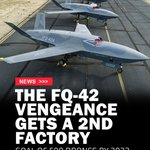
The Air Force's drone wingman program just got bigger.
General Atomics announced Friday it is partnering with Spirit Defense, a Boeing company, to build airframes for the FQ-42 Vengeance.
Spirit will be the fuselage design-build partner, and the work has a home: a new 50,000 sq ft facility in south Wichita, Kansas, opened the same day the partnership was announced.
General Atomics has been the sole manufacturer of its own drones since 1992.
That changes now.
The Wichita plant brings engineering and manufacturing capacity to a program that needs to scale fast, while General Atomics keeps the rest of the build in San Diego.
General Atomics won the Air Force production contract for the FQ-42 in June. This partnership is about scale: more capacity, more resilience, fewer single points of failure as production ramps.
WHY IT MATTERS
- The Air Force intends to have at least 500 CCAs in service by 2032, up from 150+ by the end of the decade. Secretary Troy Meink set that target Sept 14.
- The FQ-42 Vengeance (General Atomics) and FQ-44 Fury (Anduril) are the two Increment 1 CCAs, built to fly alongside F-35s and the future F-47.
- Target cost is about $20M per drone at full-rate production, about a third of an F-35A. That is the drone's target price, not a jet price.
Flight testing is already underway at Creech AFB, Nevada, where the first FQ-42 arrived Sept 18.

A $1.057 billion campus for a jet with no home yet.
The Air Force just released a draft plan for the F-47's campus at Nellis AFB, Nevada, with the test site running by spring 2031.
To be clear, that is construction money, not the price of the jet. And Nellis is the operational test home, alongside the F-15EX test mission. Where the F-47 actually operates from day to day is still unspecified.
Phase one is a hangar, a reprogramming lab, a simulator facility, and a 1.154 million sq ft apron. Phase two runs through 2032 and adds a stealth corrosion control hangar and a weapons load training hangar.
Here is the twist. A new report to Congress names only two F-22 squadrons, both at JBER in Alaska, for a transition mission through 2035. Even that mission is still to be determined.
WHY IT MATTERS
- $1.057B, a 1.154M sq ft apron, and a 2032 finish line. The build is real and already on a timeline.
- Nellis becomes the F-47's operational test home, alongside the F-15EX test mission.
- The F-22's own future is still being sorted out. Only two squadrons are named for a transition mission, and the mission itself is still TBD.
- First flight is promised by the end of Trump’s term. Operations come in the 2030s.
The test base is being built. The jet's real home, and the Raptor's replacement plan, are still open questions.

The Air Force is considering a surprising new role for its next-generation bomber: helping fight enemy aircraft. 😳
A report sent to Congress last week reportedly raises the idea of using bombers, especially the B-21 Raider, in air-to-air missions.
The concept is straightforward: the stealthy B-21 could stay far from danger and launch long-range missiles, while also coordinating drone aircraft closer to the fight. It’s still just an idea. Nothing has been approved, and it’s not clear what changes the bomber would need.
That’s a big shift for an aircraft designed to strike targets on the ground.
The B-21 is still in testing, too.
WHY IT MATTERS
- A formal Air Force report suggests the service is looking at new ways to use its bombers.
- Bombers could bring more long-range missiles to a fight without waiting for a new fighter.
- Air Force leaders have hinted at this possibility before.

Finally, after all the drama.
Canada’s first two CF-35As are here. They just aren’t in Canada yet.
The RCAF has taken delivery of the jets at Luke Air Force Base in Arizona, where they’ll be used to train Canadian pilots while Canada finishes building the infrastructure needed to operate them at home.
And that part is going to take a while.
Canada’s first F-35 only flew on September 23, and the first jet isn’t expected on Canadian soil until 2028, when it arrives at CFB Cold Lake in Alberta.
The politics around the purchase still haven’t settled either. Prime Minister Mark Carney ordered a review of the F-35 buy in March 2025 amid diplomatic and trade tensions with the Trump administration. The review hasn’t canceled the purchase, but CBC sources say Ottawa is now discussing a mixed fleet of F-35s and Canadian-built Saab Gripens.
That combined fleet could eventually total more than 100 aircraft, according to those sources.
WHY IT MATTERS
- Canadian pilots can now begin training on actual RCAF F-35s instead of waiting for the first jets to arrive at home.
- The first F-35 on Canadian soil is still roughly two years away, with Cold Lake targeted for 2028.
- Canada still hasn’t settled the final size or makeup of its future fighter fleet. The F-35 is moving forward, but the Gripen option hasn’t gone away.
So the CF-35 is real now.

Cue X-files theme song. 👽
Federal agents near a secure U.S. facility reported a matte-black triangle rising above a ridgeline, hovering, then covering about 1.5 miles in three seconds before vanishing.
No sound. No visible engines, windows, or panels, even through binoculars.
The accounts come from FBI and Defense Department reports in the Pentagon’s seventh UAP file release.
Officials label the case “unresolved,” meaning there wasn’t enough data to identify it, not that it’s been linked to anything extraterrestrial.
WHY IT MATTERS
- Reported as small, 9 to 15 feet across, flying just 200 to 300 feet up.
- Axios: the U.S. has no known craft like it, and neither do adversaries.
- These are 2026 firsthand accounts from federal agents, not Cold War files.

Russia is turning to a bank’s AI for design help. 😳
Russia is testing a chatbot developed by a bank, yes a checking and savings accounts bank, to help design aircraft. What could possibly go wrong?
United Aircraft Corporation (UAC)—the company behind the Su-57—is trying out Sberbank’s GigaChat as an engineering assistant, with an initial focus on early-stage design.
No, it’s not a chatbot flying a stealth fighter.
And no specific new aircraft has been named.
WHY IT MATTERS
- UAC says nine core software modules and about 4,000 workstations now run Russian tools.
- Su-57 builder is looking at AI to speed design work and cut costs.
- UAC claims some calculations, like hydraulics, dropped from months to days.

Man beheads marine on Iwo Jima statue at Quantico
Prince William County Police say a 27-year-old Stafford, Virginia man took a sledgehammer to the Iwo Jima flag-raising statue near Marine Corps Base Quantico. Officers found him actively damaging it and detained him without incident.
The statue is a 9-foot limestone replica of the Marine Corps War Memorial in Arlington, sculpted by Felix de Weldon. One figure lost its head, another has gouges across the helmet and face, and a third has a damaged bayonet.
Miguel Alonso Maldonado Soriano is charged with three counts, including felony injury to a monument. He’s held without bond. No motive has been released.
WHY IT MATTERS
- Police estimate hundreds of thousands of dollars in damage to a 9-foot statue.
- Police haven’t said whether the monument can be repaired.
- It’s a replica of one of the Marine Corps’ most recognizable symbols.
Singapore’s F-35 secret is hiding in federal spending records. 👀
Air Data News traced an $18.8M contract through USAspending, the federal spending database. The program line reads “Singapore Program Team Support.”
An earlier $53.4M award from August 2022 is labeled “Singapore Group A Integration.”
Same contract, same unnamed customer.
The Pentagon still hasn’t named the buyer, so this is procurement records, not confirmation. It’s the strongest evidence yet.
The timing fits.
Singapore expects its first F-35B before the end of this year, and the custom-work program has been running since 2021.
WHY IT MATTERS
- More than $130M across four awards since 2021 for custom work.
- Singapore’s first F-35B is due soon, the first of 20 jets.
- The order is 12 F-35Bs and 8 F-35As, a rare mix of variants.

Smart deterrence. 😈
F-22 Raptors from the 525th Expeditionary Fighter Squadron are operating from Tsuiki Air Base on Kyushu for Keen Sword 27.
They deployed from Joint Base Elmendorf-Richardson in Alaska and were on the ground by opening day, Oct. 19. That’s a Japan Air Self-Defense Force base, not a U.S. one.
Keen Sword is the biggest yet: about 45,000 Japanese and 12,000 American personnel, running through Oct. 29. Much of it focuses on defending Japan’s southwestern islands, which stretch toward Taiwan.
The detail that matters: on Yonaguni, about 68 miles from Taiwan, U.S. Marines have deployed NMESIS anti-ship missiles and MADIS air defense for the first time.
WHY IT MATTERS
- About 57,000 personnel this year. 2024 had roughly 33,000 Japanese troops alone.
- Fighters, anti-ship missiles and air defense are all rehearsing for the southwest islands.
- The base is only 68 miles away from Taiwan.

The talks are over. The framework is signed.
Today, Lockheed Martin and the Pentagon reached an initial production-and-sustainment agreement for at least 850 F-35s over the next 10 years. The largest deal in the program's history.
The structure is the story: this is not an order yet. It is a prearranged long-term contract covering U.S. and international jets plus initial spares and modification kits, with Lockheed holding production at about 156 jets a year.
Lockheed is self-funding at least $7B in program initiatives.
The fine print: a formal contract still needs Congress to grant multi-year authority in the coming months. Under Secretary of Defense Michael Duffey: "We have fundamentally changed how we stabilize the American defense industrial base to produce at speed and scale."
Sequel to the Oct 13 post about the decade-long talks. Nine days later, the paperwork exists.
WHY IT MATTERS:
- 850 jets over 10 years locks the F-35's production line for a decade. It is the largest deal in the program's history, and it takes the jet's future off the year-to-year budget fight table.
- The structure is the shift: a prearranged framework covering U.S. and international jets, spares, and sustainment, with Lockheed holding ~156 jets a year. The Pentagon is buying stability for the whole industrial base, not just airplanes.
- It's still not an order. The formal contract needs Congress to grant multi-year authority, and Lockheed is putting at least $7B of its own money in. If Congress balks, the framework is paper.
Source: Reuters, Oct 22.
🤖 Made with AI

A carrier in the Pacific just flew a drone sitting in Illinois. 😎
USS Ronald Reagan remotely commanded a Boeing MQ-25A Stingray over 2,100 miles, linking the moving carrier to the aircraft at Boeing’s Mascoutah, Illinois facility.
The connection ran through a low Earth orbit satellite network, not direct radio, using an MD-5C control station.
That matters because the Navy’s plan depends on it.
Today, Super Hornets burn flight hours and weapon stations carrying fuel for other Super Hornets. The Stingray is meant to take that job, delivering about 6,350 kg of fuel roughly 926 km from the carrier.
The catch: the Navy still has to prove control handoffs between shore and ship, dropped-link procedures, and operations during busy launch and recovery cycles.
IOC isn’t planned until 2029.
WHY IT MATTERS
- UAC says it has swapped nine core software modules and about 4,000 workstations to Russian tools.
- Russia can’t buy Western design software, so it’s trying AI to fill the gap.
- UAC claims digital tools cut some calculations, like hydraulics, from months to days.
- The record is mixed: Russia sought $3.2M back from a firm that failed to replace US-made cockpit displays.

Russia's had a rough month! 👀
A Russian Su-30SM crashed in Kaliningrad Oblast today. Russia’s Defence Ministry confirmed it, saying the crew ejected, the jet came down in an uninhabited area, and the flight was a training sortie with no ammunition aboard.
Moscow hasn’t given a cause. A video circulating online, posted by the Ukrainian OSINT project Exilenova+, allegedly shows the crash. That footage hasn’t been independently verified.
The timing is what makes it stick.
Ukraine claims it hit two Russian jets on Oct 3-4 and six Su-34Ms on Oct 14-15. Russian tactical aviation has had a rough month.
WHY IT MATTERS
- Kaliningrad sits between Poland an Lithuania, so any aviation trouble there gets watched closely.
- Routine training losses are normal. Several aircraft problems in weeks is the unusual part.
Is this just a mishap, or the strain of a long war showing?
🤖 Made with AI

The Nighthawk has landed at the museum. 🦇
A Lockheed F-117A Nighthawk is now on display at the Steven F. Udvar-Hazy Center.
The F-117 was the world’s first operational stealth combat aircraft. Lockheed Martin’s Skunk Works restored the aircraft for display, demilitarizing it and returning it to its final operational appearance.
A rare chance to see one of the aircraft that changed the way the U.S. approaches stealth and combat aviation. Have you seen it in person yet?
Photos courtesy of the National Air and Space Museum.

With F-35s leading the pack 😏
Lt. Gen. David Tabor, the service's deputy chief of staff for plans and programs, laid out the new fighter force structure at a Pentagon roundtable Tuesday, four days after the plan went to Congress.
The headline number: 1,509 combat-coded fighters by 2035. That's roughly 1,271 projected for 2026, plus more than 200 jets. The growth rides on F-35A, F-15EX, and F-47 buys.
The new mix, per Tabor: about 40% F-35A. About 20% F-22 and F-47 combined, with the F-47 replacing the Raptor roughly one for one (around 186 operational F-22s built). The other 40% splits roughly evenly between F-15 and F-16 variants.
Do the math on today: the fleet, excluding the A-10, is roughly 45% F-16, 30% F-35, 15% F-15, 10% F-22. By 2035 the F-35 owns the top spot, the stealth share climbs to about 60%, and the F-16's share gets cut in half.
The honest caveats, straight from Tabor: the number is built on combatant commanders' medium-risk requirements and "will likely change," Congress has to fund the jets, and the industrial base has to build them. The analysis started before the Iran war and was not driven by it.
One thread to pull: this is why the Pentagon is in 10-year F-35 production and sustainment talks. The F-35A is the growth engine for all of it.

Uninvited guests. 😳
Japan scrambled fighters as three Chinese aircraft probed the gaps between its islands on day one of Keen Sword, the Japan-US exercise.
A BZK-005 drone and a Y-9 surveillance plane ran through the Miyako Strait into the Pacific. A TB-001 strike drone flew between Yonaguni and Taiwan, then doubled back through Miyako.
Seven Chinese ships were tracked too, including a supply ship built to support carrier groups. The carrier Liaoning had already passed through Miyako.
Japan’s own move: Type 25 anti-ship missiles deployed away from their Kumamoto base for the first time.
WHY IT MATTERS
- 45,000 Japanese and 12,000 US personnel are training through October 29.
- Japan tracked 3 Chinese aircraft and 7 ships on the exercise’s opening day.
- China's TB-001 drone can carry weapons, and it flew the gap between Yonaguni and Taiwan.

Moody's Flying Tigers brought the BRRTTT to Northwest Arkansas last week. 😈
A-10C aircraft from the 23rd Wing staged at KXNA, and the ramp shots under the night lights show everything that makes the Hog a legend: the classic shark mouths, Diddy Kong manning the GAU-8 on the nose, and a full grid of mission markings.
Every silhouette is a sortie someone flew.

And these aren't just any Hogs.
The 75th Fighter Squadron's A-10s flew home from Operation Epic Fury in June, and the Nintendo nose art, Diddy Kong included, was painted on at Muwaffaq Salti Air Base in Jordan during the deployment. The mission grid on the nose is from that fight.
Then Tuesday morning they spooled up and rolled out of Northwest Arkansas.
Still the best close-air-support jet ever built.
Big thanks to Jamie at @LadyAstroJet for permission to reuse. Give her a follow!
WHY IT MATTERS:
- Washington keeps debating the A-10's retirement. The jets keep deploying and the mission grids keep growing.
- Nose art isn't decoration, it's earned. Every mark is a sortie someone flew.


The Navy’s nuclear message carrier has a familiar shape again.
The Navy has received the first airframe for the E-130J Phoenix II, a stretched C-130J-30 built by Lockheed Martin in Marietta, Georgia. It will be fitted with a new TACAMO system, which relays messages between the president, the secretary of war and U.S. Strategic Command.
The Phoenix II name looks back to the EC-130Q Hercules, which flew the TACAMO mission during the Cold War. The new aircraft will eventually take over from the E-6B Mercury.
This first aircraft is a bare airframe. Northrop Grumman and Collins Aerospace are reportedly developing its mission systems, which still need to be installed and tested.
WHY IT MATTERS:
- This is the first of three C-130J-30s purchased in September 2024.
- The Navy says the new aircraft will offer greater endurance, capacity and range.
- The Hercules is returning to TACAMO as the E-6B begins its eventual retirement.

I'm surprised. 👀
The 30-day review clock on the $24.3B sale of 48 F-35As to Saudi Arabia runs out today, Oct. 17. I found no reports of a committee markup or floor vote. Resolutions of disapproval have been introduced, including one from Sens. Markey and Merkley, but stopping a sale takes veto-proof majorities in both chambers.
Congress has never successfully blocked an arms sale this way. It passed resolutions against Saudi sales in 2019, and Trump vetoed them.
This is also only the notification stage. Contracts, training, and Saudi infrastructure all still have to come together before a single jet arrives.
WHY IT MATTERS
- 48 F-35As, 49 engines, $24.3B. That’s one spare engine for the whole fleet.
- Saudi Arabia would become the first Arab country to fly the F-35.
- Congress has never blocked an arms sale by resolution. Vetoes sank the 2019 attempts.
