

Research Director at Wood Mackenzie | Energy markets analyst | Geoscience geek | Reading rocks and price curves | Views my own
Dubai, United Arab Emirates
Joined February 2026
- Tweets485
- Following60
- Followers1.3K
- Likes174




This brings us to Oman and yesterday’s big announcement: ExxonMobil just entered Oman, and it’s going straight for the hardest gas in the country: Makarem.
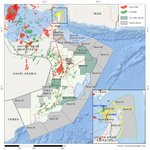
Oman signed a concession with Energy Oman and ExxonMobil to appraise and develop the Greater Makarem area (now know as Block 20 - although the exact boundaries of that block have not been disclosed), with an initial commitment of more than US$400 mn. It is tied to a proposed LNG project at Duqm, targeting 6-9 mmtpa.
Makarem is a known problem. PDO found it in the 1990s. BP held it and relinquished it in 2018 after poor appraisal results. The gas sits in the deeper, tighter Amin and Buah formations, with sour gas in places.
Oman needs this to work. Majors drilled for gas across the country with few commercial discoveries, and the planned fourth Sur LNG train was shelved for lack of feedgas.
It’s not the first US attempt at Omani tight gas. EOG entered in 2020 with Blocks 36 and 49. Thameen-1 found a 30-40 m hydrocarbon column in the Hasirah sandstone but no flows on test. EOG decided to exit in late 2021, completing it in 2023. The problem was the nature of the discoveries, gas in tight, low-permeability rock, more than their size.
Now EOG is in the UAE and Bahrain, and ExxonMobil is in Oman, bringing US tight-rock expertise to the region. Different players, same bet.
Cautious optimism is warranted. Feeding a 6-9 mmtpa plant likely means moving beyond the sweet spots, and the LNG plant adds substantially to capital needs.
More on Makarem and ExxonMobil's plan in Oman (for our clients only) -> lens.woodmac.com/reports?doc…

1
324
Not long after EOG’s Shilaif oil results, ADNOC made a big and long-awaited decision (a couple of weeks ago at ADIPEC): FID on Ruwais Diyab, its first commercial-scale unconventional gas development.
This is a long way from where it started. The first wells tested in 2020 came in at or below 2 mmcfd IP.
The project now targets 345 mmcfd of raw gas from 2029 under a 25-year plan, with potential to reach 1 bcfd. Capex and partners are undisclosed (expect for TotalEnergies with its 10% in the JV area).
The play spans three Jurassic carbonate mudstones, analogues of Saudi Arabia’s Jafurah. But this is dry gas with H₂S and CO₂, not liquids-rich, and deep, overpressured, tight rock made early appraisal difficult.
What changed is well performance. Multi-formation fracture zones and longer laterals have lifted productivity to levels comparable with the core of the Haynesville, while drilling costs keep falling. At the well level, returns now rank among the best of global unconventional gas peers.
The key variable is now gas pricing. ADNOC’s historical domestic price cap has weighed on commerciality, and a revision to attract international partners looks necessary.
Next, expect ADNOC to farm down part of its 90% stake. EOG, already active in Shilaif oil, would be a credible partner. Operators in both plays can share rigs, standardise completions and pool subsurface expertise, cutting costs across the two.
The UAE’s unconventional push is now running on both oil and gas.

3. The rise of unconventional resources, from the UAE to Oman
The Middle East’s unconventional story is moving from theory to results, and the UAE is leading it. Oman has followed (yesterday!), but let me start first with the UAE and its unconventional oil and gas ambitions.
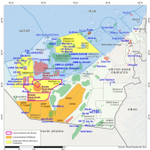
EOG’s first Shilaif wells in Abu Dhabi are almost certainly targeting the Upper Cretaceous Shilaif Formation, the source rock behind an estimated 22 bn bbl of technically recoverable unconventional oil. Activity is accelerating, with Petronas also drilling appraisal wells on UCO1 and UCO5, while UCO4 is still available for future licensing but actively pursued by several US independents.
Three reasons the results matter:
i. Productivity. 30-day cumulative output of 25,000 bbl is in line with the best acreage in leading US liquids plays. And it came from one-mile laterals, while Permian and Eagle Ford wells now routinely exceed two miles. Per foot, EOG’s UAE wells clearly outperform.
ii. Commercial framework. UCO3 is a concession with tax and royalty terms better suited to capital-intensive unconventionals than a PSC. After a three-year appraisal, EOG can elect full-field development, with ADNOC holding a participation option.
iii. Cost reduction potential. Appraisal has relied mostly on local drilling and completion services. If commerciality is confirmed, higher-spec equipment, longer laterals and further optimisation should cut unit costs, and locally sourced frac sand already helps.
Caveats: I believe the first two wells share the same area and landing zone, so repeatability is unproven, and decline rates, well spacing and reservoir variability will decide resource quality.
Still, the UAE could become the first internationally competitive unconventional oil play able to compete with leading US shale economics.

120
2. Iraq's exploration (and DRO) renaissance
Between LUKOIL’s Eridu in 2017 and this year, Iraq had no major discovery. Then ZhenHua Oil made three in 2026 alone, including Shams on the Qurnain block adjacent to the Saudi border, an estimated 8.84 bn bbl in place and a possible new play in the under-explored Jurassic Mus formation.
Meanwhile, the big redevelopment contracts are going to Western companies, almost always with a US partner (the best example is ConocoPhillips alongside BP in Kirkuk). Chevron, ExxonMobil and HKN are all very active too signing MoUs, HoTs and negotiating commercial terms.
But when it comes to exploration, the story is being written almost entirely by Chinese companies while they capitalize on their Round 5+ and 6 awards. The West takes discovered giants and super-giants, while China takes the risk on the frontier.
The reason is fiscal. Iraq’s terms leave the government ~90% of pre-share NPV and deliver the lowest post-tax investor NPV/boe in the Middle East. Almost all upside from higher prices goes to the state, and there’s little protection when prices fall. That’s tolerable for development, but hard to justify for exploration’s added risk and longer payback.
Iraq has ~200,000 km² of open acreage, the lowest opex in the region and a global industry desperate to reload portfolios. The rocks are ready. Whether the terms follow, especially with Hormuz raising the region’s risk premium, will decide if Iraq’s potential stays just that.

4
206
The reopening of the Federal ITP is also important for the redevelopment of the Kirkuk fields. Iraq awarded BP a contract in February 2025 to rehabilitate and redevelop the fields, with ConocoPhillips (42%) and TPAO (15%) involved in the wider redevelopment plans from July 2026. The project encompasses more than 3 billion boe of recoverable resources, with additional exploration upside in deeper, high-pressure reservoirs.
Discovered in 1927 and brought onstream in 1934, Kirkuk is one of Iraq's oldest and largest oil fields. Production exceeded 1.4 million b/d in the 1970s before declining due to sanctions, conflict, infrastructure damage and under-investment. Current combined production across the five fields is around 300,000 b/d. The fields produce light, sour crude from fractured carbonate reservoirs. Decades of production and limited investment have resulted in reservoir damage, elevated water cuts and ageing infrastructure, requiring extensive rehabilitation.
Produced oil is currently supplied to northern refineries and exported via the KEP. The reopening of the Federal ITP provides an alternative export route, allowing production to bypass the KEP and potentially unlocking additional pipeline capacity for higher exports.
A more detailed analysis of the Kirkuk fields is available to our clients:
lens.woodmac.com/reports?doc…
1
179
This brings us to yesterday's reopening of the Iraqi section of the ITP. We have published a detailed analysis for our clients, covering the economics behind the restart, the availability of northern crude and the strategic importance of the Basra-Haditha link:
lens.woodmac.com/reports?doc…
A spoiler:
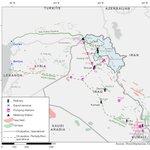
Iraq has restarted crude oil flows through the 46-inch section of the "Federal ITP" for the first time in 12 years, initially pumping around 120,000 b/d. The oil minister is targeting 300,000 b/d, although no timeline has been provided. The restored segment runs from IT1A pumping station to the MS-1 metering station near Fishkabour, on the Iraq-Türkiye border, where it connects to the export route to Ceyhan on Türkiye's Mediterranean coast.
The federal section of the ITP, which has been non-operational since it was attacked by the Islamic State (ISIS) in 2014, comprises two parallel pipelines (40-inch and 46-inch) extending over 573 kilometres, with respective capacities of 500,000 b/d and 1.1 million b/d. It is separate from the spur line known as the Kurdistan Export Pipeline (KEP), although both systems converge at the MS-1 metering station.
The announcement leaves an important question unanswered: where will the crude come from? Iraq did not disclose the source of the initial 120,000 b/d, or whether these volumes are incremental or simply being redirected from the KEP.
Alternatively, Iraq could supplement northern supplies with trucked southern crude. The country has 264,000 b/d of truck-loading capacity in the south and 240,000 b/d of receiving capacity in the north, including 100,000 b/d at IT-1, where expansion could lift unloading to 300,000 b/d. Baghdad has already started trucking operations to facilitate exports via KEP since October 2026.
Even if the Federal ITP reaches its planned capacity of 300,000 b/d, the KEP would still need to contribute roughly 450,000 b/d for Iraq to meet its 750,000 b/d commitment to Türkiye.
Pipeline capacity exists across the system; the constraint is moving sufficient crude into northern Iraq.
The Federal ITP's real value therefore depends on completing the Basra-Haditha strategic pipeline. The reversible line would reconnect the northern and southern systems for the first time in decades, expanding the supply base and giving Baghdad genuine export optionality.

2
175
1. On alternative routes to Hormuz
Bypass capacity has become a strategic priority across the Gulf. Only three Hormuz-bypass crude pipelines exist today: Saudi Arabia’s 7 million b/d East–West line, the UAE’s 1.8 million b/d Abu Dhabi Crude Oil Pipeline (ADCOP) and Egypt’s 2.5 million b/d SUMED, which carries Yanbu cargoes to the Mediterranean.
Expansion is under way. ADNOC will add 1.5 million b/d to ADCOP next year, lifting UAE bypass capacity to 3.3 million b/d, roughly all its typical exports. Aramco plans to convert part of its Master Gas System to carry crude, adding 1.2 million b/d initially within weeks and up to 3 million b/d within two to three years. With East–West pump-station upgrades, Saudi bypass capacity could reach 10 million b/d, although the converted pipes must revert to gas service each May to accommodate summer gas-to-power demand.
Further routes are also being examined. Saudi Arabia is considering a 1,200-kilometre pipeline option to Duqm in Oman. Kuwait, which has no coastline outside Hormuz, is seeking access through Saudi and UAE territory. Iraq’s proposed Hormuz-bypass pipeline has seen its cost estimate swell to well over US$15 billion. The project comprises a 2.25 million b/d trunk line from Basra to Haditha, which then forks into sections terminating in Baniyas in Syria and Ceyhan in Türkiye via the existing Iraq-Türkiye Pipeline (ITP).

I stopped using and posting on X for a while. I was increasingly overwhelmed by AI-generated content that often brings little added value or substance, relying instead on assertive formulations such as “this is not XXX, this is XXX” or “this is a structural shift”.
That said, I intend to start sharing my views again. Lately, I've sensed a growing appetite for human perspectives and content with actual substance.
For my return to X, I'll share my thoughts in separate posts on three major trends shaping the Middle East oil and gas industry.
Hormuz, security risks and data flows are already all over this platform, so I won't add to that conversation. Instead, I'll focus on:
-The rise of alternative export routes bypassing Hormuz.
-Iraq's exploration (and DRO) renaissance.
-The rise of unconventional resources, from the UAE to Oman.
1
3
732
Three commercial vessels attacked in the Strait of Hormuz. US strikes on nearly 90 targets across Iran. President Trump declares the ceasefire "over". Brent responds with a 6% rally to around $78/bbl.
The market is repricing export risk, not physical supply (for now).
Gulf production has recovered faster than expected, but output is still around 4.5 million b/d below pre-conflict levels. The UAE has exceeded 4 million b/d, while Saudi Arabia has recovered to above 7 million b/d.
Iraq remains the key constraint. The issue is getting crude onto ships - not wellhead production. Limited tanker availability and rising war-risk concerns could delay export recovery even if upstream operations continue to improve.
Maritime security is once again setting the oil price.
Demographics are becoming an energy story. Slower population growth could cap long-term energy demand, but AI, electrification and emerging market development will continue to drive electricity and critical mineral demand, increasing pressure on hydrocarbons. The long-term downside is greater for oil and gas than for electrons.

Population growth is a cornerstone of future energy demand. But alarming declines in birth and fertility rates suggest that UN projections for global population may be far too high. A falling global population would have huge implications. Read more: okt.to/0m6RrF

Genel Energy's US$360 million acquisition of Capricorn Energy is a pivotal step in its strategy to diversify beyond the Kurdistan Region, where geopolitical tensions, export disruptions and payment delays have exposed the risks of concentration. The deal more than doubles Genel's production and follows several years in which Capricorn explored, but failed to execute, alternative strategic combinations.
🇮🇶In Iraq, momentum continues to build. Chevron has secured access to evaluate West Qurna 2 through a confidentiality agreement, a potential precursor to operatorship of one of the country's largest oilfields.
Meanwhile, HKN Energy has entered Federal Iraq through the Hamrin redevelopment, targeting a threefold increase in production under Iraq's evolving hybrid contract model.
Together, the developments reinforce Baghdad's push to attract international (mainly US) investment into its core upstream sector.
More on this available to our clients only 👉my.woodmac.com/web/woodmac/d…
3
224
Eni and XRG have agreed to take stakes in three unconventional blocks in the Vaca Muerta from YPF, deepening their exposure to Argentina's LNG ambitions. The blocks form the core upstream resource for the proposed Argentina LNG project, which could be sanctioned as early as the second half of 2026.
For XRG, the entry into Vaca Muerta fits a strategy centred on large, long-life unconventional resources linked to export-led monetisation. The tie-in with Argentina LNG frames the acreage as part of an integrated value chain rather than a standalone upstream position.
The partnership with Eni and YPF strengthens the upstream base of the LNG project and aligns resource development with expected export infrastructure timelines.
Our clients have access to the full analysis 👉my.woodmac.com/web/woodmac/d…
Post-ceasefire, Gulf supply is returning faster than many expected. The UAE has restored offshore production within days of operations resuming, demonstrating strong reservoir management and operational execution.
In Iraq and Kuwait, most of the remaining recovery is expected to be constrained by logistics rather than field performance, with the majority of production able to return once export operations fully normalise.
The next question is whether the shipping system can keep pace. Around 5 million b/d of Gulf oil still has to return to the market, requiring a significant increase in tanker availability through the Strait of Hormuz. Vessel traffic and insurance costs have improved markedly since the ceasefire, but rebuilding export capacity will still take some time.
As logistical constraints ease, the conversation is shifting from "Can Gulf supply return?" to "Can the market absorb it?" With oil prices already under pressure, the next major variable may be Riyadh's response rather than Tehran's. Saudi Arabia's strategic choice will be whether to defend prices through continued supply restraint or prioritise market share by flooding the market with barrels.