sudo founder @ https://xitter.cf/t.co/G9G53oNzf6 // digital sovereignty infrastructure Esver OS (core) Mr Haven (web3 non-custodial) | Visage (Face Auth for Linux)
EST
Joined June 2016
- Tweets5.1K
- Following961
- Followers986
- Likes6.5K

Mr Haven’s smart contracts are now public.
The code securing live and programmable time vaults on @base is open:
verifiable, auditable, and inspectable by anyone.
github.com/sovren-software/m…
🧵

Trillions of dollars are moving onchain.
But the systems used for long-term wealth coordination — estate planning, inheritance distribution, beneficiary management, insurance coverage — were designed for traditional financial rails.
They do not map cleanly to digital-native assets, global families, or self-custody.
At the same time, self-custody without recovery introduces its own failure mode.
Onchain infrastructure can solve both problems.
But only if the underlying primitives are open.
T4
Mr Haven V1 has been live on Base since December 2025:
mrhaven.io
Core contracts:
VaultRouter
0x8C09a5f79e62D29BeB9d2FA710Ecc4cC17cdE842
PlanExecutor
0x244eA67F2FcaEBeEBeCdFF1cE45a9abB4918E02D
EmailEscrowManager
0x2E3E2aC4F32A0eEe3b811D302fBB897f1E027b25
Verify the deployments on Basescan.
Recompile from the v1.0.2 release tag.
Bytecode is the proof.
T5
Each user receives a dedicated personal vault.
While assets remain time-locked, capital can earn yield through Aave V3.
Distribution logic is governed by user-defined plans:
• scheduled execution
• inactivity-triggered execution
• beneficiary-directed distribution
Beneficiaries can be specified either by wallet address or by email using hash-locked escrow flows.
The protocol is dual-licensed:
• AGPL-3.0 for the core protocol implementation
• MIT for interfaces, libraries, and integration tooling
Inspect it.
Audit it.
Fork it.
Build on top of it.
The next generation of digital-asset protection infrastructure will be open-source by default.
@BaseHubHB @baselatam @EFetheverywhere @CoinbaseDev @ethereum
For the past five months, I’ve worked 70+ hour weeks to bring this idea to life. The thesis is simple: if AI is going to excel at computer use, it should be the computer itself.
Today a milestone. Still early, much more ahead. 👇

This isn’t “small model beats GPT-5.5.”
It’s “encode the workflow, and dispatch becomes the bottleneck.”
What’s still hard: anti-bot reputation, cross-site transfer, and durability over days.
If you have a recurring workflow you wouldn't trust to a normal cloud agent, healthcare, admin, legal, compliance, back-office, let's talk.
▎xitter.cf/TheCesarCross/status/2…

This isn't "small local model beats GPT-5.5."
It's "once the workflow is encoded, the dispatch path becomes the bottleneck."
Hard problems remain, anti-bot reputation, cross-site transfer, production durability across days. The article names them.
If you have a recurring workflow you wouldn't trust to a normal cloud agent, healthcare admin, legal, compliance, back-office, let's talk.
Full writeup: xitter.cf/TheCesarCross/status/2…
Private AI that actually does the work.
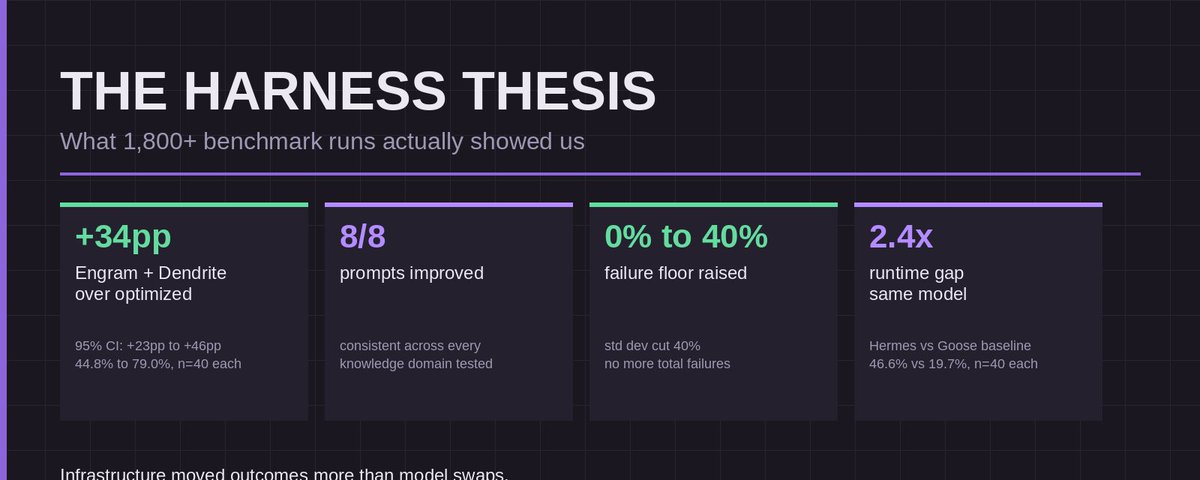
1,800+ benchmark runs we ran internally at Sovren:
- Optimized prompting alone: ~0pp uplift on knowledge retrieval
- Engram + Dendrite harness on a local 27B Qwen: +34.2pp success rate, tighter variance, 40pp higher failure floor
For project-specific context and coding agents, retrieval infrastructure is delivering more than model scale or extra reasoning.
Posted the full results on @sovren_software.
Curious how this lines up with what others are seeing in production.