

Crypto Researcher on All Chains | L1, L2, L3 & Coin Expert.. building @Velvet_Capital
enjoy research? ⏎ Highlights
Joined June 2009
- Tweets38.6K
- Following2.1K
- Followers51.5K
- Likes95.4K




Pinned Tweet
When some top chads post their portfolio, some people ask questions "what are they doing, that I'm not doing?"
It's diversification mate!
Many people flock to overpriced crypto assets, overlooking the vast landscape of innovative projects emerging.
While diversification can improve risk-adjusted returns through metrics like the Sharpe ratio, its benefits go deeper.
In a dynamic market like crypto, it's crucial to gain exposure to the diverse applications and other crypto sectors.
Think of returns like a power law distribution. A few investments deliver exceptional results, while many yield lower or negative returns. This is similar to venture capital, where success hinges on identifying a few breakout startups.
Diversification in crypto serves the same purpose, it increases your chances of capturing the "runner" that'll propel your portfolio upwards.
In the last 24h, AI tokens surged +15% outperforming other crypto sector. This is because Nvidia is close to becoming World’s Most Valuable Company.
If you had spread your investment into AI tokens also, your portfolio would've added gains despite this week's bloodbath.
➭ 𝗕𝗲𝘆𝗼𝗻𝗱 𝘁𝗵𝗲 𝗧𝗼𝗽 𝟭𝟬: 𝗔 𝗕𝗿𝗼𝗮𝗱𝗲𝗿 𝗖𝗿𝘆𝗽𝘁𝗼 𝗨𝗻𝗶𝘃𝗲𝗿𝘀𝗲
A portfolio concentrated solely on the top 10 cryptocurrencies by market cap might seem diversified, but it only captures a limited scope.
These are primarily Layer 1 blockchain protocols. While these tokens may appear less risky, they miss the wave of innovation happening across the crypto landscape.
Expanding your portfolio to include the other top crypto sector paints a more dynamic picture. This encompasses:
• AI: $ARKM, $GRT, $BOTTO, $DEAI, $KAI
• RWA: $PENDLE, $OM, $LNDX, $TRADE, $PRCL, $SOIL
• Layer 2: $ARB, $OP, $STRK, $METIS, $MANTA
• DePIN: $OPSEC, $FIL, $AIOZ, $IOTX, $GPU
• GameFi: $PIXEL, $APE, $SAND, $NAKA, $KARRAT, $MYRIA
The crypto market's rapid evolution necessitates an active approach to portfolio management. Diversification isn't simply buying more assets.
It's about taking a long-term view and strategically allocating your investments across different sectors and project sizes to capitalize on diverse potential outcomes.
RWA Market Cap Expected to Reach $16 Trillion in 2030. DYOR and find your best RWA project pick, buy and HODL!
✍️ 𝗖𝗼𝗻𝗰𝗹𝘂𝘀𝗶𝗼𝗻
Think of diversification not as weakening your portfolio, but as giving it more firepower. It increases your chances of capturing the winners while managing risk.
In essence, diversification gives you more opportunities for success, for less.

THEDEFIPLUG retweeted
UNI has a new source of token burns, but whether that translates into a sustained bid for the token is a different question.
@Uniswap’s October 22 Aggregator Hooks launch allows v4 to route trades through external liquidity, including venues such as Curve, Fluid and PancakeSwap.
The key change is that swaps routed through these external sources pay Uniswap protocol fees, contributing to UNI burns.
That’s a more direct token-economic connection than simply announcing another product feature.
1. The protocol trade
Previously, capturing trading activity depended heavily on liquidity sitting within Uniswap’s own markets.
Now external liquidity can be wrapped as v4 pools, allowing Uniswap’s routing infrastructure to access competing venues while collecting protocol fees.
Seven external sources are supported at launch across Ethereum, Base and Robinhood Chain.
This potentially expands the volume that can contribute to UNI burns without requiring all the underlying liquidity to migrate onto Uniswap.
But access to liquidity and actual routed volume are two different numbers.
2. The token trade
A stronger protocol doesn’t automatically produce a stronger token chart.
The bullish setup would involve several things happening together:
➤ UNI outperforming ETH after the announcement, supported by expanding spot volume rather than derivatives alone.
➤ Open interest increasing alongside price without excessive funding, suggesting participation rather than an overcrowded leveraged chase.
➤ External routing producing measurable incremental fees and UNI burns, giving the repricing an economic basis.
The bearish setup is fairly straightforward.
UNI rallies on the announcement, OI expands, but spot participation fades and UNI/ETH fails to sustain relative strength.
That’s the kind of reaction where a legitimate product improvement becomes an opportunity for existing holders to distribute into event-driven demand.
3. The structural question
Uniswap is effectively expanding from competing primarily for liquidity provision to competing for order flow across a wider liquidity network.
If traders consistently receive better execution through its routing infrastructure, more activity can pass through Uniswap even when another venue supplies the liquidity.
But there’s no guarantee that better routing immediately creates enough incremental protocol fees to materially change UNI’s supply dynamics.
The economics depend on actual routing volume, fee capture and the resulting burns.
And competitors can respond through pricing, liquidity incentives or improvements to their own routing.
Conclusion
Constructive on the protocol development, but I wouldn’t automatically translate that into a bullish UNI position.
The cleaner confirmation is UNI outperforming ETH with genuine spot demand, followed by evidence that external routing is contributing meaningful fees.
A product upgrade can be real while the initial token rally is still a crowded trade.

THEDEFIPLUG retweeted

Apart from it's novel d(3,3) model, the biggest value proposition of @namidefi lies in its positioning as an all-in-one liquidity + yield coordination layer across chains.
Why so?
Rather than building isolated DeFi products, Nami's Omni Layer connects the entire user journey:
🔸 OmniSwap → Aggregates 16 providers for optimised same-chain + cross-chain execution, alongside MultiSwap.
🔸 OmniDeposit + OmniShift → Simplifies LP creation + migration across chains, allowing capital to follow better yield opportunities w/o the usual bridging + rebalancing complexities.
🔸 OmniGauge → Aggregates liquidity incentives across chains into unified markets, enabling veNAMI holders to vote once across multiple networks.
🔸 Nami Relayer → Automates voting, reward collection + reinvestment strategies.
imo the bigger picture is how these products reinforce one another.
More efficient execution + mobile liquidity enables deeper markets + trading activity → greater fee generation → stronger incentives for veNAMI voters + ogNAMI stakers.
Coupled with d(3,3)'s adaptive emissions, Nami is essentially building a multichain liquidity economy where capital efficiency, user experience + token value accrual are interconnected.
The interesting part isn't any single feature, but how the entire stack could compound adoption + economic activity across the ecosystem.
Worth a read 👇





UNI has a new source of token burns, but whether that translates into a sustained bid for the token is a different question.
@Uniswap’s October 22 Aggregator Hooks launch allows v4 to route trades through external liquidity, including venues such as Curve, Fluid and PancakeSwap.
The key change is that swaps routed through these external sources pay Uniswap protocol fees, contributing to UNI burns.
That’s a more direct token-economic connection than simply announcing another product feature.
1. The protocol trade
Previously, capturing trading activity depended heavily on liquidity sitting within Uniswap’s own markets.
Now external liquidity can be wrapped as v4 pools, allowing Uniswap’s routing infrastructure to access competing venues while collecting protocol fees.
Seven external sources are supported at launch across Ethereum, Base and Robinhood Chain.
This potentially expands the volume that can contribute to UNI burns without requiring all the underlying liquidity to migrate onto Uniswap.
But access to liquidity and actual routed volume are two different numbers.
2. The token trade
A stronger protocol doesn’t automatically produce a stronger token chart.
The bullish setup would involve several things happening together:
➤ UNI outperforming ETH after the announcement, supported by expanding spot volume rather than derivatives alone.
➤ Open interest increasing alongside price without excessive funding, suggesting participation rather than an overcrowded leveraged chase.
➤ External routing producing measurable incremental fees and UNI burns, giving the repricing an economic basis.
The bearish setup is fairly straightforward.
UNI rallies on the announcement, OI expands, but spot participation fades and UNI/ETH fails to sustain relative strength.
That’s the kind of reaction where a legitimate product improvement becomes an opportunity for existing holders to distribute into event-driven demand.
3. The structural question
Uniswap is effectively expanding from competing primarily for liquidity provision to competing for order flow across a wider liquidity network.
If traders consistently receive better execution through its routing infrastructure, more activity can pass through Uniswap even when another venue supplies the liquidity.
But there’s no guarantee that better routing immediately creates enough incremental protocol fees to materially change UNI’s supply dynamics.
The economics depend on actual routing volume, fee capture and the resulting burns.
And competitors can respond through pricing, liquidity incentives or improvements to their own routing.
Conclusion
Constructive on the protocol development, but I wouldn’t automatically translate that into a bullish UNI position.
The cleaner confirmation is UNI outperforming ETH with genuine spot demand, followed by evidence that external routing is contributing meaningful fees.
A product upgrade can be real while the initial token rally is still a crowded trade.
Plasma One outgrew EtherFi and KAST in September.
I checked the monthly spending growth across five crypto cards, and here’s how they ranked:
➤ @Plasma: +28.9%
➤ @wirexapp: +23.8%
➤ @ether_fi: +17.6%
➤ @useTria: +16.1%
➤ @KASTxyz: +8.6%
Plasma’s spending reached $25.64M, putting it ahead of Wirex and Tria, although EtherFi ($128.8M) and KAST ($113.8M) still lead by a wide margin.
What makes Plasma’s growth particularly impressive is its combination of XPL cashback, membership perks, and recent Android expansion.
Of course, growing from a smaller base is easier. But nearly 29% growth on $25M+ in monthly spending is still a strong result.
Plasma is becoming a serious contender in the crypto-card market.

A lot of traders don’t necessarily struggle with finding entries. They struggle with following their own rules once they’re in a position.
You plan an entry, price moves against you, and suddenly the exit you had in mind becomes negotiable.
That’s one reason I find rule-based trading automation worth exploring.
@ZoqoTrade lets you build your own prediction-market trading bot without writing code.
You choose the markets, define your entry and exit conditions, and set risk limits before the bot starts trading.
For example, I’d structure a strategy around three restrictions:
➤ Only enter when a predefined price condition is met
➤ Stop opening positions once the daily loss limit is reached
➤ Trigger a cooldown after consecutive losses
The bot follows those instructions automatically, but the part I particularly like is the decision log.
You can see which trades were executed, which opportunities were skipped, and the reasons behind both.
That gives you something concrete to review when evaluating whether your strategy is behaving as intended.
Your funds also remain in your own Polymarket wallet.
Of course, automation doesn’t turn a bad strategy into a profitable one. It simply removes some of the discretion involved in executing it.
And for traders whose biggest problem is sticking to a predefined process, that’s a practical application worth testing.
Want to try it? DM @ZoqoTrade with your email address to request beta access.



THEDEFIPLUG retweeted
Most people who want privacy in crypto never use a privacy tool, and the reason has little to do with privacy.
Every option so far made you either set up a brand new wallet or give your keys to software you’d never checked, and hardware wallets like Ledger also fails to protect your data.
The people with the most to protect, anyone keeping serious money on a hardware wallet, were the ones shut out.
@nullmaskio $MASK fixes this, but how?
For a user, that means 4 things 👇
1) You keep using the wallet you trust, hardware wallets included (no new recovery phrase to write down and nothing to move)
2) You can swap tokens privately on the same exchanges you already know (@Uniswap on Ethereum, @aeroxyz on Base, @PancakeSwap on BNB Chain) and move money between chains through @near_intents
3) Every deposit gets checked by AMLBot before it enters the pool. That keeps out obviously dirty money, so your withdrawal is less likely to get mixed up with someone else’s problems.
4) Withdrawing earns points until mid-Jan: 1 point for every $10 you take out, with a $100 minimum, and up to 1.5x more if you use the Big Wave batching option. At the end, points turn into $MASK tokens from a 100M pool, which is 10% of all $MASK.
Privacy does cost something. Nullmask takes 0.5% when you put money in and another 0.5% when you take it out, so a full round trip costs about 1%.
Yet people are paying it anyway.
If you hold $MASK, look past the big revenue numbers:
> $1.01M in total revenue, with $748K of that is $ZEC sent to the team’s wallet, so it isn’t money earned from people using the privacy pool
> Actual users paying the 0.5% fee = $265.9K
> Holders have been paid $1.6M in ZEC so far (1,384 ZEC), and 2.36% of all $MASK has been permanently destroyed, which leaves fewer tokens around.
Holders have received about 6x more than the pool has earned in fees. Those rewards come from how the token itself is set up, so the pool needs to get much busier before the fees alone could pay that much.
This is only 3 weeks old, which isn’t much history to judge anything on but seems like it has good potential to ride on the privacy narrative.
The next month will show how much real demand/incentives-driven usage there are.

THEDEFIPLUG retweeted

6 major DeFi protocols changed holder allocation, buybacks or burns in the last 12M.
@Uniswap
@aave
@LidoFinance
@maplefinance
@ether_fi
@ethena
We are seeing credible holder returns eventually becoming a competitive weapon. If customers get similar products, but one token offers a dependable share of the economics, rivals have to justify why theirs doesn’t and the strongest earners will force the whole sector to improve its terms.

THEDEFIPLUG retweeted
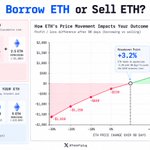
Borrowing against your ETH instead of selling sounds like a pretty good deal until you actually run the numbers.
Say you have $10K in ETH and need $5K in cash.
You can either sell half your ETH or borrow $5K USDC against the entire position.
Borrowing lets you keep all your ETH exposure, which sounds great if you’re bullish. But you’re also paying interest to stay exposed, and that changes the trade considerably.
Aave’s USDC borrow rate on Ethereum was 12.86% on October 19, down from 14.10% four days earlier. Meanwhile, a separate ETH-backed Morpho market was quoted around 5% on October 17.
At 12.86%, borrowing $5K for 90 days costs roughly $159 in interest, assuming the rate stays constant.
Now assume you have another $5K available after those 90 days to either repay the loan or buy back ETH.
Here’s how borrowing compares with selling:
➤ ETH drops 30%: Borrowing leaves you $1,659 worse off.
➤ ETH drops 10%: You’re $659 worse off.
➤ ETH stays flat: You’re still $159 worse off.
➤ ETH rises 10%: Borrowing puts you $341 ahead.
➤ ETH rises 30%: You’re $1,341 ahead.
So ETH needs to appreciate roughly 3.2% over those 90 days just to cover the borrowing cost.
And that’s before taxes, transaction costs, or changes in interest rates.
But there’s a bigger problem with this trade.
You’re borrowing $5K against $10K in collateral, meaning you’re starting at 50% LTV.
If ETH sells off hard enough, your position can get liquidated before the market recovers. Someone who sold half their ETH doesn’t have that problem.
That’s what makes borrowing against crypto different from simply holding it.
You’re effectively paying to maintain additional ETH exposure while introducing a price level where your lender can force you out of the position.
If ETH rallies, keeping that exposure can work out nicely. If ETH chops sideways, you’re paying interest for nothing. And if ETH dumps, you can lose more than someone who just sold.
Think a lot of people underestimate this when they talk about borrowing against their crypto instead of selling.
Keeping your ETH isn’t automatically the better trade. Sometimes you’re just paying 13% annualized to avoid making a sale.
THEDEFIPLUG retweeted

1|7 As a quantum project, you're either building in one of these categories:
• quantum chain (L1/L2)
• privacy going post-quantum
• quantum as plug-in
• wallet/ security infra
• quantum computing
Or you're just simply quantum branded.
I've curated the top quantum coins that are worth watching this cycle👇


Quantum Tier List (2026)
Everyone says their chain is quantum ready but only a few can prove it.
👇 I ranked 34 "quantum" projects including the 28 on @Mars_DeFi's list based on
• quantum safety
• upgradability
• testnet/mainnet
• age + size
• privacy feature
S
.@QRLedger - every wallet has used XMSS feature, a hash-based signature quantum computers can't crack, it has been live since 2018, with multiple audits.
A
.@QuantusNetwork - uses quantum-safe ML-DSA signatures by default, but mainnet only launched this September.
.Abelian - quantum-safe lattice signatures since 2022, but its own custom design haa no public crypto audit.
.@tidecoin - uses Falcon, a quantum-safe signature, on every transaction since 2020, but it's a tiny network.
.@cellframenet wallets use Dilithium, a quantum-safe signature, by default, but adoption is small.
.@QoreChain - every transaction needs a quantum-safe ML-DSA signature, but mainnet only went live in June this year.
.@NeptunePrivacy - spending uses hash-based proofs, but it's a young chain.
.@NEARProtocol - quantum-safe ML-DSA keys are live since Jul 2026, and you can switch your account to them anytime.
.@Algorand - quantum-safe Falcon accounts are live since Aug 2026, and you can move an existing wallet over.
B
.@Starknet - its proofs are quantum-safe, but your wallet keys aren't yet, and the safe wallet is just a demo.
.@solana - an outside team built a quantum-safe vault you can opt into, the chain itself isn't quantum safe.
.@NervosNetwork - an optional quantum-safe lock exists, but you have to move funds into it.
.@trondao - quantum-safe Falcon and ML-DSA keys are being tested on its testnet.
.@tezos - testing quantum-safe ML-DSA accounts on a special testnet.
.@QANplatform - is integrating quantum-safe Dilithium signatures, but still on testnet only.
.@quipnetwork - building earky stage quantum-safe accounts for coins on other chains, still on testnet.
.@Aptos - its quantum-safe SLH-DSA accounts are coded but still waiting for a governance vote to switch it on.
.@SuiNetwork - made its first quantum-safe transaction on a dev network this month, and mainnet is targeted for 2027.
.@Tensorcash - you can create quantum-safe ML-DSA addresses, but it's a small, new network.
.Bitcoin BIP-360, a proposal for quantum-safe addresses, is still a draft
C
.@ethereum - still researching quantum-safe upgrades, most likely years away.
.@zksync - its proofs are quantum-safe, but user accounts aren't.
.@Zcash - plans for quantum-safe signatures, but nothing shipped yet.
.Qoneqt - claims a quantum-safe vault, but can't verify anything yet.
.@injective - said last week it started building toward a quantum future, but no details yet.
.@monad - quantum-safe keys are still on their roadmap.
.@aztecnetwork no quantum plan or anything substantial published yet but Mars included it in his list
.@mindnetwork_xyz - focuses on encryption, not quantum-safe signatures but seems they frame that as quantum
.@NexusMutual - security-focused imo, no quantum plan
.@Qubic - quantum-themed only, maybe to join the hype, but little real quantum-safe tech.
.@GeeqOfficial - only security claims, no quantum details
.AME Chain - claims to be quantum-secure, little public proof
.QuStream - quantum claims, little public detail
Bottom line:
Most of crypto still runs on keys a quantum computer could break. Only one project here clears every bar today and that's @QRLedger.
But there's room for growth and tech like this would take years to perfect👌

THEDEFIPLUG retweeted
Tokenized stocks are starting to reveal a pretty big gap between how many assets a platform lists and how much capital it actually attracts.
Everyone’s focused on how many assets are being brought onchain, but the capital distribution tells a different story.
The numbers make that pretty clear:
➤ @bstocksfinance: $1.2B across 95 assets
➤ @Ondo: $875M across 408 assets
➤ @xStocksFi: $582M across 1,458 assets
So bStocks has roughly 2x the asset value of xStocks with 15x fewer listings.
That’s a pretty significant difference.
I think people underestimate how much of tokenization is actually a distribution problem.
Putting 1,000 stocks onchain is one thing. Getting people to hold them, making those products accessible, and building the infrastructure around them is something else entirely.
And there’s a distinction between having more assets available and having more capital allocated to those assets.
Obviously these platforms have different issuance structures, so asset value alone doesn’t tell us who’s generating more trading activity or has better liquidity.
But I think the broader point stands.
We’ve spent years talking about how everything will eventually be tokenized.
The real question now is who actually captures the capital once that happens.

THEDEFIPLUG retweeted

Top DeFi news to pay attention to this week 🧠
1. @aeroxyz unifies Aerodrome and Velodrome on Oct 22. Aero launches across Base, Ethereum, OP Mainnet, Arc, Ink, Robinhood Chain and Arbitrum. AERO converts 1:1; VELO at roughly 0.044 AERO.
2. @fablesfi TGE on Oct 20, the Robinhood Chain DEX launches $FABLES with ve(3,3) voting, staking and emissions. Airdrop claims open at TGE.
3. @fhenix's confidential computing launches on mainnet on Oct 21.
4. @Kinetiq_xyz's Elysium approaches mainnet. The Hyperliquid L2 targets Oct 20, subject to the governance outcome. It settles to HyperEVM and uses HYPE for gas.
5. @Lighter_xyz is expanding beyond perps with an upcoming options product. Investor Q3 call is on Oct 21.
6. @infiniFi unveils $INFI. Tokenomics are out, with 45% allocated to the ecosystem, including a community airdrop. TGE is coming soon.
7. @StandX_Official cancelled its token launch and will distribute DUSD instead. Trading switches to reduce-only on Oct 20. Allocation checker: Oct 26. Claims: Nov 1, with no lockup.
8. @jumperapp opens a trading campaign this week for 2,500 waitlist traders and the top 2,500 Jumper Pass users. $JUMP incentives and up to $232K USDC in weekly rewards.
9. @Starknet voting on whether to research becoming an independent, post-quantum L1 ends on Oct 22.
10. @osmosis's proposal to stop new $OSMO issuance and fund staking rewards from protocol revenue opens for voting on Oct 20. At the current burn rate, roughly 2% of supply would burn annually without new minting to offset it.

Tokenized stocks are starting to reveal a pretty big gap between how many assets a platform lists and how much capital it actually attracts.
Everyone’s focused on how many assets are being brought onchain, but the capital distribution tells a different story.
The numbers make that pretty clear:
➤ @bstocksfinance: $1.2B across 95 assets
➤ @Ondo: $875M across 408 assets
➤ @xStocksFi: $582M across 1,458 assets
So bStocks has roughly 2x the asset value of xStocks with 15x fewer listings.
That’s a pretty significant difference.
I think people underestimate how much of tokenization is actually a distribution problem.
Putting 1,000 stocks onchain is one thing. Getting people to hold them, making those products accessible, and building the infrastructure around them is something else entirely.
And there’s a distinction between having more assets available and having more capital allocated to those assets.
Obviously these platforms have different issuance structures, so asset value alone doesn’t tell us who’s generating more trading activity or has better liquidity.
But I think the broader point stands.
We’ve spent years talking about how everything will eventually be tokenized.
The real question now is who actually captures the capital once that happens.
THEDEFIPLUG retweeted
Think one of the bigger developments for onchain trading is that institutions might end up using these markets without ever touching the actual exchange.
Ripple Prime now offers institutional RWA swaps referencing Tradexyz perpetual futures on Hyperliquid.
That’s 100+ markets covering equities, ETFs, metals, energy and FX.
Virtu is already among the clients using the product.
But I don’t think the number of markets is the biggest part of this.
It’s how the distribution works.
Institutions aren’t necessarily going directly to Hyperliquid.
They’re dealing with Ripple Prime, which acts as principal, while the underlying exposure references contracts listed on Hyperliquid.
So you effectively have:
➤ @Ripple Prime: Institutional relationships, access and brokerage infrastructure.
➤ @tradexyz: Perpetual futures markets on Hyperliquid.
➤ @HyperliquidX: The underlying onchain trading venue.
And I think this is a much more realistic route to institutional adoption than expecting traditional funds to suddenly start connecting wallets.
These firms already have prime brokers.
They already have collateral arrangements, counterparty relationships and trading workflows.
There’s little reason to rebuild all of that when an existing intermediary can provide access.
The distribution already exists. Onchain markets are being plugged into it.
Now, there’s an important distinction.
An institution taking $100M in swap exposure through Ripple Prime doesn’t automatically create $100M in Hyperliquid volume.
Actual exchange activity depends on how Ripple Prime manages and hedges that exposure.
So I’d separate three things:
➤ Institutional exposure referencing Hyperliquid markets.
➤ Actual trading and hedging volume reaching the venue.
➤ Fees Hyperliquid captures from that activity.
Those numbers won’t necessarily move together.
But the broader opportunity is pretty clear.
If more prime brokers start offering products around onchain derivatives, Hyperliquid gets access to institutional distribution without needing to acquire every customer directly.
And that changes the competitive dynamic.
Instead of competing only for traders, onchain exchanges can compete to become the markets financial intermediaries build products around.
Hyperliquid doesn’t need every institution to become its customer. It needs its markets to become part of the infrastructure institutions already use.

THEDEFIPLUG retweeted
Quantum Tier List (2026)
Everyone says their chain is quantum ready but only a few can prove it.
👇 I ranked 34 "quantum" projects including the 28 on @Mars_DeFi's list based on
• quantum safety
• upgradability
• testnet/mainnet
• age + size
• privacy feature
S
.@QRLedger - every wallet has used XMSS feature, a hash-based signature quantum computers can't crack, it has been live since 2018, with multiple audits.
A
.@QuantusNetwork - uses quantum-safe ML-DSA signatures by default, but mainnet only launched this September.
.Abelian - quantum-safe lattice signatures since 2022, but its own custom design haa no public crypto audit.
.@tidecoin - uses Falcon, a quantum-safe signature, on every transaction since 2020, but it's a tiny network.
.@cellframenet wallets use Dilithium, a quantum-safe signature, by default, but adoption is small.
.@QoreChain - every transaction needs a quantum-safe ML-DSA signature, but mainnet only went live in June this year.
.@NeptunePrivacy - spending uses hash-based proofs, but it's a young chain.
.@NEARProtocol - quantum-safe ML-DSA keys are live since Jul 2026, and you can switch your account to them anytime.
.@Algorand - quantum-safe Falcon accounts are live since Aug 2026, and you can move an existing wallet over.
B
.@Starknet - its proofs are quantum-safe, but your wallet keys aren't yet, and the safe wallet is just a demo.
.@solana - an outside team built a quantum-safe vault you can opt into, the chain itself isn't quantum safe.
.@NervosNetwork - an optional quantum-safe lock exists, but you have to move funds into it.
.@trondao - quantum-safe Falcon and ML-DSA keys are being tested on its testnet.
.@tezos - testing quantum-safe ML-DSA accounts on a special testnet.
.@QANplatform - is integrating quantum-safe Dilithium signatures, but still on testnet only.
.@quipnetwork - building earky stage quantum-safe accounts for coins on other chains, still on testnet.
.@Aptos - its quantum-safe SLH-DSA accounts are coded but still waiting for a governance vote to switch it on.
.@SuiNetwork - made its first quantum-safe transaction on a dev network this month, and mainnet is targeted for 2027.
.@Tensorcash - you can create quantum-safe ML-DSA addresses, but it's a small, new network.
.Bitcoin BIP-360, a proposal for quantum-safe addresses, is still a draft
C
.@ethereum - still researching quantum-safe upgrades, most likely years away.
.@zksync - its proofs are quantum-safe, but user accounts aren't.
.@Zcash - plans for quantum-safe signatures, but nothing shipped yet.
.Qoneqt - claims a quantum-safe vault, but can't verify anything yet.
.@injective - said last week it started building toward a quantum future, but no details yet.
.@monad - quantum-safe keys are still on their roadmap.
.@aztecnetwork no quantum plan or anything substantial published yet but Mars included it in his list
.@mindnetwork_xyz - focuses on encryption, not quantum-safe signatures but seems they frame that as quantum
.@NexusMutual - security-focused imo, no quantum plan
.@Qubic - quantum-themed only, maybe to join the hype, but little real quantum-safe tech.
.@GeeqOfficial - only security claims, no quantum details
.AME Chain - claims to be quantum-secure, little public proof
.QuStream - quantum claims, little public detail
Bottom line:
Most of crypto still runs on keys a quantum computer could break. Only one project here clears every bar today and that's @QRLedger.
But there's room for growth and tech like this would take years to perfect👌
Free Crypto Transactions Tier List 2026
Ranked by real cost removed for users, repeatability, accessibility and networks covered.
Bookmark for later ↓↓
1| @OneKeyHQ - free transfers and in-wallet swaps on select tokens on Ethereum, Arbitrum, BNB Chain, Polygon, Base & Tron
➥ Up to 10 free trxns/day on any of the above chains and 1 trxn/day on Tron
2| @TokenPocket_TP - free token transfers on BNB, Polygon, Solana & Tron
➥ BNB; 2/day for USDT & unlimited for USD1, Polygon; 2/day for USDC, Solana; 3 SPL trsf/day (USDC, USDT, BONK, JUP except SOL)
3| OKX @wallet - free transfers on @XLayerOfficial for USDT & USDC only
4| @TrustWallet + @Backpack - free stablecoin transfers on @Plasma
5| @Stable - free USDT P2P transfers on @stablechain
6| @worldnetwork - free trxns on supported tokens @world_chain_ including stablecoins
7| @SuiNetwork - free P2P transfers on Sui
➥ Supported tokens are: USDC, USDsui, SuiUSDe, AUSD, FDUSD, USDB, USDY, with a minimum approx 0.01 token
8| @BitgetWallet - only first USDT transfer on Tron is free, later transfers are discounted
9| @fusewallet - Free sponsored transactions on Solana
➥ Free tier includes 5 trxns/month; further sponsorship requires Fuse+ subscription
10| @Rabby_io - 0% Rabby swap fee across 40+ chains
➥ Other fees like gas, dex fees and bridge fees may still apply.


Think one of the bigger developments for onchain trading is that institutions might end up using these markets without ever touching the actual exchange.
Ripple Prime now offers institutional RWA swaps referencing Tradexyz perpetual futures on Hyperliquid.
That’s 100+ markets covering equities, ETFs, metals, energy and FX.
Virtu is already among the clients using the product.
But I don’t think the number of markets is the biggest part of this.
It’s how the distribution works.
Institutions aren’t necessarily going directly to Hyperliquid.
They’re dealing with Ripple Prime, which acts as principal, while the underlying exposure references contracts listed on Hyperliquid.
So you effectively have:
➤ @Ripple Prime: Institutional relationships, access and brokerage infrastructure.
➤ @tradexyz: Perpetual futures markets on Hyperliquid.
➤ @HyperliquidX: The underlying onchain trading venue.
And I think this is a much more realistic route to institutional adoption than expecting traditional funds to suddenly start connecting wallets.
These firms already have prime brokers.
They already have collateral arrangements, counterparty relationships and trading workflows.
There’s little reason to rebuild all of that when an existing intermediary can provide access.
The distribution already exists. Onchain markets are being plugged into it.
Now, there’s an important distinction.
An institution taking $100M in swap exposure through Ripple Prime doesn’t automatically create $100M in Hyperliquid volume.
Actual exchange activity depends on how Ripple Prime manages and hedges that exposure.
So I’d separate three things:
➤ Institutional exposure referencing Hyperliquid markets.
➤ Actual trading and hedging volume reaching the venue.
➤ Fees Hyperliquid captures from that activity.
Those numbers won’t necessarily move together.
But the broader opportunity is pretty clear.
If more prime brokers start offering products around onchain derivatives, Hyperliquid gets access to institutional distribution without needing to acquire every customer directly.
And that changes the competitive dynamic.
Instead of competing only for traders, onchain exchanges can compete to become the markets financial intermediaries build products around.
Hyperliquid doesn’t need every institution to become its customer. It needs its markets to become part of the infrastructure institutions already use.
THEDEFIPLUG retweeted

Private money is only one use case.
@Starknet’s VP of Growth @thedamooo on what programmable privacy enables in the age of Zcash.