





Pinned Tweet
Six years ago, Threshold started with one mission: make Bitcoin a core DeFi Asset without relying on a centralized entity or the added risk of a single point of failure.
$5.2B in bridge volume later, Threshold cryptography has shown viability as a permissionless way to keep ownership of your Bitcoin while accessing Onchain finance through tBTC.
Here's how it works...
Quick Survey: Who holds the keys 🔑 to your Bitcoin?
67%Me (Self-custody)
14%Centralized Exchange
6%Third-party Custodian
14%Multisig Setup
36 votes • 4 daysWhy this matters, especially for institutions: threshold.network/blog/who-c…

tBTC’s switch from Threshold ECDSA to Schnorr keeps the 51-of-100 signer set unchanged, but opens the door for further expansion.
Institutional custodians can integrate tBTC to provide clients with access to Bitcoin Onchain Finance.
Threshold Co-Founder MacLane Wilkison explains how this works and what it means for institutional Bitcoin adoption in his discussion with @AleaResearch.
Bitcoin-backed lending reached $73.6 billion in 2025 and is projected to exceed $90 billion by the end of 2026.
Threshold’s Verifiable Bitcoin Accounts enable institutions to participate in onchain lending while maintaining Bitcoin in segregated, auditable accounts. Here's how: threshold.network/blog/movin…

Better processing time, same Bitcoin.
The tBTC bridge upgrade to Schnorr offers a leaner signing protocol, making minting and redemption faster than with the current ECDSA signatures.
Threshold Network ✜ retweeted

i was going to make a better worded announcement about this, but i feel quite compelled now to say that i am now working at @TheTNetwork to exactly move us from ECDSA to Schnorr in a matter of weeks, not months :)
look forward to a better announcement later.


Today I call upon the blockchain industry to calmly begin planning for "bunker mode". My personal recommendation is to set in motion a controlled mass migration of assets to fresh addresses, i.e. addresses whose pubkeys remain hidden behind a hash.
Holders, starting with large and sophisticated ones, should consider moving the bulk of their funds to addresses that have never signed a transaction. And when they do sign one, they should also move remaining funds to a new address (possibly generated from the same seed phrase).
Don't rush. While I believe there is cause for action a rushed migration would do more harm than good. Don't panic either. Moving assets to protected addresses is a simple, preventative step which does not require new cryptography or new wallets.
IMO it is now reasonable to brace for the possibility that ECDSA breaks before qday, in the worst case in months not years. By "break" I mean fast private key recovery (e.g. in one week) on available hardware (e.g. a large GPU cluster).
Recent days have been humbling for human mathematical intuition. Long-held, unquestioned hypotheses have fallen. This includes the n log(n) bound for integer multiplication and the 3SUM conjecture. In hindsight, May's unexpected disproof of the Erdős unit distance conjecture was our warning shot.
Yesterday's OpenAI drop made it clear that mathematical superintelligence is upon us. They say there are weeks where decades happen. We are about to live through weeks where centuries of mathematical progress happen. Could our magic 64-byte ECDSA signatures be too good to be true? Was it just security through obscurity all this time?
Elliptic curves feel especially vulnerable to superintelligence. Curves carry rich structure, with room for fancy tricks like Schoof, Frobenius, pairings. (By contrast, hashes are designed to minimise algebraic structure.)
Separately, as Ewin Tang can attest, an efficient quantum algorithm sometimes foreshadows an efficient classical one. We should be open to the possibility of a classical counterpart to Shor that breaks elliptic curves and RSA at once.
Also noteworthy is the striking under-representation of cryptographic breakthroughs among the 722 mathematical results OpenAI published. I've witnessed first-hand the US government censoring academic quantum cryptanalysis results. Backroom interventionism is my base case.
I urge large, sophisticated actors to lead by example. Project11's "risq list" (bitcoin-risq-list.projecteleven[.]com) is a great tracker of exposed BTC pubkeys. Binance, Bitbank, Robinhood, Bitfinex, and Tether have an opportunity to harden their cold storage. Next month I'll address institutions in London in a live Q&A (forum.ethereuminstitutional[.]org/london-2026).
Again, please do not rush. Wallets holding under 50 BTC enjoy partial cover from "Satoshi's shield", i.e. his 20K exposed addresses that hold 50 BTC each. Load-bearing signers like oracles and L2 security councils should consider rotating ECDSA pubkeys with every signed message and/or multi-signing with a hash-based schemes like SPHINCS.
Exiting bunker mode safely will require post-AI cryptography. My inclination is to go all-in on hash-based cryptography and avoid structured mathematical assumptions entirely, whether from curves, lattices, or isogenies. A single battle-tested hash (e.g. from the SHA or BLAKE families) yields plausible post-AI security.
The Ethereum roadmap on strawmap[.]org fully embraces hash-based cryptography with end-to-end formal verification as a response to the quantum threat. Those timelines must now be revisited and accelerated in light of mathematical superintelligence. I'll be pushing for maximum defensive acceleration.
$144M of tBTC backing loans on @Aave 🤝

tBTC's Q4 roadmap is focused on migration from ECDSA signing to FROST Schnorr. This update aims to tighten security, minimize bridge latency, and improve mint & redemption processing times.
Here's a quick summary of the upcoming updates:
FROST verifies each signature share individually, so a faulty signer is identified immediately. Signing drops to two rounds and stays fast as the signer set grows.
For more technical specifications, visit docs.threshold.network

ALT Last post from thread | Threshold Network
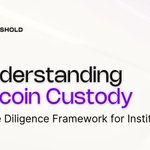
A six-category diligence framework helps institutions understand how Bitcoin custody works with Threshold (and tBTC). This becomes increasingly important as Bitcoin moves deeper into institutional financial structures. Read it here: threshold.network/blog/who-c…

ALT Understanding Bitcoin Custody | Threshold Network
The latest technical diagram for VBA V1:
docs.threshold.network/verif…

ALT Last post from this thread | Threshold Network
Another quarter closes, and positions hold.
Access liquidity at up to 73% LTV with Bitcoin as collateral.

Stay liquid without selling your Bitcoin.
Borrow against your BTC at 4%* in USD or 2.5%* in EUR to cover expenses, meet obligations, or access capital while keeping your Bitcoin safe.
Explore Bitcoin-backed credit with tBTC @tBTC_project

Bitcoin just broke through the $82k resistance level, whilst still down roughly 35% from its October 2025 peak.
$BTC buys since August have come almost entirely from funds, with US spot Bitcoin ETFs taking in $3.52B and assets under management reaching $101.3B by September 12. That fund-led return after a cautious first half is the signature institutions watch for, rather than retail-driven moves.

