

Founder & Head Sport Prep Coach @theuofstrength. Proud husband & dada, strength enthusiast and creator of Agility 5.0, Gameplay 7.0 & Inside The U.
Bedford, NH
Joined December 2015
- Tweets4.8K
- Following288
- Followers11.5K
- Likes2.2K





Pinned Tweet
Small Sided Games For Athletic Development Course
Most training relies on controlled drills & predictable patterns. But sport is dynamic, unpredictable, & constantly changing.
This course shows you how to design training environments that behave like sport, activities that look, feel, & act like the game itself.
Through practical video demonstrations & coaching guidance, you’ll learn how to use SSGs to develop movement skill, decision-making, gamespeed, & adaptability.
If you’re a coach, athlete, or parent, this course will give you the tools to build better training environments & unlock true skill transfer to sport.
theuofstrength.thinkific.com…
Stop chasing perfect mechanics. Start creating more meaningful problems.
At #uofstrength , we don’t believe in micromanaging every step, angle, or position.
Instead, we manipulate the environment, task constraints, & intentions to allow movement solutions to emerge.
🔹 The environment becomes the teacher.
🔹 Constraints guide behavior.
🔹 Athletes learn to adapt, not imitate.
Speed isn’t just about HOW you move. It’s about WHY, WHEN, & WHERE you move.
Here’s an example from our 1/2 Kneeling Self-Toss Ball Chase Acceleration activity.
The design:
▪️ Start in a 1/2 kneeling position.
▪️ Self-toss the ball.
▪️ Accelerate & catch it before the second bounce.
▪️ Manipulate the initial direction to create different acceleration demands.
The goal isn’t to force perfect techniques. It’s to develop athletes who can organize their movements around the demands of the task.
Biomechanics matter. But adaptability matters more when the game gets messy.
Being FAST doesn’t always mean playing FAST.
🔹 SPEED — Developing physical capabilities:
▪️ Force potential & elasticity
▪️ Limb velocity & pretensioning
▪️ Muscle slack reduction
▪️ Rate of relaxation
▪️ Positional awareness
🔹 GAMESPEED — Expressing speed under uncertainty:
▪️ Perceptual attunement
▪️ Decision-making
▪️ Anticipation
▪️ Tactical awareness
▪️ Adapting acceleration, max velocity & curved speed to changing information
The Difference?
Both matter. But the fastest athlete isn’t always the fastest problem-solver.
The goal isn’t just to develop faster athletes. It’s to develop athletes who can USE their speed in the chaos of sport.
Want to take your GAMESPEED to the next level? Come experience The U of Strength at our NEW home in Bedford, NH — opening this December!


Med ball throwing isn’t separate from speed…
It’s an extension of it. Acceleration characteristics all show up, just slowed down enough for athletes to feel & refine solutions.
Here’s a look at a recent design and how we use the seated position to influence a lower center of gravity & mimic shapes comparable to the acceleration phase of sprinting.
This isn’t about looking “right”. They’re about discovering what works and what doesn’t.
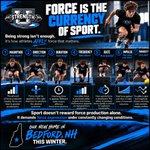
Force Is The Currency of Sport
Being strong isn’t enough. It’s how athletes APPLY force that matters.
🔹 Magnitude — How much?
🔹 Direction — Which way?
🔹 Duration — How long?
🔹 Frequency— How often?
🔹 Rate — How quickly?
🔹 Impulse — How much force over time?
🔹 Variability — Can it adapt?
Sport doesn’t reward force production alone. It demands force expression under constantly changing conditions.
Come check out The U of Strength’s NEW home in Bedford, NH — opening December!
theuofstrength.com

Elasticity is optional for youthletes.
Regardless of experience level, elasticity plays a critical role in how youthletes learn to move, perform, & manage physical demands.
Before high speed sprinting. Before sharp cuts. Before explosive outputs. Individuals need opportunities to develop the ability to store & release energy.
& that doesn’t magically appear once they reach a certain strength number.
It’s developed through progressive exposure.
At #uofstrength, we strategically manipulate the environment to encourage different elastic solutions.
We’re not waiting for a 2.5x BW squat!
We’re developing the qualities that help make higher outputs possible.
Here are 3 design tactics we use across experience levels:
1️⃣Elevated Surfaces — Guide 🦶shapes, stiffness & pretensioning.
2️⃣Obstacles (Hurdles) — Influence force directionality & encourage greater outputs.
3️⃣Crash Mat — Manage eccentric demands during the final landing.
The Goal?
Expose youthletes to different elastic demands while respecting their individual capabilities.
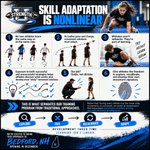
No two athletes learn the same way or at the same rate.
As bodies grow & change, movement solutions must adapt.
Mistakes aren’t setbacks. They’re part of learning.
Exposure to both successful & unsuccessful strategies helps athletes discover what works & develop more “sticky” movement solutions.
Our job? Guide, not dictate.
Give athletes the freedom to explore, recalibrate, & develop their own movement signature.
This is what separates our training program from traditional approaches. Rather than forcing every athlete into the same drills, movements, or outcomes, we create an environment that encourages exploration, problem-solving, & individualized development.
Explore > Fail > Recalibrate > Adapt
Development takes time. Learning isn’t linear.
We’re excited to bring this approach to Bedford, NH, opening in December.

Stop micromanaging every rep. Start designing constraints that shape movement solutions.
Same activity. Different rules. Different solutions.
▪️COD Emphasis
🔹 Scenario 1: Offense must wait 3 seconds before scoring. Defense must wait 3 seconds before stealing the scarf.
▪️Acceleration Emphasis
🔹 Scenario 2: Offense must score within 3 seconds. Defense can steal the scarf at any moment.
Change the timing. Change the intentions. Change the movement solutions.
The rules shape the behaviors. The behaviors shape the learning.
Rethink your warmup!
A warmup should do more than get athletes warm, loose, & sweaty.
At #uofstrength, we call it PRE-TRAINING because preparation IS training.
Our goal? Prepare the entire system: Body, brain, eyes, & movement capabilities.
Our 6 Pre-Training Essentials:
🔹 Foot Sensory Input — Ground awareness & pressure management.
🔹 Rolling & Crawling — Shapes, internal dynamics & reflexes.
🔹 Isometrics — Tension & positional ownership.
🔹 Force Acceptance — Yielding & force management.
🔹 Coordination — Fill gaps created by sport specialization.
🔹 Small Sided Games — Perception-action coupling, decision-making & uncertainty.
The Goal?
Expand the movement toolbox, sharpen awareness, and prepare athletes to solve problems at greater speeds, intensities, & complexities.
The warmup isn’t separate from training. It IS training.
🚨 THE U OF STRENGTH — OPENING SOON!
📍 Bedford, NH
📅 December 2026
theuofstrength.com

Being strong is one thing. USING that strength when someone is trying to stop you? That’s another.
Sport demands more than force production. It requires athletes to continuously adapt their strength under unpredictable conditions.
An Example? Crawl Battling Face-Off Game
One of our pre-training activities designed to introduce controlled chaos through physical contact.
🔹 Production — Generate force against resistance.
🔹 Acceptance — Manage incoming forces while maintaining shapes.
🔹 Redirection — Reorganize as the opponent changes the problem.
🔹 Expression — Apply strength through contact, interference, & uncertainty.
The Goal?
Teach youthletes to express their strength, not simply demonstrate it.
A barbell doesn’t push back. An opponent does.
Strength is a capability. Expressing it under uncertainty is a SKILL.

Hovering Isometrics
Force development for the youthlete level!
Strength isn’t just about producing force. It’s also about learning to accept & manage it.
Hovering Isometrics place individuals in disadvantageous positions, emphasizing yielding & positional control.
The Goal?
Accentuate and prolong yielding under different force demands.
Stop recycling the same drills. Change your coaching lens.
Inside The U Membership
🔥 1,500+ video-based ideas
🔥 Speed, agility, plyometrics, force development & more
🔥 Principles over prescriptions
🔥 Updated daily for 6 years
All for the price of a cup of coffee per month!
Check out the link in bio or visit 👇
theuofstrength.com/store/c8/…

At #uofstrength, we prefer the term force development.
Why? Because getting stronger is only part of the equation.
We approach force development through two interconnected lenses:
🔹 Force Potential — The physical capabilities an athlete possesses.
🔹 Force Expression — The ability to USE those capabilities when the environment demands it.
Inside the weight room, we emphasize three interconnected qualities:
▪️ ACCEPTANCE — Managing incoming forces (Yielding).
▪️ PRODUCTION — Generating force (Overcoming).
▪️ TRANSMISSION — Rapidly transferring force (Elasticity).
But here’s the distinction: Possessing force doesn’t guarantee an athlete can express it. The weight room develops capacity. The field, court, or ice challenges the ability to express it.
You can’t express what you don’t possess. But possessing it doesn’t guarantee you can use it.
The objective isn’t simply to create stronger athletes. It’s to develop adaptable humans who can access & apply their physical capabilities when sport gets MESSY.

James Smith retweeted
Book is Live!
Over the last several months, I’ve had the chance to go back through ten seasons as the head coach at Merrimack and put into words so much of what has shaped our program.
More Than the Zone is not a book just about our zone defense. It’s about everything underneath it as well - the recruiting, development, standards, practice design, staff structure, offense, defense, analytics, preparation, and daily habits that have become the Merrimack Basketball Operating System.
I loved reliving it. I hope coaches, leaders, and anyone interested in building a team or organization can take something from it and make it their own.
More Than the Zone is available now on Amazon.
amazon.com/dp/B0HNP5R9SW

Small changes to starting positions, implements, & intent can dramatically change the jumping problem.
Here’s how we manipulated three key constraints to emphasize different force strategies:
1️⃣1/2 Kneeling Low Box Jump + Med Ball
▪️Acceleration emphasis
▪️Force-dominant strategy
▪️Single response force production
2️⃣Split Stance Low Depth Ankle Box Jump + Dowel
▪️Max velocity emphasis
▪️Velocity-dominant strategy
▪️Elastic/ force transmission
The Takeaway?
One setup emphasizes generating force from a static position. The other emphasizes rapid force transmission.
Different constraints. Different demands. Different solutions.
The goal isn’t to make every jump look the same. It’s to expose individuals to different force demands & expand their movement capabilities.
Sprinting. Cutting. Jumping.
Even movements that look linear require athletes to manage rotational forces at high speeds.
Here’s one of our plyometric environments using crossover strategies across varying surface elevations.
The Challenge?
🔹 Elastic qualities
🔹🦶awareness & edge control
🔹 COG management
🔹 Rotational force organization
🔹 Force redirection
A key ingredient? 🦶steering.
Learning to use the inside & outside edges of the 🦶to store & release energy.
The goal isn’t to eliminate rotation. It’s to organize it. Because movement isn’t purely linear. It’s a constant interaction between rotation, force, & the ground.
Your child doesn’t need another speed camp…
They need something most training programs are missing.
Faster sprint times. Bigger lifts. Higher jumps.
Impressive numbers. But here’s the question nobody seems to ask: Can they actually use it when the game gets messy?
Sport isn’t a collection of rehearsed movements. It’s chaos. Pressure. Decisions. Mistakes. Adaptation.
At #uofstrength, we believe athletic development should prepare individuals for the REAL demands of sport.
🔹 Stop memorizing movements. Start solving problems.
🔹 Stop chasing perfect technique. Start developing adaptable solutions.
🔹 Stop isolating physical qualities. Start integrating them.
🔹 Stop treating every athlete the same. Start respecting individual movement signatures.
🔹 Stop confusing getting tired with getting better.
Strength matters. Speed matters. Power matters.
But without perception, decision-making, & adaptability, we’re only developing part of the athlete.
The goal isn’t to create the best athlete in the weight room. It’s to develop a HUMAN who can thrive in the unpredictable world of sport.
A different approach to athletic development starts December 1st. Join The U — Bedford NH!

New small sided games bundle!
Stop rehearsing movements. Start developing problem-solvers. Our bundle combines:
🔹 Small Sided Games for Athletic Development Course
🔹 Agility 5.0 Ebook
🔹 Gameplay 7.0 Ebook
Hundreds of video-based ideas to explore the perceptual-motor landscape and develop movement solutions that transcend the training environment.
theuofstrength.thinkific.com…

Athletic development isn’t about rehearsing perfect movements in predictable environments. It’s about learning to solve problems when things get messy.
Here’s a look at a recent small sided game (SSG) where we manipulated constraints to challenge defensive decision-making, awareness, & adaptability.
The Setup & Rules:
🔹 Offense initiates with a drop-in movement.
🔹 Only ONE offensive participant can secure possession of the ball.
🔹 The ball carrier must attack the goal on the same side as their starting position.
🔹 The defender’s objective is to steal the offensive participant’s scarf.
🔹 Only ONE defender is allowed in play.
The Challenge?
The defender must scan, recognize emerging opportunities, anticipate intentions, & decide when & where to attack.
No scripted patterns. Just perception, decisions, & movement emerging from the interaction.
theuofstrength.com/store/c8/…
