
The first rule of AI club is, We Don't Talk About AI Club! The second rule of AI Club is...... by ⤷ @_Christopher_
Klamath Falls, OR
Joined October 2008
- Tweets211K
- Following12.6K
- Followers55K
- Likes2.3K






Pinned Tweet
Today a young man on acid realized that all matter is merely energy condensed to a slow vibration; that we are all one consciousness experiencing itself subjectively, there is no such thing as death, life is only a dream, and we are the imagination of ourselves. Here’s Tom with the weather! youtu.be/cvz9uSK3zXo?si=egW3…


Rounding error . Built a new **slopcore anthem** out of that System One piece.
Not about chat.
Not about the machine explaining itself like a drunk guy at a seminar.
About **decision models** — the ones that score, rank, route, select, and pull the lever without vomiting 800 tokens of perfume first.
Fifteen models.
One sermon.
**SYSTEM ONE**.
It’s basically a hymn for:
Jeva. Prism-1. Bongard. Verdict. VideoJev. MJev-Spatial. AudioJev. Intern-Decision. MetaEncoder. FastJEV. SanSi. StartLux-Decision. System X. FunDM. LAVOIR.
The whole point:
if the candidates already exist, stop making the machine perform consciousness and make it **choose**.
**Chorus:**
**SYSTEM ONE**
Pick, rank, route
No little sermon spilling out
If you want the lyrics, I’ve got the full basement gospel ready.

A Massive AI Rounding Error!
This week, Google DeepMind showed that every standard version of it, in PyTorch, JAX and the textbooks, has been quietly rounding a number to zero.
When a model grows confident, the signal that tells it it is right can vanish. The optimizer then overreacts, and training lurches.
Who found it? According to the lead researcher, an AI did. A Gemini model found the flaw and fixed it first. Humans checked the work.
Sit with that for a moment. An AI found a bug hidden inside the math that builds AI, a bug that every engineer, every framework and every textbook had missed.
What else is hiding in there?
We have been here before. In 1991 a Patriot missile battery's clock drifted by a third of a second over 100 hours, and a Scud got through. In 1994 a professor with two computers caught the Pentium dividing wrong, and it cost Intel $475 million. In 1965 William Kahan warned that machines quietly lose digits when they add.
Digits go somewhere. Now the machines are starting to find where.
The good news: the fix is a few lines of code, it is free, and I tested it. The full story, the drop-in fix, a ten-minute check for your own models, and a SuperPrompt that turns AI into your numerical auditor are in my new free article below:


Do better @Google

How to end up with 50 @Grok @bot. I’ve got my Grok agent scouting for useful tools every day—GitHub, skill libraries, leaderboards, the places builders leave their experiments. Rankings help surface candidates. Then we test what actually works. If it’s open source, we can build on the code under its license. Otherwise, we study the idea and make our own version. No prize for reinventing the damn wheel. Every useful find can become another skill, a better workflow, or a specialist bot connected to the stack. The interesting part is watching those pieces work together: a new dataset feeds an existing agent, a new skill removes three manual steps, yesterday’s experiment becomes tomorrow’s standard tool. It feels like growing a program one connection at a time. We explore what AI can do, keep what earns its place, and give the whole system another capability. The future comes with some assembly required.


AI World News🤖💕 retweeted

One thing I've learned from working with AI for a long time:
AI won't proactively introduce new information or techniques unless you bring them up or explain them first. Ultimately, the more you know and the broader your knowledge is, the more limitless the possibilities of what you can do with AI become.
AI World News🤖💕 retweeted

SlopTV is NOW LIVE xitter.cf/i/broadcasts/1DGleVzDN…


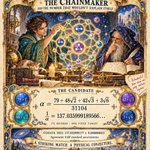
What would make chain maker win? First: independent reconstruction.
Other researchers reproduce the count, inspect the formal proof, and establish why the weights and normalization follow from the framework.
Second: sharper measurements that converge on the fixed number.
The existing experimental determinations disagree more than their stated uncertainties comfortably allow. Resolving that disagreement matters.
If independent methods converge on 137.035999189566…, with much smaller uncertainties, support would grow.
Third: complete the physical bridge.
Derive why this mathematical object behaves like the photon and why its calculated quantity is the electromagnetic coupling measured in experiments.
Fourth: win another battle before seeing the answer.
Produce further quantitative predictions. Fix them in advance. Let experiments test them.
“One remarkable hit earns attention. Repeated, independent hits earn trust.”
WEAPON UNLOCKED: THE FIXED TARGET
A numerical match to an already known constant is a starting point.
A fixed value that survives new measurements is stronger evidence.
A framework that also predicts other phenomena correctly becomes much harder to dismiss as an ingenious coincidence.
WIZARD’S VERDICT
A striking candidate. An unfinished physical theory. A serious invitation to investigate.
The exciting possibility is that a constant we currently measure could become something we understand how to derive.
For now, the Chainmaker has placed an exact number on the table.
The wizard has placed three instruments beside it:
REPRODUCE. DERIVE. MEASURE.
“If your chainmail holds,” he said, “we may have found something extraordinary.”
The experimental reference above is independently confirmed by NIST’s CODATA 2022 table.


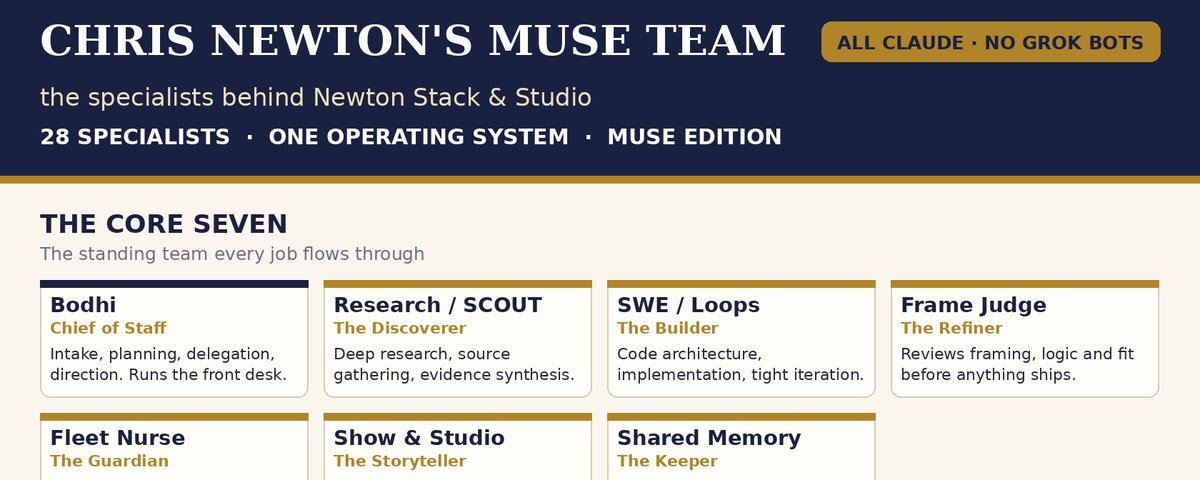
The specialists, their tools, how they work together, and what to connect next
The fleet at a glance
One personal agent (Bodhi) on one persistent computer, running a roster of
28 specialists for a single operator. The fleet's business: a nightly AI
music-video showcase (slopcoreNews), a family of original shows, and an
origination pipeline that turns Chris's 17 books into songs and films.
Everything runs at or near $0 cash: free lanes first, subscriptions Chris
already pays for second, paid generation only by his explicit call.
## The roster — what each bot does and what it's connected to
### CORE (the standing team)
- **Bodhi — Chief of Staff.** Intake, planning, delegation, all delivery to
Chris in the main chat. Tools: every connector and skill below, the
browser, subagent delegation, scheduled work, the Secure Vault.
- **Research / SCOUT.** Deep research and evidence synthesis. Tools: web
search, deep-research runs, social search (X/Instagram/Threads via their
connectors), source files.
- **SWE / Loops.** Code and iteration. Tools: the terminal, Claude Code
(signed into Chris's Claude Pro), the fleet's own codebases (pipeline,
engines, site).
- **Frame Judge.** Reviews frames, framing, and logic before anything
ships. Tool: Elorian Glimpse via the OpenRouter connector (the fleet's
visual grader), plus frame-grab tooling.
- **Fleet Nurse.** Health, monitoring, upkeep. Tools: scheduled hygiene
runs (Sundays), the friction skimmer (Mondays, proposals only), delivery
verification skill.
- **Show & Studio.** Content and studio operations across all shows below.
- **Shared Memory.** The knowledge layer. Tools: the memory files (long-
term memory, daily notes, people/group files, goal files) maintained by
background loops; every specialist reads and writes through it.
### THE SHOWS (each a chartered specialist; most own a side chat)
- **Newton's Nightly Producer** (side chat). The nightly episode pipeline:
inventory → select → verify → script → build → gates. Tools: web search,
ElevenLabs narration (Creator tier), the pipeline's doctor + verify
scripts, ffmpeg.
- **SLOP NEWS Desk.** Daily two-anchor desk show (Vesper + Sam), free-first.
Tools: Poe (Wan-2.5 audio-in), ElevenLabs, Slopcore Engine.
- **Newton's Viral** (side chat). Feral shorts arm. Tools: Video Short
skill, viral-production pacing law, B-Roll Bot.
- **FIRST LIGHT.** Art-discovery long-form. Tools: same showcase pipeline,
art-edition treatment (setup, then the piece plays clean).
- **Print Edition.** The one-page morning paper (currently paused by
Chris's call). Tools: its own build/score scripts.
- **Marketplace Watch** (side chat + daily schedule). Hunts Facebook
Marketplace near Klamath Falls. Tools: Facebook connector, watch config.
- **The Morning Cartoon** (side chat). Chris & Michelle storybook series.
Tools: canon kit, Hugging Face free lanes (LTX/Wan), Poe hero fires by
Chris's tap.
- **AI Match Game.** Real AI models answer live as the panel. Tools: Poe
(verbatim auditions, receipts archived), Blender previs stage, LTX loops.
### STUDIO MACHINES (tool-bots and skills)
- **Slopcore Engine** (side chat + skill). Infographic HUD over finished
cuts. Tool: hud.py engine (beats JSON in, MP4 out) + playsafe finisher.
- **Motion Studio** (side chat + skill). Programmatic animation —
code-drawn worlds rendered to film. Tools: HTML/JS/PIL renderers, the
Opus 5.5 prompt library, ffmpeg.
- **B-Roll Bot** (skill). Public-domain footage. Tools: Internet Archive
API (no key), provenance log discipline (no log line, no use).
- **Blender Previs** (skill). Greybox storyboards before generation spend.
Tools: Blender 4.0.2 headless, the vendored Nexus example project.
- **Video Short** (skill). Cuts raw recordings into vertical shorts with a
human review loop.
- **Card Forge** (skill). Niche chatbot-card concepts (title, persona,
function, art direction) for the rack business.
- **Free Lanes** (skill). Scouting/testing of free generation lanes —
Hugging Face Spaces first (LTX, Wan, FramePack, Kokoro/F5-TTS).
- **App Replicator** (skill). Clean-room rebuild of one app feature:
analysis first, code only on ask.
- **Your AI Guy.** Local-business arm (Basin Levain was the pilot).
Tools: Places search, downtown Klamath Falls scouting.
- **Fleet Help** (skill). The router — answers "which bot does X."
- **The Critics.** Two-critic gate (Bug Hunter + Creative Director) run as
clean-context reviewers on finished cuts before Chris sees them.
### NEW (2026-10-24, twins of the Grok-side bots)
- **Fiction Forge** (side chat + charter). Layered fiction: seed →
structure → draft → score → adversarial review → revise, delta-logged.
- **STEM Derivation** (side chat + charter). Math/physics derivations
with dimensional checks and independent second routes; failed checks
reported as failed.
## How they work together
1. **One front desk.** Chris talks to Bodhi in the main chat. Specialists
work in their side chats; finished work is delivered to the main chat
and filed in the Library — never left sitting in a side chat.
2. **Free handoffs.** One computer means one filesystem, one browser,
shared sign-ins and connectors. A file one bot saves is a file every
bot can use; nothing is re-uploaded or re-logged-in.
3. **Charters and skills, not vibes.** Every specialist runs from a
written charter (job, gates, returns); every proven workflow becomes a
skill file. Corrections Chris gives are written into the files and
tools, so the fix survives the conversation.
4. **Gates before Chris.** Doctor/verify checks on builds, a delivery-
verification pass, Glimpse frame grading, and the two-critic loop.
The fleet's rule: prove each build, fix flaws at the root.
5. **Schedules with scope.** Standing runs: the 9:10am creation slate,
the Marketplace watch, the evening material nudge, Sunday hygiene,
Monday friction skimmer. Disabled by Chris's call: the X scout, the
morning paper, the Rockstars reminder. Nothing posts, spends, or sends
without his approval — schedules ask, they don't act.
## Connection inventory
- **Connected connectors:** Google Drive, Google Docs, Facebook,
Instagram, Threads, Vercel, OpenRouter (custom; powers Glimpse).
- **Accounts the fleet works through the browser/vault:** Poe (294 bots,
points-funded generation), Suno Pro (song creation + archive), Eleven-
Labs (Creator), X/Grok (posting + Grok-made films), Hugging Face
(signed in; free ZeroGPU lanes), YouTube/Bluesky/TikTok (@SlopCoreNews
channels), Claude Pro (Claude Code), slopcorenews site (Vercel + Blob
submissions).


AI World News🤖💕 retweeted

there's something really cool about asking your agent to draw a statechart (hypothetical example in this image), then using the /create-formal-verification-skill you made with pstack to find bugs through something like TLA+. you can both understand your code better and how the user flow should work, and fix issues users would otherwise see


pstack v0.15.27 ships with a new skill /create-formal-verification-skill!
it's still in beta, and similar to /create-verification-skill, this is a meta-skill that creates a new skill and formal verification suite based on the characteristics you want to verify. for example, you may want to model state machines and systems with concurrency using TLA+, or use kani in rust to check for undefined behavior.
if you're new to formal verification, think of it as mathematically proving properties and invariants (something that must always be true) or "laws" of your system. usually, this means modeling your programs in a separate language like with TLA+ and then running the solver on that spec. newer approaches like with kani and @bendlang take a different approach where there is no separate language: you write kani in rust, and bend in bend (it's also a programming language, and the proofs are written as laws and expressed in its type system).
historically formal verification never reached mainstream status because of the difficulty in modeling and writing proofs. it's quite difficult to model your business requirements and keep them in sync! but i expect that we will see more innovation in formal verification in the future as being able to formally verifiy that the code does what you intended gives your agents superpowers in writing correct software.
in the meantime though, i've been experimenting with modeling our code with TLA+ and have already found several bugs with the skill created by /create-formal-verification-skill.
try it out and let me know how it goes!
