

@TimescaleDB
Account based inUnited States
About this account
- Account based in
- United States
- Connected via
- Web
Account-level information from X, not a live location or the device used for a specific post.
The modern cloud platform built on PostgreSQL for time series, events, and analytics (and vectors too). ⭐️ - https://xitter.cf/t.co/9HK3eQGIr5.
🌎 Employees Worldwide
Joined July 2015
- Tweets6K
- Following459
- Followers9.2K
- Likes3.1K







Pinned Tweet
🐯 Timescale is now TigerData! 🚀
Eight years ago, we started as a PostgreSQL-based time-series database. But innovation never stands still—and neither have we.
Today, we proudly unveil @TigerDatabase, marking our evolution into the fastest and most powerful PostgreSQL database, purpose-built for modern transactional, analytical, and AI-driven workloads.
🌟 Why TigerData?
We’ve grown far beyond our initial identity. From handling early renewable energy use-cases to powering Bloomberg’s critical geotemporal data, our customers showed us we're not just the best in time-series—we're the best in PostgreSQL, period.
🔑 Our Journey Highlights:
- 2017: TimescaleDB introduces groundbreaking hypertables.
- 2019: Native columnar compression; our cloud service launches.
- Recent innovations: 2500x faster distinct queries, 8x more efficient Boolean storage, and ultra-fast queries on high-cardinality data.
🚀 Customer Impact:
- Bloomberg leveraged us for massive geotemporal datasets.
- Renewable energy utilities replaced Redis to efficiently monitor operations.
🤝 Community Commitment:
Our core remains open-source, including the beloved TimescaleDB extension. This rebrand changes nothing about our dedication to our community and customers.
🌐 Looking Ahead:
Exciting innovations await:
- Deeper lakehouse integrations.
- AI-native features.
- Enhanced scalability and unmatched performance.
We are not just renaming; we're recommitting—to deliver on our mission of building the fastest Postgres, and to give our customers speed without sacrifice.
✨ Join the Tiger Era! 🐯
Your feedback is invaluable. Tell us your thoughts and what you'd love to see next.
Ready for the ride? Let's roar ahead together!
tsdb.co/tigerdata
IIoT ingest, edge buffering, and the reconnect problem nobody tests for.
A remote site loses its uplink. The sensors keep reading for six hours. When the link comes back, do those rows land once, or twice? And what happens to every other site while that one catches up?
New guide on designing the reconnect path before you need it.
tsdb.co/cut-uplink-x

In a benchmark against Ignition’s existing SQL Historian on Postgres, the new Enterprise Historian Module for TimescaleDB ingested 10x more data, queried it 10x faster, and used 10x less storage. Full SQL access throughout.
Travis Cox (@InductiveAuto) and Doug Pagnutti (@TigerDatabase) walk through how Ignition and TimescaleDB fit together, plus TimescaleDB for Ignition: unlimited tags, one price, optional HA cluster at no extra charge.
Thursday Oct 22, 9am PDT / 4pm GMT. Register and you'll get the recording either way.
tsdb.co/ignition-webinar-x

TimescaleDB (by Tiger Data) retweeted

First, make Postgres really good at search. Then make search really easy to use.
That's the thinking behind pg_textsearch, pg_vectorsearch, and now searchgres.js.

Storing vectors is easy. Retrieving the right evidence is harder.
Introducing searchgres.js: BM25, semantic + hybrid search in Postgres, with hierarchy, metadata, regex + time filters.
Filtering belongs inside retrieval.
tsdb.co/searchgres-x

Storing vectors is easy. Retrieving the right evidence is harder.
Introducing searchgres.js: BM25, semantic + hybrid search in Postgres, with hierarchy, metadata, regex + time filters.
Filtering belongs inside retrieval.
tsdb.co/searchgres-x
TimescaleDB (by Tiger Data) retweeted
Really enjoyed joining Colby Clegg, CEO of @InductiveAuto, on the Ignited podcast.
I've long admired what they've built with Ignition: an open, flexible platform that has transformed how industrial teams build and deploy software.
We talked about our growing partnership, why @TimescaleDB is such a natural fit for industrial workloads, and how we're bringing the two together with the new Ignition Enterprise Historian.
Excited about what this unlocks for industrial engineers!
youtube.com/watch?v=di0ddOuC…

Your IIoT gateways drop for 10 minutes, then flush to Postgres at once.
At 80% of your ingest ceiling, that backlog clears in 40 minutes. At 95%, over 3 hours.
Few teams know where their 80% is. Here’s how to measure ingest headroom in SQL.
tsdb.co/bznvuggh

TimescaleDB (by Tiger Data) retweeted
GitHub source code (Postgres Licensed):
github.com/timescale/pg_vect…

TimescaleDB (by Tiger Data) retweeted
Blog post:
tigerdata.com/blog/announcin…

TimescaleDB (by Tiger Data) retweeted
Today we're open-sourcing pg_vectorsearch, a new vector search extension for PostgreSQL.
The performance improvements over HNSW are pretty remarkable. At 100 million vectors:
◆︎ Faster queries, 4× less RAM: 6 ms vs. 8 ms at 95% recall, using 128 GB vs. 512 GB RAM. HNSW couldn't even build on 128 GB.
◆︎ 7× smaller indexes: 25 GB vs. 180 GB at 100M vectors.
◆︎ 50× faster index builds: 49 minutes vs. 42 hours on identical hardware.
And at 1 million vectors, PRISM delivers 15 ms queries at 99% recall on just 2 GB RAM, versus HNSW's 392 ms on 4 GB.
What leads to these improvements? Rather than traversing an HNSW graph with random memory accesses, our new PRISM index partitions vectors based on distance, compresses them using RaBitQ, and scans them efficiently using SIMD vectorization techniques. This takes better advantage of modern CPUs and memory locality.
This is actually our second open-source vector index. We learned a lot from building DiskANN-based pgvectorscale, including some important limitations of graph-based approaches. Those lessons convinced us there was a better architectural foundation, so we started over.
pg_vectorsearch is still in alpha, with more engineering ahead. But we believe fast, scalable vector search should live alongside your relational data, without requiring a separate vector database.
Released under the permissive PostgreSQL License, just like our pg_textsearch extension for BM25 keyword search. Together, they provide the building blocks for hybrid vector + keyword search in PostgreSQL.
Feedback and contributions welcome!
Code and blog post below.
⚡️⚡️⚡️

The HNSW build took 42 hours.
We indexed 100M Cohere embeddings with pgvector. On a 128 GiB machine, the build couldn’t finish. On a 512 GiB machine (4x the cost), it took 42 hours and served 95% recall in 8 ms.
Today we’re releasing pg_vectorsearch, an open-source Postgres extension with a new index called PRISM. On the 128 GiB machine, the one HNSW couldn’t build on, PRISM built in 1h 40m and serves 95% recall in 6 ms. The index is 25 GB to HNSW’s 180 GB.
It holds at smaller scale too. At 1M vectors, PRISM serves 99% recall in 15 ms on 2 GiB of RAM. HNSW on twice the memory takes 392 ms.
How it works: PRISM groups similar vectors into partitions and stores them as compressed codes of about 1 bit per dimension. A query finds the nearest partitions and scans them sequentially, which keeps the CPU prefetcher ahead and lets SIMD score many vectors at once. Graph hops are unpredictable, so the CPU spends most of its time waiting on memory.
It builds directly on existing pgvector columns. No rewrite, no copy, and your pgvector queries run unchanged.
It’s an alpha. Heavy churn needs a manual rebalance, deletes don’t reuse space yet, and filtered streaming search is on the GA roadmap. Requires Postgres 18+.
Run it on your data and tell us where it falls short: tsdb.co/ugw9oocq

An IIoT dashboard panel gets slow. Someone adds an index. It gets fast again.
That lowers the curve’s starting point and leaves its slope alone.
Measure the slope instead: latency vs row count, fit it in Postgres, get the date it breaches your target. tsdb.co/query-degradation-x

A remote inverter drops off for 3 days, then flushes every buffered reading with its original timestamp.
Those rows land in aggregate buckets materialized days ago. A 12-hour lookback never sees them.
5 refresh policy shapes for solar and wind SCADA: tsdb.co/cagg-refresh-x

Every instrument the oilfield commissions adds a column to your wide SCADA table.
Reshape it in place: narrow hypertable plus tag metadata, history stays put, dashboards served by a view over the old name.
100M synthetic readings, under 7 minutes.
tsdb.co/wide-to-narrow-x

TimescaleDB (by Tiger Data) retweeted

What does a 40-year-old database have to do with the AI boom?
Explore why PostgreSQL is adapting to AI workloads while giving developers a trusted foundation for applications, data, and more: hackernoon.com/why-a-40-year…

Every addition to a RAG pipeline bets the model keeps needing it.
One Postgres table. Two indexes. One search tool over MCP. No graphs, no planners, no rerankers.
MuSiQue 0.418 EM vs PAR-RAG's 0.33. BRIGHT 0.556 nDCG@10.
Ten experiments, ten reverts.
tsdb.co/rag-complexity-x

No fact extraction. No graphs. No memory manager.
One Postgres table, three search tools over MCP, and the agent picks its own retrieval strategy.
F1 0.665 on LoCoMo, vs 0.613 for the prior best.
The complexity moved to the tool interface.
tsdb.co/agent-memory-x

41 experiments in 6 days. LoCoMo memory F1 0.392 → 0.666. Claude wrote nearly all of the code.
The 4 changes that decided it were all a human asking one question: is this metric measuring what we think it's measuring?
The agent rows. You steer. tsdb.co/41-experiments-x

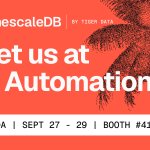
The Tiger Data team is heading to ISA Automation Summit & Expo, Sept 27-29 in Orlando. Find us at booth 414: tsdb.co/isa2026-x

We're at ISA Automation Summit & Expo, Sept 27-29 in Orlando. Booth 414. Come talk industrial telemetry, SCADA data, and why you don't need a second database for real-time analytics.
tsdb.co/isa2026-x

What does it look like when the historian experience and the database underneath it are designed to work together?
With Ignition Enterprise Historian, you configure the historian in Ignition. Connect it to the TimescaleDB environment. Then let the integration handle historian-specific database setup and configuration.
No separate database design and tuning workflow.
Come see it at Booth #2 at ICC 2026.
