

I draw the dabbingest™ Jesus comics and post every Friday.
- Tweets854
- Following58
- Followers20.7K
- Likes2.5K




ALT JOKE-OGRAPHY: In this cartoon, a curious Pharisee asks Jesus what He thinks the first of all God's commandments is. By "first," the Pharisee clearly means "foremost" or "most important," but Jesus jokes and answers with the actual first commandment ever spoken to mankind, which is when God tells the first man, Adam, not to eat of the Tree of Knowledge in the Garden of Eden (i.e. "Don't eat that"). It's funny that God's first recorded commandment to a human is the same thing we have to yell at infants.

ALT JOKE-OGRAPHY: In this cartoon, a Pharisee poses the infamous tax question and Jesus poses His infamous answer (from Matthew 22:15-22). The Pharisee then ponders. "Render unto Caesar what is Caesar's," means they should pay the coins made in Caesar's image to Caesar. That's logical. But the Pharisee wonders about the next part: "Render unto God what is God's." He wonders aloud, "But what's made in GOD'S image?" The second Pharisee behind him remembers Genesis 1:26 and pieces it together: Jesus is implying that humans, being made in God's image, should devote themselves to God -- a calling much more consequential than earthly taxes. This isn't groundbreaking theology, but it IS a poetic reminder of mankind's connection and duty to their Creator, which should be of more concern to the Jews than their taxes. This whole thing sends the Pharisee spiraling when all he wanted to do was talk about taxes and ruin Jesus's career. Better luck next time, friend!

ALT JOKE-OGRAPHY: In this cartoon, we see a portion of the Parable of the Wedding Feast (Matthew 22:1-7). The servants issue their invitation, asking for everyone to "R.S.V.P." In American English, this is an acronym that stands for "Répondez S'il Vous Plaît" (or "Respond, Please" in even Americaner English). For important occasions, the acronym is added to invitations as a call to action for recipients to respond so the host knows how many people are actually attending. In this cartoon, two townsfolk muse over the acronym and interpret it incorrectly, setting off the parable's gruesome turn. This would be hilarious AND whimsical, if not for the fact that it immediately precedes fictional bloodshed. Well... maybe it's still a little funny anyway.

ALT JOKE-OGRAPHY: In this cartoon, we zoom into the first verse of the Parable of the Tenants (Matthew 21:33-46), where the story is set up. The landowner prepares the vineyard, then declares that he's going to lease it out. However, while, in the Bible, he leases it out to "tenants" (human renters), in the cartoon, he leases it out to "ten ants" (10 insects). "Tenants" and "ten ants" have all the same letters, but "tenants" is all one word, while "ten ants" has a space between "ten" and "ants" transforming the meaning completely. This is, as dictated by all the greatest scholars and mystics, a "sick pun, yo," and quite hilarious.

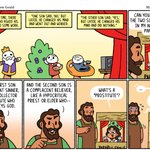
ALT JOKE-OGRAPHY: In this cartoon, a young Jesus is coming up with the Parable of the Two Sons (Matthew 21:28-32) for the first time. He presents it as a play with little puppets and props for "Papa Joe" (St. Joseph), who explains the moral of the parable back to Jesus to show he gets it. But when he says the word "prostitute," young Jesus asks Joseph what that is. Of course, in His divine nature, Jesus knows all things, but in His human nature, He's just a child, so Joseph worries that he's said something inappropriate, provoking an awkward question from his Son. He tells Jesus to ask His other parent to explain (a common parenting tactic when face with awkward questions), but instead of sending Him to His mother, Mary, Joseph (His EARTHLY father) sends Him to God (His HEAVENLY Father).

ALT JOKE-OGRAPHY: The cartoon is based on the Parable of the Workers in the Vineyard (Matthew 20:1-16). In this cartoon, we find one of the full-day workers complaining to the landowner about the wage discrepancy, just like in the parable. Also like in the parable, the landowner defends himself, saying he paid the full-day workers what they were promised, so they have no right to complain if he was extra generous to other workers. After all, it's his money, isn't it? He can do what he likes. The cartoon version of the landowner then demonstrates this by gifting FIVE days' wages to the nearest Cockney orphan he can find. The orphan thanks the landowner in his weird, fictional accent (like the one they use in that amusement park island across the Atlantic), and begins eating the money as if he has no clue what it is. The worker looks on in frustrated horror, and the landowner's logic remains as alien to him as ever.

ALT JOKE-OGRAPHY: In this cartoon, we just take some time to savor the first part of the Parable of the Unmerciful Servant (Matthew 18:23-35) and the immensity of the servant's debt. Some Bibles translate the debts in the story as "a huge amount" and "a much smaller amount," respectively, instead of using the literal numbers, but I think that misses the comedy of comparing 60 MILLION denarii and a mere 100. Also, the servant is much more flippant here than in the parable. It's funny to imagine a guy who owes 60 MILLION DAYS' WAGES using phrases like, "Aw, shucks, I musta lost track," or, "Yeah, my wife says I need to write down a budget," or, "Guess I gotta cut back on the fast food, huh?" as if he wasted a single paycheck on McDonalds and didn't blow -- once again for those who arrived late -- 164-THOUSAND-YEARS-WORTH OF MONEY.


ALT JOKE-OGRAPHY: 1. In Matthew 18, Jesus gives a famous line while telling His apostles about the Church He's forming: "Where two or more are gathered in My Name, there am I in the midst of them." 2. In Mark 6, Jesus sends His apostles out in pairs to preach and cast out demons in His Name. 3. In this cartoon, John takes the Matthew 18:20 quote and compares it to the missions Jesus sent them on in pairs in Mark 6:7. The way HE puts these two events together, he thinks Jesus is saying He can teleport between people who gather in His Name, as long as there are at least two gatherers present in the target destination. This is madness... for now. When Jesus appears beside John to question him, John cries out in shock, believing that Jesus has just teleported between him and Peter because the two of them were gathered together in His Name. Peter points out that Jesus didn't teleport, but simply walked over while John was describing his divine superpower headcanon.

ALT JOKE-OGRAPHY: In this Bible story (Matthew 16:13-23) Jesus asks the apostles Who they think He is, and Simon gives an answer that's spot on. Jesus blesses him and changes his name to "Peter" (from "petra," Greek for "rock" and "stone"), because his faith -- gifted to him by God the Father -- will become the foundation for the new Church (which Peter ends up leading in early Christianity). Later in the same chapter, Jesus is foretelling His death and resurrection at the hands of the Jewish elders, but Peter rebukes Him for it, saying such a death would not be fitting for Him. Jesus counter-rebukes him, saying, "Get behind me, Satan!" because such thinking goes against God's plan and tries to tempt Jesus away from His salvific mission, even if Peter meant it with a good heart.

ALT JOKE-OGRAPHY: 1. Matthew 16:13-19 -- Jesus renames Peter and promises him the keys to the kingdom of heaven, along with the authority to bind and loose. 2. Isaiah 22:15-22 -- God promises to replace a wicked master of King David's palace with a new man named Eliakim, and promises to give him the key to the kingdom, along with the authority to open and shut. 3. Catholics schedule these passages for the same Sunday because the parallel between Peter (head of the Church) and Eliakim (master of the palace) is clear. Both serve under a true king and are given authority over their kingdom with authority to bind/shut and loose/open. 4. In this cartoon, John notices this parallel and shares his insight with someone beside him. That Someone is revealed to be Jesus, Who obviously already gets it. Meanwhile, Peter notices the typo in John's word-flood, where he says "Stewart" (a person's name) instead of "steward" (someone who manages something). This is hilarious.

ALT JOKE-OGRAPHY: 1. In this Bible story (Matthew 15:21-28), Jesus is traveling abroad when a Canaanite woman begs Him to cure her daughter, who's tormented by a demon. Jesus tests her faith, then finally answers her prayer, and her daughter is immediately cured. 2. In this cartoon, we imagine the woman's daughter, with the demon tormenting her until angels show up, dressed like mafia, to deal with him on Jesus's orders. Gabriel enjoys the mafioso role with quips and slang while Michael prepares for a very one-sided fight. 3. Gabriel starts by barging into the house and SAYING "knock knock" instead of actually knocking. This is to assert dominance. 4. The idea to subvert the common "make like a tree" idiom is a new joke I invented. Please don't steal it and go back in time to use it before me so I look like I stole it. Thanks! 5. "Scramoose" is a mix between "scram" (like "go away") and "vamoose" (like "go away") for double the "go away" action! This is to assert dominance.

ALT JOKE-OGRAPHY: This cartoon follows from Friday's, and in it, Simon is sinking, like in Matthew 14. In the cartoon, Jesus notes that he's sinking like a rock, then leans close and begins a quote from later in Matthew 16, where He renames Simon "Peter" (meaning "rock") and says, "...And upon this rock I will build my church." Mashing these two moments together in this cartoon implies the possibility that Jesus's new name for Peter was informed both by his negative present attributes of being a little dense, slow to change, and quick to sink, but also his positive future attributes of occasional spiritual clarity, sturdiness as a leader of the early Christians, and fortitude as a martyr for the faith. As with all believers, Peter is a competition between the part of him that struggles with God and the part that wants to follow Him to the end.

ALT JOKE-OGRAPHY: 1. In this Bible story (Matthew 14:24-31), Jesus prays alone for a bit while His disciples take a boat without Him. They get caught in a storm, but then Jesus walks to them on the waves. He calls Simon (later named Peter) out to join Him. At first, Simon trusts Jesus and is able to walk on the water like Him, but with the storm raging, doubt clouds Simon's faith, and he sinks. Jesus pulls him back up and gives him the classic "Oh, ye of little faith!" line. 2. In this cartoon, Jesus tells Simon that, if he has faith, he won't sink. Simon gets it, but starts slowly descending into the water almost immediately. Jesus slides into frame with a disappointed glare. The cartoon portrays Simon's lack of faith being something of a surprise to Simon himself, which is a consistent character flaw of his throughout the Gospel. Between his sinking and his stubborn denseness, it's no wonder Jesus later calls him "Peter" or "Cephas," which comes from a word for "rock" and "stone."

ALT JOKE-OGRAPHY: In this cartoon, a man and woman among the crowd discuss Jesus's miracle of multiplying the fish and bread (Matthew 14:13-21). The man suggests two possibilities for how the multiplication could have been achieved (not an exhaustive list, for sure): first, Jesus might have created more fish and bread from nothing, crafting the food from newborn atoms of His own personal conjuring; or, second, Jesus might have simply teleported EXISTING fish and bread to the people. The teleportation theory is absurd, of course, because it's as fantastical as the creation theory, but just replaces the creation theory's divine power with magical stealing. Nevertheless, the woman imagines the teleportation theory through two scenes where fish and bread are stolen from their natural habitats, leaving those that loved them to cry out in anguish.

ALT JOKE-OGRAPHY: 1. In this cartoon, Jesus tells the Parable of the Net (Matthew 13:47-50), but two fishers in the back of the audience struggle to hear Him. One hears Him say something about "fishers" and being thrown into the "furnace" but he misses most of the rest. He also hears Jesus say there will be "wailing" in the furnace (as in "crying"), but he thinks Jesus said "whaling" (as in "hunting whales"). The first fisher pieces together what he understood and concludes that Jesus is saying that fishers who go to hell (the furnace) will have to change occupations from hunting fish to hunting whales. The second fisher complains that he doesn't WANT to hunt whales; it's altogether a very different job from fishing, of course. Thus, he decides to stop sinning so he doesn't have to go to hell and change jobs.

ALT JOKE-OGRAPHY: In this cartoon, each of Jesus's three parables (from Matthew 13:24-35) is summarized into an absurd one-sentence blurb that is technically accurate but a little more jarring than the wording we're used to. Some of us long-time Christians grew up with these parables, so their intended oddness can be lost on us. Hopefully this helps communicate how bizarre some of the imagery would've been to a listener back then. Anywho, a guy in the crowd notices Jesus's odd metaphors and complains, then talks himself into a theological awakening, then talks himself out of that awakening because it makes him uncomfortable. We all do be that guy sometimes, ahaintgonlieboutdatmaynsheeeewt.

ALT JOKE-OGRAPHY: In this cartoon, Jesus tells the Parable of the Sower (Matthew 13). A man in the crowd is confused by the sower's over-abundant sowing because, despite the fact that some of the seed lands on fertile soil, he's also wasting some on soil that won't properly receive it. Of course, with our knowledge of the meaning BEHIND the parable, the man is, without realizing, critiquing the real sower (Jesus) for wasting seed (the Word of the Kingdom through His teachings) on soil that won't properly receive it (the man, himself). It's terribly ironic, and that makes it funny. Do not question me.

ALT JOKE-OGRAPHY: ***𝚆𝙰𝚁𝙽𝙸𝙽𝙶*** 𝚂𝙾𝙼𝙴 𝙿𝙾𝚁𝚃𝙸𝙾𝙽𝚂 𝙾𝙵 𝚃𝙷𝙸𝚂 𝙳𝙴𝚂𝙲𝚁𝙸𝙿𝚃𝙸𝙾𝙽 𝙷𝙰𝚅𝙴 𝙱𝙴𝙴𝙽 𝚁𝙴𝙳𝙰𝙲𝚃𝙴𝙳 𝙵𝙾𝚁 𝙿𝚄𝙱𝙻𝙸𝙲 𝚂𝙰𝙵𝙴𝚃𝚈. In this cartoon, Jesus starts with His Biblical line about how His yoke is easy, but then adds that one might even say "over easy." "Over easy" describes a style of cooking eggs where the egg is cooked on both sides while the ████ (the yellow core of the egg) remains soft, unbroken, and runny at the center. Naturally, because "yoke" and "████" sound the same, in the second panel, Jesus continues by saying, "██████████████████!" I'll be honest: it's probably one of my best puns to date, and with the eye-catching composition, dynamic poses, and perfect expressions in the second panel, I anticipate a lot of people using that panel specifically as a reaction image or a meme template. Viral internet fame, here I come! Because that's what Tomics has always been about. FAME!