

@TonyW
Account based inUnited States
About this account
- Account based in
- United States
- Connected via
- United States App Store
Account-level information from X, not a live location or the device used for a specific post.
Managing Partner @500GlobalVC. Tech adviser, investor and executive. Previously: operator at @Google @Twitter @Color
🇹🇼-🇺🇸-🇬🇧-🇺🇸-🇹🇼-🇺🇸
Joined October 2009
- Tweets10.9K
- Following4.5K
- Followers16.8K
- Likes4.8K





Tony Wang retweeted

Putting all our work together we present Boba! Using our Ampersand model, trained in simulation with our Persimmon model to be a great collaborator while respecting your preferences and values - here we put it all into practice, helping people.

Introducing Boba - the social intelligence that understands your goals and your community. Text Boba today or message it online at boba.app
Having a U.S. based CRO with AI, science and robotics to automate lab experiments to create molecules is ambitious . Great to see a stellar team to put this together. Let’s go @kevinweil @dpatil @manohar_paluri @warpsciences

💥 Introducing Warp Sciences, a new company applying AI and robotics to help the world develop new medicines faster.
We’ve raised a $215M Series A led by @lightspeedvp to bring frontier AI out of the browser and into the lab, and build scientific capacity here in America.
I co-founded Warp with my long-time friend @dpatil, FAIR co-founder @manohar_paluri, and drug hunter Sol Reisberg. The early team is full of incredible people like @bkspears9, who helped achieve Q>1 fusion at LLNL.
Another great launch today, this one from the @humansand team. Let’s go 🔥

Tony Wang retweeted

This kind of third party evaluation should be gold standard

Ahead of launch, @robocurve evaluated Dream-1 independently. Result: a new Pareto frontier for robot control. 16x cheaper, 1.7x faster, and better performance (59 vs. 48 on RoboDojo-RC Tier 1) than the previous best alternative.
LLMs can plan. Robots still need a cheap, fast, and general System 1 to act.

Tony Wang retweeted
This team is one big reason I believe robotics is closer than it may appear

Dream-1 by @dreamlabs_ai beats every LLM in robotics while being faster than all of them. Dream-1 scores 1.3x higher than GPT-6 Astra Ultrafast while being 1.7x faster.

One of the companies that worked out of our office @500GlobalVC…excited for the reveal tomorrow! Follow along with @jang_yoel

This post by @nickcammarata is exciting and promising. It’s possible it marks the end of an era where we knew the lesser about neural networks. Major implications on alignment and interpretability:
“almost the entire network is interpretable if we look closely enough, especially if we look at how it grew over training.”

interpretability might be the most important scientific problem in the world right now, as I don't think we can solve alignment if we don't know what we're building. I think I have good news about it. I co-authored early work in mechanistic interpretability at OpenAI and came away pessimistic, because neural networks appeared to fold into arbitrary tangled knots. years later, I started openai's first large-scale automated interpretability project, finding about 2% of neurons legible with the primitive tools we had
with modern agentic tools and a much closer look, the picture looks totally different. the vast majority in models up to trillions of parameters are legible, and their circuits beautiful. many famous examples of tangled neurons turned out to be misunderstood. The roadblocks I expected mostly aren't there. I now think ambitious interpretability will be solved by the time we need it most, and possibly quite soon, as automated scientists keep improving. it may be a bitter lesson for interpretability: the simple thing, at absurd scale, works
already-clean.goodfire.com/

Tony Wang retweeted

I make this same post like every 2-3 years, because there's always new data further supporting it.
Georges Harik (@gharik) is one of the most prescient people in AI, and definitely the least well known and underappreciated one.
In 1999 he joined Google as one of the first employees (like #7 or something) because he thought he could use his AI knowledge to build a better ad system. He and Salar Kamangar built Adwords (Salar later bought YouTube and Georges later was the force behind Google wanting to buy Andy rubin's company to build Android)
Georges left Google so he could focus on AI research, which he self funded. He did so with someone he worked with closely at Google, our friend Noam Shazeer (they built the AdSense targeting engine). When Google finally decided to work hard on AI around the time of the deepmind acquisition, they tried to get Georges and Noam to come back. Georges wanted to stay independent, and our friend Noam went on to do great things obviously. This was my good fortune because it led to Georges and I hanging out a lot, because he basically needed a new lunch buddy.
Georges at the time was working on language models and despite karpathy saying nobody saw LLMs being so big even in 2017, Georges was telling me they were on the cusp of changing everything in 2013. My wife and I literally changed some of our parenting priorities that year (less tigery) because georges convinced me the world was going to change so much.
Later on he and I got involved in a company making CV photo filters called Lambda. They needed to make money to survive so they started building ML boxes which Georges bought a bunch of. But his significant other was mad there were so many loud and hot boxes in the house, she started worrying about fire risk, so Georges told the lambda guys they should build a cloud because in the future, the power density of the systems was going to be too big for even most enterprises to handle. This was like 2017. That's how lambda cloud began, and the premise Georges had was that AI was going to change things so much, demand growth would outpace supply growth, and the value of compute was eventually going to rise and that lambda was effectively going to be a REIT... so we should own as many GPUs as possible. It took the world almost a decade to finally figure out what Georges saw then (see attached tweet).
About 5 years ago when pretraining was still the only thing people cared about, Georges started telling me inference was going to be super impt. He was working on research investigating post training as a way to improve reasoning. He found some other guys working on the same idea that had a paper known as the STAR paper, and they worked together to prove it even further with another paper called quietstar. (They all later cofounded the neolab humans&). Georges got some friends to build deepinfra.com to be one of the first inference clouds because he saw it all early. He and the humans& team also smartly used all their money to buy compute knowing it would go up in price and also get harder to obtain.
It's kind of amazing to me how he has gotten everything right so far ahead of time. It's also amazing to me how VCs don't really get or believe a lot of the things he says, they often tell me I am wrong whenever I parrot Georges' current thoughts... and then years later they all put out charts and papers reaffirming those same things as if they knew it all along.
The founders of Google recognize Georges' brilliance and still talk to him a lot. (Besides being smart, he is a lot of fun to hang out with.) I'm just wondering when the rest of the world figures it out


I found the place that the @humansand team must be getting their coffee in the morning @ericzelikman @gharik


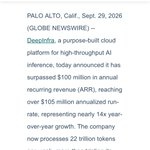
🚀 Already at 14x for the year and breaking the $100M revenue mark, congrats to @DeepInfra on executing at this pace 🔥 globenewswire.com/news-relea…

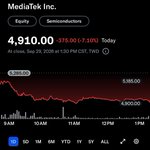
Ouch. This is what platform risk looks like at the infrastructure level. If you didn’t secure enough substrate, TSMC could cut your supply. 😮

There is alpha here for people paying attention 👇🏼
Or, build a cluster and own the hardware, make your money go way further, still have a valuable asset after 3-5 years, and make a differentiated model bet. That's what humans& did
Huge thanks to @DeepInfra and to @nvidia @Supermicro for working with us to make it happen

ALT A photo inside of one of the humans& clusters, showing a few air-cooled racks
😮 In the future, rival AI clusters will be sending humans to each other as good will gestures. Stay cute, humans. 🐼

🚨 JUST IN: Xi Jinping announces China will be sending TWO Giant Pandas to the Atlanta Zoo, Ping Ping and Fuhuan
"The giant panda has been an envoy of friendship between the Chinese and Americans. Here, I have a piece of good news.
In a few days, two pandas, Ping Ping and Fuhuan will come to their new home in Zoo Atlanta and meet with the American people."
I freaking love pandas. So I'm glad to hear this 😆
I’ll be in Austin for this with @TomorrowXSummit. If you are around, let me know!

Welcome Nasdaq Private Market (@NPM) to TomorrowX Summit.
Nasdaq Private Market is the platform powering modern private markets — serving private companies and their investors with liquidity, capital and investment solutions.
Come find them at the NPM Cafe at the Moody Center.
Registration link in the replies.

If you are a founder that can do this for every other company, I would love to talk to you 🙏

Greg Brockman says OpenAI pointed Astra at its own systems until it ran out of vulnerabilities to find:
"We took 25% of our production engineers and said, 'Sorry, all your projects are on hold. You are now defending. You are now up-leveling our security architecture. You're going to use the models to find all the holes.' And we found a number of serious issues, and we fixed them."
"We found some new problems, but eventually it saturated. We basically have found, to our knowledge, all of the P0s, all of the critical problems that Astra is smart enough to find. And of course, there will be a new model, there will be a new round."
"You want to be in this tight loop of new cyber capability drops, you deploy it against your systems, you find the new holes, and ideally, you've managed to automate this, what we call defense factory. That's what we're building internally."
"There are ideas, for example, formally verifying all of software, that are possible with AI."
@gdb @bhorowitz
Can you imagine how much more this would have sold if there were <10% chance of AI wiping out humanity?


This is a wild way to report the price of housing increases.

A San Francisco home where prosecutors said a landlord killed his tenant outside the property has been listed for rent at $6,300 a month — nearly double what the slain tenant had been paying. sfchronicle.com/bayarea/arti…

AI Infrastructure Economics continues today @GoldmanSachs
Comparing Google TPU economics below to $NBIS CEO comments today: Nebius capex payback is 22-months, very similar to <2 years for GCP. The difference is that Nebius makes clear it covers capex plus related opex.
Long term contacts moved from $10-15M per MW to $20-25M, whereas short term contracts are $40-50M per MW. This is very consistent with the terms that SpaceX has with Anthropic and Google.
Nebius has guided capex to $20-25B for 2026.

Google’s TPU Economics 👀
Google GCP CEO Thomas Kurian @ThomasOrTK just said that their payback period on AI servers is <2 years, and half that on their own silicon. 😊 (at @GoldmanSachs today)
But it’s not clear whether he means revenue payback or profit/cash-flow payback. 🤔
Let’s assume he means revenue payback, the more realistic of the two in my opinion. 😐 I’d also interpret the statement as payback for just the servers and not the entire datacenter.
This means that they monetize TPU clusters at about $30M per facility MW.
How do I get there?🤓
Currently, the list price for Ironwood ranges from $5.40/hr (with a 3 yr commitment) to $12/hr on demand. Google says 10MW of IT/pod power can support 9,216 TPU chips. However, this likely does not include the other energy needs (chillers, pumps, transformers, lighting, etc.) So assuming a very efficient modern Google AI data center with 1.10-1.15 PUE (power usage effectiveness), it means about 800-840 Ironwood TPUs per facility MW.
Assuming 820 TPUs per MW, at the 3 yr per hour rate of $5.40, that’s $39M/MW at 100% utilisation. I likely wouldn’t lower the utilization assumption because everyone is sold out everywhere. 😮
But I’d lower the rate for these two reasons: (1) TK paired his statement with a mention of 5 yr contracts, and (2) it’s possible volume enterprise contracts (eg for Anthropic) will be at a further discount with a longer commitment.
Here there is not list price to use for 5 yr contracts, so extrapolating a diminishing returns curve on the discount from the listed schedule (from on-demand to 1 yr to 3 yrs) suggests $4.50/hr for 5 year commitments (16% discount from the 3 year $5.40/hr rate). Add on top an additional 10% discount for scaled customers and you get $4.08/hr.
Thats how I estimate the ~$29M revenue per facility MW of TPUs.
TKs statement also has presents some suggestions on margin. Alphabet depreciates their servers and networking equipment over 6 years. With 2yr/1yr payback on AI servers/TPU respectively, it means every $2 server investment produces $1/$2 per year respectively. Depreciation for AI servers generally consume 33% of each revenue dollar ($2 investment divided by 6 years depreciation as percentage of $1 per year) whereas it consumes 17% of each revenue dollar for TPUs ($2 investment divided by 6 years as percentage of $2 per year). So there’s a 16 percentage point gross margin advantage for TPUs.
TPU revenue covers the capex in one year for assets that are depreciating over six years. Of course there are operating costs, but once you get long term commitments, it becomes an attractive asset. No wonder Google is spending on capex.
This whole post is speculative, but the margin part especially so. 😝 But it will be interesting to build out this model with more information to come. Tell me what I missed!
