

Systematic futures trader | Trading since 2017 I build rules, backtest them with data and AI, and share what works and what fails Course starts Nov 12 ↓
Joined August 2017
- Tweets14.2K
- Following156
- Followers5.7K
- Likes17.7K




Pinned Tweet
𝗪𝗵𝗮𝘁 𝘆𝗼𝘂 𝗮𝗰𝘁𝘂𝗮𝗹𝗹𝘆 𝗴𝗲𝘁 𝗶𝗻 𝗺𝘆 𝗰𝗼𝘂𝗿𝘀𝗲
The first lesson of my course on building and backtesting a strategy with AI goes out on Thursday, and a few people have asked what the course really includes.
It runs every weekday from November 12 to December 22, about an hour a day, and this is what you get:
1. A real start from zero, beginning with creating your Claude account, with every step shown on screen.
2. Ten years of 1-minute NQ and ES data, downloaded and checked step by step, covered by the free credit Databento gives new accounts.
3. A real setup of mine that I tested and dropped, followed from the first idea to the final verdict, with all the numbers and the mistakes.
4. Exercises where you rebuild each piece with Claude and compare your numbers with mine.
5. The checks that tell a real edge from luck, and how to know when a strategy is really dead.
6. A simulation of the strategy with prop firm rules or with your own capital.
7. A TradingView version of the strategy, checked trade by trade against the backtest.
8. Answers to your questions from me, within 48 hours, with the questions chat open until January 8.
You don't need to know how to code, because Claude writes the code and you learn how to check that it does what you asked.
There are no signals and no promise of profits, just the method I use every day.
It's for a group of 20 people, at $99 plus VAT: tradingamok.gumroad.com/l/fr…

𝗧𝗵𝗿𝗲𝗲 𝗾𝘂𝗲𝘀𝘁𝗶𝗼𝗻𝘀 𝗮𝗯𝗼𝘂𝘁 𝗺𝘆 𝗰𝗼𝘂𝗿𝘀𝗲, 𝗮𝗻𝘀𝘄𝗲𝗿𝗲𝗱
1. Is it live or recorded? Neither: every weekday you get a written lesson of about an hour, with the messages you send to Claude and my numbers to check yours against, and you do it when it suits you, with a chat for questions open until January 8.
2. Do I have to pay for the data? No: Databento gives new accounts $125 of free credit, and the two markets we use, Nasdaq and S&P futures at one minute, cost less than a third of that.
3. What do I need? A Claude account (Pro, $20 a month, from lesson 3), a free TradingView account and no coding at all, because Claude writes the code and you learn how to check it.
Places are limited to 20 people, at $99 plus VAT, and the course starts on November 12: tradingamok.gumroad.com/l/fr…

Compare trading results in R, not in points or dollars
Points depend on where and when you trade, because a 20-point move is small on one market and huge on another.
Even on the same market, price moves more in some years than in others, and the same happens between sessions.
Dollars, on the other hand, depend on how many contracts you traded, which says nothing about whether the strategy works.
R fixes both, because it measures each trade against what you risked on it.
That's why I record every trade in R, in the backtest and live.
A trade that made twice its risk is +2R and a full loss is −1R, whatever the market, the session, the year or the number of contracts.
If you ask an AI to simulate how likely you are to get paid before losing a prop firm account, it will probably count an account as lost only when it hits the loss limit.
But an account can become useless before that.
If the balance ends up just above the limit, the room left is so small that you can only trade tiny size or risk losing the account on the next trade, so there's no realistic way left to reach a payout.
However, the simulation still counts that account as alive.
In my own simulations, almost none of the lost accounts actually hit the limit, and nearly all of them were stuck like that, so counting only the ones that hit it would have made my plans look far safer than they are.
So tell the AI to also count as lost the accounts that end up too close to the limit, and decide before running the simulation how close counts as stuck.
Today, the people who already joined my course received lesson 0, where they create their Claude account and the project we'll use in every lesson.
The course itself starts on next Thursday, November 12, and this is the first week, one lesson a day:
1. Thursday and Friday: how to work with Claude so it doesn't invent anything, writes down your decisions before it calculates, and tells you when a number can't be right.
2. Monday and Tuesday: the data, one-minute Nasdaq and S&P futures from 2016, downloaded with the free credit Databento gives to new accounts.
3. Wednesday: the small library of code we reuse in every test, with its own check that nothing broke.
From the second week on, we take a real setup of mine from its written rules to its final verdict, one step a day until December 23.
If you join now, you get lesson 0 right away, so you're ready for November 12: tradingamok.gumroad.com/l/fr…
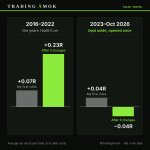
Before running the first test of a new setup, I wrote its rules down, and with those rules the backtest made a little money per trade over the first seven years of my data (the grey bar in the chart).
Then I looked at the results and made three changes, and each one sounded reasonable:
1. I asked for a stricter condition before entering.
2. I added a time limit to the trades.
3. I removed the part of the day where the trades did worst.
After those three changes, the same backtest made about three times more per trade (the green bar).
I had kept the last years of data aside without looking at them, so I fixed the rules and opened those years one single time.
In those years, the version with my three changes lost a little money, and the rules I wrote first made close to nothing, so neither of them showed a real edge.
I also checked how often a loss like that would appear if the improved backtest had been true, and it would be very rare.
So the most likely explanation is that my three choices fitted those seven years and nothing more.
I normally look at many versions that are very close to my rules instead of trusting the exact ones I picked.
Here, those close versions also looked good, but all of them included the same three choices, so they couldn't warn me.
The only thing that did was the data I hadn't touched.
So what I do now is leave the most recent years out of everything: I don't use them to choose any rule, and I open them one single time, with the rules already frozen.
And I treat every change I make after seeing results as a new guess that only those untouched years can confirm, because once you open them and tune again, they stop being a test.
In my course, you learn how to keep the most recent data apart and when to use it, on a real setup we follow from start to finish.
It starts on November 12: tradingamok.gumroad.com/l/fr…

The Fed said last week that one of its eight meetings in 2027 will be only about long-term strategy, with no rate vote and no statement expected, and for 2028 the plan is two strategy meetings and six rate meetings.
This means a Fed meeting on next year’s calendar won’t always be a decision day, so the market may not move the way it does when a rate decision comes out.
The Fed hasn’t said yet which 2027 meeting will be the strategy one, so it’s worth flagging it in your rules now and fixing the date once it’s announced.
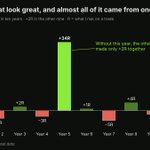
A backtest over many years feels safe, but the years don't all count the same.
If one of ten years made almost all the money, the other nine together made close to nothing, and what you're looking at is the story of that one year.
It's obvious when you see it like this, but when a backtest is summed up as "36R in ten years", it's easy to miss.
That's why, every time I run a backtest, I take out the best year and check whether what's left is still worth trading.
