Tushar Sonawane (@Tushkiz) profile picture

Spreading tech insights and good vibes. Building epic stuff at @deel. Ex-crew @SlackHQ @getmaximai

India
Joined April 2009
Photo by Tushar Sonawane (@Tushkiz)Photo by Tushar Sonawane (@Tushkiz)Photo by Tushar Sonawane (@Tushkiz)Photo by Tushar Sonawane (@Tushkiz)Photo by Tushar Sonawane (@Tushkiz)Photo by Tushar Sonawane (@Tushkiz)Photo by Tushar Sonawane (@Tushkiz)Photo by Tushar Sonawane (@Tushkiz)Photo by Tushar Sonawane (@Tushkiz)Photo by Tushar Sonawane (@Tushkiz)
Tushar Sonawane retweeted
On Dec. 8 we're building a reconciliation agent live on a real month-end close. → Reshmi Suresh builds it live → Gal Aharon on the accounting agents his team runs → Deb Mukherjee moderates Inside @deel: 20+ day closes now in minutes, 93.5% end to end, a human on every entry. Watch and bring a problem: deel.com/events/akai-for-fin…
3
2
3
196
Reinstalling Codex 🚀🚀
I've joined OpenAI! I'm very proud of my time at Anthropic, and I'll continue to root for my former colleagues. Both companies have important roles to play in the future. There is a tremendous amount of work ahead of us to bring AI to the world, and it will demand the very best of all of us. I felt that I could personally contribute the most to this effort at OpenAI. I believe this is one of the great strengths of Silicon Valley, the flow of ideas and people. I'm excited to join a team I've long admired, building incredible AI products for over a billion people, and to work alongside friends like @_catwu, @thsottiaux, @ajambrosino, @sharifshameem, @jxnlco and many others to push the frontier forward. More than anything, I hope to make your experience of using AI just a little bit better. I am once again at your service. Thariq
56
This is a super interesting pattern for improving your services exposed through MCP servers: Closing the feedback loop. Let agents report issues they encounter, include context and maybe propose fixes. Route them to an internal channel and have a review agent triage and implement them with keeping you in loop. The MCP becomes more than a way to interact with your service. It becomes a feedback channel that helps the service improve through real usage.
Lot of people asked about this. You can basically make your MCP self improving by doing this: - Add a submit_feedback tool to your MCP - Agent using your MCP will write detailed issue including proposed fix. - Have it send to an internal Slack channel - Have Claude in Slack channel and tag it to put up a PR when you agree w proposed change.
2
97
Ever came across this when you fix the last review comment and the review agent comes back with new ones. Why did it not raise them the first time? Every fix adds new code that the next round has to review. A full re-review of the whole diff rarely returns nothing. Here are a few things you can do to break this loop which worked for us: 1. Write the scope as a closed list before the first review round. 2. After the first full pass, review only what changed since the last reviewed commit. 3. Show the reviewer its earlier comments and drop any finding that repeats one. 4. Raise the review severity floor each round, so later rounds only block on serious findings. 5. Count how many new comments are about code your last fix added. If most are from the last fix, two rounds in a row, the fixes are creating the problems. Stop the loop and flag, let the human request for re-review.
5
181
LLM weight lifting 🏋️
We asked GPT-6 Astra to edit Qwen3.5-0.8B weights to improve math. It directly changed only 0.016% of weights, fixing 0.8B's reasoning loops & improving math up to 6x and even instruction following 3x, without gradients or training. We call this Weight-Space Programming: frontier LLMs can now natively read/write neural network weights! 🧵 Blog: rikiyat.github.io/blog/weigh…
Readers added context they thought people might want to know
LLM was given weights explicitly as text in prompt and used code/forward passes (per authors' logs) to ablate Qwen looping direction, a known thinking-mode issue per model card. Primarily fixed repetition in that mode, not general 'natively' improving weights/math. rikiyat.github.io/blog/weight-sp… github.com/RikiyaT/lm_und… huggingface.co/Qwen/Qwen3.5-0… huggingface.co/RikiyaT/Qwen3.…
3
83
A high agent autonomy rate can mean your software factory works. It can also mean people stopped checking or reviewing the output. That is why autonomy should not be tracked alone. Sharing four metrics to track together, these are based on Antoine Carossio's Escape field report. 1. Issue clarity: issues started without a question/issues assigned. Low here shows up later as rework. 2. Autonomy rate: tasks merged with no human edits or restarts/tasks started. Generally goes up when reviews get lighter. 3. Reopen and rollback rate: agent changes reopened, reverted or followed by a fix/changes merged. Count follow-up fixes, because people file new tickets instead of reopening. 4. Wasted work rate: features reverted or unused 30 days after merge/features merged. Needs a usage check at day 30 by owners.
6
155
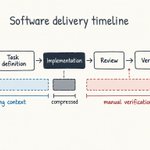
As more teams move to cloud coding agents, you will hit times when the agent stalls. These are a few cases I came across, with the fix for each. 1. The tests pass but the behavior is wrong Case: The requirements had gaps. The agent misread them and wrote tests that check its own misreading. Fix: Get the requirements validated by someone who knows the domain, before the agent writes any plan or tests. 2. The agent "fixed" the failing test Case: The agent loosened the assertion to get green. Fix: Put the check where the agent cannot edit it. Keep test changes and the implementation in separate commits so test edits get reviewed on their own. 3. The agent built something nobody agreed to Case: The task said "improve search" and the agent picked the most reasonable reading and built it. Fix: Write down what is out of scope, what must not get worse and who answers each open question. Tell the agent to stop and ask when it reaches one of them. 4. The agent guesses a fix from the code Case: It cannot follow the trail from the ticket to the logs and traces. Fix: Give it the request ID, customer ID and timestamps, plus logs it can search by them. 5. The pull request sits unread Case: It arrives with a diff and nothing else. Fix: Attach the test output, screenshots or video of the run, the assumptions made and what was not checked. 6. None of these gets faster when the coding does, so delivery runs at the speed of the slowest one. In a 281-day delivery cycle with 32 days of coding, making coding 50% faster saves about 16 days, a 6% improvement. Taking coding to zero would still leave about 88% of the cycle untouched. Fix: Take one small change from request to production cycle and mark every place where agent stalled or waited for long. Start with the longest one.
3
5
237
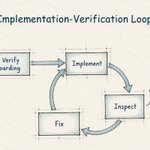
At @deel we now hand more tickets to a cloud agent by tagging it in Slack. It asks about anything ambiguous, then comes back with a plan. Nothing gets built until a human approves it. After that it implements, fixes review findings in a loop and opens a PR with evidence and a sandbox with a preview that we can try. I see many of us in Deel schedule tasks in the evening too and wake up to PRs to review. These are the things that is making it actually work: - A clean, isolated runtime. Devboxes are ready in about 10-20 seconds with no production access, so a mistake stays in one box. - Approval at the plan. A wrong reading of the ticket is cheapest to catch before any code exists. - A sandbox preview with the PR, so the reviewer tries it instead of reconstructing it from the diff. Cloud agents move the work off the laptop and into the review queue. If that queue can't take overnight volume, the agents make it longer.
2
1
11
392
Matlab, garibo ki bhi job kha jao!
Coming to a city near you
5
309
A coding agent can write a change quickly and reviewing it can still take a long time. It got even slower in products I was new to where I had to trace the flow, find the business rule and check whether the tests covered it. When agents work around the clock, pull requests arrive faster than anyone can read them. At Deel we get more than 10 pull requests per engineer per day and it is only going up. For an agent-native SDLC, I would make each PR arrive ready to review with below items: - A separate review agent checks it against the requirement and the coding agent loops until the findings that hold up are fixed. - The tests come from the requirement, not from same agent that writes the code. - The pull request carries evidence from the run and keeps the agents' assumptions and gaps separate. The review agent also gives a confidence score and a security assessment. They are a model's opinion, so low confidence or a security finding only sends the change to a person first.
7
11
445
A designer, a product manager and a company leader should not all get the same chat box with a different prompt. Each role works with different material, so each needs its own connection to it. The interface only changes where the work needs one. - Design: a UI screen builder that composes from approved components and previews the result in a browser. I use this today. - Product: the same screen builder, to prototype an idea before engineering starts. - QA: a browser extension testers keep open during a session. It records the interaction history, network and console errors and a screenshot, and files the issue in one click. - Leaders: a plain chat in Slack, connected to metrics with agreed definitions. No new tool to learn, and each person sees only what their access allows. These are part of the foundation you need for an agent-native SDLC.
2
9
315
Meet Emet - our very own AI lab. AI has read the internet and gets things almost right, but in payroll "almost right" is wrong and we are building the expertise to fix that. Pangaea is our first model family, built on open-weight models and trained with Emet 🚀
AI has read the whole internet. But it’s never run payroll or a business. We’re changing that. Today, we’re launching Emet, our AI lab for model evaluation and training, and Pangaea, our first family of models for global work. On real payroll tasks, the best AI model fully solves only 49%. Close enough to look right. Wrong enough to break a paycheck. At Emet, in-country experts define what getting it right looks like. We turn that into public benchmarks and training data, and score every model against them. Ours included. Pangaea is the first proof. Built on open-weight models and trained with Emet, it gets close to top-model accuracy, up to 3x faster, at a fraction of the cost. @deel and the payroll teams that joined us bring decades of experience running payroll, HR, and compliance across 150+ countries. Knowledge the internet doesn’t have. Emet puts it to work for every AI model, not just ours.
7
325
Can your agent come up with a fix by just being pointed at an escalation ticket? In many setups the answer is no. A ticket only describes a symptom. An engineer still follows the trail from the ticket to the logs, then the traces, then sometimes a few rows of data. If the agent cannot follow that trail, it guesses from the code or waits for someone to paste in the missing context. It comes down to two things: 1. What it needs to see: the ticket with its request ID, customer ID and timestamps, logs, traces and metrics it can search by those IDs and a sandbox with seeded data. 2. What it can change: the sandbox, freely. Production, nothing. The fix comes back as a pull request that an engineer reviews and deploys. Redact customer data where logs are written and the agent rarely needs a database connection. If it does, give it a masked, row-limited, audited query tool. Visibility lets the agent investigate, the sandbox is where it tries a fix and we decide what reaches production.
1
6
193
Back then I used to be the feedback loop for my coding agent. I set up test data by hand and clicked through the browser flow every time it changed something. Now I write Playwright scripts to set up the test bed and for UI changes, the agent implements the change, inspects it by running the end-to-end flow and fixes what fails. Code review often gets skimmed, so the pull request carries the evidence from that run: the setup, the test output and a video or screenshots of the browser states.
4
1
7
123
Funny how the same SF that said "be earnest, don't larp" is also the capital of LARPing.
Visiting SF makes you realize how far behind Bangalore tech bros are in LARPing.
3
126
A component library is what lets an agent build UI for your customers, not only for your engineers. OpenAI's Intelligent UI in ChatGPT answers with charts, forms and interactive diagrams instead of only text. They built a library of components for the model to compose from. A build-time version of this in my UI workflow is that our components in the Figma design mapped straight to components in the codebase, so the agent did not have to guess and build a generic container. With the approved components, their loading, empty and error states and a catalog like Storybook, the agent can build a screen, open it in a browser and verify and revise it itself. The same library can also power features like Intelligent UI in your own product. A small decision model picks which prepared component fits the question, and a customer who asks for sales by region gets the team's own data grid, not a block of text.
1
1
5
293
If an agent writes both the code and the tests, a passing test suite can still be wrong. The agent can misread the requirement and then write tests that check its own misreading. That is why I think engineering attention moves to two places as agents write more of the code. 1. Understanding the domain. If you cannot tell what the right behavior is, you cannot tell when the agent got it wrong. A prompt like "make no mistakes" does not draw a boundary. 2. Verification. The check/tests has to come from the requirement, not from the agent's reading of it. With that in place, a low-risk change can be reviewed the way a product manager reviews it: by what the system now does and not by reading the code diff.
1
12
203
Models are good enough now that the product-to-engineering handoff matters more than it used to. A human engineer who gets "improve search" usually asks questions first. They check with the PM or remember what the team decided last quarter. A coding agent picks the most reasonable reading and starts building. The better the model, the more convincing that reading looks. You get a clean diff and passing tests for something you did not agree to. Before I hand over a task, I always write down: - the customer problem and the behavior we want - what is out of scope - how we will know it worked and what must not get worse - open questions, each with an owner - how to check the result The open questions tell the agent when to stop and ask. Which users the change is for and what counts as better are product decisions, the model should not make any of them.
5
12
353
Some codebases let me make a change quickly. Good tests catch what I break. A Jira link next to a quirky rule tells me why it exists, so I do not remove intentional behavior. Code and tests are usually the closest record of what the product does today. A separate wiki page can lag behind. I want a coding agent to have that same path through the repo: 1. A short map of entry points (routers → controllers/components) and owners. 2. Rules in tests or schemas with links to the decisions behind unusual cases. 3. Setup so easy that a fresh worktree can start the app and run tests without local patches, shared env data or port clashes. 4. Focused checks for the area being changed, so the agent can test as it goes. 5. Failures that let it try again. Show what failed and where, with a hint for the agent's next step. Then it can fix the change and rerun. For a given task, the coding agent can follow the router to the implementation, then read the test and the Jira ticket behind an odd rule. After a change, it can run a focused check in its own worktree and use the result to decide what to inspect next. That is what I would change in a codebase before expecting agents to deliver fast and independently.
1
12
300
Announcing JEVLAS-KA-1 A Marathi-native System One model trained on millions of girlfriend → boyfriend chats. Does not generate text. Does not explain. Only answers one question that matters. SOTA on the "jevlas ka?" benchmark 🚀
2
19
435