
Hilalien
الجزائر المحروسة
Joined April 2026
- Tweets859
- Following75
- Followers121
- Likes573






The Byzantine loss of most of its territories to the Arab Muslims plunged the remnant of the Byzantine Empire on the European continent into what some histo-rians have called a 'dark age'. Trade between the remainder of the Byzantine Empire and the former Byzantine lands that


Byzantium faced. The despair also showed culturally: "fewer authors wrote, fewer teachers taught, fewer artists and artisans created, and fewer builders built." The demoralization was fur-ther reflected in arguments on God's displeasure with the Byzantines, resulting in
1
13
Henri Bresc and Annliese Nef also agreed that Idrisi's Sicily description was highly original highlighting the fact that unlike previous Routes and Kingdoms authors Idrīsi was based at Palermo: 'l'ensemble de ces chapitres constitue ainsi l'essentiel de l'apport du savant


the Encyclopaedia of Islam, in its entry on Sicily states that: A special place should be reserved for the work of al-Idrīsi, who excels over all the other writers in the systematic nature of his survey,
1
1
44


A number of cities however were inherited from pre-existing civilizations: in Damascus, capital of the Omayyad caliphate (661-750) Alexandria, Tripoli, or Córdoba, the Muslims used the ancient cities. Their settlement did not cause a brutal change, and changes in the organization


commercial function of this axis. Also in Damascus, as in Córdoba, the Muslims began by sharing the main church with the Christians, before destroying it a few decades later in order to build a mosque. Without causing any brutal upheaval of urban space, the Muslims maintained
1
25
إبن الرشيد retweeted

Conditions of the Peoples of the Sasanian Empire Before and After the Islamic Conquest 🧵🔥
1 - The ancient Persians were known for their filthiness, bathing in cow urine, and did not know bathing with water, nor did they have bathhouses.
Their religious beliefs despised bathing, considering it a foreign habit.
It is narrated that they killed one of their kings because he bathed with water.
This did not change among them until the arrival of Islam and the rule of the Muslim Arabs over them.
[ The Nature and Function of Water, Baths, Bathing, and Hygiene from Antiquity through the Renaissance Edited by Cynthia Kosso pp 269 - 270 ]
2 - Most of the Persians’ income throughout their rule over the peoples came from the lands of Iraq, where the farmers in Iraq, under the Persian state, lived in a system akin to slavery, with most of their produce going to the Persian rulers, nobles, and landowners.
[ THE GREAT ARAB CONQUESTS , HUGH KENNEDY P100 ]
3 - The farmers in all the lands ruled by the Persians were constantly subjected to provocation, extortion, and oppression by the Persians due to heavy taxes and the persistent mistreatment by Persian landowners.
[ A HISTORY OF MEDIEVAL ISLAM , J. J. Saunders P42 ]
4 - Reading and writing were forbidden for the common Persians and the peoples under Persian rule, as well as all classes under their governance, and were only available to the nobles.
[ THE SASANIAN ERA Edited by Vesta Sarkhosh Curtis p151 - 152 ]
5 - Most farmers were illiterate and uneducated, and learning to read and write was only available to the dihqans (landowning elites) and urban merchants in the cities. Those below these elites—namely the nobles, merchants, and dihqans—had no education.
The Iranians did not care about learning to read, write, or acquire knowledge, focusing only on their trades, as writing was forbidden among them and considered a foreign custom.
[ L'IRAN SOUS LES SASSANIDES , PAR CHRISTENSEN , COPENHAGUE. 1936 p411 ]
6 - With the arrival of Islam, everything changed.
Thomas Arnold and Arthur de Gobineau state that artisans and craftsmen in the Sasanian Empire were despised, scorned, and ostracized by the Persian government and treated with racism due to Zoroastrianism’s hostility toward industry and manual crafts. When the Muslim Arabs, with the creed of Islam, arrived and conquered the lands of the Sasanian Empire, including Iraq, Iran, and Khorasan, the artisans and craftsmen embraced Islam because it made them free men with status and importance. It also made them brothers in faith and creed, where preference of one over another was based on piety.
[ PREACHING OF ISLAM 1913 , BY T. W. ARNOLD p208 ]
7 - The subjects of the Sasanian Empire, consisting of Iranians, followed various religions and sects, including Zoroastrianism, ancient Persian beliefs, Buddhism, Manichaeism, and others before the advent of Islam. The Arab and Semitic peoples adhered to Christianity, Judaism, and Sabianism.
All these sects followed by the Iranians and Arabs were brutally oppressed by the ruling Zoroastrian Sasanian dynasty because their religion and sect differed from all the peoples under their rule.
The Arab Islamic conquest was a sign of divine blessing for these peoples. The Persians, Iranians, Arabs, and Semites in the Sasanian state welcomed the Muslim Arab conqueror because he was the reason for their liberation from oppression and injustice and the cause of their happiness. Most of them converted to Islam thereafter.
[ PREACHING OF ISLAM 1913 , BY T. W. ARNOLD p206 ]
8 - Leone Caetani also mentioned that most of the peoples of the Sasanian Empire welcomed the Islamic conquest because it was a salvation for them from the rule of tyrants and a cause for justice.
[ Leone Caetani , Annali dell'Islam , Millano, 1907, Vol II, Tomo II, page 911 ]


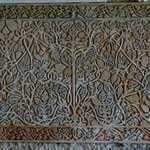
Madīnat al-Zahrā'. Parietal decoration in the reception majlis.
Courtly poets liked to use plants as images of the Umayyad dynasty: 'The tree of Prophecy and the tree of the Caliphate are its trunk/the branch comes from these intertwined roots'.


Contemporary accounts of the Mughal court suggest how its cosmopolitan atmosphere overlapped with the Persianate world
Chandar Bhan Brahman who enjoyed a long career as imperial secretary for Jahangir, Shah Jahan and Alamgir described one of Shah Jahan's assemblies as including:


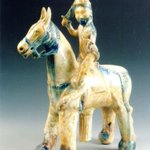
إعتمد حكام المغول في الهند على الخيول العربية و مربينها التي كانت تجلب من الجزيرة العربية بفضل التجار العرب الذي كانوا يسيطرون الطرق التجارية في جنوب بلاد الهند. طبعا إشتهرت الخيول العربية بأنها الأجود لسرعتها و خفتها
صورة لعربي يقود الحصان في الهند


1
89

