

PhD candidate studying adaptations and vision in deep pelagic invertebrates - Smithsonian @NMNH / @GEOMAR_en
Joined May 2021
- Tweets214
- Following119
- Followers158
- Likes1.8K



Pinned Tweet
Excited to share my first PhD chapter, which was just published in @NatureComms !!
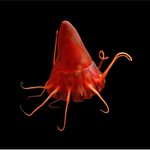
Read more about the impacts of mining plumes on the helmet jellyfish #Periphylla here:
rdcu.be/drFvO
@iAtlanticEU @GEOMAR_en @LeniHauss

Vanessa Stenvers retweeted

First paper of 2024! 🪼
Very excited to announce a ✨️BEAUTIFUL✨️project published in @CurrentBiology with @RebeccaRHelm.
Within, we use phylogeny and ancestral reconstructions to better understand the evolution of organisms on the ocean's surface.
doi.org/10.1016/j.cub.2023.1…

Vanessa Stenvers retweeted

Deep sea mining may pose a threat to the largest and least explored habitat on the planet—the deep pelagic ocean—and some organisms living within it, including pelagic jellyfish, suggests a @NatureComms paper. go.nature.com/3uomId4

ALT This is figure 4, which is an illustrated health rating based on the amount of sediment aggregated on the bell and mucus produced.
Our paper was picked for the editor's highlights by @NatureComms!
Read more about the effects of mining-induced sediment plumes on the midwater jelly #Periphylla #periphylla here:
nature.com/collections/jadch…
@LeniHauss @LaraSchmittmann @Ute_Hentschel
@CharlotteHav1

Vanessa Stenvers retweeted

Research done by iAtlantic scientists that examines the effects of sediment plumes on jellyfish living in the water column has been making headlines from @nytimes to @BBC. Read about the implications of @VIStenvers' work: nytimes.com/2023/11/21/scien…

Vanessa Stenvers retweeted
The research got a feature in BBC bbc.com/news/science-environ… 👏🏻 @VIStenvers

Vanessa Stenvers retweeted

Species-specific responses to deep sea mining are unclear. Stenvers et al. show that elevated temperatures & simulated sediment plumes cause physiological stress in a cosmopolitan deep-sea jellyfish
@LeniHauss @LaraSchmittmann @Ute_Hentschel @CharlotteHav1
nature.com/articles/s41467-0…

Vanessa Stenvers retweeted

Important new #deepseamining study just out!
Please also see BBC News article by @Vic_Gill bbc.com/news/science-environ…

Research published today by iAtlantic scientists reveals that deep-sea mining could significantly impact pelagic animals in the deep ocean, as well as those living on the seafloor. Read the story: iatlantic.eu/news/new-study-…
Image credit & copyright holder: Helena Hauss

My co-authors and I investigated the effects of mining-induced sediment plumes on the midwater jelly #Periphylla and made this video to explain the main findings. Read all about it on @NatureComms rdcu.be/drFvO
Vanessa Stenvers retweeted

New study from @iAtlanticEU Project highlights potential threat of deep-sea mining to key species in deep-sea food web doi.org/10.1038/s41467-023-4…
Vanessa Stenvers retweeted

Deep-sea mining and warming trigger stress in a midwater #jellyfish: Researchers have investigated the effects of experimental sediment plumes. The results of the study under #GEOMAR leadership are published today in @NatureComms. geomar.de/en/news/article/ti…

Vanessa Stenvers retweeted

Published today: Experimental mining plumes and ocean warming trigger stress in a deep pelagic jellyfish. With @VIStenvers , who also put together below video. @iAtlanticEU @GEOMAR_en nature.com/articles/s41467-0…
Vanessa Stenvers retweeted

All are very welcome to create their own PhD project in my Duke Biology lab in in vision/signaling/camouflage/biophotonics/navigation. Stipend ($38,500 USD) is guaranteed for six years via TA/RA/fellowship. Current one-bedroom rent is ~$1600. DM me if interested. #scitwitter
Vanessa Stenvers retweeted

#PhDAlert! We have a 4-year #PhDposition available in #Siphonophore biosystematics and biogeography at @NHMuseum_Bergen @UiB_museet @UiB. RT highly appreciated. Deadline 15th August. More info & how to apply: bit.ly/PhD_Sipho @AinoHosia @LuisFMartell

ALT Physonect siphonophore Physophora hydrostatica, known as the hula skirt siphonophore.
Vanessa Stenvers retweeted

New Smithsonian fellowship opportunities in Climate Change, Environmental Justice and Resilience & Sustainability Science. See: fellowships.si.edu/CCEJ

Vanessa Stenvers retweeted

Polynoidae is the most species-rich family of Aphroditiformia (scale worms), with over 900 species. A new study presents a transcriptome-based phylogeny that emphasizes relationships between taxa and provides insights into the origin of enigmatic lineages. ow.ly/utQV50Oz3Jk

Vanessa Stenvers retweeted
MBARI’s @BioinspirLab, led by @KakaniKatija, develops tools to view deep-sea animals in groundbreaking ways.
Bringing the laboratory into the ocean gives the team a close-up look at delicate structures like feeding filters made out of snot. Learn more: mbari.org/team/bioinspiratio…
#MeetMBARI #snotpalace