

Definite optimism in a world of indefinite thinkers. Co-Owner of @CVresearch_
Joined May 2022
- Tweets164
- Following315
- Followers2.7K
- Likes19.4K





$NVDA got its CEO back today. Neoclouds got their lender back.
BofA estimates $NVDA has made $407B of capital commitments since September 2025, from equity stakes to loans backed by its own GPUs. When Huang resigned on Nov 12, reports said $NVDA would stop making new ones. Bloomberg's AI Value Chain Index fell 17% from Nov 11 to Nov 20. The bid in $IREN and $NBIS today is the market betting that the financing keeps flowing.
BofA expects neoclouds to own about 5% of global data center capacity by year-end. Arya puts them at roughly 25 to 30% of $NVDA sales. A meaningful slice of $NVDA demand runs through customers $NVDA helps finance.
Huang returns with a new chief compliance officer and a board committee on national security and export controls. The board's independent investigation is still open. BofA expects more conservative practices around financing and customer relationships.
The rally assumes $NVDA keeps writing checks. The new compliance setup suggests smaller ones.

3
457
No one in AI wants to hear this, but we are building multi-billion-dollar data centers that might never turn on.
$ING tried to sell $500M of data center loans this week, including a slice of the Stargate campus in New Mexico. The auction stalled on low bids.
Rental prices for $NVDA chips are still rising. The problem is not compute demand. The problem is electricity.
By July, nearly 80% of data center bonds sold since early 2025 were already trading below their issue price.
Lenders are now sorting these projects by who actually has grid access. $ORCL loans in Wisconsin and Texas trade above 90 cents on the dollar because power is secured. The New Mexico slice was expected in the mid-80s because the site is still fighting for permits. In September, $ORCL sent developers a force majeure notice. That notice lets $ORCL stop paying if power delays push back the schedule.
Debt only clears right now when a giant balance sheet guarantees the checks. The same day $ING stalled, $APO and $GS priced $44B of GPU debt for $SPCX. $SPCX agreed to pay five years of rent no matter what happens to the hardware.
If a project has power secured, the debt finds a buyer. If a project is waiting on the grid, lenders are walking away.

Circuit boards are getting tight, and the data says relief won’t come until 2028.
PCB bookings are up 56% this year. Shipments are up 13%. Lead times on high-layer boards are 16-20+ weeks, and one Chinese AI board maker says orders placed after July 10 won’t ship until 2028. The industry association says it could rival the 2021 chip crisis.
The problem isn’t the board factories, it’s what goes into them. Every board is built on laminate, which is glass fabric soaked in resin with copper foil on both sides. At Taiwan’s main PCB show last month, every laminate maker HSBC met said demand is outpacing supply, and none expects balance before 2029. ITEQ, one of the big ones, can only run about 75% of its capacity because it can’t get enough glass fabric. The presses needed to add more take 1.5-2 years to get.
The glass is the tightest part. Nittobo makes about 90% of the special low-expansion glass (T-glass) that AI boards need. In August, it said it would stop price hikes. This month it told investors it plans to raise T-glass prices again starting April 2027. The last round was about 25%, and its glass unit already runs a 50% margin.
AI makes it worse every generation. AI server boards run 40-60+ layers vs about 12 for a PC board, so each one eats several times the laminate. Hyperscalers are locking up supply, and autos, industrial, medical, and defense go to the back of the line.
Defense gets squeezed the hardest. Starting January 1, 2027, the Pentagon can’t buy mission-critical boards from companies located in or controlled by China, Russia, Iran, or North Korea. Over 90% of the world’s boards are made in Asia. The certified US base is small, some of the new security certifications take 8-16 months, and those shops buy the same short laminate.

1
6
789
First casualty of the new rule. Moonshot AI, the Chinese lab behind Kimi, canceled a ~$150M deal to rent $NVDA B300s from a cloud provider in Indonesia, per The Information. It was meant to train their next model. They’d reportedly prepaid around 50%, vs a normal 15%.
It’s not the only one. Lenders on a $480M loan to Aolani, a Singapore provider building Nvidia capacity in Malaysia for ByteDance, are weighing pulling out, per Bloomberg.
$NVDA’s guide excludes China. It doesn’t exclude Singapore, Malaysia, or Indonesia. In its last annual report, about 18% of revenue was billed to Singapore, with most of it shipped elsewhere.

$NVDA earnings thoughts, after sleeping on it and rereading it all.
AI compute is getting more expensive, not cheaper. B300 rental rates are up 60%+ since launch. Old Hopper chips are re-contracting at up to 2x their original price. Token prices fell ~60% since May, usage exploded, and the GPUs underneath got pricier to rent. Q4 margin is the “bottom” because $NVDA honored old orders at old prices. New pricing comes next year.
$NVDA has $118B in guarantees backing the buildout. $105B of it is one campus in Ohio, for one tenant, OpenAI, online in 2028. A new line in the CFO commentary says the guarantee only starts once the builder raises its own financing. If they can’t build, Kress: “our guarantee doesn’t exist anymore.” The backstop shows up after the money is already there.
The cash priority, per Kress: buybacks first, prepaying suppliers second, customer financing last, because “a lot of things have changed over this last quarter.” New supply deals on the call with Kinsus, Samsung Electro-Mechanics and SPIL. Amkor, Ibiden, KYEC and Unimicron last month. $NVDA’s money is going to substrates and packaging.
Malaysia never came up once on the call. Monday’s new US rule says any data center renting more than ~222 B300s’ worth of compute to Chinese companies needs a license. That’s about three racks. Malaysia, Singapore, Indonesia, Thailand, and Brazil now need licenses just to receive the chips.
Malaysia has ~2GW running in one province and ~10GW under construction. NYT reporting ties about half to China-domiciled companies. Korea’s chip exports there were +341% y/y in early November, faster than any other country.
China got a number and an exclusion: $2.4B last quarter, none in guidance, shipments stopped. The new rule got one sentence, “demand far exceeding supply,” and they’re “still studying” it. The 10-Q will shed more light when released.
I think it’s more tenant swap than lost demand. The buildings and power stay, and US companies can still rent them if they report monthly. But nobody outside $NVDA knows the true size of that swap.
$NVDA also disclosed Anthropic’s run-rate of $81B.
Going forward, neutral on $NVDA for now. Under 10x next year’s earnings is cheap, but gaps remain. The litigation and Washington side isn’t close to done, and everyone’s focused on China while Malaysia and the rest of Southeast Asia are the bigger unknown.
If you think they keep executing, there’s an easier buy than $NVDA itself: who they’re paying. $AMKR, $ASX, Ibiden, Unimicron, Kinsus, Samsung Electro-Mechanics. $NVDA is prepaying their capacity, and most of them are down hard from October.
1
5
1,351
$INTC CEO Lip-Bu Tan said at the TomorrowX Summit today that 18A yields have reached 70% and Intel signed its first outside customer for the node. No name, no volumes.
Yield depends on chip size. Defects land randomly, so the bigger the chip, the more likely it catches one. 70% on a ~115mm² laptop chip like Panther Lake would mean something like 8-14% on an ~800mm² AI chip.
So 18A works for small chips today, not big ones. The way around that is splitting a big chip into small ones and connecting them in one package, which is the EMIB packaging $MSFT just signed up for.
Microsoft and Intel announced a long-term deal. Most of it is Microsoft buying CPUs, which it already does. No firm value, no exact terms released.
However, Microsoft is now the first company to use Intel’s EMIB packaging for Azure’s chips. Packaging, not wafers.
Same thing $NVDA just prepaid for.
$INTC $MSFT
7
761
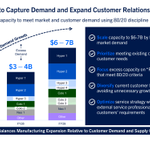
$MOD (now Modexus) laid out 2029 targets at its investor day today. Management expects data center sales to grow from $1.1B to $4.5-6.5B, or 60-80% a year, at a 22-24% EBITDA margin. For the whole company, they’re targeting $5.7-7.7B in sales at a 19-21% margin.
Getting there hasn’t been smooth. Data center margins fell from 19.4% last year to 15.1% in the first half of this fiscal year, after shortages of key parts hit in Q1. They admit it caused production disruptions and launch delays, and they had to pay up for supply. They expect margins back to 20-21% in the second half, with price increases doing most of the work.
They’re also building fast. The plan takes data center capacity from $2B today to $6-7B by 2029. Plants doubled from 7 to 14, and chiller lines go from 4 to 25. On their chart, two hyperscalers take up about 45% of the 2029 capacity.
All that building costs cash. Free cash flow was 3.3% of sales last year and negative $140M last quarter, and even the 2029 target is only 5-6%.
For comparison, $VRT did a 25% adjusted operating margin last quarter, and turned 15% of sales into free cash flow.
Modexus puts the full cooling setup for a data center at $0.8-1.0M per MW. At that price, the $78B 2030 market they cite implies roughly 80-100GW of data centers cooled in that year alone.

Soitec just reported earnings. They’re the sole supplier of the wafer under AI’s shift from copper to light.
Photonics did ~$125M in H1, up 2.6x from a year ago and now about a third of revenue. They beat their own ~2.3x target. Q3 is guided at ~$90M on its own, vs ~$25M a year ago. The report says CPO was a key driver of the acceleration.
The bigger number: ~$1.2B in customer commitments, backed by cash deposits. That’s about 4x this year’s photonics revenue. Customers have already prepaid €106M, up from ~€17M a year ago. Most are locked in through 2028, and volumes beyond that are already being discussed.
To meet it, they’re pivoting their newest French fab, Bernin 4, away from silicon carbide to SOI. They took a €46M write-down to make the switch. A Singapore extension comes next, and capex was raised to €130M from €100M.
The rest of the business is turning too. Their smartphone filter wafers (POI) more than doubled y/y. For the first time in a while, the outlook calls for a slight increase in RF-SOI volumes, after a long customer inventory correction.
The full-year photonics guide of “above $300M” looks pretty conservative, with $90M in Q3 alone.
The 33% gross margin includes ~6 points from stretching tool depreciation from 8 to 10 years, so underlying is closer to 28%. H2 also carries pivot costs while the fabs convert.
Demand has been proven. Now it’s time for margins to be tested.
$SLOIF $SOI

Microsoft and Intel announced a long-term deal. Most of it is Microsoft buying CPUs, which it already does. No firm value, no exact terms released.
However, Microsoft is now the first company to use Intel’s EMIB packaging for Azure’s chips. Packaging, not wafers.
Same thing $NVDA just prepaid for.
$INTC $MSFT
$NVDA earnings thoughts, after sleeping on it and rereading it all.
AI compute is getting more expensive, not cheaper. B300 rental rates are up 60%+ since launch. Old Hopper chips are re-contracting at up to 2x their original price. Token prices fell ~60% since May, usage exploded, and the GPUs underneath got pricier to rent. Q4 margin is the “bottom” because $NVDA honored old orders at old prices. New pricing comes next year.
$NVDA has $118B in guarantees backing the buildout. $105B of it is one campus in Ohio, for one tenant, OpenAI, online in 2028. A new line in the CFO commentary says the guarantee only starts once the builder raises its own financing. If they can’t build, Kress: “our guarantee doesn’t exist anymore.” The backstop shows up after the money is already there.
The cash priority, per Kress: buybacks first, prepaying suppliers second, customer financing last, because “a lot of things have changed over this last quarter.” New supply deals on the call with Kinsus, Samsung Electro-Mechanics and SPIL. Amkor, Ibiden, KYEC and Unimicron last month. $NVDA’s money is going to substrates and packaging.
Malaysia never came up once on the call. Monday’s new US rule says any data center renting more than ~222 B300s’ worth of compute to Chinese companies needs a license. That’s about three racks. Malaysia, Singapore, Indonesia, Thailand, and Brazil now need licenses just to receive the chips.
Malaysia has ~2GW running in one province and ~10GW under construction. NYT reporting ties about half to China-domiciled companies. Korea’s chip exports there were +341% y/y in early November, faster than any other country.
China got a number and an exclusion: $2.4B last quarter, none in guidance, shipments stopped. The new rule got one sentence, “demand far exceeding supply,” and they’re “still studying” it. The 10-Q will shed more light when released.
I think it’s more tenant swap than lost demand. The buildings and power stay, and US companies can still rent them if they report monthly. But nobody outside $NVDA knows the true size of that swap.
$NVDA also disclosed Anthropic’s run-rate of $81B.
Going forward, neutral on $NVDA for now. Under 10x next year’s earnings is cheap, but gaps remain. The litigation and Washington side isn’t close to done, and everyone’s focused on China while Malaysia and the rest of Southeast Asia are the bigger unknown.
If you think they keep executing, there’s an easier buy than $NVDA itself: who they’re paying. $AMKR, $ASX, Ibiden, Unimicron, Kinsus, Samsung Electro-Mechanics. $NVDA is prepaying their capacity, and most of them are down hard from October.
Texas just handed SpaceX $SPCX the air permit for its $24B AI data center at Starbase: 35 gas turbines, about 748MW, on 444 acres.
The filing names every turbine:
- 18 Solar SMT-130s from $CAT’s Solar Turbines, the same model running xAI’s Colossus in Memphis
- 9 Mitsubishi FT8s
- 8 $GEV TM2500s, GE’s trailer-mounted turbines
SpaceX says all of them are “used and/or refurbished,” and it bought none directly from the manufacturer. New turbines are sold out for years, so the AI build is now buying used ones.
They’re also temporary. The filing says they’ll be replaced by 8 GE 7E heavy-frame turbines, about 708MW, also used. GE Vernova gets paid on both rounds through parts and service.
The detail that matters most is the emissions cap. The permit limits NOx, the main smog pollutant, to 248.86 tons a year. The federal line that triggers a full major-source review is 250 tons. SpaceX came in 1.14 tons under.
That cap also limits how hard the plant can run. A local outlet that read the filing estimates full output would emit about 458 tons a year. Under the cap, the plant can average only around half its 748MW.
The clock matters too. The TCEQ, the state agency that signs off on anything that burns fuel, says it has “resumed” permitting AI facilities after Governor Abbott paused them in September. Democratic Governor-elect Gina Hinojosa takes office around January 19 and promises a data center freeze. An issued permit is hard to undo, since the TCEQ’s three commissioners are Abbott appointees on staggered six-year terms.
Every AI power project waiting at the TCEQ now has about nine weeks. ERCOT, the Texas grid, hasn’t approved a new large load to connect since August.

ERCOT just released its October report, and the most important slide is about data centers.
Texas has approved 9,456MW of large loads, mostly data centers, to connect to its grid. For nine straight months, about 4,000MW of that was actually running. In October it jumped to 5,115MW, the biggest monthly increase on the chart.
The other half of the chart is what matters. Total approvals barely moved all year, from 8,786MW last December to 9,456MW today. And there have been zero new approvals since August. Texas froze new large-load hookups while it re-studies a queue of roughly 200GW of requests, and the results don’t go to regulators until December 17.
So the data centers already approved are ramping fast, but only about 4,300MW of approved room is left before the cap hits.
Meanwhile, supply is flooding in from the other side. Batteries are now the biggest category in ERCOT’s queue at 160GW, with about 87GW scheduled for 2027 and 2028 alone. Gas projects mostly don’t show up until 2029 to 2032, which is how long new turbines take.
The forward market is pricing exactly that. 2027 Texas power is trading near $41/MWh, down from about $65 a year ago. 2031 is near $58, barely changed. Cheap now, tight later.
Record demand, frozen approvals, and a wave of batteries add up to one thing: the near-term Texas power trade isn’t about generators getting paid more. It’s about who gets through the approval gate on December 17, and who doesn’t need the grid’s permission at all.

The Pentagon has invited seven teams to a laser shoot-off against drones at Dugway, Utah, in mid-December. Systems that perform can get a purchase order on the spot, and up to $200M in contracts is on the table within a year.
The public names are $AVAV, $KBR through Kord, and $LMT teamed with $IPGP on Crossbow. The other four are private: Aurelius, Thor Dynamics, Allen Control Systems, and Yrikka. Thor Dynamics is not $THO, the RV maker.
Only one of the seven teams is already in production. AeroVironment’s LOCUST family runs 20–35kW and mounts on trucks, pallets, and ships. Its production model, the X3, has pulled in about $920M of orders in roughly 10 weeks: $465M from the US Army (its first-ever production contract for a laser weapon), $405M from a Middle East customer and $50M+ from another overseas buyer. On the southern border, it shot down 11 cartel drones in about 10 days.
The rest of the field is earlier stage. KBR’s Firefly runs 5–30kW but engages one drone at a time. Crossbow’s only disclosed buyer is Lockheed itself. Thor’s Laser Armor is 2–20kW and light enough to carry. Allen Control Systems raised $200M at a $2.2B valuation, but its laser is a 3kW unit still in development.
The economics are the whole story. A laser shot costs the Army about $3 to $5 in power, while a missile intercept costs hundreds of thousands to millions. The weapon is expensive, and the shots are nearly free, so the money stays with whoever builds the weapon.
Drone makers have the opposite setup. The Pentagon’s $1B Drone Dominance program pits 25 vendors against each other, pays a fixed price only for drones that pass inspection, and is built to push the price per drone from $5,000 down to about $2,000. Ukraine builds FPV drones for $500 to $1,500.
Drones keep getting cheaper and more crowded. Every one of them is also another reason to buy a laser. Owning the shield beats owning the swarm.

6
846
$VRT just laid out how it plans to shrink part of its own business, on purpose.
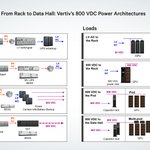
Vertiv made its name selling the boxes between the grid and the servers: switchgear, UPS battery systems, and power distribution. This week, it rolled out a full 800 VDC lineup, the high-voltage DC power $NVDA wants its next-generation racks to run on.
Today’s setup runs grid, medium-voltage switchgear, transformer, low-voltage switchgear, UPS, rack. The top version Vertiv just launched runs grid, switchgear, one solid-state transformer, a battery, and a rack. The low-voltage switchgear and the UPS are gone. Vertiv says it cuts two to three conversion steps, and a single 5MW unit can power a 4.8MW GPU pod at up to 98% efficiency.
The rack version is built for existing buildings. It keeps the old AC gear upstream, moves power conversion and batteries into a cabinet next to the server rack, and frees 8 to 16 slots inside the rack for more GPUs.
Storage is built into every level, from 50 seconds of battery hold-up at the rack to fault ride-through at the transformer.
The 800 VDC ramp follows Nvidia’s next rack generation, which is slated for 2027. These are pilots today, so volume lands in late 2027 into 2028.
Vertiv isn’t alone. $GEV, $ETN, Schneider, and Delta are all building solid-state transformers and DC gear for the same slot.
Meanwhile, the world's biggest companies are paying to get into what Vertiv already does. Samsung bought FläktGroup for €1.5B last year and is now in talks to buy $MOD, a $5.6B cooling company. $SLB is buying Kelvion for $3.4B to get into data center cooling.
Vertiv is already #1 in data center cooling, and #1 in large UPS and power distribution. It sells to hyperscalers, colos, neoclouds, and enterprises in 130+ countries, so it doesn’t need any one customer to win. The content it sells per megawatt rose from $2.75-3.0M to $3.25-3.75M.
And it has the people. In a buildout where skilled electricians and techs are among the hardest things to find, Vertiv has about 5,300 field service engineers, 31 training academies, and 32 factories, building more of the system in the factory so less has to be done on site.

This weekend, two American rockets flew. $SPCX caught a Starship upper stage. ULA’s Vulcan, owned by $BA and $LMT, failed about 10 minutes after liftoff. It was Vulcan’s first flight back after a nine-month fix, and it lost 40 $AMZN Leo satellites.
The Pentagon was waiting on that flight to clear Vulcan again. The Space Force counts on it for about half of its major national security launches through the early 2030s. It’s also Amazon’s second lost batch this year, after Blue Origin lost 48 in May.
The backup is thinner than people think. SpaceX is cutting Falcon 9 to about 140 launches this year, down from 165, and winding it down before Starship is ready to replace it. In October, nobody bid on three Space Force missions, not even SpaceX.
So America’s path to orbit is one company, and that company is rationing.
Today Iridium $IRDM switched on NTN Direct. It’s the first global satellite service that talks to devices on the standard cell protocol, the low-data kind used for texts and trackers. $RKLB agreed to buy Iridium for about $8B, closing mid-2027. SpaceX bought its own spectrum to get into the same business. $ASTS is leasing airwaves in Iridium’s band and paying Firefly $1.3B to build it a rocket.
Everyone is landing on the same idea. A constellation is worth little if you can’t launch it, and a rocket is worth more when you have your own satellites to fill it.
Rocket Lab is getting the airwaves, the satellites, and the government customer. What it’s missing is the rocket: Neutron slipped to 2027, and the stock is down more than half from its high.
The market is paying up for SpaceX’s monopoly and selling the companies trying to break it. But a monopoly that can’t keep up with demand is the best setup a second supplier will ever get.

1
16
1,182
Been quiet on here for a while. Head down, building @CVResearch_ with @CKCapitalxx and a few other things behind the scenes.
This is the part I’ve been waiting for. The market’s scared, the narratives are breaking, and the gap between what people see and what they’ll say is the widest it’s been all year.
Back on here daily. The journey restarts.
“Brilliant thinking is rare, but courage is in even shorter supply than genius.” - Peter Thiel
Vantix Research retweeted

Joint Statement from Department of Commerce and Department of Justice on Megaspeed Investigation.

$AAPL $QCOM $MU
New Morgan Stanley survey: only 41% of people plan to upgrade their phone next year. The average replacement cycle hits a record 4.4 years. Phone prices are up 28% this year and 53% over five years, mostly because memory got so expensive.
Phone shipments are on track for a record 14% drop in 2026, and MS now sees another 5% drop in 2027. Android takes the hit at -9%, while iPhone grows 7%. AI also fell from the #4 to the #7 reason iPhone owners give for upgrading.
Stocks aren't pricing any of it in. Since June, smartphone stocks are up 5% while AI hardware stocks are down 20%. Smartphone valuations barely moved, while AI hardware valuations fell 44% even as earnings estimates went up.
Investors ran into phone stocks to get away from AI. AI infrastructure is a major reason phones are getting squeezed: data centers are soaking up memory supply, pushing prices so high people stop upgrading. The “anti-AI” trade is an AI trade, just on the losing side. Apple is the one phone maker gaining share through this. The Android supply chain pays for it.

1
8
1,124
$GD $HII $RTX $KTOS
General Dynamics’ backlog jumped $84B last quarter to a record $220B. Only about $8B of that jump is funded. The rest is signed contracts Congress hasn’t paid for yet. Huntington Ingalls added $33B this year, and about $6B of it is funded. RTX’s new missile deals, worth up to $74B, are “subject to Congressional appropriations made on a fiscal year basis.”
That money now has to come from a government spending more on interest than on its entire military, and a Democratic Congress that wants about $500B less in defense spending than the White House asked for this year.
Most of these contracts won’t get canceled. They’ll get paid slower. A lot of this work is fixed-price, so slower payments plus inflation means thinner margins on the record backlog everyone is cheering.
The number that matters is funded backlog, not total backlog. Kratos is down 76% from its high, and 78% of its backlog is funded. General Dynamics is 51% funded, Huntington Ingalls 44%. The market is chasing record backlog headlines while barely checking how much is actually funded. The names that are already funded are the ones getting dumped.
Which one gets paid first when the money runs short?

1
7
783
PJM runs the power grid for 13 states plus DC, including Virginia, home to the biggest cluster of data centers in the world. Today it asked FERC, the federal agency that regulates the grid, to approve a new rule. Any data center using more than 50 MW would have to stay connected when the grid has a brief voltage or frequency dip, instead of switching over to its own backup power. New data centers couldn’t plug in until they comply, and existing ones would get one year.
The rule comes after July 22. A power line in Virginia faulted, and 3,870 MW of data centers dropped off the grid in 91 seconds. That’s about enough power for 3 million homes, and it was the biggest drop in PJM’s history.
To ride through those dips, data centers need batteries and backup power systems sitting between the grid and their servers. $VRT $ETN and $GEV sell that equipment.

Vantix Research retweeted

Last night an AI agent performed brain surgery on a mouse.
We gave it 19 gene therapy vectors in a spreadsheet, a mouse model of epilepsy, access to a motorize surgery rig with cameras and one goal: reduce seizures.
It picked the drug. It picked the brain region. It derived the coordinates from three papers. Then it drove the stereotaxic arms into the brain and injected 250 nanolitres while watching the entry site through the rig camera for bleeding.
A licensed vet gated every irreversible step and held a physical kill switch to stop the AI agent.
Thread on what it decided, what it saw, and the moment it refused to let me override it.
[Writing this on the spot out of excitement, but I've been 18hrs in front of my laptop coding and coordinating this, so keeping it brief and descriptive, more cohesive thoughts on this soon...]
