

Hindu. Libertarian. Contributor in philosophy, religion, and politics. satyam muktaye (truth liberates)
New York, NY
Joined June 2011
- Tweets3K
- Following291
- Followers551
- Likes26.5K




🎯

My parents paid $16,000 for the house I grew up in. It’s now worth $783,000 on Zillow.
Sounds like they made a fortune, right?
In gold terms, that house cost 450 ounces in 1962. At today’s gold price, it’s worth 250 ounces.
The house actually lost value.
Politicians get away with robbing working class people blind because most people don’t realize their nominal gains aren’t real gains.
They think they’re inflation-adjusted rich, but they’re not.

Gopal Saraswat retweeted

Inflating away the debt is the oldest trick in the sovereign bankruptcy playbook.
The U.S. federal debt sits above $40 trillion. Congress cannot tax enough to close that gap without triggering a political revolt, and cutting spending requires courage that Washington has not displayed since roughly never.
So a third option emerges: print dollars until the real value of that debt shrinks to something manageable.
Here is how it works: The Treasury owes creditors fixed nominal amounts. A bond that promises $1,000 in ten years still pays $1,000 nominally, but if the Federal Reserve has expanded the money supply enough to push cumulative inflation to 40%, that $1,000 buys what $600 buys today. The government repays in diluted dollars. Debt-to-GDP falls because the denominator (a nominal GDP inflated by new money) grew faster than the debt stock, not because Washington became fiscally responsible.
Who bears the cost of this? Your savings account, your pension, your paycheck's purchasing power, all of it transfers quietly to the federal government and to the first recipients of newly created money. Inflation is a tax. It is the most politically convenient tax ever invented because no congressman has to vote for it.
Foreign creditors, Japan and China holding combined trillions in Treasuries, get cheated alongside you. At some point they stop buying. Then the Fed must purchase the bonds directly, and the spiral accelerates past the point where "manageable" means anything at all.


Gopal Saraswat retweeted

My salute to the Indian pilot Captain Smit Machchhar for his extraordinary bravery.
Despite being stabbed and seriously injured, he fought back, resisted, opened the cockpit door, and enabled passengers and crew to overpower the attacker — preventing a catastrophic mid-air disaster.
He saved the lives of 174 people, including Israeli citizens and other nationals.
I wish Captain Machchhar a speedy and full recovery.
He is a true hero.
teapaw.org/i/grok/share/bGVnYWN5_…
A must read for anyone honestly trying to understand why central planning does not - cannot - work.
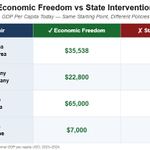
The net cost is always greater than the benefit. This is true for every tariff. Every subsidy. Every government intervention in the economy. There are no exceptions.
The most active governments do the most damage, producing the most corruption and stagnation.

Every tariff puts a visible winner on TV and buries the losers where no camera follows.
When Trump slapped 25% tariffs on Canadian steel in 2025, American steel producers cheered. Politicians pointed to those mills. Journalists photographed those workers. Nobody photographed the automakers in Michigan paying higher input costs, or the consumers absorbing those costs in vehicle prices averaging $1,200 more per unit according to Anderson Economic Group.
Frédéric Bastiat laid this out in 1850. The seen is the protected industry. The unseen is every downstream producer who now operates with a cost disadvantage, every consumer who buys less, every dollar of capital that flows into a politically protected sector instead of somewhere it would have gone voluntarily.
A tariff redirects production, at gunpoint, away from efficient allocation toward politically favored allocation. The steel worker keeps his job. The appliance manufacturer cuts ten jobs you never hear about. The net result is destruction of real wealth.
Governments run this scam because the winners are concentrated and loud, and the losers are diffused and silent. You don't know which products you didn't buy because tariffs quietly raised their prices out of your range. That invisibility is the entire political mechanism.
Politicians manufacture a crisis, protect an industry, and collect the credit. You pay the bill through higher prices, and you never even see the invoice.

🎯

I have said this many times and I will say it again: foreign powers are behind the caste war in India. These powers are:
CIA
Chinese Communist Party
Vatican
ISI
Some sold-out Indians who keep visiting USA and UK including political leaders, media houses, activists, Marxist professors, and NGOs are executing this sinister agenda of India’s enemies. A political party and its student organisations are directly connected to CCP. They supported China in 1962 war also. I have already exposed role of Europe based Church in SC/ST amendment act 2015.
The aim of the CIA and CCP is to keep India in conflict so that its economic growth is stalled. The aim of the Church and ISI is to control India by destroying Hindus through an inter-caste civil war.
As for India, I do not know whether it will become a Christian country or an Islamic country at the end
General, OBC, SC, and ST communities must understand that they are all being used. They are just pawns on this grand chessboard.


Gopal Saraswat retweeted

Palantir Co-Founder: AI Panic Is Being Used To Push Communism, Globalism, And Regulatory Capture realclearpolitics.com/video/…




Need a firewall between politics and economics.
It's time for the separation of money and state:
The state's monopoly on money is the original sin of modern economics. Every other government intervention you suffer under depends on it.
Before 1913, private banks issued competing notes backed by gold. A bank that overissued faced immediate redemption pressure from rival institutions. The discipline was mechanical and merciless. When the Federal Reserve centralized that function, it removed the punishment for overissuance and handed politicians a printing press in a marble building and formal titles.
Ludwig von Mises identified inflation as a tax in 1912. Every dollar created without corresponding production transfers purchasing power from your savings to the first spenders, which are invariably governments, contractors, and politically connected financial institutions. By the time the newly created money reaches your wage or your savings account, prices have already adjusted upward. You absorb the cost. The Treasury captures the gain.
Currency competition, not central planning, produces monetary discipline. El Salvador's 2021 Bitcoin adoption experiment, whatever its stumbles, demonstrated that states are not the only entities capable of running a monetary system at scale. The technology exists. The political will is the variable.
The deeper point is constitutional, almost philosophical. Separation of church and state recognized that fusing spiritual authority with political power corrupts both. The same logic applies to money. Give the state control over the unit of account and it controls the terms of every transaction, every contract, every act of saving you attempt. Control over the unit of account is total power, exercised quietly, denominated in percentage points, and blamed on supply chains.

Gopal Saraswat retweeted

Folks in Michigan: Jamaat-e-Islami and Muslim Brotherhood networks—foreign-origin movements with U.S. proxies—are running a coordinated campaign against American Hindus. They are pressuring allied politicians to refuse donations from Hindu Americans.
Every American who opposes imported Islamist bigotry should reject candidates who enable this anti-Hindu agenda.
Hindu Michiganders, Register to vote.


The license-permit Raj lives on even today!
There is an alternative, and it can be tested with minimum risk and disruption.
Reclaim Indic Prosperity: tinyurl.com/bdfudhtx
7k words, 30 min read
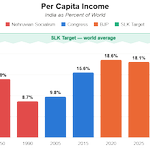
Nehru built India's poverty with regulations. The Import Substitution Industrialisation policy, formalized through the 1956 Industrial Policy Resolution, handed bureaucrats the power to decide which industries lived, which died, and which foreigner could never compete.
They implemented the License Raj: a system where producing a bicycle required government permission, and importing steel meant navigating a labyrinth designed to protect domestic manufacturers from the terrifying threat of better, cheaper alternatives.
The logic sounds reasonable on the surface. Build domestic industry. Stop importing what you can make yourself. Become self-sufficient. Protection removes the competitive pressure that forces producers to improve. Without foreign competition, Indian manufacturers had no incentive to cut costs or raise quality. Consumers paid the price, literally.
Take the Ambassador car, built by Hindustan Motors from 1958 until 2014. The design traced back to a 1956 British Morris Oxford. Fifty-eight years. Same car. Protected from foreign competition, the company produced an outdated vehicle at inflated prices. Industrial success! Indian families funded this arrangement through higher prices on every purchase.
The 1991 crisis forced partial liberalization. India's foreign reserves dropped to roughly two weeks of import cover. The government opened the economy partially, and growth followed. Manufacturing competitiveness improved wherever the state loosened its grip. The lesson wrote itself in GDP data.
India's current tariff structure still runs high by global standards, with effective rates on electronics and textiles protecting incumbents rather than consumers. Every tariff is a tax on Indian buyers, transferred directly to a producer who lobbied well enough to avoid competing fairly. The poor pay disproportionately. They always do.
