


Vish Rao retweeted

Repurposing adult AI radiograph models for neonatal care through continual learning: an international multicentre study go.nature.com/4B1rzP4

Medical AI is built for adults, and newborns are left behind.
Out today in Nature Biomedical Engineering (@natBME): we took an AI model built to check breathing tube placement on adult X-rays and adapted it for newborns by sending it to 30 NICUs in 20 countries and territories. Learning from just 50 X-rays at each, it pinpointed the tube tip and the base of the windpipe more accurately than hospitals' own models at 29 of 30 sites, even at hospitals it had never trained on.
Why it matters: only 17% of FDA-authorized AI medical devices are labeled for use in children, largely because pediatric data is scarce and hard to share. Out of the box, the adult model misplaced the tube tip on newborn X-rays by more than 5 cm, about the length of a newborn's windpipe, in 37% of cases.
So instead of pooling data, the model travels: it's fine-tuned on 50 X-rays at one hospital, then passed to the next. We simulated this using real X-rays from 30 NICUs, an approach designed so patient data never has to leave a hospital.
Across 30 NICUs:
• Large errors (over 5 cm) fell from 37% to 2.6%
• Better at flagging dangerously deep breathing tubes at 27 of 30 sites
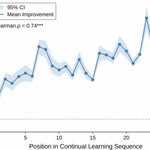
• Gains grew with every hospital added, with no plateau
It's been surreal working with such a diverse global team. My goal is closing the gap between AI development and real impact for patients. This is one step: it removes a major feasibility barrier, scarce and siloed pediatric data, and could help open the door to a new generation of pediatric AI.
Paper, code and figures below 👇
Grateful to @pranavrajpurkar, @emma_ychen and our team of 75 researchers across 20 countries and territories (full team below)
@harvardmed @PennMedicine @BrighamWomens @StanfordMed @GreatOrmondSt @KU_Leuven @UAlberta @UniklinikEssen @TelAvivUni @OsakaMetUniv_en @AUB_Lebanon @AUBMC_Official @SidraMedicine @ChildrensColo @SLU_Official @Newark_Beth @MedUnivSC
Thank you to our full team: @emma_ychen, Agustina Saenz, @obanerjee13, Henrik Marklund, Lucas Bijnens, Sung Eun Kim, Evan Zucker, Susan Shelmerdine, Jeremy Palacio, Kent Ryan Kleinschmidt, Sathvik Suryadevara, Sri Sai Dinesh Jaliparthi, Jiaxi Lu, Rithvik Akula, Mario Scala, Julian F. Niedermair, Nikolaus Stranger, Sebastian Tschauner, Georg M. Schmölzer, Maria Jose Veloza Vega, Juan Sebastián Osorio Valencia, Oscar Jaramillo Robledo, Oscar Julian López Uribe, @AfatDr, @KuestnerThomas, @starasteh, @DanielTruhn, Kelsey L. Pomykala, @JensKleesiek, Naela Himayati Afifah, Rozan M. Irfan, @RezaShahriariMD, Amirhossein Erfani, Israel Amirav, Moria Be'er, Yasuhito Mitsuyama, @DaijuUeda, Alain S. Abi-Ghanem, Safaa Al Zakleet, Mossad Abdelhak Shaban Mohamed, Wan Irfan Bin W Mustapha, Naila Nizami, Rafeah Khan, Khalid Al-Kharazi, Zafar Iqbal, Abdullah Al Shahrani, Amna Kashgari, Tijana Prodanovic, Nikola Prodanovic, Lim Shi Wei Desmond, James Thomas Patrick Decourcy Hallinan, Phumza Nongena, Melissa Louise Cooke, Montserrat Bret-Zurita, Almudena Alonso-Ojembarrena, Alexandra Nemes, Yung-Chieh Lin, Wei-Ting Lin, Wen-Hui Fang, Chin Lin, Atchara Mahayosnond, Sira Sriswasdi, Piyapong Khumrin, Suphakris Tanmuk, Didem Arman, Serdar Cömert, Serdar Alan, Umit Ayse Tandircioglu, David Andrew Mong, Esther Chung, Michael Sadler, Morgan P. McBee, Richard H. Jones and @pranavrajpurkar 🙏
1
323
The more hospitals the model visited, the better it got, averaged over 300 random orders of hospitals. The same framework could potentially be extended to other populations underrepresented in AI training data.

33
The clinically critical case: a tube placed too deep can collapse a lung. Even at hospitals it had never trained on, the traveling model was better at flagging these than a model trained on that hospital's own X-rays at 27 of 30 sites.

44
At each hospital the model had never trained on, it beat a model trained on that hospital's own X-rays at 29 of 30 sites. Average tube-tip error: 0.67 cm vs. 1.29 cm for single-hospital training vs. 4.30 cm for the original adult model.

52
What this looks like: predicted vs. true tube and airway positions on newborn X-rays, before and after adaptation.

63
📄 Paper (open access): nature.com/articles/s41551-0…
💻 Code: github.com/rajpurkarlab/MAID…
📰 Harvard Medical School story: hms.harvard.edu/news/childre…

Vish Rao retweeted

Generalist biological artificial intelligence in modeling the language of life go.nature.com/3NdkqaE

Vish Rao retweeted

AI to understand the language of life.
Our review @NatureBiotech just published
nature.com/articles/s41587-0…
Free access rdcu.be/e89lQ
@VishRao5 @serena2z @BrianPlosky @pdhsu @BoWang87 @james_y_zou @marinkazitnik @pranavrajpurkar

Vish Rao retweeted
Our @Nature paper today on multimodal generative #AI for interpretation of medical images and generating reports across many specialties nature.com/articles/s41586-0…
@pranavrajpurkar @VishRao5

