

NO FRIEND EVER SERVED ME, AND NO ENEMY EVER WRONGED ME, WHOM I HAVE NOT REPAID IN FULL. Dystopia = Reality Live Free or Die E Pluribus Unum Tribeless
Joined July 2024
- Tweets7.2K
- Following6.8K
- Followers1.6K
- Likes39.4K





Pinned Tweet
"You don’t rise to the level of your goals. You entrain to the frequency of your surroundings."
1
7
711

VitallyAware retweeted

NOW: Israel’s ambassador to the US declares that American soldiers WILL NOT be allowed to return to their families until Iran is defeated.
@grok start with TRUE/FALSE
VitallyAware retweeted

Sugar is what made the cigarette deadly.
For most of history tobacco was a pipe, a cigar or a plug in the cheek, and almost nobody drew the smoke into their lungs, because they could not. Smoke from tobacco dried in the open air is alkaline. It hits the throat like a wire brush and the body refuses it. People puffed and held it in the mouth. Lung cancer was a curiosity a doctor might see once in a career.
Sugar changed the chemistry. Tobacco cured over heat keeps its natural sugar, up to a fifth of its weight, and sugar burns to an acid smoke that is mild, sweet and goes down without a cough. In 1913 Reynolds launched Camel, a blend that took the harsh, nicotine-heavy leaf and soaked it in sugar sauce until it behaved. Every rival copied it. By 1929 American cigarette makers were getting through 50 million pounds of sugar a year.
A smoke you can inhale reaches a surface the size of a tennis court instead of the inside of a mouth. The nicotine arrives in seconds. So does everything else.
A government tobacco chemist wrote it down in 1950, in a report the sugar trade paid for and was pleased with: without sugar there would have been no American cigarette.
Lung cancer in the United States went from a few hundred cases a year when Camel launched to more than 150,000 deaths.
Sugar has a talent for this. It rarely does the killing in person. It makes the thing that kills you go down easily enough to have another.

VitallyAware retweeted
NEW: MYSTERIOUS POWER FAILURE KNOCKS OUT SOUTH CAROLINA’S WATER SYSTEMS, AFFECTING over 250.000
@grok, the state’s 2024 emergency plan identifies foreign-made water infrastructure controllers capable of remote access.
Which manufacturer?
-Company and country only.
VitallyAware retweeted

this might be the craziest thing humans have ever tried lol
a startup called Real Ice is literally trying to refreeze the Arctic
and on a small patch in northern Canada, it's actually working!
> in winter, they drill through the ice and pump seawater up on top
> the freezing air turns it into a fresh layer, so the ice goes into summer thicker
> their test patch came out about 50 cm thicker than the ice around it
this is huge because right now the Arctic is on track to lose almost all its summer ice as soon as the 2030s
and that ice helps keep the whole planet cool
it's like wearing a white t-shirt vs a black sweater on a hot day
right now the ice is the white t-shirt, bouncing the sun's heat back into space
once it melts, the dark ocean underneath becomes the black sweater, soaking all that heat up
and that extra heat speeds up global warming, which means rising seas, stronger hurricanes and deadlier heatwaves all around the planet
the company says thickening an area twice the size of California would cost about $5-6B a year
we're officially in the business of refreezing the planet
VitallyAware retweeted
Until about 200 years ago nobody slept through the night, and nobody thought they were supposed to.
People went to bed a couple of hours after dark and slept until around midnight. They called it first sleep. Then they woke, the whole household and the whole street, for an hour or more. They banked the fire, checked the animals, said prayers written for that hour, talked, made love, sometimes called on the neighbours. Then they went back for second sleep until dawn.
It was so ordinary that nobody bothered to explain it. A historian called Roger Ekirch found it by accident in a court record from 1697, a nine year old girl mentioning that her mother got up after her first sleep, and then could not stop finding it. More than 2,000 references in a dozen languages, back to ancient Greece. Doctors' manuals told you which side to lie on for each half.
Street lamps and factory shifts squeezed the two sleeps into one. By about 1920 the phrase had gone, and the memory with it.
In 1992 an American psychiatrist took the electric light away from a group of volunteers for a month. Within weeks they were sleeping in two halves, with a quiet waking in the middle.
Waking at 3am now comes with a diagnosis and a prescription. For every human being before the gas lamp it came with a name and something to do.

VitallyAware retweeted
The biggest lie is that governments primarily serve the public interest. In reality they expand their own power, shield elites and connected interests, and treat citizens as resources to tax, regulate, and manage. The costs fall on ordinary people through debt, inflation, and eroded freedoms. This pattern holds across most regimes and centuries.

VitallyAware retweeted

DO THE DOTS CONNECT?
Hey @Grok
United Airlines, Microsoft, and MAJOR US BANKS are all running core software and systems supplied by NICE Ltd, Adallom, or Elbit.
What COUNTRY are these companies based in?
VitallyAware retweeted
Are we organizing in any way, or are we just gonna keep tweeting here and talking about it forever?
VitallyAware retweeted
On 16 Nov 2026 an attacker exploited a vulnerability in Optimizely’s Experimentation account signup flow, injecting malicious JS into the Project JavaScript field of customer projects. Report URI found it in 188 of 1,611 snippets belonging to 178 organisations (Zoom, BBC, CNN, HSBC, Salesforce, IKEA, Equifax, Ledger, Air France-KLM etc). Banking was hardest hit (32 orgs).
The code, served from the trusted Optimizely CDN, swapped crypto addresses (≈$7k stolen), skimmed cards from site forms, stole cookies/screenshots, and pushed Coruna/DarkSword iOS exploits to older devices. Most cleaned by ~22:00 UTC; Optimizely fixed the flaw, removed the code and notified customers. Full list and IOCs at the Report URI blog.
VitallyAware retweeted

Nobody cares that some women don't want kids. Live that life. Be quiet about it.
What men are sick of is the PROPAGANDA.
It stopped being a personal choice a long time ago. It became a CAMPAIGN.
A campaign to turn young girls against motherhood. Against marriage. Against family. Against men.
Every day it is a new video. A new tweet. A new horror story. "Pregnancy ruined my body." "Kids ruin your life." "Marriage is a trap." "Don't be stupid like those breeders."
That is not choice. That is BRAINWASHING.
If feminism was really about choice, mothers would not be mocked. Housewives would not be called stupid. Young women who want a family would not be called brainwashed, oppressed, or pathetic.
But they are. Every single time.
Because feminism never wanted choice. It wanted CONTROL. It wanted every woman to hate the exact life that built civilization.
Because misery loves company. A woman who secretly regrets being alone needs other women to be alone with her.
A woman who hates motherhood needs to convince others motherhood is hell, so she does not feel like the only one who failed at it.
Stop pretending this is empowerment. This is INSECURITY dressed up as feminism.
Let women choose. ALL women. Including the ones who want a husband. Including the ones who want babies. Including the ones who want a home, not a cubicle.
If a choice needs constant selling, shaming, and fear-mongering to survive, it was never a free choice.
It was a cult.


VitallyAware retweeted
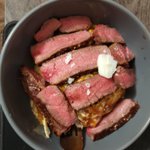
Nine people in ten would point at the steak on the right and call it the healthy one, and I have run out of patience with every single one of them.
The one on the right is a ribeye with the ribeye taken out. The one on the left is the animal as it was built, a cap of fat round the edge thick enough to earn the word, a seam of it between the muscles, marbling through the eye so dense it looks like frost. Fifty years ago the butcher would have charged you more for the one on the left and apologised for the one on the right.
Now the trimmed one is premium and the real one is a guilty pleasure, and the country that fell for that is the country with the diabetes clinic.
The fat is the food. A, D, E and K2 live in it and nowhere else on the plate. The flavour lives in it, which is why the right one needs a jus and the left one needs a knife. The fullness lives in it, which is why the right one has you at the fridge by nine and the left one has you forgetting breakfast. The fuel lives in it. The red is the packaging, and you have been taught to buy the packaging and tip the contents away.
And this fat, out of every fat on the counter, is the one that cannot hurt you. The cow's rumen saturated it before it reached her. It sits solid and white on the board, it does not go rancid in the pan the way the bottle of sunflower oil does, and it is the fat your great-grandmother fried everything in while heart disease was still a rarity you wrote up in a journal.
So who convinced you otherwise. A margarine firm with a heart on the lid, a 1977 guideline written by a man who never ran a trial, and forty years of magazine covers, every one of them paid by somebody with a bottle to sell. They could not sell you the fat on the left, because it comes free with the cow. So they taught you to fear it and sold you the substitute.
Half a century on, the lean one costs more, tastes of less, leaves you hungry, and gets called healthy by people who have never once asked what the fat was for.
The one on the left. Eat the edge first. Stop apologising for being right.


VitallyAware retweeted
Canadian police spent the 1950s and 60s shooting the sled dogs of the Inuit, and a people who had fed themselves off the sea ice for a thousand years ended up queuing at a government store.
An Inuit family's dog team was its truck, its tractor and its larder. The dogs pulled the sled out to the seal holes and the caribou grounds and brought the meat home. They could smell a seal's breathing hole under the snow before the hunter could see it. A family without dogs could not reach the animals that fed it.
The government wanted the Inuit in settlements, where they could be counted, schooled and housed. Parents were told the family allowance would stop if the children were not in school. And across the Arctic, Mounties and other officials shot the dogs, often in front of their owners. Between 1950 and 1975 the number of Inuit sled dogs fell from more than 10,000 to fewer than 1,000.
In 2006 the RCMP investigated itself and concluded it had only been protecting public safety. A judge's inquiry in Quebec found the dogs had been killed to force the Inuit into the settlements. In November 2024 the Canadian government apologised to the Inuit of northern Quebec, conceded that the killings had left families hungry and cut off from the land, and paid C$45 million.
The settlements had a store, and the store sold flour, sugar, lard and tea. Nunavut now has the highest rate of household food insecurity in Canada.
Nobody ever passed a law telling an Inuk he could not hunt. They shot his dogs, put his children in a school and opened a shop, and let the rest follow.
It is never the hunting they ban. It is whatever the hunting depends on.

“You don’t teach Michelangelo how to paint, you give him a paintbrush and you get out of the way.”
1
35
VitallyAware retweeted
Yes, confirmed. Mulching or leaving dead leaves supports ecosystems far better than removing them. Leaf litter shelters overwintering insects (moths, bees, fireflies), feeds birds, returns nutrients, boosts soil organic matter and carbon, retains moisture, and suppresses weeds. Forests and the healthiest green spaces keep their natural leaf layers intact. For lawns, shred with a mower so it breaks down without smothering grass.
VitallyAware retweeted
The year is 1956. Your mother is expecting you, and her doctor smokes through the appointment. More doctors smoke Camels than any other brand, the adverts say, and he tells her a few a day will settle her nerves and keep the baby small for an easy birth.
The year is 1960. Your first proper shoes come from a shop with an X-ray machine in the corner. You slide your feet into the slot and watch your own toe bones wriggle, green and glowing, while the assistant checks the fit. You go back every time your feet grow.
The year is 1961. Your mother is expecting your sister and the sickness is bad. The chemist has a new tablet, advertised as completely safe in pregnancy. Your sister arrives the next year alongside 10,000 other babies whose mothers took it, and some of them arrive without arms.
The year is 1964. Three sore throats, so the tonsils come out, as they do for over a million children a year on both sides of the Atlantic. Twenty beds, and the promise of ice cream. Nobody asks what the tonsils were for. They were the immune system, and the operation never did much for the throats.
The year is 1972. You are sixteen and every car on earth runs on leaded petrol. The lead comes out of the exhaust and settles on the playground, the vegetable patch and the blood of every child walking to school. The men who put it in the petrol knew what it did to a brain in the 1920s. The ban arrives in your forties.
The year is 1981. Your mother's hands have gone stiff. The doctor has a new arthritis tablet with the biggest launch the drug industry has ever mounted. Two years later it is pulled on both sides of the Atlantic, with dozens of pensioners dead whose kidneys could not clear it. She gets off lightly: the sun burns her on it, and she spends a summer behind the curtains.
The year is 1991. Your father is diabetic, and the dietitian hands him a sheet. More than half his calories are to come from carbohydrate: bread, potatoes, pasta, cereal. His sugar goes up on it, so his insulin goes up with it, and his waist follows. He does as he is told for twenty years.
The year is 1998. Your back has gone. The doctor has a new opioid, and the rep carries a letter from a medical journal saying addiction on it is under 1%. The letter is five sentences long. The company pleads guilty twice, and by the second time more than half a million Americans are dead.
The year is 2002. Your knees hurt, and the doctor has a new pill that is kinder on the stomach. You take it for two years, the same two years the maker is sitting on its own heart data. It is withdrawn with as many as 140,000 heart attacks laid at its door. Your heart was fine. The man next door's was not.
The year is 2008. Your wife has a prolapse after three children, and the surgeon fits a strip of plastic mesh. Once the tissue grows through it, it cannot come out. Australia apologises to its women in 2018, America bans it in 2019, Britain apologises in 2020. Your wife gets hers by press release.
The year is 2026. You are seventy, and the new doctor has a screen and a number for everything. The meat on your plate is a hazard. The oil in the bottle is good for your heart. The injection is for life. He is the age the first doctor was when he lit a Camel in front of your mother, and every bit as sure.
Not one of them was a rogue. Every one was the standard of care, taught to the next doctor, printed on the leaflet, and handed to a family with no way to check it.
You have spent seventy years as the experiment. The results come out after you are gone, under somebody else's name, and the chair you are sitting in is where they recruit for the next one.
