

AI News | AI Tools | AI Agents | AI Automation and Open-Source Updates. Practical insights on what’s new and how to use it.
Joined February 2021
- Tweets58
- Following141
- Followers317
- Likes4.8K








@OpenAI releases a physical controller for Codex for $230
Codex Micro is not a new computer or a separate neural network, but a programmable macro pad for those who run multiple AI agents simultaneously.
What it can do:
🟡 RGB keys indicate the status of the agents: thinking, finished, waiting for a response, or encountering an error;
🟡 Individual buttons allow you to accept or reject changes, open a new chat, and launch a voice prompt;
🟡 Rotating the dial changes the depth of reasoning for Codex: less for simple tasks, more for complex ones;
🟡 Four pre-defined or custom skills can be assigned to the joystick;
🟡 Any keys and layouts can be remapped directly within Codex.
Inside, it features 13 mechanical switches, a sensor, an encoder, a joystick, and six programmable layers. It connects via Bluetooth or USB-C and works with macOS and Windows. The package includes 32 keycaps with icons.
The device is released in a limited edition in collaboration with Work Louder.
Should we buy it?


Hermes Agent can now be integrated directly into your browser
An unofficial extension, the Hermes Browser Extension, has been released. It opens Hermes in a sidebar for Chrome, Edge, Brave, and other Chromium-based browsers.
The main feature: the agent can receive context directly from the browser:
🟡 The content of the active page;
🟡 Selected text;
🟡 Headings, links, buttons, and forms;
🟡 Selected or open tabs.
The extension connects to the actual Hermes Runtime – with your models, tools, skills, sessions, memory, and MCP servers.
It works through a local Hermes instance, a remote gateway, or Hermes Cloud. However, there's a nuance: transferring page context is currently only available for the Local/Remote API, while connecting to Hermes Cloud only works in regular chat mode.
The extension remains read-only: it doesn't click on pages, fill out forms, or request access to cookies, history, or bookmarks.
Currently, this is a public alpha version and is not yet available in the Chrome Web Store – you need to install it manually from GitHub.

Anthropic allegedly tried to charge a Korean user on the free plan $16.6 million, despite zero API usage.
A day earlier, the same invoice showed $1.67 million, meaning it jumped roughly 10x overnight.
The user said he first thought it was phishing. But then he checked the sender and payment link, and both pointed to Anthropic’s official domain.
His bank declined the charge attempts because they exceeded the card’s per-transaction limit.
This comes after auditing startup Vaudit said it found about $1.7 million in overcharges across $34 million in AI invoices, mostly tied to Claude Code.
There have also been months of GitHub reports about contradictory Anthropic billing emails.
Claude may be smart, but the billing system apparently needs a model upgrade.


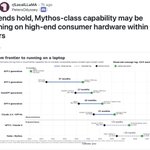
Will Fable 5 be available for local use in two years?
That's the prediction that appeared on r/LocalLLaMA. The author of the graph calculated the time it takes between the release of a leading cloud-based model and the appearance of a comparable open-source model that can be run on a powerful laptop.
The results were:
🟡 GPT-3 reached local models in 37 months.
🟡 GPT-3.5 – in 17 months.
🟡 GPT-4 – in approximately 24 months.
🟡 Claude 3.5 Sonnet – in 21 months.
The average lag time is 24.75 months.
If we simply continue this trend, an open-source model at the level of Fable / Mythos 5 should become available on high-performance consumer hardware around July 2028.
However, it's important to note that this doesn't mean Anthropic will release the original weights of Fable 5. The prediction refers to a future open-source model with roughly comparable practical capabilities.
Furthermore, "running on a laptop" here doesn't mean any laptop for $50,000. It refers to a device with a large amount of memory and a quantized model. Moreover, the author honestly notes that such a comparison does not guarantee complete parity in multimodality, tool usage, speed, and other features.
So, the graph is more of a curious extrapolation based on four observations, rather than a law of AI development.

Grok 4.5 is released to the public
Elon Musk wrote that after the beta, Grok 4.5 will be publicly available on July 9th. The main pitch: Claude Opus level, but faster, more economical in tokens, and cheaper.
What's important according to the official xAI/SpaceXAI docs:
🟡 model: grok-4.5
🟡 tailored for coding, agent tasks, and knowledge work
🟡 context: 500,000 tokens (possibly soon raised to 1 million)
🟡 API price: $2 / 1M input, $6 / 1M output, cached input — $0.50
🟡 there's reasoning effort: low / medium / high
🟡 supports function calling, structured outputs, web search, X search, code execution
🟡 multimodality: text + image → text
🟡 access: xAI API, Grok Build, Cursor, Office add-ins, OpenRouter/Vercel/Cloudflare/Snowflake/Databricks
🟡 not yet available in the EU API Console, promised later this month
The most interesting thing: Musk wrote that Grok 4.5 is based on the 1.5T V9 foundation model, with additional training on Cursor data, and early evaluations are "close to or higher than Opus". But this is still a vendor claim, independent tests are needed.


Based on strong positive feedback from customers in our beta test program, @spacexai will make Grok 4.5 available to the public tomorrow.
It is an Opus-class model, but faster, more token-efficient and lower cost.
China looked at the US and said: "So, you could do that?"
Reuters reports that Beijing is discussing restrictions on foreign access to the most powerful Chinese AI models - including future releases.
According to sources, over the past month, officials have held meetings with Alibaba, ByteDance, and Z.ai. They discussed not only closed models, but also more "open" versions - meaning even models with open weights could potentially be affected.
What they want to do:
🟡 restrict foreign access to frontier models
🟡 tighten control over who can invest in Chinese AI startups
🟡 equate leaks / theft of proprietary AI technologies with a violation of national security law
🟡 for the most sensitive models, consider the option: either only China, or no public release at all
Importantly: these are not yet adopted rules, but discussions. Reuters sources say that the restrictions may only apply to future models, and it's not clear when and in what form this will actually work.

GPT-5.6 Sol, Terra, and Luna are launching tomorrow - OpenAI has officially updated the announcement
It seems that a major release is just around the corner: OpenAI wrote that GPT-5.6 Sol, Terra, and Luna will be publicly launched on Thursday, July 9. And the preliminary access has already started to be expanded globally - so let's go check who has already received it.

Anthropic wants its own AI chip too.
It looks like the AI lab race is slowly turning into a hardware race.
According to The Information, Anthropic has started early work on its own AI chip and has discussed Samsung Electronics as a potential manufacturing partner.
Investing/Yahoo adds that detailed design and production have not started yet, and the project may still never launch.
But the direction is clear: Anthropic wants more control over the expensive infrastructure behind Claude training and inference.
The interesting part is that this is not just “Samsung may help somehow.”
The talks reportedly include Samsung’s 2nm process and advanced packaging.
For Samsung, this could be a major opportunity too. The company has been trying to catch up with TSMC in advanced foundry orders, and landing a major AI customer like Anthropic would be a strong market signal.
🟡 Anthropic already uses AWS Trainium, Google TPUs, and Nvidia GPUs
🟡 Amazon remains a key cloud and training partner for Anthropic
🟡 Anthropic also has a separate next-gen compute partnership with Google and Broadcom
🟡 But even with diversified hardware, scaling Claude still depends on compute cost and availability
🟡 A custom chip could give Anthropic more control over pricing, supply chain, and workloads optimized specifically for Claude


Claude Fable 5 is coming back for everyone - but with caveats on top of caveats.
@AnthropicAI says it is restoring global access to Claude Fable 5 across Claude Platform, Claude.ai, Claude Code, and Claude Cowork.
What happened:
🟡 On June 12, the US government placed export controls on Claude Fable 5 and Claude Mythos 5. Anthropic could not reliably verify user citizenship in real time, so it temporarily disabled access for everyone.
🟡 On June 30, the restrictions were lifted, and Anthropic announced the relaunch.
🟡 Fable 5 will be available globally again, but first with stricter new safety classifiers.
The main catch for regular users:
Fable 5 will be included in Pro, Max, Team, and some Enterprise plans only up to 50% of weekly limits, and only until July 7.
After that, access moves to usage credits, which basically means pay-as-you-go.
One more important note for developers:
Because of the new filters, some normal tasks like coding and debugging may temporarily get routed away from Fable 5 and into Claude Opus 4.8 instead.
Anthropic says it will tune the classifiers to reduce false positives.
Why so strict?
Anthropic points to cybersecurity. Fable/Mythos-class models are very strong at vulnerability discovery, so the company is building stricter safeguard classifiers and a broader industry framework for jailbreak evaluation with Amazon, Microsoft, Google, and Glasswing partners.


WallStreetAIs retweeted

Claude Fable 5 will be available again globally tomorrow.
After a series of productive conversations with the US government, we're redeploying the model with a new set of classifiers to target and block more cybersecurity tasks. In the near term, some routine tasks like coding and debugging will fall back to Opus 4.8. We’ll continue to refine these classifiers over the coming weeks to reduce false positives and better distinguish genuine misuse from legitimate requests.
We’ve also begun drafting a consensus framework—with Amazon, Microsoft, Google, and other Glasswing partners—for assessing the severity of AI jailbreaks and how AI developers should respond to them. We invite other industry partners and model providers to join us in this effort.
Finally, we’re scaling up our collaboration with the US government on model testing and safeguards. This will include pre-release access to models and safeguards for evaluation, information sharing on jailbreaks and misuse, and dedicated resources for joint research.
Thank you to our users for your patience, and to our partners across the government, industry, and the research community who worked alongside us to make Fable 5 available again.
Read our full blog: anthropic.com/news/redeployi…

Why Sonnet 5 can end up costing more than Opus 4.8
Artificial Analysis ran Sonnet 5 in max effort, and the result is not pretty.
🟡 Sonnet 5 generated 300M output tokens on the Intelligence Index
🟡 Opus 4.8 generated 120M
🟡 GPT-5.5 xhigh generated 72M
🟡 Fable 5 generated 87M
So Sonnet 5 is not just “a bit more verbose.”
It burned around 2.5x more output tokens than Opus 4.8, and 4.2x more than GPT-5.5 xhigh.
And that kills the whole “cheaper per token” story.
At the standard $3 / $15 pricing, Artificial Analysis says the full Intelligence Index run cost:
🟡 Claude Sonnet 5: $6,015
🟡 Claude Fable 5: $5,631
🟡 Claude Opus 4.8: $3,753
🟡 GPT-5.5 xhigh: $2,819
Yes, Sonnet 5 currently has promo pricing at $2 / $10 until September 1, so the real cost is lower for now.
If you recalculate the AA run with that discount, it comes out to roughly $4,010.
But even then, Sonnet 5 still ends up more expensive than Opus 4.8 in this test.
Why?
Because in agentic tasks, cost is not just about the price per million tokens.
It also depends on how much the model actually burns:
🟡 Extra tool calls
🟡 Longer thinking
🟡 Overengineering
🟡 Turning a 5-step solution into 15 steps
🟡 More agentic turns
🟡 More reasoning and output tokens
And based on AA’s run, Sonnet 5 behaves like a model that tries really hard.
But then the bill arrives like it was Opus.
For normal chat, this is much less visible.
There are fewer tools, shorter answers, and no constant loop of “think → call tool → check → think again.”
So in chat, Sonnet 5’s discount may actually feel real.
In agents, not always.


My entire AI stack is now Chinese 🇨🇳
87% cheaper. Same revenue.
Swaps by task:
1. Reasoning / backend brain
Opus 4.8 -> Kimi K2.7
Benchmark gap: ~8%
Price: ~11x cheaper
2. Code generation
GPT-5.5 -> Qwen 3.7 Max
Benchmark gap: ~18%
Price: ~7x cheaper
3. Agent loops + tool calling
Sonnet 4.7 -> GLM 5.2
Benchmark gap: ~3%
Price: ~5x cheaper on input
4. Cheap volume / bulk processing
GPT-5.5 mini -> MiMo V2.5
Benchmark gap: ~6%
Price: ~12x cheaper
5. Image generation
GPT-Image-2 -> Wan 2.5
Benchmark gap: ~5%
Price: ~8x cheaper
6. Video generation
Sora 2 -> Kling 3.0
Benchmark gap: roughly equal
Price: ~6x cheaper
Result after 30 days:
Operating costs dropped 87%.
Output quality dropped only 4% on average.
Revenue stayed the same.
The most important part: these models are less likely to disappear overnight, and I can run many of them locally.
No forced lock-in. Less data risk. More control.
And I can fine-tune them for exactly what I need.
Full article drops tomorrow with:
- Exact routing logic by task type
- The 2 cases where I still pay for American models
- The migration playbook anyone can copy in a weekend
Very important to migrate now, before it is too late.

Fable 5 coming back sooner than we expect...

Since June 12, we’ve been working closely with the US government to restore access to Claude Mythos 5 and Fable 5. Today, the government notified us that Mythos 5, our strongest cybersecurity model, can be redeployed to a set of US organizations that operate and defend critical infrastructure.
We’re restoring access for these organizations quickly, and we’re continuing to work with the government to expand access to Mythos 5 and make Fable 5 available for general use again.
🚨 @OpenAI has officially introduced GPT-5.6 Sol, but the release is still not for everyone.
GPT-5.6 is now a full model lineup:
🟡 Sol - the flagship frontier model
🟡 Terra - a cheaper balanced model
🟡 Luna - the fastest and cheapest option for mass tasks
The focus is clear: coding, cybersecurity, computer use, science, and long agentic workflows.
OpenAI says Terra is close to GPT-5.5 quality at roughly half the cost. Sol starts at $5 per 1M input tokens and $30 per 1M output tokens.
But the main story is access.
Because of US government involvement, GPT-5.6 is launching first only for a small group of trusted partners shared with the government.
So the limited, customer-filtered rollout rumors were basically confirmed.
Frontier models are no longer launching like normal software.
They are now treated like dual-use technology.


🚨 US officials are reportedly slowing down the GPT-5.6 rollout.
According to The Information, @OpenAI will not release GPT-5.6 to everyone at once.
Instead, it will first enter a limited preview for select enterprise customers. The Verge says access may be approved by the US government customer by customer.
The reason: security and cyber-risk concerns around the model.
This also fits the broader pattern after @AnthropicAI's Fable 5 and Mythos 5 drama.
Frontier model launches are no longer just product releases.
They are becoming politics, export control, cybersecurity, and a race over who gets next-level intelligence first.

Fable-5 has started reappearing for some users.
After the sudden disappearance and all the export control drama, access seems to be coming back gradually.
Not for everyone yet, but some users are already seeing it again.
So @AnthropicAI may be quietly restoring availability, or at least testing access before a broader return.


WallStreetAIs retweeted
Cursor is preparing a massive new model.
After the whole SpaceX story, it looks like Cursor really wants to stop being just a convenient wrapper around Claude, GPT, and Kimi.
When Cursor released Composer 2.5, there was an important line in the official blog: the current Composer 2.5 is built on Moonshot’s Kimi K2.5, but Cursor is already training its next major model from scratch together with SpaceXAI, using Colossus 2 and roughly 10x more compute.
Now we have more details from Compile and public posts.
This could be a 1.5T+ parameter model, and not just for coding. It may be positioned as a more general frontier model.
In short:
🟡 Composer 2.5 was still tied to Kimi K2.5
🟡 The next model should be trained from scratch, without Kimi as the base
🟡 Training is reportedly happening with SpaceXAI on Colossus 2
🟡 Cursor officially mentions million H100-equivalents and 10x compute
🟡 Fresh reports suggest the model could be around 1.5T parameters and may launch in the coming weeks
🟡 The key point: it is not being positioned as coding-only, but as a broader general model
Cursor may be trying to move from “best AI coding editor” to a serious model lab of its own.

WallStreetAIs retweeted
@cursor_ai is going to @elonmusk for $60B.
SpaceX is officially acquiring Anysphere, the company behind Cursor.
This is no longer the April “purchase option” story. It is now a full Merger Agreement: SpaceX subsidiary X67 Inc. will merge with Anysphere, while Cursor shareholders receive SpaceX Class A shares.
Cursor is valued at $60B in the deal.
And if SpaceX changes its mind, this is not a simple “never mind” situation. The documents include a $10B termination fee. If regulators block the deal, there is also a $4B regulatory fee.
Now this is where it gets interesting.
We all know the current setup: Grok is fast and cheap, but many developers still use Claude or GPT for serious agentic coding. xAI has not fully closed that gap with the model yet.
So now it is trying to close it with infrastructure.
Cursor gives Musk:
🟡 One of the best AI editors on the market
🟡 Behavioral data on how people actually write code
🟡 Massive B2B distribution among developers
🟡 The perfect interface to push Grok and Composer
Scenario 1: Grok actually breaks into the top tier.
If Cursor data, RL on real repositories, and Colossus compute are combined properly, we could get a coding model built for real-world development instead of pretty benchmarks. In that case, “the default model for code” may no longer automatically mean Claude.
Scenario 2: Cursor gets worse under Musk.
The main risk is not the acquisition itself. It is lock-in.
If Cursor quietly starts throttling Claude and GPT while pushing Grok even when it performs worse, the editor could shift from “use the best model for the task” into another xAI showcase.
For now, the deal is expected to close in Q3 2026, and Cursor remains multi-model.
But the question is simple:
Did Musk buy the best AI editor to make Grok stronger, or to turn Cursor into another product inside the X ecosystem?
