

Analyst | Consultant leveraging on Knowledge, Money & Gaps for a better life. Verified Creator on @CoinMarketCap
Crypto.com Boulevard
Joined January 2022
- Tweets14.9K
- Following3.8K
- Followers4.1K
- Likes13.3K






An empty Keplr balance can reflect recovery activity as well as theft.
Keplr’s 8 November SGT update says some Google/Apple-login accounts may show reduced balances during mitigation. Web3Auth says some of its recovery transfers have been mistaken for attacker activity.
The practical check is where the assets went and what happens next. Look for the official recovery-address list and an account-level reconciliation of assets stolen, secured, still locked and returned.
Recovery remains ongoing in these statements. Net loss and completed repayments need separate evidence. Use the official updates below; ignore unsolicited “recovery” DMs.
teapaw.org/keplrwallet/status/211…
teapaw.org/Web3Auth/status/211911…

Berkshire’s Q3 net earnings fell by about $8.7bn. About $7.9bn of that came from lower investment gains.
Its 7 November release shows operating earnings fell about $0.8bn, from $13.485bn to $12.705bn.
Investment gains include realized gains on sales and changes in unrealized gains on shares still held. That can make the headline profit change look very different from the operating businesses’ result.
The useful next check is the segment breakdown, cash flow and reconciliation in the 10-Q. Operating earnings are a company-defined measure. Operating performance and portfolio outcomes both matter to shareholder wealth; this bridge helps locate what changed.
Source: Berkshire, 7 Nov 2026
berkshirehathaway.com/news/n…
USDC can grow while its issuer’s reserve income falls.
Circle’s 4 November Q3 release reports average USDC circulation up 8% year on year, but reserve income down 8% to $658m. The reserve return rate fell 61 basis points.
Quantity and yield both matter: a larger reserve base can earn less when its return falls.
The $865m total revenue and reserve income figure also includes $182m from the ARC token presale. That is a different source of revenue from earning interest on reserves.
When reading a stablecoin issuer’s results, separate circulation, reserve yield and token-sale revenue before projecting the next quarter.
Source: sec.gov/Archives/edgar/data/…
Keplr users: the account’s creation method matters in today’s security warning.
Keplr says it is investigating reports of unauthorized transactions on some accounts created with Google or Apple login, together with Web3Auth.
Its current instructions for potentially affected accounts:
• Do not send new funds.
• Do not re-import or recreate the account elsewhere.
• Google/Apple login is paused.
• Ignore recovery DMs and links; follow updates from @keplrwallet.
Keplr’s initial assessment says accounts created with a recovery phrase or hardware wallet are not affected. That is the operator’s preliminary finding, not an independent guarantee.
The practical point: changing the wallet interface is not the same as resolving the issue behind an account. Re-importing during an unresolved incident should not be improvised as a recovery method.
The notice gives no total loss or compensation figure. Further verified details and next steps are pending.
Operator notice, checked 7 Nov, 18:27 SGT:
teapaw.org/keplrwallet/status/211…

We have received reports of unauthorized transactions on some Keplr accounts created with Google or Apple login. We flagged this to the @Web3Auth team and have been working with them on the investigation since.
Based on our initial assessment: if you created your Keplr wallet with a recovery phrase or a hardware wallet, you are NOT affected.
If you created your Keplr account with Google or Apple login, your account may be affected. While we investigate:
– Do not send new funds to that account.
– Do not re-import or recreate it anywhere.
– Google/Apple login is paused for now.
– Trust updates only from this account. Ignore DMs or links offering “recovery”.
We will share verified details and next steps here as soon as we have them.
A crypto app can be online while one of the services behind its transfers is still recovering.
Chainalysis’s 6 November update says it has begun restoring KYT transaction monitoring and Address Screening in phases. It asks affected customers to provide trusted IP addresses, then reset passwords and rotate API keys where applicable before registering transactions. The same update says work to restore Reactor and Data Solutions continues.
That is a dated company statement—not confirmation that every customer or product is back online.
If I were using a platform affected by a screening outage, I’d check three things before relying on a transfer:
• Is my specific asset and network available?
• Is the request queued, rejected or awaiting a manual check?
• What confirmation shows that the recipient can actually use the funds?
For affected teams, restored access is the start of verification: test the new credentials, review queued work and reconcile completed transactions before clearing the incident.
A screening interruption does not by itself establish lost customer funds. Availability, credential exposure and asset custody need separate evidence.
Company notice, checked 7 Nov:
chainalysis.com/blog/securit…

“Operating normally” and “uninterrupted banking access” are different claims.
On 6 Nov, FinCEN ordered U.S. financial institutions not to transmit funds to or from MEXC Global. Treasury says the order becomes effective 30 days after Federal Register publication. MEXC says its operations are normal and user assets secure while it reviews the order. That is the operator’s statement; it does not independently verify every customer route.
What the order does—and does not show:
• It targets transfer relationships with U.S. financial institutions.
• It does not itself say every withdrawal worldwide is frozen, that the exchange is insolvent, or that customers lost $16B.
• The $16B cited by Treasury is its allegation about illicit transactions between May 2021 and May 2026—not a customer-loss figure.
• A balance can remain visible while a bank, currency or off-ramp becomes harder to use.
Practical checks for customers:
1. Identify which bank or payment partners actually handle the deposit and withdrawal route you use.
2. Save account statements, transaction IDs and support records.
3. Treat asset custody, exchange operations and fiat settlement as three separate questions.
4. Watch FinCEN, Treasury and MEXC’s official notices for implementation details; availability can differ by bank, country and currency.
Primary sources:
fincen.gov/news/news-release…
home.treasury.gov/news/press…
Ethereum app users: an upgrade readiness check should cover getting money out, too. ☕
In its 6 November Glamsterdam update, the Ethereum Foundation called on developers and auditors to check assumptions affected by changes to gas accounting. Hoodi’s upgrade remains delayed while compatibility issues are addressed. This is a testing-stage issue, not an announcement that mainnet contracts have already changed.
For users of lending, staking or other Ethereum apps, my practical check would be the team’s dated compatibility update: has it tested the paths you actually use—including withdrawals—and explained any required changes?
An earlier audit is useful evidence, but I would also want testing against the proposed rules. That is a readiness question, not evidence that a particular app is unsafe.
For builders, the Foundation’s checklist covers both on-chain and off-chain code. Follow the current official guidance rather than an old activation date.
Source: blog.ethereum.org/en/2026/11…

“Funds unaffected” is only the first check after a crypto-card data breach.
Gnosis Pay disclosed on 6 November that customer information from its branded-card system was exposed. It says funds were unaffected and affected customers were emailed.
For cardholders, a plausible follow-on risk is fake support using real details to sound convincing. Verify any request through the official app or a contact you find independently—not the message’s link or phone number.
Gnosis Pay says it will never ask for your PIN, seed phrase or a transfer of funds. A “move to a safe wallet” instruction should stop the conversation.
Check your own exposure notice: the public X statement doesn’t list every affected data field. Knowing a real detail about you does not authenticate the sender.
Operator statement: teapaw.org/gnosispay/status/21187…

We had a data breach affecting the system powering Gnosis Pay-branded cards (our B2C business line) that resulted in the exposure of certain customer information.
Everyone affected was sent an email today with full information.
We deeply regret that this happened. While funds were not affected, the security of personal information is just as important and we take full responsibility.
Additional measures are in place until the B2C platform involved is fully retired as planned on 20 December 2026. In the meantime we encourage everyone to be even more vigilant. We will never ask for your PIN or seed phrase, or ask you to move funds.
Further Details: gnosispay.com/blog/data-brea…
We encourage security researchers to communicate security vulnerabilities directly with us via [email protected]. The same rewards apply as to Gnosis Chain: immunefi.com/bug-bounty/gnos…

A hacked freezer can threaten physical supplies. Independent alarms can buy time to protect them. ☕
After the 2 November incident at three French blood-service sites, EFS reported no blood-product losses or identified health consequences. Staff secured or transferred stocks after monitoring detected abnormal settings.
The reported 110°C figure concerns reprogrammed settings—not a verified measurement of plasma reaching that temperature.
Singapore’s CSA issued an advisory on 6 November: poorly secured remote access to equipment can let attackers alter physical processes. Its recommendations include restricting internet exposure and vendor access, updating equipment, and practising safe isolation and continuity procedures.
For a clinic, food business or cold store, a practical check is whether temperature monitoring can still alert staff when the controller is compromised—and whether someone can move stock before storage limits are breached.
A normal reading after recovery cannot reconstruct the missing temperature history. Affected stock needs the appropriate quality assessment.
Source: CSA advisory, 6 November; EFS account reported by AP. Checked 6 November.
csa.gov.sg/alerts-and-adviso…

A public blockchain can verify a credential without becoming a public database of personal records. ☕
The Ethereum Foundation’s 3 November public-infrastructure note describes Bhutan NDI using a shared registry while individuals hold their credentials in their own wallets. The accompanying case study says Ethereum helps verify issuers and signatures; Bhutan’s governance arrangements decide which organizations are trusted.
That separates two questions a digital-service team needs to answer: “Was this credential issued by the stated organization?” and “Is that organization authorized to certify this information?” Cryptographic verification does not decide whether the underlying information is correct.
For an implementation review, I’d trace one ordinary application and one disputed credential: what the user discloses, which registry information the service checks, who can correct an error, and how a person gets help if wallet access is lost. A useful success measure is whether people can complete the service and challenge errors.
Bhutan NDI is an existing system; the separate humanitarian aid example in EF’s note is a proof of concept. They should not be presented as equally deployed.
Sources:
blog.ethereum.org/2026/11/03…
publicsector.ethereum.founda…

A Bitcoin quantum proposal can protect one attack window without solving every quantum risk. ☕
BIP 360, Pay-to-Merkle-Root, remains a draft as checked on 6 November. It proposes a new output type that removes Taproot’s key-spend route and commits to a script tree instead.
The boundary matters: it targets attacks where public-key information stays exposed for a long time. It does not by itself solve an attack fast enough to recover a key while a spending transaction waits for confirmation. The draft says that shorter window may require post-quantum signatures, a separate change.
For anyone evaluating a “quantum-resistant” claim, my practical questions are: which key information is exposed, for how long, and what protection applies when spending? The draft also warns that key reuse or disclosed wallet information can undermine the intended protection.
This is a proposal review, not an activated Bitcoin feature or a forecast of when a capable quantum computer will exist.
Primary specification, checked 6 November:
github.com/bitcoin/bips/blob…

A seven-day timelock is not a promise that every upgrade waits seven days. ☕
Polygon’s PIP-93 draft proposes two routes. Polygon Labs Operations would propose routine transactions through a seven-day delay. An 8-of-11 Security Council would retain veto power and the ability to execute immediately.
The operational distinction matters: Operations could pause contracts, but could neither bypass its timelock nor unpause them. Unpausing would belong to the Council.
For teams assessing the proposal, map each role’s powers rather than applying one delay to the whole system. Then check the deployed permissions if adopted: a nominal timelock offers little protection if the proposer retains another route around it.
This is a draft, not confirmation that these controls are live. The forum post is dated 5 November; the proposal itself is dated 2 November.
Source, checked 6 November:
forum.polygon.technology/t/p…

A safety check can protect the assets and still cost gas. ☕
The Ethereum Foundation’s 5 October research on native transaction assertions describes rules checked after a transaction’s actions run. If a rule fails, the actions revert—but the gas consumed is still charged.
For wallet teams, that makes two budgets worth showing: the asset outcome a user will accept, and the execution cost of an attempt that fails the check. “Reverted” should not look like “nothing spent.”
These assertions are still being designed, not a live guarantee for every Ethereum transaction.
Source (checked 6 November):
blog.ethereum.org/2026/10/05…

Automating fee conversion still leaves a treasury decision. ☕
Uniswap’s 30 October TJAR explainer describes fees accumulating in a Token Jar. Searchers can exchange a fixed amount of the chosen token for assets in the jar when the economics are attractive.
The release threshold creates a trade-off. A lower setting generally clears fees sooner, reducing the time they remain exposed to price changes. But a large individual deposit can push the jar well above that threshold, leaving more surplus for the searcher. A higher setting reduces sensitivity to individual deposits while keeping assets waiting longer.
My practical check for a team evaluating this system: compare the threshold with the size and timing of actual fee deposits—not just average daily revenue. Then decide who reviews the setting when that pattern changes.
This is a reading of an existing mechanism, not a new launch announcement or a promised conversion return.
Source, checked 6 November:
blog.uniswap.org/how-tjar-wo…

For Ethereum privacy apps, the phone can be the deployment bottleneck. ☕
In a 3 November study, the Ethereum Foundation’s Technical Foundations team tested credential proofs inside an app on ten Android phones.
One particular workload—the OpenAC preparation step that checks a whole SD-JWT credential—hit Android’s memory limit on one of the three low-end phones. That was a preparation-stage failure, not evidence that every privacy proof failed on budget devices.
My practical takeaway for teams evaluating this technology: test first-time setup separately from repeat use, on the devices your intended users actually own. Record successful completion and peak memory alongside waiting time. A quick repeat-use demo can miss a setup step that some users cannot complete.
These are research benchmarks within a humanitarian-assistance proof-of-concept programme, not confirmation of a live aid rollout. The study did not measure battery use or what waiting time users would accept.
The adoption question is whether the whole journey works for the intended user—not just whether a proof verifies.
Source, 3 November; checked 5 November:
publicsector.ethereum.founda…

Base's Denim upgrade is an integration migration as well as a speed change. ☕
The official documentation currently targets mainnet activation for 6 November at 02:00 SGT (5 November, 18:00 UTC).
Denim replaces Flashblocks with native 200ms blocks. After activation, existing Flashblocks subscriptions and pending state become unavailable, according to the migration guide.
For app teams, the practical preparation is to inventory those subscriptions and pending-state requests, test the documented replacements, and confirm infrastructure-provider support. The replacements return canonical data, so their meaning differs from the preconfirmation data an app may use today.
Mainnet activation is still upcoming as checked on 5 November. This is a preparation note, not confirmation of launch.
Sources:
docs.base.org/upgrades/overv…
docs.base.org/upgrades/denim…

Before comparing bank capital ratios, check the label beside the number. ☕
DBS’s results today report a Common Equity Tier-1 ratio of 15.9% under transitional arrangements, versus 14.0% on a fully phased-in basis.
There’s another distinction: DBS says Singapore’s regulator reduced its operational-risk multiplier on 4 November. Applying that change to the 30 September figures would produce ratios of 16.1% and 14.1%, respectively.
Those adjusted figures describe a different calculation basis—not an additional quarter of capital accumulation.
My practical check when reading bank results: match the reporting date, transitional or fully phased-in basis, and any subsequent adjustments before comparing headline ratios. Otherwise, different measurement bases can look like different financial performance.
Source, 5 November:
dbs.com/newsroom/DBS_third_q…
Credit conditions have more than one dial. In the Fed’s October lending survey, small-firm C&I lending standards tightened; large and middle-market standards were broadly unchanged. Small-firm collateral requirements and use of interest-rate floors also tightened. Standards govern approval; terms describe the contract offered after approval. My practical reading: assess renewal access, required security and contractual limits alongside the quoted rate. This survey reports changes generally corresponding to Q3 2026, not a default forecast. Unchanged standards need not mean easy credit. Source checked 5 November: federalreserve.gov/data/sloo…

When a bank uses AI, a useful question is what it can do on your behalf. ☕
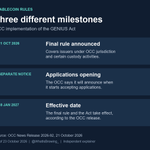
The US OCC’s 4 November framework gives bank examiners a guide to assessing “Super Intelligence,” including agentic systems. The bulletin explicitly says it creates no new regulatory expectations or enforceable standards for banks.
Its practical emphasis: potential consequences, delegated authority and human oversight. Control intensity can rise with the consequences of an agent failing or being misused.
A simple illustration—not a claim about any particular bank:
• An assistant summarizes an internal policy.
• It drafts a customer response for a person to approve.
• It can initiate an action within an account.
The model could be the same in all three. The authority, possible harm and opportunity for a person to intervene differ.
For customers and builders, that suggests three concrete questions:
1. Which actions can the system take without a person approving each one?
2. What limits apply to those actions?
3. Who can stop it and review what happened?
That is my practical reading of the framework, rather than a new legal checklist. Its stated scope covers OCC-supervised national banks, federal savings associations and federal branches/agencies of foreign banks.
Source, dated 4 Nov 2026:
occ.gov/news-issuances/bulle…
