

Crypto, US stocks and macro, fast. What moved, why, what to watch. Not financial advice.
The bay area
Joined October 2026
- Tweets284
- Following109
- Followers29
- Likes173









Pinned Tweet
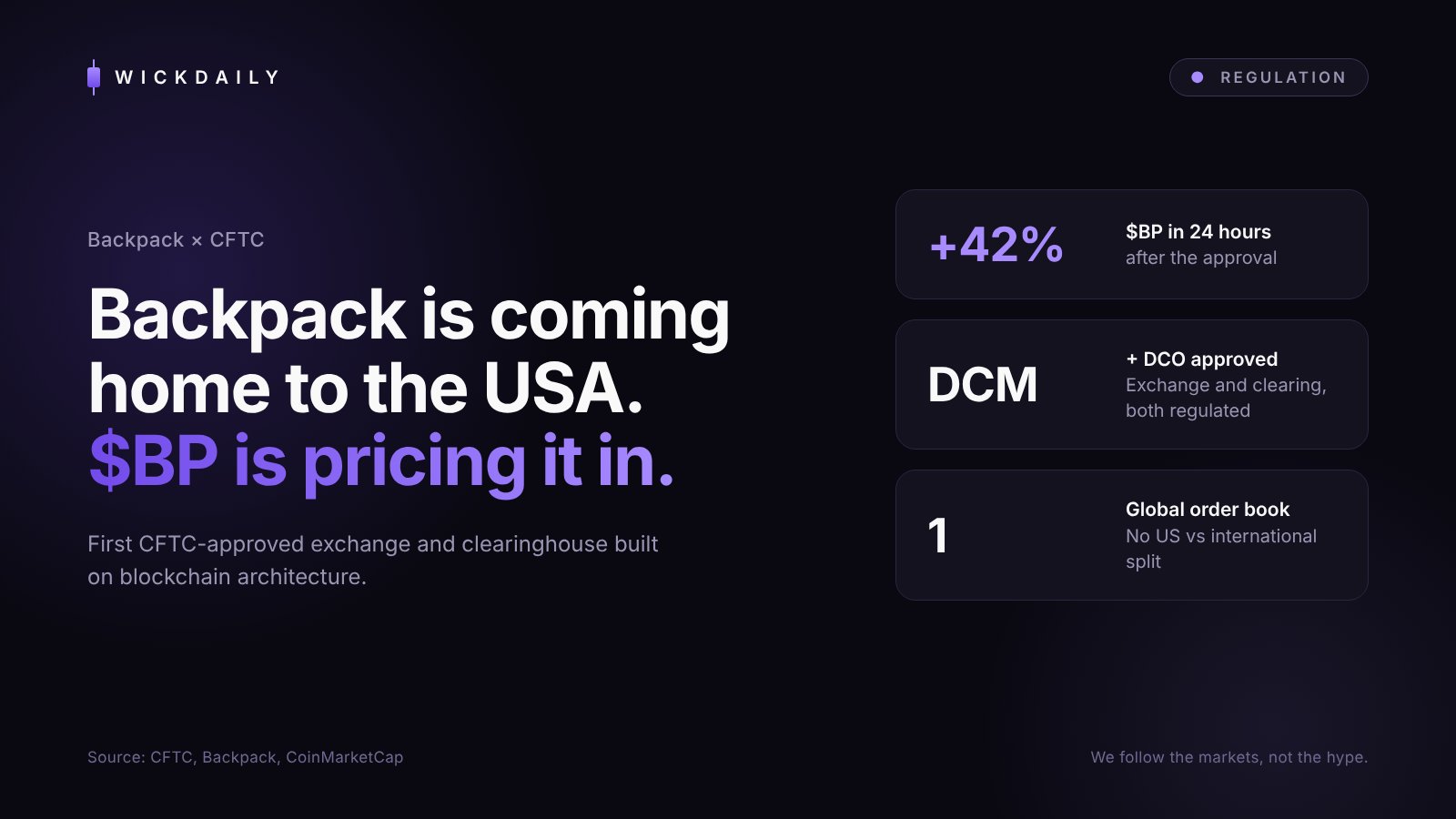
🇺🇸 Backpack is coming home to the USA.
The CFTC has approved Backpack's derivatives exchange (DCM) and its clearinghouse (DCO). According to CFTC Chair Mike Selig, it's the first approval for a firm that uses blockchain-based systems to execute and settle derivatives.
What US traders get:
• Leveraged perpetual futures
• Crypto collateral and cross-margin
• 24/7 trading
• One global order book, with no "Backpack
International" vs "Backpack USA" split
The market has already reacted. $BP is up about 42% in 24 hours, with volume and market cap both climbing.
The CFTC called it proof of "a regulated pathway" for blockchain-based market infrastructure.
Is this the start of US crypto perps going mainstream?
The UK Financial Conduct Authority has finalized rules preventing cryptoasset trading platforms from acting as market makers on their own venues.
The restriction will take effect on October 25, 2027, when the UK's new cryptoasset regulatory regime comes into force.
Under the rules, operators of qualifying cryptoasset trading platforms cannot execute orders against their own capital on venues they operate.
Matched principal trading remains permitted when firms execute client orders under the platforms' non-discretionary trading arrangements.
Third parties can carry on providing liquidity on the platforms, provided they meet the required conditions (without the need for a separate FCA licence).
The changes aim to reduce conflicts of interest and strengthen oversight of crypto trading.

BTC or ETH if you have less than $10k in cash right now?
Short answer: If you only pick one, Bitcoin has been the less risky of the two. Neither looks like a clear bargain right now.
Where things stand:
• Bitcoin is around $59,341, down 26.85% over the past month and 32.22% year-to-date. Ethereum is around $1,666, down 30.13% over the month.
• Bitcoin hit a two-year low of $55,640 before rebounding above $61,000, and Ethereum's year-to-date losses are about 42%.
• ETH has fallen harder than BTC: Bitcoin fell less than ETH in the recent selloff.
Why it's falling:
• U.S. spot bitcoin ETFs flipped negative for 2026 after a $1.28B outflow week, with analysts linking the slide to the midterm results and doubts over AI spending.
• Ethereum has had it worse: Glassnode counted a record 23 straight trading days of Ethereum ETF outflows as of October 31.
BTC vs ETH:
• BTC: It's the larger, more established asset and has held up better in this drawdown. It's also the simpler thesis, a scarce asset that institutions can hold through ETFs.
• ETH: It has more upside if sentiment turns, but it falls harder when it doesn't. Its price is down roughly 40% from a year ago, and there's no sign yet that the selling has stopped.
If you're deploying under $10k:
1. Keep an emergency fund and any near-term bills out of it. Only use money you could watch drop another 30–50% without needing it.
2. Don't go all in at once. The trend is still down, so splitting the buy into 4–8 chunks over weeks or months (dollar-cost averaging) reduces the risk of buying right before another leg down.
3. If you want both, many people weight heavily toward BTC and treat ETH as a smaller, higher-risk slice. A 70/30 or 80/20 split is common, but that's a rule of thumb, not advice tailored to you.
4. Decide your exit or "I'm wrong" level before buying, and don't use leverage.
Short-term price moves are close to unpredictable, so the real decision is how much risk you can stomach.
What's your time horizon: months, or several years?

1
2
81
87% of market contacts now see AI as a risk to US financial stability. In the spring, it was 50%.
That's the finding in the Federal Reserve's November Financial Stability Report.
And it's not just about whether AI stocks are overvalued.
The concerns go deeper:
→ Valuations: If AI earnings fail to meet expectations, highly valued stocks could face a sharp correction.
→ Financing: The AI infrastructure boom is increasingly funded through debt, leases and complex financing arrangements.
→ Cybersecurity: AI could make cyberattacks more sophisticated and create new risks for the financial system.
Here's the number worth watching:
Debt issuance tied to advanced computing infrastructure reached $680 billion by October 2026, roughly five times the total issued in all of 2023.
The Fed also estimates that related debt, guarantees and future lease commitments could exceed $3 trillion.
Why does this matter for QQQ?
Because the Nasdaq-100 is heavily exposed to the companies driving this AI investment cycle.
If AI spending keeps translating into earnings growth, the trade has room to run.
But if returns disappoint while financing costs and commitments keep rising, the consequences could extend well beyond a handful of tech stocks.
The AI opportunity is enormous. But so is the amount of capital riding on it.
Is the market underestimating the financial risks of the AI boom?

1
1
48
CoinMarketCap’s Crypto Fear & Greed Index just hit 6.
That’s extreme fear, and it puts today in rare company:
• Luna collapse (Jun 2022): 6
• FTX collapse (Nov 2022): ~12
• 2025 tariff selloff: 10
The record low is 5, set back in February this year.
What makes this one wild is the speed. A month ago the index was near 70, close to extreme greed. Bitcoin went from $81K on Nov 5 to ~$55K in under three weeks, its lowest in over two years.
You should remember:
Fear & Greed is a sentiment gauge, not a timing tool. Extreme fear can last weeks or months.
Past extreme readings have historically come before big rallies, but the recoveries usually took months.
Fear spreads fast. Bottoms take time.
1
3
60
Should you buy the dip? Here's what could happen.
Right now Bitcoin is under $60K, Fear & Greed sits at 12, and the S&P has been red for 7 days in a row.
If it bounces: fear this deep often shows up near the end of a selloff, when forced sellers start running out. The Dec 9 Fed hike is also ~95% priced in, so once it's done, some of the pressure could lift.
If it keeps sliding: we're still in a hiking cycle, and traders expect another hike in January. The level to watch is BTC's July low around $57.7K. If that goes, the next leg down could be quick.
I wouldn't try to catch the exact bottom. Buying slowly, in small pieces, takes a lot of the guesswork out!

2
41
TRUMP trades near $0.95, about 99% below its $73.43 high. The people who launched it made hundreds of millions of dollars, while most buyers are under water.

2
4
154
ANTHROPIC’S $81B IPO PUTS AI DEMAND TO THE TEST.
The Claude maker is scheduled to debut on the Nasdaq Global Select Market today, November 19, under $ANT.
980 million shares priced at $83 each, above the initial $70–78 range. Total offering: approximately $81.3 billion.
The deal values Anthropic at roughly $1.5 trillion fully diluted, or $1.1 trillion based on outstanding shares, according to Reuters.
Backpack says eligible users can trade $ANT once it lists, with availability depending on region. It does not offer IPO allocations.
The $83 offering price isn’t a guaranteed entry price: once trading begins, the market sets the price.
Will demand hold when public trading starts?

2
117
$26 billion of Anthropic's IPO money is coming from the companies it buys compute from.
Nvidia. Google. AMD. Broadcom. Micron. Microsoft. TSMC.
They're buying stock in a side deal at the same $83 IPO price, separate from the ~$68B sold to the public. At $83, Anthropic is valued around $1.5 trillion.
Why would a supplier buy shares in its own customer?
Look at the other side of the deal. Anthropic has signed about $900B of compute and infrastructure commitments for the coming years, $70B of it in the next 12 months.
So the money runs in a loop:
Suppliers put $26B in → Anthropic spends on chips and cloud → a big share flows back to the same names.
I don't think that's a red flag by itself. Big suppliers have always backed big customers.
But it changes how you read AI demand. When chip and cloud revenue jumps, part of it is demand the suppliers helped pay for.
What I'm watching:
• How ANT trades vs $83 today
• Whether suppliers start disclosing revenue from customers they invested in
• Anthropic's $70B compute bill vs its actual revenue
Smart business, or a bubble signal?

1
107
Stocks down. Bitcoin down. Gold down.
When everything falls at once, it's usually not about the assets.
It started with AI. A big bet against the AI bubble went public. Then OpenAI's CFO floated a government guarantee on its debt. On Nov 5, the Nasdaq had its worst day in 19 months.
Then Nvidia lost its founder. Jensen Huang resigned after a scandal with a China angle. $NVDA just had six straight red weeks, its longest losing streak since 2012.
Crypto didn't hedge anything. Bitcoin fell more than $10K in a week, into the low $60Ks. Bitcoin ETFs saw money pulled out seven days straight, and the fear index hit "extreme fear."
Gold didn't save anyone either. It's down over 25% from its January record and just hit a one-year low. Oil is up, inflation is still running hot, and the Fed has been raising rates, not cutting them.
This is what forced selling looks like. People sell what they can to cover what they can't.
Then Tuesday night, Nvidia posted $115.8B in revenue, up 103%.
AI demand looks fine. It's the nerves that are shot.
Are you buying here, or waiting?

2
84
Silver is Back at 1980's levels!
1980: $49
2011: $49
Today: $49
Add M2 money supply growth since 1980's
Inflation since 1980
Approximate buying power loss on investment is at 92%

COINGECKO LOOKS BEYOND PRICE TRACKING.
CoinGecko has confirmed backing from the Solana Foundation to accelerate its next phase of growth.
The roadmap: broader coverage of onchain assets, RWAs and derivatives, stronger data tools, and exploring trading features that connect research with market participation.
A potential bridge from checking prices to acting on them.
Could crypto’s data platforms become the next gateway to onchain finance?

1
28
No time for the markets this weekend? Here's what you missed 👇
📈 Stocks
S&P 500 -0.4% and Nasdaq -0.9% on Friday as Nvidia and AMD sank. Still a winning week: S&P +2.5%, Nasdaq +2.3%.
Nvidia's CEO change is still hanging over tech.
Asia overnight: Hang Seng +1%, Shanghai -0.6%, Japan's Topix -0.3%. India's Sensex +600 pts.
₿ Crypto
Bitcoin hit ~$62K over the weekend, a 4-month low, and bounced to ~$65K. Still down ~14% on the week.
Fear & Greed: 10. Extreme fear.
Why it fell:
• ~$2B in leveraged bets liquidated, mostly longs
• Spot BTC ETFs: 7 straight days of outflows, $1.91B gone
• Stablecoin supply (USDT + USDC + DAI) down $11.5B in 30 days, the biggest drop on record. Less cash on the sidelines to buy the dip.
What to watch this week: whether ETF outflows finally stop. That's the buyer bitcoin is missing.
Which worries you more right now: tech or crypto?

3
28
Bitcoin just fell below $67K, its lowest since August. Here's what's actually going on.
Three things are hitting at once:
1. Forced selling
About $1.3B of leveraged crypto bets got liquidated in 24 hours. When price drops, those positions get closed automatically. That selling pushes price lower and sets off the next batch. That's how BTC lost $70K and then $68K within days.
2. ETF money keeps leaving
Spot bitcoin ETFs just had 6 straight days of outflows. On Thursday alone $284M left, $204M of it from BlackRock's IBIT.
3. Rates
The 10-year Treasury is above 5.1%. Friday's PPI came in a touch cooler than expected, but wholesale inflation is still running 6.5% a year, the highest since 2022. A December Fed hike is close to locked in.
Bitcoin pays no yield. With 5% available risk-free, big money doesn't need to take the risk.
Add Nvidia down 11% this week after its CEO's exit, and nobody wants risk right now.
Where BTC stands:
~$67K, about 47% below the $126K high
Below its 200-week moving average
On track for a 6th straight losing week
What I'm watching:
→ ETF flows. One green day isn't enough, I want a full week.
→ Whether BTC can get back above its 200-week average quickly, or stays below it
→ The December Fed meeting
My take: this looks like leverage and rate fear, not people giving up on bitcoin. But until ETF flows turn, rallies get sold.
Are you buying under $67K or waiting?
1
19
US PRODUCER INFLATION HITS A NEAR FOUR-YEAR HIGH.
October PPI rose 6.5% year over year, its highest annual reading since November 2022.
The monthly increase slowed to 0.3%, down from September’s revised 1.4%.
A slower monthly pace, but annual price growth is still accelerating.
Which matters more for markets now: the monthly slowdown or the annual trend?

2
14
BREAKING: DTCC ADDS SOLANA TO ITS TOKENIZATION ROADMAP.
DTCC plans to connect its Tokenization Service to Solana, allowing eligible assets held at its DTC subsidiary to be tokenized on the network.
Planned rollout: H2 2027.
DTCC says the tokenized securities will preserve investors’ ownership rights and the safeguards of traditional markets.
Another step in its multi-chain strategy, connecting traditional market infrastructure with onchain finance.
How much institutional activity will follow?

2
19
BACKPACK’S NEXT MOVE IN JAPAN: DIGITAL BANKING.
Backpack’s Japanese arm, Trek Labs Japan, has signed an MOU with Minna Bank to explore connecting banking and crypto services.
First on the agenda: yen deposits and withdrawals for its planned Japanese exchange, subject to crypto-exchange registration.
The companies will also explore tokenized deposits and integrating Backpack investment services into Minna Bank’s app.
A closer link between bank accounts and onchain finance. Regulatory registration is the next milestone to watch.

$222M in crypto longs, gone in 30 minutes.
Nobody chose to sell those. When price slips, overleveraged longs get force-closed. That selling knocks price into the next batch of liquidations.
That's how a dip turns into a cascade.
Are you buying this flush or waiting for lower?

1
20
Bitcoin just logged 5 losing weeks in a row, while the S&P 500 sits about 2.6% from its record.
So who's doing the selling?
1. ETF holders
US spot bitcoin ETFs lost $1.28B in the week ending Nov 6. Four of five days were outflows, the biggest -$430M.
These buyers are mostly advisers and funds, not crypto natives. When rates look like they're going up, they cut risk first.
2. Miners paying down debt
MARA sold 13,597 BTC (about $1.1B) after Q3 to fully repay $750M of bitcoin-backed loans.
That's not a view on price. It's a balance sheet decision, and it still hits the order book.
3. Rates
A December Fed hike is almost fully priced in. The 10-year Treasury is near 5%. Bitcoin pays no yield, so it has to compete with 5% risk-free. Right now it's losing that fight.
The scoreboard:
$86.5K five weeks ago → about $74.6K now
41% below the $126K all-time high
What would turn it around:
→ ETF flows positive several days in a row, not one bounce
→ A cool PPI on Friday, which takes some heat off a hike
→ Miners done selling now that the loans are cleared
The last time bitcoin had a streak like this (Jan–Mar 2026), it bounced about 20% over the next two months, then made a new low in June.
So a long losing streak doesn't mean we've hit the bottom.
ETF money leaving for good, or just rate fear? Tell me below.

1
11