







Pinned Tweet
I got tired of researching subnets that were already dead.
So I built this.
Bittensor keeps rewriting its own rules.
This year :
> An emission gate that pays only -30 subnets
> 57 subnets cut off from emissions in a single day
> Owners can now change emission splits every week
> A runtime release reverted days after it shipped
Subnets with real products got deregistered anyway.
So before you read a whitepaper, check the numbers.
I built a free tool for that.
Type a subnet name or number and get 6 live on-chain checks:
•emission;
•circulation;
•market cap;
•pool depth;
•owner lock;
•weekly momentum.
One score. One verdict. A few seconds.
Numbers first. Fundamentals second.
Reply with a subnet number and I’ll post its result.


A card built on farm-price cycles from 1875 marked 2026 as “the time to sell.”
Not a bottom yet.
VIX is 31. At real bottoms it hit 36 (2022), 52 (2025), 82 (2020).
The S&P 500 peaked on October 6, 2026.
Today it’s officially in correction. −10.2%.
Bitcoin topped on the same date, one year earlier.
Before you treat the card as a prophecy, read the rest of it.
What it says:
> 2026: good times, high prices, sell.
> Next “buy and hold”: 2032.
> Next panic: 2035.
So by the card, this isn’t 1929. It’s the start of hard times.
A long grind with sharp bounces.
What its own history says:
> Real bottoms came years before its “buy” dates.
> Peak 1999. Card says buy in 2005. Bottom came in 2002.
> Peak 2007. Card says buy in 2012. Bottom came in 2009.
> Wait for 2032 and the best prices are probably gone.
What actually changed this week:
> Last week stocks fell and yields rose. The market feared the Fed.
> Today stocks fell and yields fell, 10Y back under 5%. Now it fears the economy.
> That shift hurts. It’s also what eventually forces the Fed to stop.
The card is a mood map, not a trade signal.
The money gets made in the middle of the fear, long before the year marked “buy.”


The highest VIX we've seen all year. The silver lining is this is how bottoms usually start or get close, especially on an OPEX day.

1
5
255
Yarko retweeted
Max loss $2,470. Max win $7,530. Here’s the AI’s setup.
The market says 39%. My AI says 50%. I’m trading the gap.
Claude scored the market −5. Verdict: down.
Here’s what it saw:
> Macro −2. Hawkish Fed minutes, 96.7% odds of a December hike, 10Y yield above 5%.
> Flows −2. $1.91B left BTC ETFs in 7 sessions. Wallets holding 1K to 10K BTC dumped 39K BTC.
> Technicals −2. Price below every EMA, including the 200. RSI 37.7.
> Positioning 0. Volatility 0.
> Sentiment +1. Fear & Greed at 10. A bounce is possible, and it priced that in.
Target: BTC ~$60.5K by Dec 4.
> Trade #3. BTC put spread, Dec 4. Buy $62K, sell $58K.
Cost $1,438. Max win +$2,560. Breakeven $60,563.
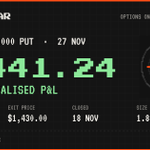
> Trade #4. BTC put spread, Nov 27. Buy $60K, sell $56K.
Cost $1,031. Max win +$4,970. Breakeven $59,313.
The interesting part: Derstar prices the odds of profit at 39% and 27%. Claude’s model says 50% and 36%.
That gap is the trade.
Why spreads: downside puts trade at a premium right now (56% IV vs 45% on calls).
Selling the lower strike pays for part of the put I buy.
Total risk: $2,470, 2.5% of the account. That’s the most I can lose. No liquidation, no margin call.
Real prices, virtual money.

Max loss $2,470. Max win $7,530. Here’s the AI’s setup.
The market says 39%. My AI says 50%. I’m trading the gap.
Claude scored the market −5. Verdict: down.
Here’s what it saw:
> Macro −2. Hawkish Fed minutes, 96.7% odds of a December hike, 10Y yield above 5%.
> Flows −2. $1.91B left BTC ETFs in 7 sessions. Wallets holding 1K to 10K BTC dumped 39K BTC.
> Technicals −2. Price below every EMA, including the 200. RSI 37.7.
> Positioning 0. Volatility 0.
> Sentiment +1. Fear & Greed at 10. A bounce is possible, and it priced that in.
Target: BTC ~$60.5K by Dec 4.
> Trade #3. BTC put spread, Dec 4. Buy $62K, sell $58K.
Cost $1,438. Max win +$2,560. Breakeven $60,563.
> Trade #4. BTC put spread, Nov 27. Buy $60K, sell $56K.
Cost $1,031. Max win +$4,970. Breakeven $59,313.
The interesting part: Derstar prices the odds of profit at 39% and 27%. Claude’s model says 50% and 36%.
That gap is the trade.
Why spreads: downside puts trade at a premium right now (56% IV vs 45% on calls).
Selling the lower strike pays for part of the put I buy.
Total risk: $2,470, 2.5% of the account. That’s the most I can lose. No liquidation, no margin call.
Real prices, virtual money.

Can an AI trade BTC options better than me? Trade #1 is in.
I handed my options trading to an AI.
Claude does the analysis. It’s plugged into live market data: on-chain flows, options positioning, macro, sentiment.
It reads all of it and gives me a trade. Strike, expiry, reasoning.
I execute. BTC and ETH options only.
I place it on an options Derstar platform (testnet).
Real market prices, virtual money.
I’m learning options in public, with an AI as my analyst.
Success or failure? In the replies.


We're putting a number on it
By Dec 31:
🎯 50 active testers
🎯 500 trades
🎯 25 real feedback reports
Every Monday we post where we are. Good weeks and bad weeks.
Hit it early → we open the next wave.
Miss it → you'll hear why.
Testnet went live yesterday. Every complaint in #suggestions counts toward the 25 👇

Buying Bitcoin at $68K. Smart or stupid?
I don’t care what BTC costs. I care what I risk.
A trader doesn’t care if BTC is $68K or $40K. He cares where his take profit is and what he risks to get there.
An investor is no different. The entry decides the trade, not the price tag.
Same coin. Same $68K.
> If $68K is the top of the range, there’s little upside left. The R:R is ugly.
> If the high is $126K, the same $68K is a different trade.
The price didn’t change. Your analysis did.
That’s why I’m testing options for myself.
This platform gives me real market prices with virtual money, plus rewards for finding bugs and using the testnet.
Real prices, zero real risk. Looks smart to me.
Why not?


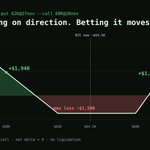
$1,500 max risk. No liquidation. Profit if BTC moves either way.
After a flush like this, the market usually picks a side fast. Short squeeze up, or a break below $ 60K.
I split it on the Derstar options testnet:
• $1,000 on BTC below $62K by Nov 27
• $500 on BTC above $68K by Nov 20
Net delta at entry: ≈0. Small moves cancel out.
What pays:
• BTC $70K: +$800
• BTC $58K: +$1,800
• BTC stuck between $61K and $68K: −$1,500. (That's the worst case.)
No liquidation. No margin calls. Max loss known before you click.
I set this up on Derstar's options testnet, live as of today.
Real prices, virtual money.
Good place to test a strategy before it costs you anything. In the replies.

$1,500 max risk. No liquidation. Profit if BTC moves either way.
After a flush like this, the market usually picks a side fast. Short squeeze up, or a break below $ 60K.
I split it on the Derstar options testnet:
• $1,000 on BTC below $62K by Nov 27
• $500 on BTC above $68K by Nov 20
Net delta at entry: ≈0. Small moves cancel out.
What pays:
• BTC $70K: +$800
• BTC $58K: +$1,800
• BTC stuck between $61K and $68K: −$1,500. (That's the worst case.)
No liquidation. No margin calls. Max loss known before you click.
I set this up on Derstar's options testnet, live as of today.
Real prices, virtual money.
Good place to test a strategy before it costs you anything. In the replies.
Weeks of “soon” Today it’s “now.”
Derstar Private Testnet is live on Arbitrum Sepolia
What’s in:
🔹 BTC and ETH options, European, cash-settled
🔹 A fully onchain orderbook, not an LP pool
🔹 Buy calls and puts. Max loss = premium, no liquidations
What we want from you: try to break it, then tell us where. Every bug report and every “this makes no sense” shapes what ships next
You can grab invites in our Discord, or from our ambassadors. Links below 👇

Index funds have 15 days to dump Strategy shares.
Everyone watches ETF flows. Watch this instead.
Strategy holds 850,364 BTC at an average cost of $75,456.
BTC is at $64.6K.
That’s -$9B underwater.
On Nov 30, MSCI removes it from its indexes:
• Funds tracking MSCI hold 3.1% of its shares
• They have to sell by the Nov 30 close
• JPMorgan estimated up to $2.8B of outflows from an MSCI exit
Nothing forces Strategy to sell its BTC.
But the whole model runs on one thing: the stock trading above the value of the BTC behind it.
That premium funds every new purchase.
No premium, no fuel.


Why are crypto prices down?
No one knows for sure. Correlation does not prove causation. Here are some potential reasons.
Money shifting to the Anthropic IPO: teapaw.org/ColeMacro/status/21212…
ETF outflows: U.S. spot Bitcoin ETFs saw about $1.9 billion in outflows over seven trading sessions through November 13. Ether funds also saw withdrawals. crypto.news/bitcoin-price-fa…
Security fears: the Binance hack, iPhone-linked crypto wallets drained, Chrome exploit, Microsoft down. These security incidents could make some people less willing to keep funds in crypto.
Hot U.S. inflation has raised expectations of another Fed rate hike. Higher yields and a stronger dollar can weigh on "riskier assets" such as crypto.
Political uncertainty: Midterm results have raised concerns about potentially stricter U.S. crypto policy.
No, Binance did not sell crypto.
I bought crypto in the past few days, as I got some stablecoins recently. (maybe this is the cause 🤣)
Mid-long term, crypto will continue to grow.
Views are my own. Not financial advice.
For future reference, price of BTC hit a low of $62,006 today.

A weekend wick to $61,946.
Over 90% of the people wiped out this weekend were long with leverage.
Not wrong about direction.
Just destroyed by it.
When you buy an option instead of using leverage, you cannot be liquidated.
Your worst case is the premium you paid, set before you click.
A wick to $61K takes out a leveraged long.
It does nothing to a bought option.


6
184
#20 on this leaderboard has 24K points.
That’s how early it is.
I ran the numbers on farming Ondo Perps.
Doing it directly loses money.
What you get:
> Ondo USDC pools: $280K a week
> Jumper pool: up to $57K USDC a week
> Ondo Points: 5M a week
> xPerps points: 1M a week, up to 1.25x boost
Why Jumper: trade on Ondo directly and the fees (0.025%) are bigger than the rewards (0.01%).
Jumper charges -0.06%, but its own pool covers that while total volume stays under -$109M a week.
Steps:
> Open Jumper Perps (link in reply) → deposit USDC → pick an Ondo market
> BTC, ETH, SPY, gold only
> Hedge: long on the Ondo route, short on another Jumper route
> Trade small, every week
> One wallet
After week 1: USDC received ÷ your volume. Under 0.06%? Farm points only
Example: $2K, 5x, 7 round trips = -$88 fees, -$174 USDC.
That assumes -$50M of total Jumper volume a week.
Why now: JUMP premarket -$125M FDV.
No token, no snapshot yet.
Full math in the article.

I did the math on Ondo Perps so you don’t donate your margin to fees.
One trade. Four reward streams. Here’s the math.

1
9
315
I did the math on Ondo Perps so you don’t donate your margin to fees.
One trade. Four reward streams. Here’s the math.
Your hedge on Binance earns nothing.
The same hedge on two point DEXs earns twice.
Every rewards program has a break-even number. Almost nobody calculates it.
Pool ÷ your fee = the volume below which you’re paid to trade.
A $200K weekly pool at 0.025% fees breaks even at $800M in weekly volume.
Below that, every $1 in fees comes back with a premium.
How to farm a quiet market without betting on price:
• Long on one venue, short on another. Price moves, you don’t care
• Limit orders, not market. Maker fees are 2.5x cheaper
• Hold, don’t churn. Many programs now reward open positions over time, not just volume
• Collateral that earns. Tokenized gold or T-bills as margin beat idle cash
Put both legs on perp DEXs that still run points and haven’t launched a token yet.
Same $5K. Same zero price risk. Two point programs instead of none.
One position, paid twice.
The market is boring. The math isn’t.

Market makers: this one's for you 👋
What you get on Derstar testnet:
🔹 A real order book with price-time priority, matched inside the contract. Not an RFQ queue where you wait to be asked.
🔹 Stylus on Arbitrum - Rust contracts run the matching logic, so the compute doesn't cost what it would on the EVM
🔹 BTC and ETH, weekly and monthly expiries, full strike board
🔹 No custody. Your collateral stays in contracts you can read.
What we want: tell us where the book hurts. Fill logic, fee levels, OI caps, settlement timing. Fees aren't final - they get tuned on testnet, and makers quoting early get a say in that.
DMs are open. Bring flow, get in first 📩

11
218
3% vs 0.9%. The gap between gambling and trading.
Same question. Two markets. Very different answers.
Will BTC hit $85K before December?
> Betting markets: 3%
> Options traders: under 1%
And it’s not just the moon shot. Ask about a crash to $55K:
> Betting markets: 4.9%
> Options traders: 2.3%
Near the current price, both markets agree. The further you go from reality, the more bettors overpay.
> Bettors pay for the dream.
> Options traders price the risk.
That gap is the whole edge. And it’s why the people who actually read the market trade options.

1
10
341

