

CS PhD student @NotreDame | Prev: @IBMResearch @amazon @JHUCLSP 🦋: https://teapaw.org/t.co/gPXvdPuesy
South Bend, IN
Joined December 2019
- Tweets152
- Following683
- Followers255
- Likes564





Pinned Tweet
Thrilled to share that I'll start my Ph.D. at @ND_CSE this fall, working with @Meng_CS. I am so grateful for the sincere guidance from my current advisor, @DanielKhashabi, and for the unconditional support I received from my family, friends, and collaborators over the past years!
Yining Lu retweeted

不管你的东西做得怎么样,只要存在微小的瑕疵,就容易得到一个 negative 的分数
现在的审稿系统似乎只奖励那些完全挑不出任何漏洞的工作。但如果一项工作真的有很多创新,它必然很难做到面面俱到
往往 incremental 的论文反而更容易被接收。而在 AI 时代,这种倾向被进一步放大了

Yining Lu retweeted

Long-horizon agents can take hundreds of actions before receiving a single outcome reward. Training them raises two questions:
➡️ Which actions deserve credit?
➡️ How does training fit with existing compaction and memory strategies?
Introducing FOCUS: active critic learning over managed context states, with modular, customizable context protocols and integrations with Tinker and slime.
Docs: zipjiang.github.io/FOCUS (1/4)
I will be at #EMNLP2026 in Budapest next week to give an oral presentation of our TACL paper on Multi-Objective Alignment.
Excited to catch up with old friends and meet new ones! Feel free to reach out if you’d like to grab a coffee together!

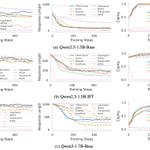
✴️ Pleased to introduce our new paper yining610.github.io/dynamic-…
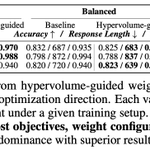
- Rebalance multiobjectives during training through dynamic reward weighting
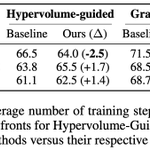
- Build Pareto-dominant front over static baselines across online RL algorithms, datasets, and model families
- Faster convergence rate
1/8

Yining Lu retweeted

We built Agent as Policy (AGP), a robot control harness on top of GPT-6 Astra.
With AGP, Astra performs zero-shot manipulation on real robots across precision manipulation, long horizon tasks, dynamic actions, and deformable objects.
How it works. 🧵
agent-as-policy-2026.github.…
Yining Lu retweeted

Please submit papers to NeurIPS 2026 Workshop on Continual Learning for Enterprise AI Agents (CLEA)! We welcome submissions on continual learning, AI agents, reinforcement learning, agent memory, workflow learning, planning, evaluation, and enterprise AI. clea-neurips.github.io/

Yining Lu retweeted

Introducing Kimi K3: Open Frontier Intelligence
🔹 2.8 Trillion Parameters, 1 Million Context, Native Multimodal
🔹 Kimi Delta Attention enables up to 6.3x faster decoding in million-token contexts
🔹 Attention Residuals deliver ~25% higher training efficiency at <2% additional cost
🔹 Built for long-horizon agentic coding and self-evolving workflows
Kimi K3 is now live on on Kimi.com, Kimi Work, Kimi Code, and the Kimi API.
Open Weights by July 27, 2026.
🔗 API: platform.kimi.ai
🔗 Tech blog: kimi.com/blog/kimi-k3


Yining Lu retweeted

Imagine this: It's Friday. You've been deep in a debugging session with your agent for hours. Suddenly it says: "Need to compact context" because it's about to exceed the context window. And with that, it forgets various details about your session.
𝐓𝐡𝐞 𝐜𝐡𝐚𝐥𝐥𝐞𝐧𝐠𝐞
As they work, agents' context fills with both useful things and junk (dead-end searches, stale results, superseded plans). That junk impacts everything that follows. Compaction (summarizing the context and resuming from the summary) is the standard fix.
Two questions matter: (1) 𝑤ℎ𝑒𝑛 to compact, and (2) ℎ𝑜𝑤 to compact.
Both matter: a poorly-timed call discards the partial result you still needed.
𝐖𝐡𝐚𝐭 𝐝𝐨 𝐩𝐞𝐨𝐩𝐥𝐞 𝐝𝐨 𝐭𝐨𝐝𝐚𝐲?
Within academia there are a few camps:
1️⃣ Deployed agents compact at a certain token threshold. This is an intuitive starting point: compact if you're about to exceed. But it starts to make less sense once one realizes that this compaction point may appear in the middle of an important task. And there is no agreement on the threshold — triggers range from 30% to 95% of the context window.
2️⃣ Another camp compacts on a fixed interval — every k tokens regardless of trajectory state. This increases the frequency of the compactions, which allows one to use shorter active context (and hence less memory). But again there is no informed logic to when compaction is applied.
3️⃣ Training-based approaches bake the when-to-compact decision into weights via SFT/RL. But with the increasing capabilities of the models, especially with their tool-use capabilities, is training really a necessity?
In industry, various agents have compaction strategies that more or less work. We don't always know how they work. Even in cases that we do, it's unclear how well they do and why.
𝐎𝐮𝐫 𝐩𝐫𝐨𝐩𝐨𝐬𝐚𝐥: 𝐒ᴇʟꜰ𝐂ᴏᴍᴘᴀᴄᴛ
A training-free scaffold pairing two inference-time elements:
(i) 𝐀 𝐜𝐨𝐦𝐩𝐚𝐜𝐭𝐢𝐨𝐧 𝐭𝐨𝐨𝐥. The model emits a summarize signal, the scaffold runs the summarization, and generation resumes from the summarized prefix. This is the ℎ𝑜𝑤.
(ii) 𝐀 𝐫𝐮𝐛𝐫𝐢𝐜 𝐠𝐚𝐭𝐞. At periodic probes, the model returns COMPRESS or CONTINUE. Fire when a sub-task has resolved or the trajectory is converging. Suppress mid-derivation or when stuck. This is the 𝑤ℎ𝑒𝑛.
The same model is generator, judge, and summarizer.
𝐎𝐮𝐫 𝐞𝐯𝐚𝐥𝐮𝐚𝐭𝐢𝐨𝐧𝐬
We evaluate on two task families and 6 datasets: (1) Competition math (IMO-Answerbench, HMMT Nov 25, HMMT Feb 26) and (2) Agentic search (BrowseComp, BrowseComp-Plus, DeepSearchQA).
We also evaluated 7 models: GLM-4.7-Flash, MiniMax-M2.5, MiMo-V2-Flash, Qwen3-4B-Instruct, Qwen3-30B-A3B-Instruct, Qwen3.5-4B, Qwen3.5-9B.
𝐅𝐢𝐧𝐝𝐢𝐧𝐠𝐬
🔹 The pattern of gains is consistent across various evaluations: baseline < fixed-interval ≤ 𝐒ᴇʟꜰ𝐂ᴏᴍᴘᴀᴄᴛ.
🔹 In scenarios where window size is limited, +𝟏𝟖.𝟏 𝐩𝐨𝐢𝐧𝐭𝐬 over no-compaction.
🔹 Even if there is no limit on context window, 𝐒ᴇʟꜰ𝐂ᴏᴍᴘᴀᴄᴛ is still helpful. It is the strongest method on all three models: +𝟓–𝟗 𝐩𝐨𝐢𝐧𝐭𝐬 over no-compaction, at 𝟑𝟎–𝟕𝟎% 𝐥𝐨𝐰𝐞𝐫 𝐩𝐞𝐫-𝐪𝐮𝐞𝐬𝐭𝐢𝐨𝐧 𝐜𝐨𝐬𝐭.
🔹 In our analysis, we find that 𝐒ᴇʟꜰ𝐂ᴏᴍᴘᴀᴄᴛ fires earlier than the fixed-threshold baseline.
🔹 We also observed that 𝐒ᴇʟꜰ𝐂ᴏᴍᴘᴀᴄᴛ helps most on the hardest questions, where deep search accumulates the largest contexts. On easy questions, all three policies are within noise.
——
💡 𝐓𝐚𝐤𝐞𝐚𝐰𝐚𝐲:
💡 "When to compact" is a meta-cognitive capability a lightweight rubric can supply at inference time .
💡 Across 6 benchmarks and 7 models: 𝐒ᴇʟꜰ𝐂ᴏᴍᴘᴀᴄᴛ matches or exceeds fixed-interval summarization at 30–70% lower cost.
💡 To our knowledge, this is the first work to introduce and evaluate rubric-based adaptive compaction timing in a training-free setting.

Yining Lu retweeted

🚨 New paper: "Self-Compacting Language Model Agents"
LM agents build up long traces of reasoning and tool calls. As the trace grows, old mistakes and stale info stick around and anchor everything that follows. We ask: can the model itself decide when to clean up?
Yining Lu retweeted

Real-world agents juggle instructions from skill files, tools, other agents, ... each with different trust levels. When these conflict, can models reliably prioritize the most trusted one?
Our ManyIH-Bench🪜 finds that even frontier models like GPT-5.4 only get ~40% accuracy! 👇

Yining Lu retweeted
LLMs continue to struggle with long-context tasks—such as needle-in-a-haystack problems—because of “positional bias.” What can we do if we only have 𝘣𝘭𝘢𝘤𝘬-𝘣𝘰𝘹 access to the model? (i.e., we can’t modify the model weights or attention patterns, as is often the case with API models.)
We introduce ⭐𝐆𝐨𝐥𝐝-𝐏𝐚𝐧𝐧𝐢𝐧𝐠⭐, a black-box Bayesian framework that, at inference time, strategically and iteratively shuffles documents to overcome positional bias.
Specifically, it searches over long contexts by (i) reordering documents to concentrate high-belief items in highly “diagnostic” positions, and (ii) updating beliefs about document relevance from model outputs.
We show that GP provably identifies a target among N documents in O(log N) rounds, ensuring scalability to many-document settings.
More in the paper: arxiv.org/pdf/2510.09770

Our code is available at github.com/yining610/ctwa. Huge thanks to my advisor @Meng_CS for his support on this project.

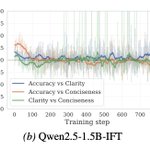
Our method, CTWA, effectively mitigates cross-objective interference compared to others. Competing methods either quickly sacrifice accuracy to achieve superficially high conciseness and clarity (e.g., GradNorm in 1a, Linear and Dynamic weighting in 1b), or trying to maintain high accuracy while overlooking the improvement of others (e.g., Lagrangian in 1a and PAMA in 1b). In contrast, CTWA achieves strong, balanced performance across all three objectives.

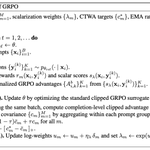
We derive a reward-level local covariance law that precisely characterizes when an objective improves under scalarized alignment: when its true reward exhibits positive covariance with the scalarized score.
Based on that, we propose CTWA, a plug-and-play controller that adapts scalarization weights to maintain sufficiently large covariance between each objective reward and the clipped advantage weight induced by the underlying PPO-style update.

Even the issue occurs when objectives are not fundamentally conflicting under traditional gradient-based definitions from MTL and MOO.

