Turning market noise into clarity. Sharp insights, striking visuals — your daily edge. For perspective, not prescriptions. Not financial advice.

Joined August 2025
China's gold imports are breaking records: China imported more than 1,000 tonnes of gold in the first eight months of 2026, already more than in all of 2025, worth a record $158.8 billion. Investment demand is driving it. Chinese households are piling in because home prices are still falling, stocks are down this year, and 10-year government bonds pay only ~1.7%. The central bank is buying too: the PBOC has added gold for 23 straight months, and September's ~23 tonnes was its biggest purchase since 2023. Meanwhile, China's US Treasury holdings sit at an 18-year low. Western investors are following: global gold ETFs took in a record $31 billion in Q3 2026, mostly into North American and European funds. The dollar's share of global reserves slipped to 56.7% in Q2, and gold is filling part of that gap.
4
1
17
559
A Bank of Japan rate hike is coming for US markets: The BOJ is expected to hold rates steady this month but hike in December. Markets are already pricing roughly 80% odds of a move. The gap between US and Japanese 10-year yields has already narrowed by 0.54 points in a year, to 1.94 points in September. The story for US investors is what happens next: yen carry trades unwind. Borrowed yen gets repaid, dollar assets get sold, and US yields get pushed around. We saw this in August 2024, when a single BOJ hike sent the VIX to an intraday high of 65. Rate-sensitive US equities (utilities, REITs, dividend stocks) face the sharpest exposure when carry unwinds hit.
1
2
110
AI infrastructure debt is crowding out US sovereign borrowing: The four biggest hyperscalers spent $410 billion on infrastructure in 2025 and are guiding toward $735 billion in 2026. Through June, the four spent $295 billion, 84% more than in the first half of 2025. That spending is financed partly through corporate bonds, competing for the same fixed-income capital that absorbs Treasury supply. The US deficit hit $2 trillion in fiscal 2026, so Treasury supply is not shrinking. The Fed just raised rates and inflation is still at 3.7%, meaning there is no easy rate-cut escape valve if credit markets seize. When the dot-com bubble burst, the Fed cut aggressively because inflation was low. That option is not available today.
4
13
324
Neoclouds don't have a demand problem, they have a financing problem. One major name paid 25% of its revenue in interest last quarter, and next quarter's interest is guided at about 4x its operating income. Most of the rest are on weaker balance sheets.
Replying to @chamath
Pretty much. As of the past few weeks, debt markets have almost entirely shut off access to money for any company that doesn’t have substantial revenue independent of AI data centers. SpaceX closed $40B of debt for GPUs, but we’re investment grade and have Starlink & launch revenue. That means the 200+ neoclouds are going to see guppy-level death and consolidation. Some will make it through, but not many.
9
1
18
1,409
The risk isn't that AI demand disappears. It's that much of it is paid for with debt. Neoclouds borrow against contracts to buy chips, so when credit tightens, the orders stop first. One big name's bond yield already touched 15%, and Gartner expects over 80% of neoclouds to lose independence by 2030. If you follow Zeno Report, you know which one I mean.
1
3
94
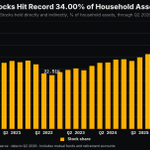
Americans' stock exposure has hit a record high: The Fed just reported that households hold 48% of their financial assets in equities. That beats the dot-com peak by nearly 10 percentage points. Counting homes too, stocks are 34% of everything households own, also the highest in Fed data back to 1945. The problem is what happens when stocks fall. A 25% drop would erase roughly $18.5 trillion in household wealth. Fed research suggests that translates to about $500 billion in lost annual spending. The saving rate is already down to 4.1%, so there is little cushion. The top 10% own 88% of the equities, but their spending is large enough to drag down restaurants, travel, and retail. A market correction now hits the real economy harder than at any point on record.
3
1
14
576
Why 48% in the text but 34% in the chart? Same stocks, different totals. 48% = stocks as a share of households' financial assets (stocks, bonds, deposits, pensions). 34% = stocks as a share of ALL household assets, which also counts homes, other real estate and belongings. Add houses to the total and the same stocks become a smaller slice. Both measures are at records.
3
51
US tariff relief is now following the electoral map: Trump just rewrote the Canadian tariff list four days before a tight Maine Senate race. He didn't cut broad agricultural tariffs. He removed duties on packaging, refrigeration, and sorting equipment the supply chain behind Maine's blueberry and potato industries. Susan Collins claimed credit. The goods getting relief were worth $5.1 billion in 2026 trade. Michigan is the next state to watch: its Senate race is also a toss-up, and 64% of Michigan voters oppose the Canada tariffs. Tariff exposure is now being redistributed based on which Senate seats are at risk.
11
303
The Zeno Report retweeted
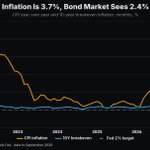
Bond markets are mispricing the Fed's inflation problem: Tariffs don't just raise prices once they reduce competitive pressure on US manufacturers, letting them widen margins too. The New York Fed found 90% of tariff increases passed directly into US import prices. Headline CPI hit 3.7% year over year in September, while core PCE sat at 3.4%. Bond markets are pricing long-run inflation near 2.2%, as if the Fed is nearly done. But the Fed just hiked again and expects another increase before year-end. Supply-side cost pressures embedded in domestic supply chains don't fade quickly. The pivot trade assumes a problem the Fed itself says isn't solved.
1
1
7
145
US consumer sentiment is crushing discretionary spending intentions: Eight in ten Americans now rate the economy fair or poor. That is the highest share since late 2023, and Trump's economic approval just hit its worst level ever recorded by CNBC. The clearest sector signal is in durable goods: buying conditions for big-ticket items collapsed 18% in October alone. Real spending is still growing, but sentiment this weak hits postponable purchases first cars, appliances, apparel, restaurants. Discretionary retail earnings risk is real and not yet fully reflected in valuations.
1
7
123
Texas is losing jobs across every major sector: Texas shed roughly 11,000 jobs in September, its biggest monthly drop in over a year. That matters beyond Texas: it is the second-largest US state economy, about 9% of national output, and pumps over 40% of America's crude oil. The losses hit government, construction, health services, finance, and hospitality all at once. That broad pattern points to cooling demand and housing stress, not just an energy blip. The Dallas Fed has already cut its 2026 Texas jobs-growth forecast to 0.9%, down from 2.0% in July. Texas is still growing year-over-year, but the engine is clearly slowing.
6
10
225
Anyone here from Texas?
1
56
Bond markets are mispricing the Fed's inflation problem: Tariffs don't just raise prices once they reduce competitive pressure on US manufacturers, letting them widen margins too. The New York Fed found 90% of tariff increases passed directly into US import prices. Headline CPI hit 3.7% year over year in September, while core PCE sat at 3.4%. Bond markets are pricing long-run inflation near 2.2%, as if the Fed is nearly done. But the Fed just hiked again and expects another increase before year-end. Supply-side cost pressures embedded in domestic supply chains don't fade quickly. The pivot trade assumes a problem the Fed itself says isn't solved.
1
1
7
145
Japan's wage inflation is removing the BOJ's reason to pause: Japan's finance minister told parliament the country is on the edge of sustained wage-driven inflation. That matters because wage growth is the one thing that gives the BOJ a domestic reason to keep hiking, independent of yen weakness. The BOJ rate is already at 1.25%, the highest since the mid-1990s. Japanese investors holding US Treasuries now face hedged returns of roughly negative 67 basis points versus domestic bonds. That math pushes capital home, and Japan still holds over $1 trillion in US Treasuries. A sustained BOJ tightening cycle gradually removes a major source of foreign demand for US debt.
5
14
341
US pending home sales just hit an all-time low: Signed contracts on existing homes fell to 66.0 in September, the lowest reading since the index began in 2001. Contracts close within one to two months, so November and December closings are already weak before they happen. The deeper problem is the lock-in effect. Over 95% of mortgage borrowers hold rates below today's market rate, so selling means trading into a much more expensive loan. Goldman Sachs forecasts only 3.9 million existing-home sales in 2027, about 26% below 2019 levels. Builders, mortgage originators, and title insurers are staring at a demand hole that prices alone won't fill.
5
11
148
A Korean neocloud IPO is repricing US AI infrastructure stocks: Elice Group, a Korean AI-cloud company, dropped 32% on its first trading day despite institutional demand nearly 400 times the shares offered. The company was profitable and growing, so the collapse was a valuation rejection, not an operational failure. Investors used Elice's IPO price as a real-time multiple test for the whole neocloud category. US peers felt it immediately. CoreWeave had already fallen over 25% that week, weighed down by $558 million of quarterly interest expense, 22% of its revenue. When a profitable, fast-growing neocloud cannot hold its IPO price, it tells you the market no longer pays aggressive multiples for GPU revenue alone.
3
1
1
13
214
Gartner is standing behind its AI infrastructure warning: Gartner ran the math on whether AI data centers can earn an adequate return by 2030. The answer was no. They need $8.5 trillion in cumulative revenue to cover costs and a 12% return hurdle, but Gartner expects at most $3.6 trillion of AI revenue to reach them. The gap shows up already at CoreWeave, which spent $6.4 billion on capex last quarter against $2.6 billion of revenue. Gartner’s chief forecaster says the problem is operational: more compute exists than demand requires, and much of it is given away through freemium products. Over 80% of neocloud providers may not survive independently by 2030. The capex thesis that drove AI infrastructure valuations higher is now directly challenged by the people who built the model.
6
13
271
Lately I keep noticing furniture stores near me closing down. Anyone else seeing this where you live, especially this year?
8
11
390
US cybersecurity consolidation is accelerating: Proofpoint just agreed to buy Varonis for $6.3 billion, at a 52% premium to its pre-rumor price. That deal is part of a real pattern. AI-powered agents now connect to email, files, and business systems, and that creates new data-exfiltration paths that companies need to close. Buyers are acquiring identity, data, and access-control capabilities rather than building them. AI-security deals hit 40 transactions through Q3 2026, versus 10 in all of 2025. Smaller vendors with those capabilities are now acquisition targets, and the premiums being paid are real.
6
13
301
Traders are betting volatility stays elevated, not spikes and fades: The VIX broke above 22 during an AI and semiconductor selloff on October 16. CoreWeave dropped 13% and the Nasdaq fell roughly 2%. What stands out is what options traders did next. They spent nearly $27 million on November VIX calls, positioning for volatility to stay high through the third week of November. That is not hedging a one-day move. Asset managers were already sitting on a large net short VIX-futures position before the spike, meaning short-covering likely amplified the move. If VIX holds above 22 while bond volatility also rises, funds that target steady portfolio risk levels may start trimming equity exposure. The recovery timeline depends on whether credit markets follow equities higher in stress.
3
12
220
SpaceX is becoming a direct threat to US telecom carriers: SpaceX just bought nationwide 800 MHz spectrum covering nearly all Americans. That low-band frequency is exactly what lets signals reach inside buildings and across rural areas. It is the same moat AT&T, T-Mobile, and Verizon have used to justify premium pricing. SpaceX paid roughly $8 billion for it. The FCC also cleared a 15,000-satellite constellation to operate without leasing a carrier's spectrum. Full deployment is years away, but the barrier that made wireless a three-player market just got weaker. Telecom stocks are widely held as safe yield plays, and that assumption is now harder to defend.
4
10
163