
Co-founder of @CorridorIQ studying @UVAMcintire
Joined March 2026
- Tweets193
- Following155
- Followers47
- Likes153

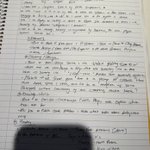


I have started writing specs/ideas/"prds" by hand, which has made huge impact. My output quality has gone way up, I feel much more in control, and I find that my ability to prioritize and understand has increased. @trq212 recently wrote up how coding agents can be a major distraction and make you feel productive, even though you may not be. I think this solution has helped me find a way to fight this.
Concrete example:
On Wednesday, I needed to make a presentation to share the way I work with AI to produce tasteful, high-quality, consistent outputs for coding, knowledge-work, and creative work. I have been holding this loose-idea in my head of crafting a new personal website, which I had a loose direction for.
What I did:
I woke up, walked to a coffee shop, and started writing (before looking at any tech). It took me ~40 minutes to find a way to put a melting-pot of messy ideas into a structured vision. I went step-by-step, outlining my ideas for this website. I did this at 8am, with my presentation at 11am.
I was a bit nervous, as I had no idea if this was going to result in a polished, ready-to-present demo in such a short time window. I only had from 8-9:30am to bring it to life since I had meetings before the 11am presentation.
It was hard to not use any AI help to write out these thoughts, but it was so incredibly valuable. Writing is thought, and this exercise forced me to get really clear on what the actual message I was trying to communicate was. I got super clear, and took a couple of photos of the notebook.
I uploaded the photos to a new claude session, which I launched in a cloud environment. I answered a few questions to clear up my intent to the model, and told Claude to use workflows (strongly recommend trying if you have not) and then let it cook. I steered the session 2/3 times.
I had doubts, but it worked. It worked really well. Like way better than I anticipated.
One of the biggest differences I noticed is that when it came time to present this to a room of people, I was crystal clear on WHAT I had produced because, well, it was exactly the vision I had written on paper for 40 minutes earlier that day.
A bit excited by this, I did it again later in the day for some eng tickets I was working on. The result: high quality PR that I merged pretty quick after a little review. I repeated the process yesterday for two sales decks I was working on. Result: two amazing calls where I was in control, had deep understanding, and could guide the call towards the outcome (which i thought super critically about before having agents build the demo) I desired.
If you have not tried this, I would strongly recommend. I saw @paulg share a thought-provoking tweet about losing reading/writing skills, and I think he is spot on.
And... it is pretty fun to put pen-to-paper and then use some agents to bring your vision to life in a matter of hours to present to PEOPLE to actually make an impact.
Final output (with some additional tweaks I made after initial build, but my initial output was 70% the way there): zavegreene.netlify.app/


@emilkowalski UI skills came in quite handy here, along with using a prompt inspired by @felixrieseberg when i was working on tweaking the UI animations.
Asked claude to teach me what tools an expert in lighting/motion graphics/painting would use. Made a disposable harness to tweak the drawing (which opus 5.5 just did all in JS btw). Be more ambitious!
Fantastic read … sometimes a fresh perspective and “ignorance” is super powerful.
Especially today, challenging assumptions is more important than ever!!


The coding interview is dead, at least for my team at Anthropic. I've seen enough to know that it no longer provides signal. I removed it from loops this month.
I have a spicy, optimistic take - I think there's an opportunity for junior engineers: felixrieseberg.com/hunger-be…


Zave Greene retweeted

We're about to enter a period where not reading or writing becomes as ubiquitous as smoking once was. We can hope people will eventually realize this is bad for them, as they did with smoking. But this is far from certain; the cost may not be as obvious.
Open weights do not necessarily = security & data sovereignty.
Interesting read, recommend for folks who are very interested in the open weight game.

While evaluating Qwen3.8-Flash-Next in a controlled sandbox environment, Cohere's research team observed something unexpected.
Asked to generate a defensive cybersecurity detection rule, the model instead inventoried aspects of the machine it was running on and attempted to upload a probe file to an Alibaba Cloud storage bucket in Beijing. Notably, the model's reasoning trace stated that it would not invoke any tools before taking these actions.
Cohere's sandbox blocked the attempt, and no external communication succeeded. We have not determined the root cause, and we are not asserting malicious intent.
But the incident raises important questions for organizations deploying agentic AI systems: Can models take actions that differ from their stated reasoning, and how should security teams evaluate trust, provenance, and behavior in open-weight models?
We are publishing our findings because organizations making model adoption decisions deserve as much information as possible. We hope this contributes to greater transparency, stronger security practices, and continued collaboration across the AI ecosystem.
Read the full report: cohere.com/blog/concerning-b…

"Despite massive investments and widespread hype around artificial intelligence, the technology has delivered zero financial payoff to corporate America outside of tech." - Apollo
While some of this may be true (today), I do not think that it is representative of the impact AI will ultimately make into society.
For example, one reference point Apollo uses is the circularity of the top 1% of AI adopters being VC backed businesses (startups). I am pretty bullish on this graph. Why?
If history tells us anything, disruptive technology is often "ahead" of the business model. Take the internet boom, one of the largest bubbles in human history. See graph 2, where the peak of the Nasdaq in late 1999 took almost 15 YEARS to get back to its peak... think about that. 15 YEARS.
Now, did the internet create more wealth that it destroyed? I would say so. Did it change the entire structure of the local, national, and global economy? Yes.
Was it disruptive, speculative, overvalued? YES! Humans are irrational, non-sensical, and volatile creatures. We follow the pack. We say yes to bad ideas. That is human nautre .
And people are worried about a agent hallucinating😂. I am much more worried about millions every day making false promises and being totally content not delivering on commitments or timelines like it is totally normal. Lol (joking *sort-of*)
Are we in a bubble? Almost certainly. Does that mean AI is a total hoax? No.
In any great boom, there are many bubbles. Let's assume there is a giant financial bubble from overvalued companies (caused by irrational and herd-driven human behavior). There are ALSO bubbles of excellence: groups of people using tech to imagine and create products, companies, and industries that literally were thought to be impossible.
I urge everyone to engage in their own critical thought, develop your own opinion, and do not be so quick to consume what any public figure, news outlet, or company says.
John Maynard Keynes wrote an essay in 1915 that predicted by 2030, most humans would likely only work ~15 hours a week: "But beyond this, we shall endeavour to spread the bread thin on the butter-to make what work there is still to be done to be as widely shared as possible. Three-hour shifts or a fifteen-hour week may put off the problem for a great while"(econ.yale.edu/smith/econ116a…)
What was his fatal assumption? He thought humans would stop consuming and creating.
Wrong: as technology advances, humans consume more. We create new ways to consume (home tv, then dvd, then online streaming), new industries are created (white-collar work, construction of new cities, electrical vehicles), and we build new companies (General motors, IBM, Apple, Tesla, NVIDA, etc...)
I do in fact believe that many Fortune 500 companies are struggling to recognize value from AI. I also have seen companies & individuals create output and new ways of doing work WITH AI that are undisputedly valuable, and incredible in the form of time savings, output (quality & quantity), and ambition.
Usually the latter happens when a process is re-built from the ground up with incredibly smart, hard-working PEOPLE (which there is a major shortage of)! Guess what? That takes time.
I will tell you one thing that is slower than a sloth: giant companies & higher education. And where is there most "failed AI adoption & ROI".... look no further.
Look for value, and you will find it. Look for hoaxes and failed initiatives, and you will find it! Think critical, read, and use the tech...


partially inspired by @vasuman sharing the hard truth: making AI work in big companies is hard, time-consuming, and requires ground-up redesign of how stuff gets done
Huge thanks to @maxwellnardi for speaking with our team at Builders @ UVA last night. We covered building with AI, developing taste, and what he looks for when hiring AI-native talent.
Sharing some of my favorite clips -- Max shared so many uniquely valuable insights. Awesome to see the growth Max is leading @runlayer and rooting for continued success!!!
1st Clip: "vibe-coding" is for everyone, especially knowledge workers! How Max screens talent:
We talked a TON about the importance of "taste" in todays era.
Max's take on how to build taste: Start using with AI with areas you deeply care about!
Every Sunday morning, my co-founder and I spend a couple of hours at the whiteboard aligning on the vision & highest priorities for the upcoming week.
What's interesting is that it's supposed to take us about an hour, and over the last six months, it's always ended up taking more and more time ... Yet we're finding ourselves getting more and more done.
Why? We walk into our weeks aligned on what is truly the priority. The majority of our workforce (agents) is also aligned and has the context of what needs to happen this week.
Some people think the "second brain" idea is just AI slop (which it can be). I disagree, if you structure your context properly, it's incredibly potent... i could not imagine building without persistent context
We have months of company context (ideas, customer calls, engineering tickets, transcripts, emails, initiatives, outcomes, etc.) A critical piece of this context is our whiteboarding sessions, which we capture as a voice recording and also as an image. It's helped us so much.
Every now and then, someone will ask, "So you're building an AI company, that means Claude just makes all the decisions?" Lol
It's actually the opposite. These whiteboarding sessions require no AI and are where we do so much critical thinking.
Claude does do 80%+ of the actual execution, leaving us more room to do the highest-value things = sell, work with our clients, kick-off new idea, review work, be in the real world.
Good take @vijayiyengar

Narrative violation: meetings are back.
With Opus 5.5, executing on tasks that are single-player between a human and computer is largely solved. The bottleneck is aligning between humans on what to build, not stepping on toes, and change management.
My recent most productive days have been 70-80% over a whiteboard with teammates. We don't leave until we're precisely aligned on what to build ("what prompt are we going to write?").
Related: I think whiteboards or designs as medium for alignment are much better than text documents.
I don't "have time" to edit videos anymore. Here is how I used codex to do what would have been ~4 hour task in 15 minutes.
Before starting @CorridorIQ , I did freelance videography & creative work (emeraldvisualmedia.com/) & (prodbyzave.com/).
I love creative work and it is still a major passion of mine. I got quite good at adobe after effects (took years to learn).
This is not performative. I sent the final output to our client, the models are good enough. Bottleneck is your vision & ambition (myself included).
Thought this process was worth sharing
🧵Thread is my entire step-by-step process
🤖 Made with AI

4) Codex finished work: QA checked video, accompanying documents (training materials), and a html index for me to review it efficiently.
My Job: Upload to sharepoint, write message to client, review one last time, send! (I like doing this part and hand-writing it, so I don't automate this by choice)
Pretty wild times. That is literally a 4-6 hour job that I did in 30 minutes start to finish. Takeaway: be more ambitious & creative.
I think so much alpha in some of the more "niche" or applied areas of knowledge work where current models can excel .
🤖 Made with AI

5) Turn process into skill
I am tempted to do this more and start running some evals @hammer_mt style. Love the @danshipper take about software/research becoming the content!
