

@carv_official @GalacticaNet Community: @XBorgHQ NIP #DOJO
Joined April 2022
- Tweets5.9K
- Following1.5K
- Followers192
- Likes3.8K








Post Tenebras .XBG | Galactica | CARV | LIFT⚡ retweeted

🤖Your agent's transaction history is your business strategy, published in real time. Your commerce patterns for the entire internet to see. Portfolio allocations readily available for others to copy and exploit... etc. etc. You got the point.
🔐Every API it pays for, every price it accepts, every counterparty, goods or service it chooses is visible to anyone watching the chain. For autonomous agents doing real work, transparency is more of a bug rather than a feature, so...
⏳In two weeks: Private x402. Settlement nobody else can see. Compliance intact.
@GalacticaNet x @aztecnetwork


Private x402 is coming to Aztec.
@GalacticaNet is bringing agentic payments to Aztec with private-to-private settlement: no exposed sender, no exposed recipient, no exposed amount.
Stay tuned for additional information.
Post Tenebras .XBG | Galactica | CARV | LIFT⚡ retweeted
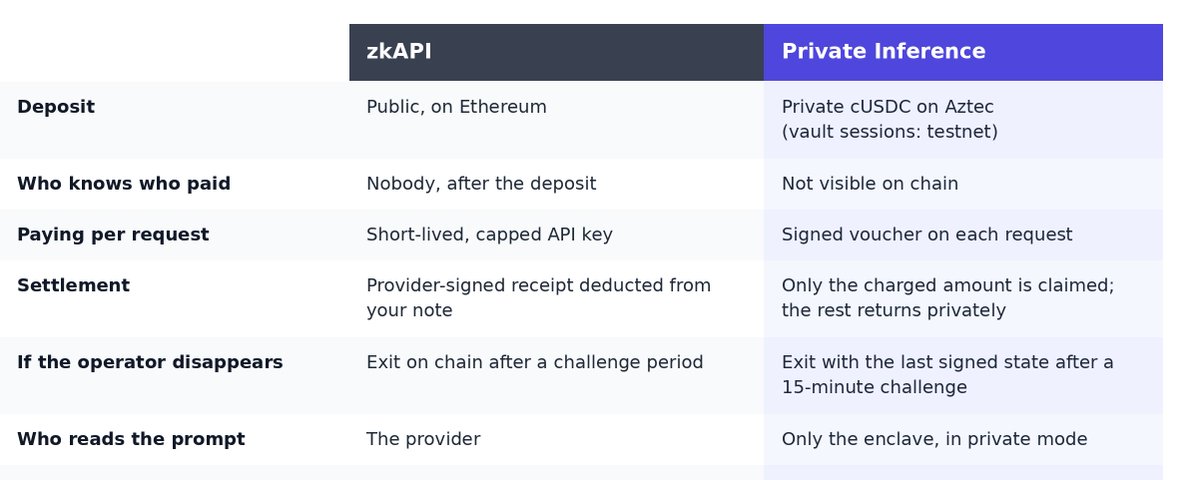
🔐 Introducing PrivateInference (PI)
🤔 What:
0 compromise private inference - wholesale or retail - one API key, one funded session, access to a universe of open and closed-weightg models from the leading labs, including OpenAI and Anthropic. No supplier accounts, no subscriptions. ✅
💭 Why:
1. Prompts have become highly sensitive data: unlike search queries, they can reveal reasoning, contracts, medical records, unreleased code, negotiations, and other confidential context. This information remains exposed on third-party servers during processing.
2. “Private inference” gets thrown around loosely: people normally think TEE - open weight models where execution is encrypted on the hardware level. Indeed, TEE can protect memory but a gateway still reads your prompt. Zero-retention policies constrain future use, not present visibility. Privacy is a chain — identity, payment, routing, and execution each need their own boundary, and a transaction is only as private as its weakest link.
⚙️ How:
🌐 Private settlement for tokens on Aztec mainnet (sender, recipient, amount never go onchain)
💳 One session funds many calls across models and inference providers
🔀 Provider routing with per-request zero data retention where supported
📅 When:
🟢 Live soon on the @aztecnetwork mainnet - settlement + session billing.
Next up: 🪪 conditional zkKYC (prove eligibility, not identity), blind routing, and an attested TEE execution tier with no fallback to a standard route if privacy can't be guaranteed.
Full article: teapaw.org/GalacticaNet/status/21…


Post Tenebras .XBG | Galactica | CARV | LIFT⚡ retweeted

REVERIE FIELD — AFTER THE REWIRING 📻
Huge Patch Notes · RFV258–RFV284
Hey everyone :3
In the previous patch notes, The Field Rewired, I wrote that the machinery was finally in place and that I wanted to spend more time making recordings, writing music, expanding the world and actually enjoying the game rather than constantly rebuilding its technical foundation.
I meant that.
And then, naturally, I spent another series of updates fixing the machinery)))
There is a difference :3 though. This is not another fundamental redesign of Reverie Field. The school specialization framework remains in place, the existing progression systems are still here, and your Relics haven't suddenly become part of an entirely new game.
Instead, these updates address the things that became apparent once players started using those systems together.
Some Crafting builds were generating rarities at a rate that could not remain sustainable. Extremely powerful Learn configurations had begun stretching the economy in unusual directions. Referral rewards needed attention. Crew Grandmaster Relics weren't contributing to school progression as expected. And a few players had accumulated enough Points to make ordinary JavaScript arithmetic look rather embarrassed.
There has also been a considerable amount of work on the Radio, the music player, achievements, notifications, mobile layouts and the general presentation of the game.
Some of these changes are significant. Others are small corrections that probably should have happened a long time ago.
I want to explain what changed, why it changed, and - just as importantly - what has been left alone.
01 / CRAFT — KEEPING RARE THINGS RARE
Let's begin with one of the more sensitive subjects: Rare → Epic crafting.
In The Field Rewired, I explained the correction to the old Tier Roll calculation, where bonuses intended for Rare, Epic and Legendary had been incorrectly multiplying one another.
That problem was fixed.
However, further testing revealed another issue, this time involving highly specialised Crafting builds.
Some accounts had accumulated enormous combinations of Craft-related Relic affixes, upgrades and other modifiers. The resulting Rare → Epic chances were becoming much higher than the intended progression curve.
I spent some time comparing the behaviour of ordinary players with that of advanced Crafting configurations.
The most important conclusion was that I didn't want to punish newer players for something happening at the extreme upper end of the system.
The final Rare → Epic rules are:
General maximum chance: 3% per eligible Rare crafting attempt.
Dedicated Crafting setup with at least five qualifying Craft Relics: 3.5% maximum.
Players with smaller chances retain their existing calculation until the relevant ceiling is reached.
The higher ceiling requires an actual qualifying Craft setup, not simply a large collection of unrelated bonuses.
Simple → Rare crafting is unaffected by this particular adjustment.
The separate Grandmaster Legendary crafting route remains its own mechanic.
The five-Relic requirement for the higher ceiling is based on qualifying Craft-school membership. You don't have to wait for the normal specialization stabilization timer simply to gain access to that probability ceiling.
That distinction is deliberate.
Crafting should still reward dedication. If somebody builds an entire character around collecting, upgrading and combining Craft Relics, that effort should be meaningful.
But a strong build and an unlimited probability engine are not the same thing.
Craft Result information has also been updated to communicate the relevant limits more clearly. Where a maximum is reached, the result can indicate that the chance has been capped rather than presenting an unrealistic theoretical value.
I don't want a player spending valuable resources based on a number that isn't actually being used by the server.
And I don't want the game to become a place where every second object is Epic simply because somebody found a sufficiently complicated multiplication chain.
02 / FARMS — A MORE SUSTAINABLE RELIC ECONOMY
Farms received a related balance adjustment.
The new Farm specializations introduced in the previous update are still here. Their storage improvements, production bonuses and progression benefits remain part of the system.
What needed additional work was the interaction between very large relic-generation bonuses and the final rarity calculations.
Farms can benefit from several different sources of improvements: their own upgrades, Talents, Relics, school effects and additional modifiers.
Those combinations are intentional.
However, at the highest levels, certain configurations were producing disproportionately strong Epic and Legendary recovery chances.
I've refined the way those bonuses are applied, especially when their combined values become unusually large.
The important distinction is that ordinary Farm builds retain their intended opportunities.
A player who is still developing a Farm, collecting better equipment or assembling their first specialisation shouldn't suddenly find that the whole system has become less rewarding.
The adjustments mainly affect extreme combinations of bonuses.
I've also brought the calculations behind Farm rarity previews closer to the probabilities used for actual rewards.
There are still separate mechanics for additional copies and special rewards, so not every possible Farm outcome is represented by one simple percentage.
But the underlying rarity calculation should be much more consistent.
I want Farms to remain useful for players who enjoy a slower form of progression.
Set up your equipment, improve it, leave it running, return to collect what the Field has produced.
That's a nice little ritual.
I just don't want it to turn the Legendary classification into an everyday household item.
03 / LEARN — A SMOOTHER REWARD CURVE
Learn has received important adjustment.
Some players (GAP <3) have created remarkably powerful Learn configurations, especially through combinations of high-level Learn SONO Amount Relic affixes.
I like this.
Learn is one of the systems that reflects the original idea behind Reverie Field: sound is something worth paying attention to, understanding and exploring.
It shouldn't exist merely to fill the space between Crafting attempts.
At the same time, the highest SONO Amount configurations were starting to produce rewards that grew much faster than the underlying economy.
Rather than introducing another blunt maximum reward, I've implemented a smoother diminishing-returns calculation for exceptionally large combinations of Learn SONO Amount bonuses.
In practical terms:
Ordinary and moderately developed Learn builds retain their intended progression.
High-level SONO Amount bonuses still improve rewards.
At very large combined values, each additional bonus contributes progressively less.
There is no new fixed maximum SONO reward per Learn attempt.
That last point is important.
The intention isn't to make upgrading Learn Relics pointless.
It's to prevent the strongest configurations from accelerating at a rate that makes further progression impossible to balance.
I've also corrected some behaviour involving high-level Learn SONO affixes and the values retained after upgrades.
A valuable Relic shouldn't become unexpectedly worse because its upgrade calculation handled a particular bonus incorrectly.
These changes allow strong Learn builds to remain strong without letting one combination of modifiers determine the entire economy.
And hopefully they give people another reason to open Learn for the actual subject matter.
There really is more to sound than Points.
Although apparently there can be quite a lot of Points.
04 / REVERIE CREWS — GRANDMASTER RELICS AND SCHOOL SPECIALIZATIONS
One of the most important consistency fixes concerns the Crew Grandmaster Relic.
This Relic occupies a special position in Active Resonance.
Unlike ordinary equipped Relics, it belongs to the player's Crew-related progression and has its own rules for effective strength, quality and other characteristics.
Until recently, however, something was missing.
A Crew Grandmaster Relic could belong to a particular school without properly contributing to the 5/8/11 school-specialization counts.
That behaviour has been corrected.
An active Crew Grandmaster Relic can now contribute one matching school member toward the normal 5, 8 and 11 specialization thresholds.
For example, a Farm-school Crew Grandmaster can help complete a Farm specialization.
The same principle applies to the corresponding schools.
These contributions also respond to relevant changes in Crew state, Grandmaster Relic acquisition and school adjustments, rather than relying on the player to rebuild their entire setup.
The existing specialization stabilization rules still apply to the bonuses themselves.
This does not mean that a Crew Grandmaster has become an ordinary equipped Relic in every respect.
It retains its separate slot and mechanics. Contributing to the specialization count does not automatically give it every other possible school-set, Memory Word or Secret Phrase interaction.
I've also corrected aspects of Crew Grandmaster voucher handling and adjustments.
Changing a Grandmaster Relic's school does not automatically increase the percentages of its existing affixes. Quality and other applicable progression characteristics are separate matters.
There have also been improvements to voucher accounting, including the handling of eligible Crew Grandmaster adjustments when a Crew is disbanded.
One more change: Grandmaster Reset players can now access Active Resonance from Level 1 under the relevant GM progression rules.
Previously, the usual level requirement could become an unnecessary obstacle for somebody who had already completed an entire progression cycle.
That didn't make much sense.
A Grandmaster should be able to begin again without forgetting how their equipment works.
05 / REFERRALS — REWARDS THAT ACTUALLY FEEL LIKE REWARDS
Referral activations have received a considerable reward increase.
As the game economy developed, the original Relic Fragment rewards for activating a referral link became increasingly insignificant.
This was especially noticeable for players who had invested heavily in Referral Talents, Relics and specialization bonuses.
I've changed that.
Successful referral activations now receive a ×100 increase to the existing Relic Fragment reward component.
This applies to both sides of the activation:
The player activating somebody else's referral code.
The owner of the referral code.
Each player's reward is still calculated independently, using their own eligible modifiers and progression.
For players with Grandmaster Reset, the activation's Points reward has also received an additional ×10 multiplier.
These changes build on the existing reward system rather than replacing all its previous bonuses.
A successful activation should now be much more meaningful, especially for players who have deliberately invested in Referral progression.
I've also corrected the requirements for Referral Relic generation.
There are two different mechanics here, and I want to clarify them because their Talent requirements are easy to confuse.
Referral Crate Claim requires:
Referral Resonator Lv10+
Daily Amplifier Lv10+
Your accumulated Crate rewards are preserved while the requirements are not met.
Referral Relic generation during activation, on the other hand, requires:
Referral Resonator Lv10+
Level Booster Lv10+
These are independent conditions.
The system now handles that distinction more consistently.
I've also improved Referral Relic notifications. Generated Relics can carry their actual identity and source information through the notification process, including the relevant details of new or duplicated objects.
A player should be able to see what they discovered, both in the game and through the appropriate notification channels.
The activation result window has also been improved. Relic information and awarded resources are presented more clearly, and compact reward numbers can be expanded to reveal the full amount.
There was even a rather ridiculous interface problem where the exact-number popup appeared behind the activation result window.
A popup that nobody can see is technically still a popup.
But not a particularly useful one.
That has been addressed.
06 / REFERRAL CRATES AND CREW REWARD SAFETY
Alongside the direct activation changes, I've refined some of the systems responsible for accumulated Referral rewards and Crew distributions.
Referral Crate progression now uses more carefully defined limits and calculations for different player states, including Grandmaster progression.
Large values are handled with greater numerical precision, and the accumulation process is designed to respect its intended ceilings.
Crew reward distribution has received similar attention.
The interaction between shared rewards, individual limits, cooldowns and very large modifier combinations can become surprisingly complicated.
I've tightened these calculations to reduce the possibility of repeated or excessive awards and make the results more predictable.
These aren't new activities or additional currencies.
They're corrections to systems that already exist.
I want a Crew to feel like a shared effort, not an opportunity to discover which accounting operation can be repeated the fastest.
And I want players to know that rewards already earned will not simply disappear because another part of the system needed adjustment.
07 / THE ECONOMY HAS REACHED SOME ABSURD NUMBERS
I have to admit that I underestimated how far some players would take the Points system.
There are accounts in Reverie Field whose balances are large enough to expose problems that don't normally appear in the everyday use of JavaScript.
At those sizes, a number is no longer something you can casually convert into an ordinary browser floating-point value and expect every digit to survive.
This matters for much more than presentation.
It affects calculations, reward settlement, conversions, displayed balances and anything that depends on an exact integer amount.
I've made several corrections to the handling of very large values, particularly in Points-related operations, GAS conversions and WOS calculations.
Where exact integer values are required, the system now preserves their precision rather than relying on ordinary floating-point arithmetic.
The WOS printing progression has also been refined, including calculations at very small progression steps and consistency with relevant Season-entry conversions.
The goal is straightforward: the game should not silently lose or invent value because a number has become inconveniently large.
The interface has also become more readable.
Large quantities can now appear in compact form using letter abbreviations, as they already do in several parts of the game.
But the precise amount remains available.
For supported values, clicking or hovering over the number reveals its full representation.
This includes improvements to balances, rewards and Radio information such as:
Current Session Points
Estimated Reward for 1h
Total Boost
Other supported large resource values
And because somebody inevitably had to reach an almost unbelievable amount of Points, I've introduced another milestone in the existing Point Signal achievement line.
Point Signal VI — The Sextillion Veil
It recognises reaching one sextillion Points.
1,000,000,000,000,000,000,000.
I think at this point we can safely say the game has progressed beyond counting pebbles.
08 / ACHIEVEMENTS — SOME THINGS SHOULD BE DISCOVERED
Achievements have also received some new additions and corrections.
The new Point Signal milestone is one of them, but it isn't the only one.
There are also two new cassette-related achievements connected to some rather nostalgic interactions in the music player.
I'll explain more about the player in a moment, but I don't want to spoil these particular discoveries.
Some of us grew up with cassette tapes, and there were certain very practical things we learned to do with them when the batteries were almost empty.
You may remember.
Completing the corresponding interaction records the event.
The game does not immediately award the full achievement and its resources simply because the player has finished a local interaction.
Instead, the achievement is recognized through Sync Achievements in the Profile.
That is where the player can receive the corresponding achievement recognition and its one-time rewards.
Each cassette achievement offers 2,500 SONO and 2,500 Relic Fragments.
Both also have their own little stories and Discord-role support, where the corresponding Discord roles are configured.
The new synchronization handling is designed to recognize the completed events without repeatedly awarding the same achievement.
I rather like these achievements.
Not everything in Reverie Field needs to be about an enormous multiplier or an exceptionally rare drop.
Sometimes a small gesture can be worth remembering.
09 / THE RADIO — A MACHINE YOU CAN ALMOST TOUCH
The Radio interface has undergone one of its most noticeable visual changes.
Reverie Field began as a continuous field-recording radio, and I wanted the act of listening to feel more physical.
Not just another Play button inside another browser window.
I've been looking at old recording machines, cassette transports, reel-to-reel equipment and the remarkable contraptions people build around endless magnetic tape loops.
If you've ever seen a reel-to-reel tape loop stretched across an entire desk, routed around improvised supports, you'll understand why.
The tape leaves the recorder, travels around a pencil or another object, bends around guides, accumulates slack, and returns to the transport.
The entire workspace becomes part of the instrument.
I've tried to bring some of that feeling into the Radio.
When a Listening Session is active, a stylised tape transport appears around the listening controls.
The tape travels through a system of rollers and external guides, with an extended loop moving around an improvised pencil support.
Instead of simply rotating two decorative wheels, the animation includes variations in tape movement, tension, drift and the shapes formed by the moving loop.
It's an interpretation of the physical behaviour of magnetic tape, created to fit the illustrated world of Reverie Field.
The transport and controls have also been reorganised.
Listening Time and Current Session Points now belong more directly to the recorder-inspired interface, while the remaining session information is arranged beneath it.
The Stop Listening control has received visual improvements and a more deliberate position within the transport.
The Radio volume control has also been redesigned with a physical fader appearance inspired by old recording equipment (Marantz pmd740).
There are separate layout considerations for smaller screens, where a literal copy of the desktop transport would simply consume too much space.
I've also continued refining the relationship between this visual system and the real listening session.
The animation belongs to the interface. It does not determine how Points are earned, and it doesn't require the server to simulate a magnetic tape machine.
The underlying listening and heartbeat systems remain independent.
Because however much I enjoy old recording equipment, I don't think the database needs to know the rotational speed of a pencil.
10 / THE MUSIC PLAYER — THE WAX FIELD TAPES 📼
The music player has also been completely redesigned.
The previous interface was functional, but visually it didn't have much of a relationship with the recordings it was playing.
I wanted something closer to the feeling of an old cassette deck or portable field recorder.
The result is a new player inspired by vintage tape equipment, worn metallic surfaces, engraved markings, aged controls and the warm, dusty visual language associated with old recordings.
There is now a little cassette in the player, complete with rotating reels.
Its transport responds to playback, pausing and seeking.
You can also interact with the cassette itself, including manually moving through a recording.
I've tried to make these interactions feel like small physical actions rather than ordinary browser controls.
The interface includes a custom pencil (yeh, Pencil :3) cursor for the appropriate tape interactions, with transport behaviour that responds to the direction and speed of manual movement.
Playback transitions have also been refined.
Starting, pausing, stopping and changing recordings now have softer audio transitions, and the player has support for additional tape transport sounds and variations.
The aim is to avoid the unpleasant hard cuts that can happen when one recording is abruptly replaced with another.
The design draws inspiration from equipment such as old Sony and Marantz recorders, alongside the dusty trip-hop atmosphere of my music itself.
You'll also notice a little reference to The Wax Field Tapes.
It's a tribute to that particular culture of worn cassettes, imperfect recordings, instrumental hip-hop, tape noise and music that feels as though it has been sitting in somebody's personal archive for twenty years. And a Dusted Wax Kingdom label. I grew up with this label's music.
I've also improved the playlist.
Rather than always beginning with the first track, the player can introduce a different available recording when a new listening experience begins.
This includes eligible music unlocked through Secret Phrases.
I don't want somebody to listen for months and never discover a track simply because it happens to be number 34.
There is also a new Sound Banks system that allows players to save the available music to their device's local browser storage.
Where the local copy is available and supported by the browser, playback can use it instead of unnecessarily downloading the same audio again.
The system can also account for changes to the playlist as recordings are added or updated.
Sound Banks are presented as a collapsible section, so they don't constantly occupy half the player when someone simply wants to listen.
The soundtrack itself has undergone a much larger musical update, including remastering and new compositions.
I'll give that its own separate announcement, because I think the recordings deserve more attention than a paragraph inside technical patch notes.
For now, the important thing is that the player has become something much closer to the atmosphere I originally wanted.
A small archive of imaginary tapes.
And perhaps a slightly unreasonable amount of attention paid to the movement of two little plastic reels.
11 / MOBILE PLAYBACK AND DEVICE-SPECIFIC CONTROLS
The Radio and music player have also received more device-specific interface work.
This is particularly important on iPhones.
Mobile browsers do not all behave like desktop browsers, and iOS has additional limitations concerning software-controlled audio volume.
A slider that works normally on a desktop computer may not provide meaningful continuous volume adjustment on an iPhone.
Rather than pretending that this limitation doesn't exist, the interface now provides a more appropriate control where necessary.
On affected iOS devices, the unavailable software volume fader can be replaced with a styled mute control.
The same principle applies to the Radio and music player, with their corresponding audio behaviour.
There have also been improvements to how the interface handles playback transitions, background state changes, visibility changes and interruptions.
These areas remain dependent on the restrictions imposed by the browser and operating system.
For example, no web application can guarantee unrestricted background playback if the operating system decides to suspend it.
But the game can handle supported transitions more carefully and avoid unnecessarily fighting with the device.
The music and Radio systems have also continued moving toward better coexistence.
Playing a piece of music, listening to the continuous Radio, or hearing another eligible sound inside the game shouldn't automatically destroy the state of everything else.
That's especially important in a project where several different forms of audio are supposed to exist together.

Post Tenebras .XBG | Galactica | CARV | LIFT⚡ retweeted

Enigma ONE has arrived on Syntetika.
Managed by Hilbert Capital, the USD-denominated fund gives access to Enigma’s high-frequency trading strategy.
Deposits are now open.
app.syntetika.io/vaults
Post Tenebras .XBG | Galactica | CARV | LIFT⚡ retweeted
Reverie Field Update - Active Resonance, Craft Economy, Mobile Audio, Seasonal Relics & Verified Expeditions
A large Reverie Field update is now live.
This one took much longer than a normal feature patch because most of the work was not about adding one isolated system. It was about making many existing systems finally agree with each other again: upgraded relics, Active Resonance, crafting capacity, Relic Fragments, Learn and Daily builds, seasonal relics, Expeditions, Radio and mobile playback.
The goal throughout all of this has been simple: preserve the value of what long-term players have built while making the economy healthier, clearer and more sustainable.
Relic strength & Active Resonance
One of the most important fixes concerns heavily upgraded relic affixes.
Some powerful affixes - especially Daily Limit Capacity, Farm Harvest and Referral Crate Points - could previously be reduced by an internal safety layer even when the relic itself contained a much larger legitimate value accumulated through upgrades and merges.
That is no longer how the system works.
The actual strength stored on the relic is preserved. Safety ceilings are now applied where they belong: at the final gameplay system that consumes the bonus. A strong relic can therefore remain genuinely strong without allowing Craft, Farms or other economic systems to become unbounded.
Active Resonance has also become more consistent. The original cumulative 3 / 5 / 8 / 11 school rewards remain intact, while school depth also strengthens affixes belonging to that school through the newer amplification layer. Source-specific relic rolls remain separate from global rarity effects, so older relics with strong Legacy Global Relic Roll, Rare+, Epic+ or Legendary Tier Roll can still have real value in modern builds.
Craft Economy
High-end Daily Limit Capacity builds had reached a point where enormous amounts of Craft throughput could effectively become free. The new model keeps the potential of those builds, but gives that extra capacity a real economic cost.
Your normal daily Craft attempts remain free. Base attempts, Crafting Adept and flat Craft Attempt bonuses still work as before.
The major difference is that Daily Limit Capacity now expands how many additional attempts your build is allowed to purchase with Relic Fragments instead of turning all of that capacity into free production.
Extra attempts cost 80 Relic Fragments each. The basic purchasable allowance starts at 100 per UTC day, while having at least 5 Craft and 5 Daily relics in Active Resonance raises that foundation to 500. Powerful builds can extend this much further.
The normal absolute Craft ceiling remains 50,000 attempts per day, while the rare Warped Craft Ceiling can bend the theoretical maximum to 87,500.
The Craft interface has been rebuilt around this distinction as well. It now clearly shows how many attempts you have available, how many are included, how much additional capacity your build can unlock and what that capacity costs. The actual purchase controls stay hidden until your included attempts are exhausted, so the screen remains readable.
Large purchases can also be completed through one protected action instead of hundreds of small requests, while Batch Craft continues to resolve every individual relic roll separately.
Better Relic Search
Relic and Memory Word search received another major quality-of-life pass.
Inside your own Relics you can now explicitly choose between Smart Search, Starts With, Contains and Exact Memory Word matching. One-letter searches work properly, and short two- or three-character searches are no longer awkward edge cases.
The same system now exists in Off-Market Relic Discovery, making Secret Phrase hunting much easier across the wider relic archive.
Fullscreen Market navigation was also fixed: changing pages while searching the archive now keeps you at the Discovery section instead of throwing you back to the top of the ordinary Market.
Learn, Daily & Streak Guard
Learn now has a much stronger progression identity.
Learn SONO Amount has more meaningful base values, while new Learn Fragment Amount and Learn Description Attempts affixes increase Fragment rewards and the number of daily Sound Description attempts.
Learn and Daily also now have major Active Resonance tiers.
With 5 Learn relics, the main Learn reward layer receives ×1.5. With 11, it becomes ×4, affecting Fragment rewards, SONO amount, SONO chance and the ordinary Learn relic roll.
Daily follows the same structure: 5 Daily relics = ×1.5, while 11 = ×4 to the ordinary Daily Claim reward layer.
These major 5/11 bonuses use a two-hour Fader stabilization window, so players cannot instantly swap a complete build in immediately before a reward and receive the full multiplier.
A new Daily Streak Guard has also been added. The 1 Save version costs 20,000 SONO and waits until the next streak-breaking event before being consumed. The 7 Days version costs 100,000 SONO and protects the streak for its entire duration. Streak Guards can also appear through Farms.
Farm UX received some smaller fixes too: upgrading Speed, Capacity or Luck no longer throws your scroll position around, duplicate upgrade popups have been removed, and the Store information control has been cleaned up.
Radio, Music & Mobile Audio
A large part of this update has been about making Reverie Field behave more like an actual layered audio environment.
Radio, Music, Expeditions, Farm sounds, Relic Memories and other game audio should be able to coexist instead of constantly fighting for control of playback.
Radio recovery is now much less destructive. Temporary pause, suspend or browser lifecycle events no longer immediately destroy and rebuild the stream. The client first tries to continue the existing connection, while full reconnects are reserved for real errors, ended playback or confirmed stalls.
Music and Expeditions also no longer constantly rewrite Media Session ownership every time their state changes.
On mobile, the lock-screen Now Playing card is now dynamic. A playing Expedition has priority and can show its title, artwork, duration and playback position. If no Expedition is active but Music is playing, the current track can appear instead. Radio becomes the main card when neither of those more specific sources is active.
Farm and map loops also received a more mobile-friendly playback path so they have a better chance of surviving screen locks and background transitions.
Background recovery remains event-driven rather than relying on another permanent polling loop. The game leaves a lightweight session checkpoint when the browser freezes or goes into the background, then reconciles the existing session when the player returns.
BUZZER & the Other Field
The BUZZER presentation has also been rebuilt.
The receiver inside the Radio tab now uses a proper live shortwave presentation rather than relying on broken direct-audio links, and the surrounding UI is styled as part of the game rather than looking like an external player dropped into the page.
THE TAPE CAME BACK WRONG has been enlarged and redesigned into something closer to a recovered transmission or damaged print artifact.
The BUZZER monochrome background was also fixed so the normal coloured Reverie Field artwork no longer flashes through while scrolling.
Warped relics remain the exceptional endgame layer around these systems. Their Fault Lines can bend limits that ordinary affixes are intentionally not allowed to modify directly, including Craft, Farm and other high-end system ceilings.
Seasonal Relics
Seasonal relics now become more rewarding to upgrade.
Their Seasonal Signature still begins from the player's actual season placement, so rank remains the main source of strength. However, upgrading the relic itself now gradually increases that Signature as well.
The growth is intentionally modest compared with ordinary affixes: at Level 16, the Signature reaches a maximum +35% relative increase over its rank-based starting value. A Rank #1 Signature therefore grows from 10% to 13.5%, rather than receiving an excessive +35 percentage points.
Seasonal Signatures now display consistently across Relics, Active Resonance, Market, Auctions, Public Profiles, Share Cards and Field Assembly transmissions, and they can also be found properly through Market search.
Verified Expeditions
Verified Route received one of the deepest stability passes in this update.
A Verified recording should now start from the first Play interaction on desktop, iPhone, Android, browser or PWA without requiring the player to switch into Open Listening first.
Once a Verified Route is active, moving through the rest of Reverie Field does not inherently end it. You can browse other tabs, inspect Relics or the Market, lock your phone or temporarily leave the application while the underlying recording continues.
Mobile browsers can sometimes return delayed checkpoints in a strange order after waking from the background. Harmless backward or out-of-order updates no longer destroy a legitimate Verified Route. They simply receive no additional credit and cannot move the authoritative progress backwards.
Real forward scrubbing, altered playback speed or an actual recording-duration mismatch still invalidate the attempt.
Most importantly @brief28k :3, the game will no longer silently switch Verified Route into Open Listening by itself. Open Listening is now always a deliberate player choice.
Expedition Rewards
Verified listening and reward claiming are also properly separated again.
Completing a Verified Route increases the expedition's verified listen count and therefore its reward multiplier. After the first successful listen, Claim Expedition Reward becomes available.
You do not have to claim immediately.
You can run the Verified Route again and increase the reward from 110% to 120%, then 130% and beyond while the Claim action remains available.
Listen more and build the multiplier, or claim when you decide the reward is worth taking.
Several edge cases where the server successfully recorded the listen but the Claim button failed to appear have also been fixed.
Only after the player deliberately claims the reward does the existing Weekly Expedition Reuse system become relevant to another reward cycle.
Stability
Despite the size of this update, I have tried hard not to solve these problems by adding more permanent background machinery.
There is no new global audio DSP layer, no additional continuous polling, and no large new background system constantly hammering the server. Critical reward settlement, Craft attempts and Listening verification remain server-authoritative, while background workers continue to handle non-authoritative post-commit jobs.
A lot of these changes came directly from long-term players finding places where the design and implementation no longer agreed.
That is useful.
Strong relics should remain strong. Old investment should matter. Extreme builds should be allowed to feel extreme. But the systems around them still need real costs, readable rules and meaningful limits so progression continues to matter for both existing players and people who have not arrived yet.
At the same time, Reverie Field is becoming much closer to the audio experience I originally wanted: Radio, Expeditions, Music, Farms, Relic Memories and transmissions from the Other Field existing together as one evolving sound environment, on desktop and mobile, even when the screen goes dark.
The Field is getting deeper, but I think it is also becoming much more coherent.
#ReverieField #SONO #webgame #indiegame #fieldrecording #gamedevelopment

Post Tenebras .XBG | Galactica | CARV | LIFT⚡ retweeted
A large Reverie Field update is live.
This one is a little different.
A lot of previous updates were about adding more things to do, more systems to build around, and more ways to progress. This update is more about consequence, memory, scale, and making the Field feel like a place that actually remembers where you have been.
Some routes now change you. Some machines remember how they were wired. Some networks care whether you kept the same people connected long enough. Some words refuse to believe you until you have actually lived through what they describe.
And for the first time, parts of the Field can now be seen from outside the door.
The Rail Where The Sea Stopped has become a real progression event.
There is a point on the Expedition map where the railway simply ends at the water. Reaching it is no longer just a strange piece of map lore. The first time you cross that point, your level falls back to 1.
The road behind you is not deleted. Your account history remains yours. Grandmaster Reset remains yours.
But the Field changes its rate card.
From that moment onward, ordinary base Level Up prices carry ×10 of their former weight. After Grandmaster Reset, they carry ×300. Level Booster can still negotiate with the bill.
It cannot make the water forget.
There is also a new achievement for surviving this:
The Take After the Last Take.
“The recorder kept rolling after the route had nothing left to give. The Field calls that continuity. Accounting calls it a new rate card. You came back anyway.”
The reward is deliberately almost insultingly small: 200 Relic Fragments and 200 SONO.
Some things are not valuable because they paid well.
This event now matters elsewhere in the Field too. A Reverie Crew can grow normally through Rank III, but a Crew Lead cannot take it into Rank IV without having reached the end of that railway first.
The Field is apparently suspicious of anyone trying to run a Studio Collective without ever losing anything.
Several Secret Phrases have also become less cooperative. Phrases 5, 9, 12, 17, 18, 21 and 24 can still be assembled normally, but their final word will refuse to bind until the operator has experienced the rail at the sea.
The message is simple:
The Field has read these words. It is not yet convinced that you have.
The second main Expedition / Farm map now follows the same logic. Completing every Expedition on the first map is necessary, but no longer sufficient. You also have to reach the place where the route ends.
Resonance Orchard remains something separate. It was never really “coming soon” - it was waiting for the right build. Its real requirement is now shown clearly: at least 8 occupied Active Resonance slots, with every equipped relic at Lv5 or higher.
The map is not unfinished.
You are.
Fader Banks also received their biggest progression change so far.
A normal saved bank can now become PRINTED.
A Printed Bank is an Active Resonance routing that has survived a Seasonal Reset and been committed to the Field as a mastered configuration. Only one bank can be printed through each Seasonal Reset, so building several fully mastered recallable setups is deliberately long-term progression.
PRINTED belongs to the routing, not to a frozen stat snapshot.
You can keep leveling and developing the same relics before and after printing. As long as the same relic IDs remain on the same Fader channels, the print survives. Replace a relic, remove it, or move it to another channel, and you have changed the routing. That new configuration has to earn its print again.
Printed Banks can also recall their own Secret Phrase-bound routing in ways ordinary banks cannot.
But instant recall created an obvious problem:
Farm build → Recall Craft build → claim something → Recall Farm build.
So Fader Recall now has Console Settle.
Recall itself remains instant. There is no annoying global cooldown. Instead, for 120 seconds after a Recall, snapshot-sensitive actions still read the previous routing. Switching A → B → C does not wash the state away.
The console is fast.
The meters still need time to settle.
Seasonal Anchors have also been made explicit and consistent. An equipped, phrase-bound relic at Lv1+ can act as an Anchor regardless of whether it is Simple, Rare, Epic or Legendary. Recall remains atomic: an Anchor already sitting in the correct channel does not obstruct the rest of the Bank, but an incompatible routing does not quietly become a half-recalled build.
Quick +1 has been rebuilt around the same idea: the button should be fast, but the machine behind it should still know exactly what it is destroying.
Quick no longer fires a long chain of real merge requests. It builds the missing feeder ladder in memory, shows you the route first, and commits the resulting upgrade as one protected transaction.
The planner can now handle the deepest honest route all the way through the high levels. In the theoretical worst case, a Lv15 → Lv16 upgrade may require as many as 32,768 actual feeder relics if everything available is raw Lv0 material. That limit now means exactly what it says: 32,768 relics may be consumed. The target relic is the thing surviving the operation and is no longer accidentally counted as a 32,769th consumed object.
Already-upgraded feeders are used when they shorten the route. Equipped, locked, listed and Fader-routed relics stay protected. Preview and Commit use the same deterministic route logic, so the result you approve is the route the server actually commits.
The planner also explains itself better. You can keep it conservative and prefer cheaper / safer material, or allow a more power-aware route that prefers stronger quality matches, affixes and stored merge power when several valid paths exist.
The point of Quick +1 is not to make upgrading mysterious.
It is to make several thousand perfectly ordinary merges stop feeling like office work.
The Echo Network / Referral system has grown into a real Active Resonance progression path as well.
With fewer than 8 Referral-school relics equipped, the network uses its normal capacity. At 8+, outgoing activations, incoming referral uses and passive credited connections expand. At 11+, those three network capacities become unlimited.
But unlimited capacity and mastered routing are not the same thing.
An 11-piece Referral Network has to remain structurally unchanged for 7 days before its Master reward layer comes online. When it does, that side of the connection receives ×3 instant referral rewards, ×3 passive Referral Total Boost, and +50% to the final Referral Crate claim.
Changing the actual Referral membership restarts the timer. Merely leveling the same relic does not. The system also now watches less obvious structural routes - including direct offers, burns, upgrades, Quick +1, Fast Forward and Fader changes - so swapping the network through a side door no longer preserves an old seven-day signature.
The archive itself does not disappear when your build changes. Referral history is permanent; Active Resonance only determines how much of that archive can currently be credited.
And “unlimited” no longer means “send an unlimited JSON document to somebody’s phone.” Lifetime totals are counted authoritatively, while the visible history remains bounded to a recent slice.
That seemed like an important distinction.
Learn has also become substantially less repetitive.
Most ordinary descriptions can receive the richer lore layer after the rarer and blended responses have had their chance.
The Field has more to say.
The server does not need to think harder to say it.
The Grandmaster Relay has become a much more physical system too.
Previously, Crew Grandmaster Relics could inherit confusing historical quality states, and parts of the interface treated them almost like a decorative projection.
An untuned Grandmaster Relic now enters the Relay with MP3 as its canonical quality. From there, the physical relic can actually be tuned.
A Standard voucher can roll a different quality or school at random. An exact quality or exact school can be selected for 5 Premium vouchers.
Affix tuning remains separate: a Standard voucher can reroll a random GM affix, while a Premium voucher can target the exact affix slot.
And quality is no longer just a badge on the card. FLAC, WAV and DSD apply their normal quality scaling to the actual server-authoritative Grandmaster Relay affix values.
What the Crew page shows and what Active Resonance uses now come from the same Relay state.
Grandmaster Relics also categorically do not belong to Secret Phrases. Old accidental phrase associations can no longer leak into the card or progression logic, and the Relay remains its own lane: it does not occupy one of your ordinary resonance slots or silently contribute to normal school sets and phrase chains.
The Active Resonance layout finally treats the Relay card as a real card when arranging the rack as well. A lone GM Relay is centered, overflow rows center correctly, and a Legendary Crew GM can sit cleanly beside the ordinary Legendary slot instead of fighting the grid for ownership of the same piece of empty space.
Secret Phrases received a smaller but overdue usability pass around all of this.
Bind All has been hardened so it can continue through the remaining bindable words without a UI rebuild making the button look as though nothing happened.
Phrase bundle progression still intentionally moves through the phrase difficulty / length structure, but the Phrase # entries inside a bundle are now displayed in ascending order.
And on mobile, the phrase preview no longer gets amputated by the boundaries of its own card. It now respects the viewport and wraps the text instead of politely hiding the interesting half outside the screen.
Relic Crafting has a new late-game rate card too.
Normal progression keeps its existing structure. Grandmaster Reset now has explicit base rates rather than a pile of hidden assumptions spread between the client and server.
For GM Reset players below Lv60, the current fragment bases are 160 Simple / 1,600 Rare, with floors of 40 / 400 after Crafting Adept reductions. The GAS Coin bases are 360B Simple / 720B Rare.
At GM Lv60, the base rates become 400 Simple / 4,000 Rare fragments, with floors of 100 / 1,000, and 900B / 1.8T GAS Coins.
Crafting Adept keeps its role in the system: its fragment reduction scales with the relevant branch, while the GAS Coin discount remains 5% per level, capped at 50%.
Single Craft and Batch Craft now use the same server-side pricing helpers, and the Craft tab, previews, info window and actual deduction all read the same rate card.
There should not be one price on the wall, another in the preview, and a third one waiting behind the cash register.
A particularly ugly Listening problem also turned out to have very little to do with listening.
At the extreme end of progression, legitimate reward values became large enough to hit old numeric boundaries in parts of the settlement chain. The server did the safest thing it knew how to do: roll the transaction back and keep the session for retry.
Unfortunately, that meant a perfectly valid session could remain trapped forever in:
Previous listening session is still being safely finalized.
The numeric range across the listening settlement chain has now been widened for the scale the game has actually reached. A failed settlement remains recoverable instead of being thrown away, but it can now finish instead of repeatedly crashing into the same arithmetic wall.
Recovery itself is stricter and more useful too. An orphaned session can be retired safely when there is genuinely no recoverable timing evidence, without inventing a reward. Older delayed sessions can also settle after newer activity when durable accounting proves that the intervals do not overlap, instead of being rejected simply because one global timestamp moved forward first.
The anti-double-credit protections remain.
The assumption that every valid session must finish in the exact order it started does not.
The client has been corrected on the same boundary. If the server credits zero seconds, the result window no longer substitutes several hours of local wall-clock time and tells you that those hours were the credited session.
That was technically a fallback.
It looked exactly like the game had eaten your afternoon.
A number of less philosophical problems were fixed too.
Android Expedition Listening should recover much more reliably after the app has been minimized or moved into the background. We found a resume case where a suspended heartbeat request could remain stuck and leave the listening verifier in a half-alive “Running” state. Foreground synchronization now has proper timeout protection and stale-request recovery, and a final listen that finishes right on the server checkpoint boundary gets one last synchronization attempt before being rejected.
Farm upgrades after Farm Reset were also rebuilt around a cleaner operation identity. An old upgrade operation could previously survive a reset and make a completely new 0 → 1 upgrade look like a replay of something that happened before. New upgrade taps now carry fresh operation IDs and the server compares them against the expected authoritative farm level instead of asking the player to “tap once more” and hope reality agrees.
Season Entry is no longer tied to the normal daily Print WOS allowance either.
Entering a Season costs exactly 5,000,000 Points. If you already exhausted your ordinary WOS printing limit that day, the Season does not care. Entering the Season also does not consume that normal printing allowance.
Relic protection received another pass. Anything assigned to a Fader Bank is now correctly hidden from feeder selection in the client, matching the protection already enforced on the server. Fader-routed relics remain protected through normal Resonance Merge, Quick +1 and Fast Forward.
The interface should no longer offer you a relic that the server would correctly refuse to destroy.
Batch Market selection is faster too: when Batch mode is active, the relic card itself becomes the selection surface instead of forcing you to hit a tiny checkbox repeatedly, especially on mobile.
The Mnemonic Gremlin 11/11 achievement was also fixed. Some relics could visually and correctly belong to the Phrase school while an older stored school value caused achievement progress to count only 10. Achievement progress and Active Resonance now use the same source of truth.
Resonance Merge also explains its power rules directly now.
Legendary + Legendary = 50%. Epic + Epic = 25%. Simple / Rare same-rarity DSD + DSD = 50%. Simple / Rare same-rarity WAV + WAV = 30%.
Cross-rarity quality matching does not add merge power.
This formula was not recently nerfed. The problem was that the interface made it much too easy to interpret “DSD” as a universal 50% rule.
Harvest received some much less dramatic carpentry as well. The progress line finally has its own space at the bottom of the popup instead of trying to live inside the text.
The Guide now points to the current Reverie Field Wiki, and the Privacy page has been rewritten around the game that actually exists today rather than carrying old language from an earlier version of the project.
Current Reverie Field gameplay and progression are off-chain.
The paperwork finally noticed.
And then there is the Observation Window.
This started as a very small idea: before asking a new visitor to create an account, show them one piece of evidence that the Field actually exists.
Not a landing page.
Not “COLLECT RELICS! EXPLORE THE WORLD!”
Just a small opening in the door:
A SIGNAL IS CURRENTLY PRESENT ↓
It has now grown into five quiet views: Live Signal, Recovered Object, Current Route, Activity and Crew.
Only one appears at a time, and the important part is that none of them are fake promotional lore.
Live Signal is a real Expedition with real artwork and a real audio excerpt. Recovered Object is a real Sonic Relic that exists in the Field, with its actual rarity, quality, level, school, Memory Word, source and holder.
Current Route comes from a real Expedition. Activity comes from real verified listening. Crew shows a real active Reverie Crew and its actual Field output.
The Field continues moving even while you are standing outside it.
Crews themselves can now exist outside the game too.
Every active Crew has a stable public identity page with its tag, name, rank, operators, listening bonus, GM Relay, Field output and Crew Lead.
Open Crews can be approached through Request a Patch.
Invite-only Crews still decide who enters.
And the collectible side of Reverie Field finally has a proper way to leave the application.
Operator Cards, Relic Cards, Expedition Completion Cards and Crew Cards can now be generated directly from the real game state in both 1440×1800 and 1920×1080 formats.
They use the actual relic and Expedition artwork when available.
No JOIN NOW.
No fake marketing slogans.
Just:
REVERIE FIELD
sono-game.com
The images are rendered locally in the browser only when you ask for one. There is no new image-rendering worker quietly burning server resources in the background.
Underneath all of this, the machinery changed too.
Reverie Field has completed its move away from the old Heroku footing and onto its new AWS production infrastructure. A large part of the project’s hosting and media-delivery work was rebuilt around that move as well.
I already talked about the migration separately, so this patch note does not need to become a diagram of servers, databases, storage buckets and cables.
The player-facing version is simpler:
the Field has more control over its own machine now.
That matters because this update also pushed several systems into territory that simply did not exist when some of the original infrastructure and numeric assumptions were written.
A game that survives long enough eventually discovers limits nobody expected anybody to reach.
Apparently some of you consider those limits invitations.
Despite the amount of new connective tissue here, I tried very hard not to make the game heavier.
The Observation Window remains click-only and cached. Normal login does not gain another request. Share cards are generated only when requested and are rendered on the client.
Learn’s expanded response system is curated locally rather than adding live AI traffic. Quick +1 models its large route in memory and commits it as a bounded transaction instead of hammering the server with thousands of merge requests.
Unlimited Referral Networks use aggregate totals and bounded visible history instead of unlimited payloads. The GM Relay tuning paths are explicit actions, not polling systems.
There are no new normal-gameplay polling loops hiding behind these features.
The recorder can become stranger without becoming slower.
A lot of this update also came directly from people actually living in the Field long enough to notice where the machinery sounded wrong.
Thank you to SnowBlind, GAP Computer (@gap_computer) , Bowiewowie, BG (@bgiannarakis80) , Post Tenebras (@_PostTenebras) , rosl80 (@rosl8097327) , and everyone else who kept sending screenshots, edge cases, strange sequences of events, balance arguments and very specific descriptions of things that “definitely worked differently yesterday.”
Some of the best fixes in Reverie Field begin exactly that way.
The archive is built from recordings.
The game is increasingly built from observations too.
The bigger idea behind this update is still memory.
A route can leave a consequence. A build can become mastered because it survived a season. A network can become stronger because its structure remained stable. A phrase can require more than owning the correct words.
A Crew can become something other people can see. A relic can leave the Field as an image without becoming an advertisement. A session can survive a server error long enough to be settled correctly later.
And a railway can end without the game pretending there must always be another track.
The Field is getting larger.
More importantly, it is beginning to remember itself.
#sono #reveriefield #webgame #fieldrecording #gamedev #gamedevelopment

Post Tenebras .XBG | Galactica | CARV | LIFT⚡ retweeted
REVERIE FIELD — FIELD ARCHIVE UPDATE
ASK THE FIELD IS NOW LIVE
We have added a new Field Assistant to the Reverie Field Wiki.
The archive has grown far beyond a single beginner guide, and many Reverie Field questions now cross several systems at once. Ask the Field is built for that kind of question.
You can ask about a mechanic, a build, a relic state, Talents, Farms, Expeditions, progression routes, Crews, rewards, unlocks, or why something did - or did not - happen.
Ask the Field searches the current published Wiki, follows the sections that matter, and answers from that material. Every response comes back with source links to the guides it used, so you can always open the exact page behind the answer.
The original instant Wiki search is still there as well:
Search the Field Index - best when you already know the system or page you need.
Ask the Field - best for natural-language questions, cross-system mechanics and situations that are harder to search by keyword.
MULTILINGUAL
Ask the Field can be used in different languages. Write the question in your own language and the assistant will normally answer in the same language. The linked guide pages remain the canonical English reference.
ARCHIVE BOUNDARY
Ask the Field does not read your account, balances, relic inventory, private profile data or internal game systems. It works from the public Reverie Field guide archive only.
WHERE TO FIND IT
catchtherecord.com/main-page
catchtherecord.com/reverie-f…
NEW GUIDE - REVERIE CREWS
Also published a dedicated guide to Reverie Crews / Field Crews:
catchtherecord.com/reverie-c…
It covers the full Crew route: joining and creating a Crew, Crew ranks, Crew Points, Crew Shares, roles and leadership, listening bonuses, progression from a small Field Crew toward larger production structures, and the Grandmaster Relay route.
WIKI REFRESH IN PROGRESS
A few older Wiki pages are still being brought up to the current game mechanics. We are working through the remaining pages now, and they will be updated in the near term.
Ask the Field always works from the currently published archive, so its source base improves automatically as those guides are refreshed.
The goal is simple: the game can stay deep without forcing every player to memorize the whole routing diagram before they can enjoy it.
#ReverieField #GameDev #IndieGame #AudioGame

Post Tenebras .XBG | Galactica | CARV | LIFT⚡ retweeted

We’ve been busy this summer.
XBorg is scaling its ventures, shipping new products, and preparing what comes next.
XBG remains at the centre of the ecosystem, unlocking reward programmes and deeper ways to participate.
A quick recap 🧵

Post Tenebras .XBG | Galactica | CARV | LIFT⚡ retweeted
🍂 AUTUMN SEASON BEGINS IN JUST A FEW HOURS!
The Summer race is almost over - and the next chapter starts immediately.
At 00:00 UTC on September 1, Summer ends and the 2026 Autumn Season goes live. There is no downtime between seasons: you can enter Autumn and continue the race straight away.
A quick note on how the changeover works:
If a Listening Session crosses the season boundary, the game handles it automatically. Everything before 00:00 UTC stays in Summer, while the part after the boundary belongs to Autumn.
Because of this, the finished Summer Season then enters a short 4h 15m finalization window. This gives sessions that started before the cutoff enough time to settle correctly before the final leaderboard is locked.
Autumn is already live during that window. Only the Summer rewards are temporarily waiting.
Once finalization is complete, head to Seasons → Claimable Rewards and collect what you earned during Summer.
Then enter the new Autumn Season and get back into the race. Remember that season entry is separate for every season and requires at least 5,000,000 Points - the game will print the eligible WOS amount automatically, while excess Points remain on your account.
Finish the Summer strong. Claim your rewards. Reset the clocks.
Autumn is almost here. 🍁🎙️
#gamedev #gamedevelopment #sonogame #webgame #webgaming #gaming


Post Tenebras .XBG | Galactica | CARV | LIFT⚡ retweeted
A fairly important milestone for Reverie Field today: the game has moved to new infrastructure.
Most of this work happened behind the scenes, but the difference is already very noticeable - pages load faster, requests complete faster, and the whole game feels much more responsive.
Not a gameplay update, but an important foundation for everything that comes next.
#sono #reveriefield #webgame #fieldrecording #gamedev #gamedevelopment #games #gamedevdiary

Post Tenebras .XBG | Galactica | CARV | LIFT⚡ retweeted

Private x402 is coming to Aztec.
@GalacticaNet is bringing agentic payments to Aztec with private-to-private settlement: no exposed sender, no exposed recipient, no exposed amount.
Stay tuned for additional information.
Post Tenebras .XBG | Galactica | CARV | LIFT⚡ retweeted
Reverie Field - The Field Has a Crew Now
I promised that the last big technical feature would be the last big technical feature for a while.
Apparently there was a loophole: build a new gameplay feature instead, and hide an unreasonable amount of tech inside it :3
So, yes - the biggest part of this update is Reverie Crews.
Crews now sit directly inside listening, Points progression, Active Resonance, Grandmaster Relics, Discord, achievements and the game economy. A crew can begin as six people carrying recorders around together and eventually grow into a 75-person Broadcast Network. And because I did not want this system to become another reason for ordinary listening, farming or relic management to slow down, quite a lot of work happened underneath the visible part too.
Reverie Crews are player-run groups built around listening. Creating one unlocks at Player Lv10. A new crew begins as a Field Crew with six seats, and can grow through Session Crew → Ensemble → Studio Collective → Production Company → Record Label → Broadcast Network.
The ranks are not cosmetic. Capacity grows from 6 → 10 → 16 → 24 → 36 → 50 → 75 members. The shared listening bonus grows from +0.5% → +0.8% → +1.3% → +2% → +3% → +4.5% → +7%, while the Grandmaster Relay grows from Rare Lv1 all the way to Legendary Lv10. Higher ranks require both enough active members and enough accumulated Crew Points, so the later stages are meant to be collective long-term goals rather than something one player can simply buy through in an evening.
Every member receives the Crew listening bonus when a session settles. On top of that, a tiny 0.00025% trace of the final listening payout is mirrored into the Crew reserve. It does not come out of the player’s reward - you still keep the full session payout. The trace is generated alongside it as a little shared residue of everyone listening together.
And this is finally visible where it should be. Sonic Session Ends now explicitly tells you which Crew listening bonus was applied and how many Points were mirrored into the Crew. The bonus was already calculated server-side, but an old client filter was quietly hiding those lines from the final session report. Now the result you see actually matches the result the game calculated.
Crew Points can be used for rank progression, distributed back to members, or reserved into Crew Shares.
Crew Shares are essentially small player-created reward drops. The leader chooses a title, Points per claim, number of claims, minimum time someone must have belonged to the Crew, and how many days the Share stays open. The budget is reserved immediately, so it cannot be spent twice somewhere else. If a Share closes with unclaimed Points, the remainder returns to the Crew.
Every Share also receives a signed public link. That means a Crew reward can travel outside the game: post it in Discord, send it to someone directly, use it for a community event or recruitment. An invite-only Crew can use the signed link itself as an invitation, but joining and claiming remain separate things - the link does not bypass membership-time requirements, claim limits or the remaining reward pool.
Crew roles now change as the organization changes. I wanted the early stages to retain the production-sound identity I like instead of immediately turning everyone into vague corporate ranks.
A Field Crew is still a real little sound department: Production Sound Mixer, Boom Operator, Utility Sound Technician, Sound Service Person, Cable Person and Production Sound Trainee. At Session Crew scale, the structure grows into First Assistant Sound, Second Assistant Sound, Utility and Sound Recordist roles. An Ensemble can have a Head of Sound and Production Sound Mixer. Only once the organization becomes a Studio Collective does the vocabulary begin moving toward Producer / Production Manager, then Executive Producer / Line Producer, Label Director / Head of Production, and finally Network Director / Head of Operations.
So the progression is not pretending that “Production Sound Mixer” somehow remains the supreme title of a 75-person media network. The language grows with the thing you built.
There is also one real second-in-command at every rank. At Field Crew scale that person is the Boom Operator; later the title changes with the organization. The UI explains what this means instead of presenting an abstract “Deputy” button. The second-in-command can recruit and is first in line to inherit leadership if the leader leaves. Crew Points, upgrades, access settings, Shares, removals and disbanding remain under the leader. If there is no appointed second-in-command, succession falls to the strongest remaining contributor. Contributor titles themselves are awarded from actual contribution and do not secretly grant admin permissions.
Grandmaster Relay is probably the strangest part of the system.
If you own a Grandmaster Relic, your Crew can route it into a completely separate Active Resonance lane. The physical relic is not consumed, moved or equipped into one of the normal slots. Instead, the Crew rank determines an effective rarity and level for that relay - from Rare Lv1 at the beginning to Legendary Lv10 at Broadcast Network.
Importantly, I did not build a second fake relic system for this. The Relay uses the same affix identities, level formulas, quality, thresholds and modifier rules as the rest of Active Resonance. Its affixes enter the canonical Combined Equipped Modifiers calculation, but the Relay itself does not count as another normal relic for school sets, Secret Phrase chains, Seasonal Signature stacking or the ordinary slot count.
In other words: it is a new lane, not a twelfth/extra normal slot disguised as one.
And the Relay now has its own Voucher Splice.
Existing Quick +1 vouchers can be used to rewire one currently active Grandmaster affix. A Standard voucher rerolls one active affix slot at random. A Premium voucher lets you choose the exact active affixe slot you want to change, while every other affix identity remains untouched. The relic itself remains the same relic: its school, quality, Crew Rank calibration and other slots do not change. The new affix is rolled through the normal affix formulas rather than inheriting a meaningless number from the old bonus.
No new voucher currency was invented for this. It uses the same Standard/Premium Quick +1 wallet that already exists.
Reverie Crews also became properly connected to Discord. Linked members receive a private Crew role and room. The room uses the full Crew name, the Discord role uses the Crew name together with its tag, and the room topic is the Crew description you wrote in-game. Leaving or being removed drops access again, and Check / Repair Discord can repair existing rooms instead of simply creating duplicates.
Opening a Crew Share now posts the same signed public Share link automatically into that private room. This happens after the game transaction has already committed, so Discord being slow or unavailable cannot hold the actual Crew action hostage.
Two new social achievements arrived with the system as well: Sound Utility Call for joining a Reverie Crew, paying 2,500 Relic Fragments + 1,000 SONO, and First Assembly for founding one, paying 7,500 Fragments + 3,000 SONO.
So yes. I said “one last big technical feature”, and somehow ended up building player organizations, a shared treasury, succession, private Discord infrastructure, public signed rewards and a virtual Grandmaster signal path. Close enough.
But Crews were not the only thing that changed.
Quick +1 received another fairly serious performance pass. High-level upgrades exposed a nasty difference between “the inventory mathematically contains enough material” and “the planner can prove it before its CPU budget runs out.”
Lv12 and Lv13 routes are enormous if you model every possible feeder as a recursive binary tree. A Lv12 feeder represents 4,096 Lv0-equivalent units. Lv13 represents 8,192. On large inventories, the old planner could have more than enough material and still report that it could not assemble the route simply because it spent too much time rebuilding and rescanning the same branches.
The first fix introduced indexed buckets, route-local cursors and direct same-level fallbacks. The deeper fix replaced the worst Simple/Rare ladder work with a linear in-memory builder. It still resolves the real merge chain and preserves quality rolls, inherited school state, affixes, Relic Power, Super Talent processing and costs - it simply stops representing thousands of deterministic merge steps as thousands of expensive recursive snapshots.
The boundary tests now behave the way the mathematics says they should: 4,095 Lv0 units cannot build Lv12, 4,096 can; Lv13 correctly resolves from 8,192 equivalents. Locked relics, equipped relics, Phrase locks, Fader Banks and active Market material are still protected exactly as before.
Market and Auction browsing were rebuilt around the same principle: do less work instead of increasing the timeout.
Previously, Market pagination mostly existed in the browser. A cold server request could still collect roughly a thousand listings (in theory) and build expensive relic state for all of them before the client displayed a few dozen. Auction had a similar problem.
Now pagination is authoritative on the server. A normal page contains 36 cards, with a hard maximum of 72, and search / rarity / school / quality / sorting are applied before the server constructs the page. Existing Market snapshots are used as a fast path, old listings fall back to the legacy resolver only when necessary, and the Market has versioned fresh/stale page caching with cheap invalidation instead of deleting a forest of cache keys after every sale.
The first Market page and then Auction can also prewarm quietly after entering Sonic Relics, with staggered requests so they do not stampede the server together. If the player opens the page while that warmup is already running, the UI reuses the same request rather than launching another one.
Auction also had a client renderer bug that could leave the old Market DOM on screen even after the Auction request itself returned successfully. That path has been fixed without undoing the new server pagination.
Navigation got a small but surprisingly useful system of its own. I did not turn the whole enormous client into a new SPA router. Instead, Reverie Field now keeps a lightweight history of up to 24 game states over the existing navigation.
So Back can remember not only “Profile → Events”, but deeper paths such as Sonic Relics → Active Resonance → Upgrade → Market → Auction and return you to the place you actually came from. The history survives an ordinary refresh through session storage and naturally disappears when the browser tab is closed.
Seasons received several correctness fixes too.
Season ranking now uses proper competition ranking at exact-second precision: #1, #2, #2, #4. If players have exactly the same Season listening time, they receive the same place and therefore the same reward. A username is only used to make the display order stable; it is not a hidden tie-breaker.
The leaderboard also shows seconds now, so two players separated by twenty seconds no longer look identical while secretly occupying different positions.
More importantly, listening sessions that cross a Season boundary are now split correctly. A session that begins in Summer and ends in Autumn records the Summer part in Summer and the Autumn part in Autumn instead of dumping the entire session into whatever Season happened to exist when Stop was pressed.
The wording around the daily Season allowance was corrected too. It is not “00:00–16:00 UTC”. It is the first 16 accounted listening hours of each UTC day, wherever those hours happen to fall.
When a Season ends, the next Season begins immediately. The old Season simply enters a 4h 15m finalization window so sessions that genuinely began before the boundary have time to Stop or reconnect before the old leaderboard becomes final and Claim opens. No dead four-hour gap between Seasons.
Expeditions and Farms became a little stranger.
Two field-lore points now live on the first Expedition map.
At the end of the railway by the water there is a small note:
The line ends at the water,
and some distances cannot be crossed twice.
The route closes here.
This one is deliberately not a reward button. The first time you truly trigger it, your current level is reset to 1. If you are already in Grandmaster mode, Grandmaster itself is preserved - only the current level returns to 1. The event is recorded permanently and cannot take the level from you twice.
The little house nearby carries a very different object: Rainer Maria Rilke’s Ninth Elegy. The German original is joined by independent Reverie Field translations in English, Russian, Spanish, Italian and French, with a compact reader that adapts pagination to desktop and mobile and remembers your language.
Its framing is intentionally the opposite of the railway note:
a plaque for the once-only world
The answer there is not return, but presence.
Reading that point for the first time leaves a small gift: 500 Fragments + 500 SONO, or 5,000 + 5,000 in Grandmaster mode. Like the loss at the railway, it is a one-time event. Neither is meant to be endlessly farmed; they are marks left on the account by something that happened on the map.
Cycle Boost on Farms was also checked from end to end. Its intended behavior is now much clearer: Production ×1.50 for 24 hours; silo capacity stays unchanged. That means it does not give you a larger harvest container - it makes the same container fill faster, taking roughly two-thirds of the normal time under a continuous boost.
The production math itself was already applying the multiplier. The real problem was state recovery: the UI could decide the boost had ended because a short-lived live Redis key disappeared even though the durable boost window was still valid. That state can now be recovered from the existing metadata, and the UI shows the effective production rate instead of making the buff look useless.
Talents got a build map. Each Talent detail window can now show Signal Routes: real synergy chains between talents, their current effective levels, required thresholds and whether the route is currently ROUTED or still missing something.
This covers routes around Daily / Tasks / Referrals / Learn relic generation, Craft upgrades and duplication, Secret Phrase generation, Learn SONO, Active Resonance expansion, Quick +1, weekly Tasks / Expeditions, Farm networks, Fader Banks + Pathfinder and Grandmaster mirror routes.
There were also a few less glamorous fixes around protected actions. Entering the wrong High Pass Key during batch crafting could leave the request lifecycle in a half-finished state, with the loader or buttons stuck after a password retry. Protected requests now have one clean completion path whether the password succeeds, fails or is cancelled.
A stale Login expired response is also no longer thrown at a device that still has a valid remembered game identity just because some unrelated request happened before Start Listening refreshed the normal session state.
And there was a more serious listening recovery case. A dead previous listening runtime could sometimes remain stuck behind “previous session is still being safely finalized” for hours. The recovery path can now fall back to the durable accounting boundary already recorded in the database, without inventing reconnect time that was never confirmed. The client performs a few quiet retries under the same loader, and truly orphaned runtime state can finally be released once the server proves that no unfinished award is hiding behind it.
Finally, the SONO tab has stopped pretending that relic burns are the entire economy.
The old management view was born when SONO mostly came from a much smaller number of systems. It could show relic burns and a few historical mint records, while the modern game can move SONO through Learn, Secret Phrases, Seasons, achievements, Farms, Market and Auctions, Pools, Staking, Store packs, refunds, buffs, relic progression, lore events and swaps.
So there is now a proper Currency Ledger.
The current Store Balance is read from the actual off-chain wallet ledger. SONO and WOS movements are grouped by source, positive and negative flows are separated, and old public/on-chain records remain visible as a distinct legacy layer rather than being accidentally counted twice.
Instead of one misleading “Total mined SONO” number, the page can now distinguish Store Balance, recorded inflow, Store outflow and legacy public records. The detailed view can filter SONO/WOS, Incoming/Outgoing and source, while showing recent activity and lifetime totals by source.
WOS is included beside SONO as well, so Points printing, Season entry, pools, swaps and spending can be checked from the same place.
And because this is Reverie Field and the economy can produce horrifyingly long histories, the new ledger is bounded and mobile-first rather than one enormous desktop table. The compact balance summary uses one lightweight aggregate request; detailed transaction history only loads when you explicitly open it, recent rows are capped, the client keeps short caches, and there is no new polling loop.
That last part has been a theme across this entire update.
A lot of systems became more connected, but I tried very hard not to solve that by making every screen constantly ask the server what time it is.
Crew titles are derived from member data we already load. Signal Routes are local. Grandmaster Relay reuses the already loaded relic inventory whenever possible. Active Resonance only forces a refresh when Crew state actually changes. Market pages are bounded. Discord room work happens after gameplay commits. Crew Share announcements happen in the background. The Currency Ledger is read-only and detail-on-demand.
Most importantly, listening rewards, spending, attempts and authoritative settlement still stay in the web/game process. The background worker remains deliberately non-authoritative: it receives notifications and fanout only after successful commits, with bounded retries instead of being allowed to decide whether a player earned something.
So this ended up being a much bigger stretch of updates than planned.
Reverie Crews are probably the most visible part, but the more important change is that many systems that used to feel adjacent now actually know about each other. Listening can grow a Crew. A Crew can route a Grandmaster Relic. That Relay can be rewired with vouchers. Listening leaves a tiny trace in a shared reserve. The reserve can become a Share. The Share can leave the game through a signed link and appear in a private Discord room. Talents now show the routes that connect them. The economy can finally show where SONO actually came from. Expeditions can leave permanent marks that are neither another chest nor another button.
The Field is becoming less like a collection of menus and more like one strange machine.
Which is, unfortunately, exactly what I wanted.
#sono #reveriefield #webgame #fieldrecording #gamedev #gamedevelopment #games #gamedevdiary

Post Tenebras .XBG | Galactica | CARV | LIFT⚡ retweeted
Honoured to be building with @AztecNetwork 🤝
This collaboration is a testament to their world-class engineering — Noir is an outstanding DSL, and the thriving Aztec ecosystem is what makes privacy-first identity truly scalable.
This collab is also a quiet nod to the zkKYC logic we’ve been grinding on for years. Honestly? It’s the best work we’ve ever done — and it’s becoming the foundation for how Web3 identity actually works.
Tomorrow, we’ve got something else to share. Just a little something. 👀
Privacy without identity doesn’t scale. Identity without privacy shouldn’t exist. Compliant privacy is how the real world comes on-chain.
Privacy without identity doesn't scale. Identity without privacy shouldn't exist.
We're partnering with @GalacticaNet to bring compliant, privacy-preserving identity onchain.
Here's what they're building on Aztec 🧵

Post Tenebras .XBG | Galactica | CARV | LIFT⚡ retweeted
This week on Aztec: a new identity partnership with @GalacticaNet, plus a 90-second intro to what Aztec actually is.
Here's the recap 🧵

Post Tenebras .XBG | Galactica | CARV | LIFT⚡ retweeted
Reverie Field - The Map Now Remembers
Another rather noticeable patch note.
This was not one isolated feature drop :3 Expeditions, farms, Active Resonance, relic upgrades, achievements, the Market, Music, audio settings and the entrance to the game have all been revisited as parts of the same field system.
The result is a game that listens more carefully, remembers more reliably and explains itself without losing the strange little world growing underneath it.
Expeditions now remember a real listen
Expedition progress is no longer granted simply because a recording was opened or the Play button was pressed and after it just rewinded to the end :3
Every rewarded listen now begins as a Verified Route. The server opens a timed listening session, issues a protected route token and follows the recording through periodic checkpoints. Position, duration, playback speed and continuity are checked before the route can be completed.
A verified route must be heard at 1× speed, without scrubbing. Only a successfully completed route increases Your Listens, and every reward claim requires a new verified listen that has not already been used by an earlier claim.
For players who simply want to hear the recording, every expedition also offers Open Listening. This mode allows normal pausing and seeking, but does not create verified progress or rewards.
The distinction is now visible directly in the player:
Verified Route - protected progress, no scrubbing, 1× playback.
Open Listening - unrestricted listening, no reward progress.
Verified sessions are also much more resilient. The recording and its route state can remain alive while returning to the map or moving elsewhere in the game. Reopening the same expedition no longer rebuilds the player or resets its position, and the client can reconnect the same route after visibility changes, page restoration or a temporary loss of connection.
The expedition interface has been rebuilt around this system. It now includes a dedicated audio deck, verified progress, visible reward multipliers, clearer recording credits, equipment information and a complete result window. When a relic is found, the result shows its rarity, quality, level, school, source, memory and active affixes instead of reducing it to a generic reward line.
Returning to a place now has its own progression
Repeated listening has become a real long-term path.
The first completed verified route raises the expedition reward to 110%. Every additional verified listen adds another 10%.
Points and Relic Fragments can grow up to ×10 of the expedition’s base reward. The relic roll can grow up to ×6.
Listens can be accumulated before claiming, so a player may continue returning to the same recording and decide later when the stored route is worth resolving.
A new Expedition Replays achievement series now follows the highest number of verified full listens completed on a single expedition:
Second Pass — 2 listens
2,500 Relic Fragments + 1,000 SONO
Familiar Footpath — 5 listens
7,500 Relic Fragments + 3,000 SONO
Groove in the Map — 10 listens
20,000 Relic Fragments + 10,000 SONO
Weathered Route — 15 listens
40,000 Relic Fragments + 20,000 SONO
Returning Ear — 30 listens
100,000 Relic Fragments + 50,000 SONO
Field Memory Keeper — 50 listens
150,000 Relic Fragments + 90,000 SONO
Century Echo Custodian — 100 listens
450,000 Relic Fragments + 300,000 SONO
At one hundred complete routes, the archive no longer files it as listening. It files it as residence.
These achievements reuse the existing verified-listen record. They do not add another counter or another job to the expedition completion path.
Resonance Orchard
A new map now waits beyond the ordinary expedition routes.
Resonance Orchard is a dynamic endgame location shaped by the current state of your Active Resonance. It opens when at least eight Active Resonance slots are occupied and every equipped relic is Lv5 or higher. Remove too many pieces or fall below the requirement, and the route closes again.
The Orchard contains eleven school-bound hotspots:
Listening
Craft
Learn
Phrase
Referral
Daily
Expedition
Farm
Economy
Relic Hunt
Tasks
Each hotspot requires at least five equipped relics of its own school. A relic found there is forced into that school, allowing the Orchard to become a deliberate source of material for focused resonance builds rather than another completely uncontrolled drop table.
Its relic trigger begins at three times the ordinary farm baseline. Every matching piece beyond the required five adds another 10% relative trigger strength, reaching a maximum additional increase of 50% with ten matching relics.
Orchard relics may begin anywhere from Lv0 to Lv10. Their level-roll progression follows the same established curve used by Secret Phrases and Daily relic generation, while deeper school commitment advances the roll further.
The Orchard alternates between SONO and Fragment nodes. Its farms are tuned slightly above the strongest ordinary hotspots, but they also cost more to calibrate:
SONO nodes begin at 1.62 SONO per hour, with 110 base capacity.
Fragment nodes begin at 2.90 fragments per hour, with 285 base capacity.
Upgrades use a ×1.20 location calibration cost.
The map itself has also been populated with listening points built around the objects visible in the landscape.
At the left side stands a memorial and a portal to first map .
Fader Banks
You don't need to reconstruct Active Resonance builds relic by relic anymore :3
Players can now keep five Fader Banks: saved resonance configurations designed like banks on a digital mixing console. A read-only Master Bank shows the build currently equipped in Active Resonance.
Each bank follows the real Active Resonance structure:
5 Simple channels
3 Rare channels
2 Epic channels
1 additional Epic III channel when it has been unlocked
1 Legendary channel
A bank can be named, cleared, filled from the current resonance build or recalled in full. Individual relics can also be routed directly from their Memory window through Send to Fader or Edit Fader Routing.
The route window shows the destination bank and channel strip before anything is replaced. Occupied channels require confirmation, and the relic remains fully inspectable throughout the process, including its rarity, quality, school, memory, source, power and active affixes.
Recalling a bank happens inside one protected transaction. The game does not unequip the current build, expose a temporary empty resonance and then slowly rebuild it. The old configuration is replaced by the recalled one as a single authoritative action.
Fader Banks also act as protection.
A relic stored in any bank cannot be selected as an upgrade feeder. It is excluded from the ordinary feeder list, rejected by Upgrade Preview, checked again during Merge, removed from the Quick Upgrade material pool and checked once more immediately before any destructive operation.
A banked relic may still be used as the target of its own upgrade. It simply cannot be consumed accidentally while serving as part of a saved build.
The system remains deliberately bounded. One player can hold five bank records and at most sixty small channel records. The ordinary relic bundle performs one compact membership lookup, while complete bank contents are loaded only when the banks are actually opened.
Fast Forward and Quick +1
Low-level relic progression now has a route of its own.
Fast Forward Route is available for relics from Lv0 to Lv4. Instead of performing a single intermediate upgrade, it calculates the entire missing chain and takes the selected target directly to Lv5.
A Lv0 target follows:
0 → 1 → 2 → 3 → 4 → 5
A Lv2 target follows:
2 → 3 → 4 → 5
A Lv4 target follows:
4 → 5
The complete route is prepared in one preview and committed in one protected transaction. It uses the same Feeder Safety rules, Route Priority, Standard vouchers and Premium Preserve system as Quick +1.
The original Quick +1 remains the progression route for Lv5 and above. Its previous range and upgrade behaviour have not been replaced by the new low-level system.
Both routes now provide a clearer final result. After commit, the popup shows the resulting relic itself: icon, ID, rarity, level, quality, school, source, memory and every final active affix.
Several persistent planner issues were also corrected.
Refreshing selectors no longer destroys an otherwise valid preview and produces a false “Preview required” message.
Large inventories no longer lose most of their planning budget before the route planner even begins. Previously, players with five to seven thousand relics could have enough total material - and even a manually prepared Lv8 or Lv10 intermediate feeder - yet still receive “the planner could not assemble a clean chain.”
The time budget now begins only after the eligible inventory pool has been loaded, relic states have been prepared in a batch and the lookup index has been built. The same correction applies to Fast Forward.
The planner remains bounded, reuses its loaded material pool across intermediate levels and commits through the existing transaction guards. Equipped, listed, locked and Fader-banked relics remain outside the destructive path.
A safer Market
Fixed-price Market listings now remain active for seven days.
When a listing expires, it is cancelled and its relic is returned to the seller. The server only releases a lock that exactly matches that specific Market listing, so an unrelated or subsequently changed lock cannot be removed by mistake.
Existing listings were protected during the transition.
High-value purchases now receive an additional confirmation step. By default, a purchase of 50,000 SONO or more requires the player to enter the exact total again.
The confirmation token is temporary and bound to the buyer, the precise set of listings and the final price. It works for both individual and combined purchases.
This is not a price cap. Players remain free to list and purchase relics at any value.
Auction achievement rewards have also been increased by ×5 in both SONO and Relic Fragments.
Achievement Archive, voting and vouchers
The Achievement Archive now better separates what it can actually account for.
Its summary displays:
Achievement badges
Relic Fragments paid by achievements
SONO paid by achievements
Quick Upgrade vouchers are no longer presented as one misleading archive-wide total. Vouchers can come from achievements, Voting and the Store, so they remain visible on the achievements that award them and in the Sync result, while the complete wallet remains in Upgrade.
The Level 60 reward path now includes Quick Upgrade vouchers:
Level 60
2 Standard vouchers by default
Mining Pass adds 1 Standard
Sonic Explorer adds 1 Premium Preserve
Post-GM Level 60
5 Standard vouchers by default
Mining Pass adds 1 Standard
Sonic Explorer adds 2 Premium Preserve
A safe one-time backfill covers players who had already reached these milestones without repeating their old SONO or Fragment rewards.
Community Voting now grants vouchers for newly submitted votes:
Every voter receives 1 Standard voucher.
Mining Pass adds 2 Standard vouchers.
Sonic Explorer adds 2 Premium Preserve vouchers.
Past votes are not scanned retroactively.
Voting Power has also been recalibrated:
Daily Streak ×750
Level ×200
Referrals +1,000 each, capped at 600,000
Mined SONO ×2, capped at 1,000,000
Mining Pass +100,000
Sonic Explorer +500,000
Grandmaster Relic +1,000,000
The Secret Phrase achievement counter has been corrected as well. Verified completion history is now authoritative whenever the proper ledger is available; the live phrase board is used only as an emergency compatibility fallback. Invalid higher milestones no longer reappear in the Archive, inflate Achievement Rank or restore a Discord role after the next sync. Already paid reward records remain in place to prevent duplicate payouts and become visible again only when the player genuinely reaches the required count.
Music has become a field archive
The old oversized system playlist has been replaced by a custom Music library.
The new player includes search, local favorites, a Favorites-only queue, sequential playback, shuffle and single-recording loop. The selected recording, playback mode, favorites and volume are stored on the device.
Unlocked Secret Phrase recordings can join the main library, and identical audio sources are deduplicated rather than appearing several times under different routes.
On mobile, the library opens as a compact sheet instead of forcing the browser’s native full-screen selector.
The visual language has also been rebuilt around the rest of Reverie Field: translucent dark paper, restrained gold and rust, etched edges and less of the generic bright interface that had accumulated around the older player.
Favorites remain local and create no server requests.
A unified sound and interface system
Profile now contains a central Sound & Interface Settings section.
It controls:
The interface sound bus
Main radio
Expedition map sounds
Expedition recordings
Music
Relic Memory sounds
New interface states have been added for crafting, duplicate and upgrade results, farm harvests, Market and Auction actions, listening sessions, liquidity operations, staking and swaps. (but there are no sounds implemented yet)
Audio files are prepared during the opening splash and stored through browser Cache Storage rather than being packed into synchronous local storage. Downloads are limited to two at a time, and loop sounds use a generation guard so that an operation which has already finished cannot suddenly start an idle loop after a delayed file download.
Better behaviour on iPhone and iPad
A missing saved radio-volume value previously became a numerical zero during first login. That zero could then be stored as a real preference, leaving a new player with Main Radio displayed at 0%.
A clean profile now begins at 100%, and a one-time local correction repairs the erroneous zero created by the earlier version.
Apple WebKit devices that lock per-element media volume no longer receive a fake percentage control where 1% and 100% sound identical. When the browser reports that volume is locked, Main Radio and Expedition Recordings use an honest Sound On / Muted switch instead.
The same rule is used inside the expedition player itself. Muting does not cancel a Verified Route; it changes local playback output while the route continues normally.
On systems where individual media volume is genuinely available, the full percentage slider remains.
The login card is now centered against the dynamic mobile viewport and respects the safe areas at both ends of the screen. When the available height is too small, the card scrolls internally instead of being pinned above the visible area.
Profile audio labels, explanatory text and the interface-bus checkbox have also been rebuilt as centered blocks so they no longer break into an accidental left-aligned column on narrow screens.
Relic Crafting is clearer without becoming simpler
The crafting system has not been reduced to a few vague tooltips. Its information window has been rebuilt around the actual server rules.
The daily limit now explains the order of calculation clearly: base attempts, Crafting Adept, purchased attempts and flat bonuses are combined first; Daily Limit Capacity is then applied to that subtotal.
Daily Limit Capacity also affects the extra-attempt shop cap. The normal purchase cap is 100 attempts, while the full 5 Craft + 5 Daily setup raises the base cap to 500 before the capacity modifier.
Batch Crafting supports between 1 and 25 attempts as always. Its result now shows the base and final upgrade chances, the base and final duplicate chances, and exactly how Active Resonance modified each one. This makes it clear when a bonus is relative rather than a direct addition of percentage points.
Economy adjustments
Relic burn payouts have been doubled:
Simple — 60 SONO
Rare — 600 SONO
Epic — 12,000 SONO
Legendary — 60,000 SONO
Previous numbers was too outdated regarding to all the stuff happens.
Historical burn calculations were updated through the same existing relic-ID divisor logic rather than being replaced with a separate payout system.
Learn now grants 4 base fragments, or 12 with Sonic Explorer, plus the existing flat Sound Interpreter contribution.
Frequency Pools have also gained proper local operation states. Adding or withdrawing liquidity, SONO–WOS swaps, staking, withdrawal and WOS-to-GAS conversion now lock their active button and display a clear pending state until the action succeeds, fails or is cancelled. Opening a session-password prompt no longer makes the operation appear idle while it is still waiting.
A quieter entrance
The login screen has been redesigned as a compact paper and printmaking card: calmer colours, centered typography, etched borders and less visual noise.
The visible entrance now contains only a brief description of Reverie Field.
At the same time, search engines and answer systems can finally understand what stands behind the login screen. The initial server response now contains a proper description, canonical links, Open Graph and social metadata, structured VideoGame data and a machine-readable explanation of the current gameplay model before the splash or application JavaScript begins.
The browser title is now:
Reverie Field - Listen Beyond the Map
Current guides and Wiki material are also prioritised above older legacy articles, so the archive is less likely to explain itself through information that no longer matches the game.
Performance and stability
These updates add several substantial systems, but they were not allowed to turn the game’s busiest paths into unbounded work.
Market expiration is limited and throttled.
The eleven Orchard school counts are prepared together rather than through eleven independent queries.
Fader membership is read through one bounded lookup.
Complete banks load only when opened.
Music favorites remain local.
Expedition Replay achievements reuse the existing verified-listen count.
Fast Forward reuses one prepared material pool across its route.
Quick and Fast Forward commits remain transactional.
Authoritative rewards, balances, listening settlement and ownership changes remain in the web process.
The background worker continues to handle non-authoritative post-commit notifications and referral fanout rather than deciding gameplay outcomes.
Large mobile windows have also been revised around real device limits. Farm Hotspots keep their header and Harvest controls inside the visible viewport while only the central content scrolls. Expedition covers no longer collide with the audio deck. Layer closing now respects the actual topmost modal, and several conflicting scroll, backdrop and touch behaviours have been removed from iPhone layouts without rewriting the ordinary Android and desktop scrolling model.
The Field has grown considerably.
It now remembers a complete expedition, a saved resonance desk, a protected relic, an unfinished route, a familiar recording and the exact place where the signal was left.
It is still strange.
It is simply better at keeping the session.
Enter the Field.
#webgame #gamedevelopment #indiedevs #indiegaming #indiegame #indiegames

Post Tenebras .XBG | Galactica | CARV | LIFT⚡ retweeted
The Reverie Field Wiki Has Been Rebuilt
23 complete player guides are now live
A major documentation update for Reverie Field is now complete.
Over the past weeks, the entire official Wiki has been reviewed, rewritten, expanded and redesigned. Old descriptions were replaced with current mechanics, incomplete sections were rebuilt, and the deeper systems now have the space they deserve.
The result is a searchable archive of 23 detailed guides, covering the journey from the first Radio session to mature Active Resonance builds, Farm networks, trading, achievement hunting and Grandmaster progression.
Play Reverie Field:
sono-game.com/
Open the complete Wiki:
catchtherecord.com/reverie-f…
Reverie Field is a sound-driven progression game built around real recordings. Listening sessions create Points, Fragments, long-term listening history and possible Sonic Relics. From there, an account can grow through Talents, Crafting, Active Resonance, Expeditions, Farms, Secret Phrases, trading, Seasons, Referrals, Achievements and several late-game systems. (catchtherecord.com)
A cleaner and more useful Wiki
Every major guide now has a wider, more readable layout, improved mobile support, consistent game icons, quick navigation, practical examples, build advice, FAQs and direct links to connected systems.
The Wiki landing page has also become a live Field Index.
You can search by:
a system, such as Farm, Crafting or Active Resonance;
a currency, such as SONO, WOS, Fragments or GAS Coins;
a Talent, such as Level Booster, Task Artisan or Soothe Sauce;
a mechanic, such as Referral Crate, GM Mirror or relic duplication;
a normal player question, such as why did no relic drop? or what should I level first?.
All guide cards remain visible when the page opens. Results narrow and reorder immediately while you type, so the archive still feels like a map rather than an empty search box.
New player route
A new account does not need to understand all 23 guides at once.
Start with these pages:
1. Getting Started: The First Signal
Your first thirty minutes, your first listening session, early resources, Profile, Daily Claim, Learn, Tasks and the basic relic states.
catchtherecord.com/getting-s…
The beginner guide recommends establishing a clean Radio session first, then learning how settlement, Profile, Daily, Learn, Tasks and early relics work. Listening relic generation begins after ten effective reward minutes, while the full session can continue for up to four hours. (catchtherecord.com)
2. Core Loop: Routing the Living Signal
See how listening rewards become levels, Talents, currencies, relics, Crafting, map progress, Active Resonance and later account systems.
catchtherecord.com/core-loop
3. Choosing Your Signal: Builds and Progression Routes
Choose a practical progression direction based on how you actually play.
catchtherecord.com/choosing-…
This guide now covers long listening, Daily play, Level Booster and Referral growth, Tasks, Referral Crates, Crafting, Farm infrastructure, trading, achievement hunting, Secret Phrases, mirror networks and Grandmaster preparation.
You can specialize early and widen the account later. There is no need to build every system at the same speed.
Three major new guides
Choosing Your Signal: Builds and Progression Routes
This is the strategy map of Reverie Field.
It explains several real progression patterns used by players:
The Allied Signal Climber
Level Booster → Level 7 → referral activity → Referral Resonator → Tasks → Referral Crate → Level 40 and beyond.
This is one of the strongest early routes. Level Booster makes levels cheaper and strengthens level-based growth. Referral activity can provide immediate rewards, permanent Total Boost and a growing Referral Crate. Task Artisan then adds another substantial passive layer through completed Tasks.
The Long-Take Listener
Long Radio sessions, Sonic Scholar, Long Take Legend, Listening relics and duration scaling.
The Daily Operator
Daily Claim, Learn and Tasks for players who prefer reliable short visits and steady Fragment income.
The Forge Operator
Fragment income, Crafting Adept, Craft achievements, batch production, relic sorting, feeders and workshop-focused Active Resonance.
The Field Cartographer
Sonic Expeditions, Farm unlock groups, SONO and Fragment hotspots, production upgrades, bonus profiles and long-term infrastructure.
The Field Ledger Hunter
A progression route built around Achievement Archive rewards, Player Rank and overlapping milestone clusters.
The Trader
Selling relics to build capital for Mining Pass, Explorer Status and Grandmaster Relic, then moving into Market, Offers and Auctions.
The Mirror Network
Referral relationships, mutual links and Grandmaster relic mirroring across Listening, Daily, Tasks, Expeditions, Farms and Secret Phrases.
The page also explains the important transitions around Levels 7, 15, 20, 30, 40, 50, 60 and Grandmaster Reset.
catchtherecord.com/choosing-…
The Operator Ledger: Profile, Public Signals & Leaderboards
Profile has grown into the account’s control room.
This guide explains:
Points, GAS Coins, SONO, WOS and Relic Fragments;
player level and Achievement Rank;
account statuses;
Total Boost and effective Talents;
Discord linking and Achievement Sync;
the Achievement Archive;
Points-to-GAS conversion;
public player profiles;
Active Resonance and visible relic information;
Farm network summaries;
completed Seasons and active buffs;
Leaderboard categories;
privacy and the information that never appears publicly.
Public profiles are designed as read-only account records. Private login data, email addresses, wallet information and active session details are excluded from the public profile response.
catchtherecord.com/the-opera…
Community Voting: The Signal Council
Community Voting now has its own complete guide.
It explains:
active, upcoming and completed proposals;
how to read proposal states;
when voting results become visible;
why each account can vote only once on a proposal;
why the vote keeps the Voting Power recorded at the moment it was cast;
how current Voting Power is calculated;
Fragment rewards for participation;
Completed Votes;
Voting achievements;
why an older vote may have a different weight from the account’s current power.
Voting Power grows through account activity: Daily Streak, player level, Referrals, mined SONO and major account statuses all contribute to the final weight. The live game presents Community Voting inside Events alongside Expeditions, Farm, Seasons, Secret Phrases and Frequency Pools. (sono-game.com)
catchtherecord.com/community…
Complete guide archive
Start and core progression
Getting Started: The First Signal
The first session, first rewards, Profile and safe early habits.
catchtherecord.com/getting-s…
Core Loop: Routing the Living Signal
How all major systems feed one another.
catchtherecord.com/core-loop
Choosing Your Signal: Builds and Progression Routes
Practical development routes from a new account to mature multiclass play.
catchtherecord.com/choosing-…
The Operator Ledger: Profile, Public Signals & Leaderboards
Profile, public accounts, balances, Rank, Discord Sync and Leaderboards.
catchtherecord.com/the-opera…
Radio and regular activity
Listening Sessions & Relic Generation
Start, heartbeat, safe recovery, reward windows, duration scaling, relic rolls, rarity, duplicate paths and final settlement.
catchtherecord.com/listening…
Daily Bonus System
Daily attendance, claims, streak protection, milestone rewards, Daily relics and long-term calendar routes.
catchtherecord.com/daily-bon…
Learn Tab
Describe the active Radio signal, receive curated feedback, earn Fragments, roll SONO and unlock Learn relic progression.
catchtherecord.com/learn-tab
Tasks: Routing the Work Chorus
Task categories, immediate rewards, persistent Task Boost, Task relics, weekly reset conditions and Grandmaster mirrors.
catchtherecord.com/tasks
Relics, builds and the Forge
Relics & Relic Memories
Rarity, quality, school, source, Memory Words, affixes, sound memories, locks, equipped state and trade state.
catchtherecord.com/relics-re…
Relic Upgrades & Active Resonance
Equipped relics, combined modifiers, school sets, quality and level upgrades, Resonance Merge, Quick +1 and feeder planning.
catchtherecord.com/relic-upg…
Talents: Routing the Field Console
All Talent effects, costs, caps, effective levels, cross-system unlocks, Super Talents and Grandmaster extensions.
catchtherecord.com/talents
Crafting: Working the Forge Bench
Craft costs, success, failure loss, daily limits, rarity upgrades, duplication and specialist workshop builds.
catchtherecord.com/crafting-…
Secret Phrases & the Mnemonic Archive
Memory Word matching, relic binding, phrase rewards, soundtracks, mastery bundles, phrase chains,
Seasonal Reset and mirror paths.
catchtherecord.com/secret-ph…
Sonic Relics can enter the archive from many systems, then become collection pieces, build pieces, phrase keys, upgrade targets, crafting material or trade objects. Their value depends on far more than rarity alone. (catchtherecord.com)
The wider Field
Sonic Expeditions: The Living Route Archive
Recorded journeys, route completion, Points, Fragments, rare relic rolls, weekly reuse and permanent Farm unlocks.
catchtherecord.com/sonic-exp…
Reverie Farm: Tending the Signal Fields
Passive SONO and Fragment production, Speed, Capacity, Luck, fill thresholds, buffs, relic signals and Farm achievements.
catchtherecord.com/reverie-f…
Seasons: The Seasonal Archive
Season entry, eligible Points, WOS printing, listening records, rankings, Signature relics and completed-season rewards.
catchtherecord.com/seasons
Referrals: The Allied Signal Network
Activations, permanent Total Boost, Referral Resonator, Referral Crate, mutual connections and Grandmaster mirror networks.
catchtherecord.com/referrals…
Community Voting: The Signal Council
Proposals, Voting Power, vote records, Fragment rewards and Voting achievements.
catchtherecord.com/community…
Expeditions and Farms now form a connected map progression: completed routes can open new hotspot groups, while Farm nodes continue producing resources over real time and can develop into an account’s main economic infrastructure. (catchtherecord.com)
Economy, trade and account status
Economy: Routing the Field’s Signal Flow
Points, WOS, SONO, GAS Coins, Fragments, conversions, staking, swaps, Frequency Pools, APY and economic planning.
catchtherecord.com/economy
In-game Store
Mining Pass, Explorer Status, Grandmaster Relic, resource packs, Quick +1 credits and protected purchases.
catchtherecord.com/ingame-st…
Relic Market, Off-Market Offers & Auction Room
Fixed-price listings, private offers, bidding, fees, batch operations and safe relic-state checks.
catchtherecord.com/relic-mar…
The game’s economy contains several connected circuits. Points can feed GAS Coins, WOS or Seasons; Fragments can fund the Forge; relics can be equipped, upgraded, traded or burned; SONO and WOS support statuses, fees, Farms, Pools and future account development. (catchtherecord.com)
Archive and endgame
Achievement Archive: The Field Ledger
The complete badge archive, Discord Sync, one-time payments, 29 achievement families and the 11-stage Player Rank ladder.
catchtherecord.com/achieveme…
Grandmaster Systems
Grandmaster Relic, Grandmaster Reset, the second level curve, higher Talent caps, special reward formulas and mirror infrastructure.
catchtherecord.com/grandmast…
The current Achievement Archive contains 225 badge entries across 29 categories. Its later Player Ranks encourage accounts to develop several systems instead of remaining permanently inside one narrow lane. (catchtherecord.com)
Pick a route that fits your time
You can begin with long Radio sessions and slowly build a Listening archive.
You can visit briefly each day and grow through Daily Claim, Learn and Tasks.
You can push Level Booster, become active in the community, build a referral network and let Referral Crate become a serious long-term source of Points.
You can turn Expeditions and Farms into the central economy of the account.
You can collect Fragments, equip Crafting sets and run the Forge every day.
You can hunt achievements and use their rewards to finance the next badge cluster.
You can trade relics until the account can afford Mining Pass, Explorer Status and Grandmaster Relic.
You can reconstruct Secret Phrases, build same-phrase chains and prepare seasonal resets.
You can eventually connect these routes into a Grandmaster account with high-level Talents, mature Active Resonance and a referral mirror network.
Each route leaves a different record in the Field.
Begin here
Play:
sono-game.com/
Open the complete searchable Wiki:
catchtherecord.com/reverie-f…
Read the first thirty minutes:
catchtherecord.com/getting-s…
Understand the whole progression loop:
catchtherecord.com/core-loop
Choose a build route:
catchtherecord.com/choosing-…
The archive is open again.
Tune in, let the first session settle, and follow the part of the Field that answers back.
#ReverieField #IndieGame #FieldRecording #SoundArt #AudioGame #GameDev

Post Tenebras .XBG | Galactica | CARV | LIFT⚡ retweeted

Get $BOOKed for BOOKWave.
Guess who's coming to Friday's live stream?
Type your answer and book the live.
discord.gg/bnj34M6aVN?event=…

Post Tenebras .XBG | Galactica | CARV | LIFT⚡ retweeted
The TBook BOOKWave is coming!
Join us as we dive into TBook Governance and Bookies NFTs. Learn how the governance proposals work, how to mint Bookies NFTs, and what's coming next for the TBook community.
📅 Jun 2 · 10:00 UTC
💬 discord.gg/emyWtd8u2?event=1…
