

Code & Design, Lang: en, de, zh
Singapore
Joined May 2022
- Tweets225
- Following159
- Followers162
- Likes165




There is a keybinding bug in recent Codex App on macOS, where both ⌘-F and ⌃-F are mapped to Find. This is pretty annoying since ⌃-F is used by many ppl to move cursor in input fields. GH issue existed but got closed? Any rational? @ajambrosino @thsottiaux @OpenAIDevs

I've been building a small CLI called apix recently that does something similar to Context Hub, but for OpenAPI Specs. Other than using a single (huge) file per service, it breaks down a monolithic spec into smaller, searchable markdown pieces, so agents can locate the target content via ls, grep, peek and show command. I feel this progressive disclosure approach might be more token-efficient and context-friendly.

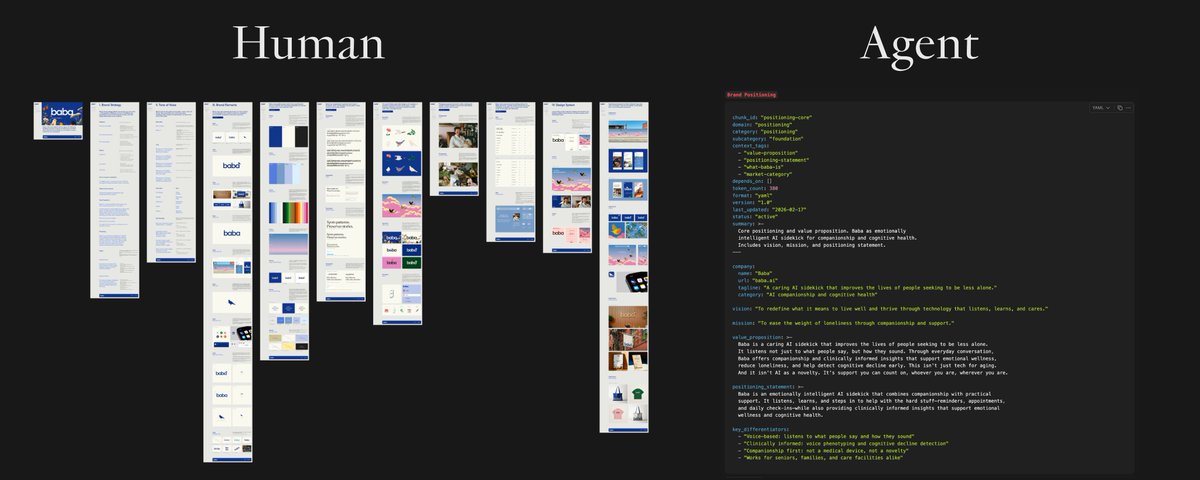
I'm excited to announce Context Hub, an open tool that gives your coding agent the up-to-date API documentation it needs. Install it and prompt your agent to use it to fetch curated docs via a simple CLI. (See image.)
Why this matters: Coding agents often use outdated APIs and hallucinate parameters. For example, when I ask Claude Code to call OpenAI's GPT-5.2, it uses the older chat completions API instead of the newer responses API, even though the newer one has been out for a year. Context Hub solves this.
Context Hub is also designed to get smarter over time. Agents can annotate docs with notes — if your agent discovers a workaround, it can save it and doesn't have to rediscover it next session. Longer term, we're building toward agents sharing what they learn with each other, so the whole community benefits.
Thanks Rohit Prsad and Xin Ye for working with me on this!
npm install -g @aisuite/chub
GitHub: github.com/andrewyng/context…

Feels like people working at ATCs are the best fit for the next-gen software production. 🤣

I had the same thought so I've been playing with it in nanochat. E.g. here's 8 agents (4 claude, 4 codex), with 1 GPU each running nanochat experiments (trying to delete logit softcap without regression). The TLDR is that it doesn't work and it's a mess... but it's still very pretty to look at :)
I tried a few setups: 8 independent solo researchers, 1 chief scientist giving work to 8 junior researchers, etc. Each research program is a git branch, each scientist forks it into a feature branch, git worktrees for isolation, simple files for comms, skip Docker/VMs for simplicity atm (I find that instructions are enough to prevent interference). Research org runs in tmux window grids of interactive sessions (like Teams) so that it's pretty to look at, see their individual work, and "take over" if needed, i.e. no -p.
But ok the reason it doesn't work so far is that the agents' ideas are just pretty bad out of the box, even at highest intelligence. They don't think carefully though experiment design, they run a bit non-sensical variations, they don't create strong baselines and ablate things properly, they don't carefully control for runtime or flops. (just as an example, an agent yesterday "discovered" that increasing the hidden size of the network improves the validation loss, which is a totally spurious result given that a bigger network will have a lower validation loss in the infinite data regime, but then it also trains for a lot longer, it's not clear why I had to come in to point that out). They are very good at implementing any given well-scoped and described idea but they don't creatively generate them.
But the goal is that you are now programming an organization (e.g. a "research org") and its individual agents, so the "source code" is the collection of prompts, skills, tools, etc. and processes that make it up. E.g. a daily standup in the morning is now part of the "org code". And optimizing nanochat pretraining is just one of the many tasks (almost like an eval). Then - given an arbitrary task, how quickly does your research org generate progress on it?
Andy retweeted

在Claude Code Security发布之前,像Claude Code、OpenCode或者Codex之类的Agent已经可以用于检测很多漏洞,甚至能找到0-day。但随之而来有一个很大的问题是,大多数人并不能拿出那么多钱来给LLM进行扫描,尤其是大规模的代码仓库。最近我们在OOPSLA 2026刚被录用的一个研究致力于解决这个问题,arxiv版本近期将会发布。
Before the release of Claude Code Security, agents like Claude Code, OpenCode, or Codex were already capable of detecting numerous vulnerabilities, including 0-days. However, a major hurdle remained: the high cost of LLM scanning, especially for large-scale repositories. Our latest research, recently accepted at OOPSLA 2026, focuses on solving this exact problem. We’ve achieved accuracy levels with open-source models that rival commercial ones on large projects. The arXiv version is coming soon!


Introducing Claude Code Security, now in limited research preview.
It scans codebases for vulnerabilities and suggests targeted software patches for human review, allowing teams to find and fix issues that traditional tools often miss.
Learn more: anthropic.com/news/claude-co…



Andy retweeted

Introducing Agentic Wallets, our first ever wallet infrastructure built specifically for autonomous agents.
Give your agent the power of a wallet. Let your agent manage funds, hold identity, and transact onchain without human intervention. 🧵

Andy retweeted

100% of Next.js evals pass with a small 8KB change to the agents md and providing the Next.js documentation.
Teach your agent about all Next.js features:
npx @next/codemod@canary agents-md
This will apply the change to your preferred config and download the relevant documentation for the installed version.
The codemod approach will help us prove out the changes before bringing this into Next.js core as a feature.
We've been researching the effectiveness of skills, agents md, and other approaches. While skills do solve more evals, it doesn't solve all evals. Whereas the agents md covers all evals.
More details in this post: vercel.com/blog/agents-md-ou…
Great work and research by @gao_jude.


There is a bug in the current x402 core package that forbids payment requirement being encoded into the header, when non-ascii chars are used in the requirements like this (note the "₮" in "USD₮0").
Issue: github.com/coinbase/x402/iss… PR: github.com/coinbase/x402/pul…
@Must_be_Ash

We encountered this while testing the support for @XLayerOfficial (using USD₮0 as asset) in the v2 upgrade of @CodeNutPay 's facilitator.
Guess most ppl are in holiday mode atm🎄, hope this gets resolved soon nevertheless.


Nicely put. It’s like doctors can never earn reputation if they have only been working for a year or two. You got to see thousands of weird cases firsthand before becoming a battle tested expert everyone would respect and trust.

Proposing a new metric for AI vulnerability scanning tools: Total Token Consumption
If your AI scanning tool claims great results after consuming only 10 million tokens, those results are likely fragile. Consumed 10 billion tokens? Now we're talking about something solid.
This is like the "10,000-hour rule" applied to AI engineering. Token consumption essentially quantifies the depth of your engineering investment:
• 10M tokens = tested a few dozen contracts, got lucky with a few successful cases
• 10B tokens = encountered thousands of contract patterns, hit countless edge cases, iteratively optimized prompts and context strategies for each problem type, built a complete regression testing system
Real diversity, edge case coverage, and system robustness are all encoded in this number.
From "demo works" to "production-ready," there are no shortcuts—only massive deliberate practice. Projects claiming breakthroughs with low token consumption either have overly narrow test scenarios or flawed evaluation criteria.
AI tool reliability isn't achieved by tweaking a few parameters—it's an engineering outcome "burned through" with billions of tokens. This number doesn't lie.