






ALT The background of space is black. Thousands of galaxies appear all across the view. Their shapes and colors vary. Some are various shades of orange, others are white. Most stars appear blue, and are sometimes as large as more distant galaxies that appear next to them. A very bright star is just above and left of center. It has eight bright blue, long diffraction spikes. Between 4 o’clock and 6 o’clock in its spikes are several very bright galaxies. A group of three are in the middle, and two are closer to 4 o’clock. These galaxies are part of the galaxy cluster SMACS 0723, and they are warping the appearances of galaxies seen around them. Long orange arcs appear at left and right toward the center.


ALT A composite image of the supermassive black hole at the center of our Milky Way galaxy. Pointing to the middle of the main image is an inset image of the region around the "event horizon," the boundary of the black hole from which nothing can escape. In the main image, golden orange specks of light and tendrils of neon purple and blue clouds are set against a black background. The oranges and purples were captured in infrared light by NASA's Hubble Space Telescope. The blues represent data from NASA's Chandra X-ray Observatory. At the heart of the main image are several bright white dots, including one that contains the supermassive black hole at the center of our galaxy, known as Sagittarius A*. Emerging from this bright white dot is an inset image, housed at our upper right. This image is from the Event Horizon Telescope. It shows a bright, orange ring with three golden yellow spots and a red aura... More at: https://chandra.si.edu/photo/2022/sgra/


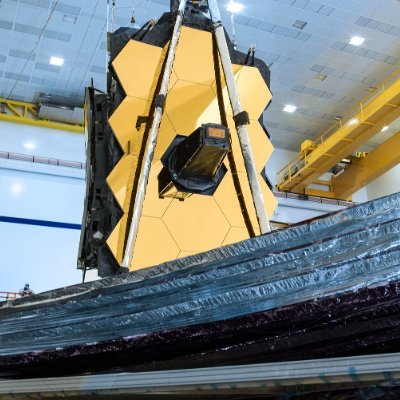
ALT The James Webb Space Telescope's primary mirror during "center of curvature" mirror testing at NASA's Goddard Spaceflight Center. The technician, on left, shines a flashlight at the mirror.
