

Prev @deathtostock The Elevator newsletter + community for founders exploring ↑Work ↑Wealth ↑Wellness https://teapaw.org/t.co/nIkjeMUgWX
📍Austin
Joined January 2012
- Tweets17.3K
- Following561
- Followers3.5K
- Likes11.6K




Pinned Tweet
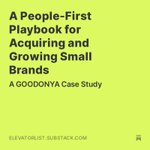
How to do a "Micro-PE" style Brand acquisition...
Not all founders want to chase VC/billion-dollar exits...
But there is a way for Founders to bring on the right people, capital, and vision to break through a growth ceiling.
(Case study in the post linked below)
David Sherry retweeted

I'm now building an "improvements" feature into all of my personal vibecoded applications: a freeform text input that's hooked up to an agent that yolo implements whatever is submitted.
It's an interesting experience -- the activation energy barrier to sanding any rough edge or implementing any new feature becomes extremely low. Someone else who uses one of the applications I created has already implemented 150 improvements over the course of a few days. This pattern feels like a new kind of tool -- liquid software? -- and every application that doesn't have this feature now has a slightly rigid and anachronistic flavor. Why can't I just tell it how I want it to be different?
Now, it's not obvious to me how this pattern can or should scale. Does it become unmaintainable after a while? (Maybe model intelligence improvement outstrips my feature appetite such that it's fine?) How does collaborative software work in this model? Can software designed this way be secure and reliable?
Whatever the larger questions about broader deployment, it definitely works great in a personal context. It reminds me a little of the visions of Lisp/Lisp machines, Smalltalk, and HyperCard -- systems that the user can take control of and modify. Those visions never quite worked, though: the vast majority of software today is not end-user modifiable in any useful way. So, while this "liquid" affordance is a very small touch, the way it changes one's relation to the software feels a bit transgressive and empowering in a Lickliderian and Engelbartian way.

Status Goods, or Status Experiences?
I think there’s an interesting questions right now regarding status: Goods, or Experiences?
Post COVID there was an experience boom (travel, etc.) and a subsequent Goods boom (LVMH, Gucci, etc.)
The problem with status goods online and on social media, like handbags, is that they don’t translate as well as experiences, which can be shot on video (OFC you can do videos of handbags etc. but they just don’t work as well).
I believe experiences are more scarce than goods, and so I would invest more into experiences over goods, which goes for Experience companies over Goods companies. Obviously status goods will still exist. Ferrari is a good example. I think even after self-driving, owning a Ferrari will be luxury/status.
But look at concert ticket prices, those will probably keep going up… Look at the Sphere.
Look at airline ticket prices for better and better seating, upgrades etc.
Personally, we spend more related to home-goods, as I like to invest more in my day to day environment…
One of the highest value “experiences" in the future will be private education, IMO. College doesn't go away, it gets more mediocre at the middle and more elite at the high end, that goes from kindergarden through College
The future of software, and likely hardware, is creative.
I believe we're entering an Instagram-like moment for software where creators and artists become "engineers"
Coding = Creativity = Artists in the world we're going to.
Not that development wasn't previously creative, it's just now the arts will move into engineering.
Written about in the Sovereign Individual (written in 97')

I don't know where I read it but someone said
High skilled Westerners immigrating to another country for better living conditions, lower taxes, easier business regulation, special benefits, is still fringe and for early adopters now
Kinda like digital nomading was fringe 10y ago but now mainstream
But it's the next thing to go fully mainstream I think
A few years ago my Dutch friends and family would never consider migrating out, now they're at least thinking about it, next they might do it
This will keep happening until life at home improves

David Sherry retweeted

After my former fiancé took her own life (following an anxiety attack) back in 2017, I've wanted to create an accessible anxiety intervention that doesn't require prescription drugs or mask symptoms but actually addresses the root cause.
The Stateshift app is my best attempt at creating this intervention: it's a guided audio journey that trains the skills necessary to unclench the nervous system's protective responses.
We currently have several hundred beta-testers using it and so far the results have been very promising.
You can find Stateshift on the iOS/Android app store or join our upcoming September 15-day Rewire Anxiety challenge using the link below.
→ stateshift.app

David Sherry retweeted

Family men:
It's ok to be a little selfish.
If you don't maintain The Three Lives, it's a disservice to everyone. 👇
This clip is from an interview with @_brandswell. More here:
elevatorlist.substack.com/p/…
David Sherry retweeted

Had coffee with @_brandswell this morning, and we were talking about the challenges of getting people more comfortable and hands-on with AI tooling. It seems the obstacle is that most can’t figure out how to tap into these resources to get their maximum potential.

This was very fun and very valuable!

This morning @_brandswell and I worked from @switchyards and went from vague idea -> named framework in 90 minutes.
Major kudos to our jam-packed whiteboard and a thinking assist from @claudeai.
I *love* doing this work!
Claude Co-Work Vs. OpenClaw
The best anology is have is that Claude Co-Work is like building Ikea furniture.
OpenClaw is Ikea furniture building without the instruction manual.
Then you get to the last piece you need to put together and you realize you built the whole thing wrong...

Great quote on the latest forward guidance @fejau_inc
"The game right now is short globalism, long protectionism, and try to get your capital as close as possible to where the gov. is about to spend it"
Really love this concept/org: Dollar Donation Club:
dollardonationclub.com/?r=M2…


Digital life feels different in 2025. The pace of change is much faster now. It’s harder to feel long-term focused, or have a solid view of the long term.
You realize that the volatility is even more distracting from what you are wanting to consciously choose, but you’re not sure how to navigate it.
It feels more like you need hard, forced breaks from online life vs. easy ebb and flow of a more natural digital relationship.
This September I did a 30 day reset and my feelings towards of the things I care about improved. Now I find myself trying to re-integrate in a healthy way that’s balanced and it’s much harder than the clean break. Rules I’m setting are slipping.
I love what I’m getting from AI in terms of its benefits. I’m finding AI journaling to be a core asset to me in my life. And yet I still really prefer writing this to you directly without any AI support or generation. If I use AI in the writing process I miss the flow state and the feeling of sharing something directly me to you without an intermediary.
As our online lives get more mediated by AI, we lose some agency (to the agents) and that displaces certain experiences we also have or had.
I’m craving smaller groups now. I have no desire to be Youtube famous or TikTok famous. I’m thinking about Dunbars number, i.e. who are the 100 people I can really impact and be connected to?
I try and remember that when I face the choice: Do you try and grow your work by playing to an algorithm? Or do you publish what *you* want knowing it’s going to get less views?
I’m recording more short form videos now and I thought about this question: How much should I script and format to the algorithm?
I decided I am going to simply publish. I don’t need a huge amount of “followers” and I don’t think I could sustainably spend my time chasing algorithmic trends. It’s not why I do it.
So I opt out from that. I use many different apps as a “wall” between me and feeds. I use Opal on my phone, and I have time-limiting chrome extensions for certain websites. I try to make the first few hours of my day distraction free. From 7-11 I am cocooned from feeds.
I don’t have email on my phone. I don’t use Slack. I don’t watch TV and never any news.
The hardest thing here is remembering that all of this is my choice. I get to choose what I put my attention on. Having choice means taking responsibility for my attention. If I’m feeling any type of way about my digital life, it’s reflective of hard choices that I have not yet made and that I am leaving ambiguous.
Jerzy Gregorek said, “Hard choices, easy life. Easy choices, hard life.”
Possible that the Polymarket founder is the Zuckerberg of this tech cycle.
Posting for my own future timestamp.
David Sherry retweeted

Approximately how much would you pay per MONTH to not lose access to the current suite of LLMs?
57%$10-99
27%$100-999
7%$1,000-9,999
9%$10,000+
56 votes • Final resultsI'll be co-hosting an event with @will_mannon in Austin, TX on Dec. 2nd bringing together interesting creators for an in-person experience.
You apply to join here (it's free) and these events have been really well attended with interesting people.
luma.com/c080ttqw?tk=0x92LS

When my business passed $1M in revenue, I thought life would suddenly get easier.
Surprise surprise… there was still work to do and new problems to solve.
Many founders think, “If I can just hit this next goal, then I can finally relax.”
A client of mine just raised over $5M for his company. The funding round was hard.
Right after he closed the round, he saw a whole new list of problems that needed attention.
Over time, I realized I have never “arrived” anywhere as a founder. Business and life are always changing.
We should celebrate our milestones. Yet big goals usually don’t give us the deep, permanent relief we hope for.
Learning to enjoy the change and watching things grow means celebrating small wins and finding a way to enjoy every stage, expanding that joy into the next one.
That means letting go of the easy fantasy that “one day soon” everything will be easy and comfortable forever.
Eckhart Tolle said:
- “To be free of time is to be free of the psychological need to live through past and future.”
I help founders with these harder, more personal questions, not just with growing their numbers.
Something great happens when you choose your discomfort on purpose.
@John_J_Brown posted:
“Permanent comfort is not luxury. Luxury is to be able to alternate between comfort and discomfort at your will.”
That’s what you can do to lean into this truth. You choose to grow and change. Instead of finding comfort in the plateau.
This is the kind of conversation I wish someone had with me when I first started my business.
Now I get to have these talks all the time.
If this speaks to you, you might like joining my newsletter and community.
substack.com/@davidsherry