
Associate Professor | Neuroscientist | Pain researcher | @CRC_CRC in Translational Pain Research |
Toronto, Ontario
Joined March 2010
- Tweets1.6K
- Following1.1K
- Followers1.2K
- Likes1.9K



Loren Martin retweeted

New research from #UofT, in collaboration with colleagues at McGill University, is shedding light on how the nocebo effect works – and what might be done to counter it. utoronto.ca/news/may-hurt-re…

Loren Martin retweeted

We’re excited to spotlighting past week publications from researchers across the University of Toronto and the Toronto Academic Health Science Network (TAHSN)
#PainResearch #UofT #TAHSN #TorontoPainResearch #UTCSP

Loren Martin retweeted

A highly sensitive genetically encoded red cAMP sensor for multiplex imaging in vivo
nature.com/articles/s41467-0…

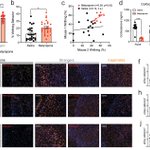
Our latest paper in Nature Communications identifies a brain circuit underlying nocebo-like pain hypersensitivity.
The neuropeptide cholecystokinin (CCK) has been linked to nocebo effects for decades, but the underlying circuitry has remained unclear.
This was a monumental effort by Sandra Poulson, who led the work and helped dissect this circuit across two very different nocebo models. The story was also substantially strengthened by a huge effort from the rest of the lab during revision.
1
58
We think these findings have important implications for understanding how expectation, social context, and prior experience shape pain through descending brain pathways.
If interested check out the paper nature.com/articles/s41467-0…

43
Interested in being a part of innovative research at the University of Toronto? Join us at the Martin Pain Lab for a novel migraine treatment study.

Our latest paper in Current Biology 🧠🔥
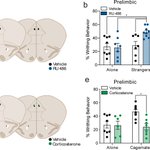
Even after full recovery, past injuries leave the brain primed. Mice show greater pain and fear when re-exposed to predator threat — driven by stress hormones and the TRPA1 receptor.
cell.com/current-biology/ful…
2
7
207
This is a psychological twist on hyperalgesic priming:
- A healed injury still sensitizes the brain
- predator (i.e. psychological threat)— with no new injury — reactivates pain and enhances fear
-TRPA1 and corticosterone are key players in this lasting vulnerability.
1
1
81
Loren Martin retweeted
Injured once, triggered forever? How the brain rewrites stress responses , via @EurekAlert! @UofTNews eurekalert.org/news-releases…
Loren Martin retweeted

Old Injuries Rewire the Brain to Feel Fear and Pain Forever
A new study reveals that past injuries can cause long-lasting changes in how the brain and body respond to stress.
Even after physical healing, the nervous system may remain hypersensitive, amplifying fear and pain in response to future threats.
In mice, exposure to predator scent triggered exaggerated fear and persistent pain — even in uninjured areas — months after an initial wound.
Researchers traced this effect to a feedback loop involving the stress hormone corticosterone and the TRPA1 receptor, often linked to burning pain.
Notably, fear responses required both stress and TRPA1 signaling, while long-term pain only needed the stress component.
These findings suggest that trauma leaves a biological imprint that can be reversed, offering new hope for treating chronic pain and PTSD.

ALT This shows a brain.
Injured once, triggered forever? How the brain rewrites stress responses , via @EurekAlert! @UofTNews eurekalert.org/news-releases…
Loren Martin retweeted

March 5 | Lecture Me!
How do social bonds impact our experiences with pain?
Join @utmeeu & @mississaugalib from 7 p.m. with prof Loren Martin from @UTMPsychology discussing his research on “Pain and the Social Brain”.
Register now ➡️ bit.ly/3K0Eur5

ALT Lecture Me! Series with professor Loren Martin from the Department of Psychology discussing Pain & the Social Brain.
