

Recent MSc graduate. Studying the effects of oil sands pollution on amphibians. @QE3_Research and @Queensu alum. she/her.
Toronto, Ontario
Joined January 2021
- Tweets26
- Following152
- Followers87
- Likes92


Pinned Tweet
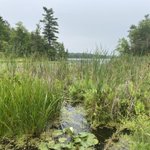
When you spend 4 months in the field, you get to witness some pretty cool things. Here’s some highlights from @SamMeiGene and I’s time at @QUBioStation: a long awaited Blanding’s turtle, a newly emerged monarch, a garter eating a toad and gray treefrogs in amplexus.


Chloe Robinson retweeted

Thanks @ConversationCA for letting us weigh in on the #ImperialOil tailings spills with some scientific facts on how wastewaters from #oilsands processes affect aquatic life. Co-authored by @_robinson_chloe @ckelvidge #AlbertaTarSands #TailingsPonds #cdnsci #cdnpoli

As Alberta’s oilsands continue leaking toxic wastewater, aquatic wildlife face new risks theconversation.com/as-alber…

Concerning.
@QE3_Research group has been studying how these wastewater pollutants affect aquatic life.
My MSc research shows that at diluted levels, these pollutants impair the survival, development and behaviour of amphibians found in the region. (1/3)

Local Indigenous communities say they were kept in the dark when millions of litres of industrial wastewater laced with pollutants leaked into the environment at the Kearl oil sands project in Alberta’s north.
theglobeandmail.com/business…

In a paper out this week, we report that early-life exposure to wastewater pollutants affects chemical communication and anti-predator behaviours in wood frog tadpoles. (2/3) sciencedirect.com/science/ar…
1
3
92
In a previous study we found that wood frogs raised in water containing pollutants were less likely to survive. Those that did were developmentally delayed and showed striking malformations - including missing toes. (3/3) sciencedirect.com/science/ar…
2
85
Chloe Robinson retweeted
Excited to share our latest paper on how chemical communication in wood frogs is influenced by early-life exposure to compounds in #oilsand tailings ponds. Co-leads @ckelvidge @_robinson_chloe in collaboration w/ @ECCCSciTech @QE3_Research sciencedirect.com/science/ar… #cdnsci
Check out this article by @wildlifesociety featuring our recently published work on oil sands pollution and amphibians. In a 3-month field study at the @QUBioStation we found that wood frog development is affected by chemicals in oil sands wastewater. 🐸🛢wildlife.org/chemicals-from-…

Chloe Robinson retweeted
To @queensu students! Here's your chance to join the @QE3_Research group to be part of an exciting #fish #ecotoxicology experiment at the @QUBioStation. Full-time employment for 16 weeks, apps due Feb 13: biology.queensu.ca/default/a…
Chloe Robinson retweeted

Ontario's #Greenbelt is over 800,000 ha in size and is the largest protected zone of near-urban nature and farmland on the 🌎. @fordnation plan to open it up to development sets a terrible precedent. None of our protected areas, ecological sites are safe if he gets away with this
After two years of hard work I am beyond excited to share my first ever publication! A huge thank you to all involved! 🐸🐸🐸

Excited to share the newest paper from my @QE3_Research lab, led by @_robinson_chloe (MSc'22 @QueensUBio) Naphthenic acid fraction compounds reduce the reproductive success of wood frogs by affecting offspring viability sciencedirect.com/science/ar… #cdnsci #oilsands #frog #ecotox
A great afternoon with my academic family! Thank you to @limnologylydia for being by my side through it all and everyone else who has supported me over the last two years!
Celebrating the Master’s success of these two academic sisters - @limnologylydia @_robinson_chloe! We will miss you in the @QE3_Research Group and are thrilled to wish you all the best for your next chapter in life!

9
An exit seminar in bare feet, followed by a swim in Lake Opinicon! QUBS will always hold a special place in my heart. 💚

Congratulations to @_robinson_chloe for an amazing exit seminar last night at @QUBioStation! We are so proud of all her accomplishments🐸


7
Chloe Robinson retweeted

Join us this Wednesday, July 20th at 7pm for our weekly QUBS seminar with @_robinson_chloe who completed her study at @QUBioStation in 2021. Learn how her results can inform wastewater management and contribute to the protection of wildlife and habitats in the oil sands region.

Chloe Robinson retweeted

Congratulations to our students Lydia and Chloe for participating in this years @queensgradstudy #3MT competition! A special shout out to Chloe for placing first in her heat 🐸🎉 We can’t wait to cheer her on in the finals next week! #scicomm @QueensENVS @QueensUBio


#CEWtweetyourthesis When oil is mined in Canada’s oil sands, wastewater is produced. This water contains naphthenic acids (NAs), which are toxic to wildlife. Frogs can be used to study NAs because they are sensitive to pollution and are good indicators of habitat health. (1/3)

I study the effects of NAs on wood frogs to determine the dangers of wastewater entering the environment. I ask if frogs exposed to NAs can mate, and if their offspring survive and develop normally. I conducted an experiment this summer at @QUBioStation to find out. (2/3)

1
8

Chloe Robinson retweeted

#CEWtweetyourthesis My research aims to synthesize Canadian studies that have brought together Indigenous and western knowledge systems to study environmental contaminants and wildlife health. (1/3)