

Scaled 50+ projects with high-converting copy/strategies| Copywriter & Strategist | Chief Of Vibes @the_citadel_gg | Director @OSP_TD | Building @DigiGetaways
Joined February 2023
- Tweets50.4K
- Following483
- Followers1.6K
- Likes70.2K








Pinned Tweet
Happy new month!
June 1st. 30 days ago, I had 500 followers on LinkedIn.
Here's where I'm standing today:
→ 2,000+ followers (grown organically)
→ 21,000+ impressions in 30 days
→ Inbound leads flowing directly into my service page
→ Audience spanning:
· London
· New York
· Delhi
· Paris
· Milan
· Kuala Lumpur
Across industries:
· Marketing
· Media
· Blockchain
· SaaS
· Fintech
· Business Consulting
No paid ads, no gimmicks.
Just intentional content, sharp positioning, and consistency.
The leads didn't come because I was loud.
They came because I was clear.
And this?
This is just the beginning; the building doesn't stop.
Happy new month to everyone playing the long game.
We move! 🥂

Sammified | Copywriter retweeted
A SaaS product can stall at a 2% trial-to-paid conversion rate when the promise that attracted the user disappears after signup.
It's because the message that acquired the user made a promise the product experience never confirmed.
Someone signed up because the copy made them feel like this product was built for their situation.
Then they logged in and saw a generic dashboard that could belong to any product in the category.
That feeling disappeared almost immediately.
And once it's gone, no amount of tooltips or check-in emails can bring it back.
I've fixed this across SaaS and fintech products in multiple verticals.
The pattern is usually the same: acquisition and onboarding were built by different teams, with different briefs and no shared understanding of what the user arrived believing.
Closing that gap is one of the clearest growth levers most products leave untouched.
Not a redesign.
Not a pricing test.
A conversation between what you promised and what you delivered on day one.

Sammified | Copywriter retweeted
The brands becoming easier to find in AI search aren’t necessarily producing more content.
They’re producing more specific content.
That distinction matters.
More content gives AI more pages to find.
More specific content gives it clearer signals about:
--> Who the company serves.
--> What problem it solves.
--> How it is different.
--> When it is the right recommendation.
A company can publish hundreds of generic articles and still be difficult for AI to understand.
Because volume without specificity creates more noise, not more clarity.
The companies that show up consistently in relevant ChatGPT, Gemini, or Google AI answers usually make it easy to connect their expertise to a specific customer problem.
That starts with understanding the questions buyers ask, then answering them clearly across the website, content, proof, and third-party presence.
That is a positioning decision before it becomes a content decision.
The goal is not to publish more for AI.
It is to become clearer to the people and systems trying to understand what you do.

Sammified | Copywriter retweeted

This is the content playbook I’m adopting for my works now, I read one of the blogs of @scribble_dao particularly about this and its all about learning and upscaling in my contents (I abide by not using big grammars for my content so non web3 can get a view of what I do but it’s time to up my games)
And it simply entails this:
• Stop creating more content
• Start creating more specific content.
The future of discoverability belongs to creators and brands that are easy for both humans and AI to understand
Be specific about what you do, who you serve, and the problems you solve. That’s how you become discoverable.
My goal is simple in this phase now
I would be writing content that is:
• Specific.
• Searchable.
• Verifiable.
• Quotable.
• Problem-focused.
Positioning > Volume.
Clarity > Virality.
Knowledge > Noise.

The brands becoming easier to find in AI search aren’t necessarily producing more content.
They’re producing more specific content.
That distinction matters.
More content gives AI more pages to find.
More specific content gives it clearer signals about:
--> Who the company serves.
--> What problem it solves.
--> How it is different.
--> When it is the right recommendation.
A company can publish hundreds of generic articles and still be difficult for AI to understand.
Because volume without specificity creates more noise, not more clarity.
The companies that show up consistently in relevant ChatGPT, Gemini, or Google AI answers usually make it easy to connect their expertise to a specific customer problem.
That starts with understanding the questions buyers ask, then answering them clearly across the website, content, proof, and third-party presence.
That is a positioning decision before it becomes a content decision.
The goal is not to publish more for AI.
It is to become clearer to the people and systems trying to understand what you do.
Sammified | Copywriter retweeted
Been off X for two weeks.
Not because nothing was happening.
Because everything was happening everywhere else.
Back now.
And I've got a lot to say.
GM.

Been off X for two weeks.
Not because nothing was happening.
Because everything was happening everywhere else.
Back now.
And I've got a lot to say.
GM.
Good morning!
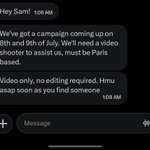
I'm looking for a video shooter based in Paris 🇫🇷
Someone in my network is actively looking for a skilled videographer for a project.
If that's you, or you know someone who's great at what they do, please drop a comment or send me a DM with their portfolio or contact details.

Sammified | Copywriter retweeted
Good morning.
Some days, the most strategic thing you can do is pause and acknowledge how far you've actually come.
Not for the grid.
Not for the metrics.
Just because God has been faithful and gratitude keeps you grounded when momentum picks up.
Dear God, I just want to say thank you.
Happy Thursday, chat ♡.
Sammified | Copywriter retweeted
The brands that win aren't the ones with the biggest budgets.
They're the ones that figured out the exact thing their buyer needed to hear and had the discipline to say only that.
I've watched companies spend six figures on campaigns that didn't move a single number that mattered.
Not because the creative was bad.
Because nobody had answered the most important question before the campaign launched.
Who specifically is this for and what do they need to believe before they'll act?
That question sounds simple.
Most teams never actually answer it.
They answer a version of it that keeps everyone in the room comfortable.
"Our audience is growth-focused companies looking to scale."
That's not an answer, that's a category.
A category doesn't feel anything when it reads your copy.
A person does.
The brands I've watched break through in the last year all had one thing in common.
They stopped trying to speak to the market and started speaking to the person inside the market who had the specific problem they solved best.
That shift changes everything downstream:
--> The homepage stops explaining and starts connecting.
--> The emails stop announcing and start landing.
--> The ads stop reaching everyone and start converting someone.
Nothing extra.
Nothing for everyone.
Just the right words for the right person delivered consistently enough that when they finally show up they already feel like they know you.
That's not a content strategy.
That's a positioning decision.
And most brands are still waiting to make it.
If you made it to the end of this, you already know which side of that line you're on.
Sammified | Copywriter retweeted
Good morning.
There was a stretch not long ago where I'd wake up, look at my numbers, and wonder if any of this was actually working.
No proof yet.
Just conviction and a plan I believed in more than the results showed.
I kept showing up anyway.
Posted on the days it felt pointless.
Replied to comments when nobody seemed to be watching.
Refined the positioning when it would have been easier to just copy what everyone else was doing.
Whatever you're building right now that feels invisible, it's compounding somewhere you can't see yet.
Keep going!

Sammified | Copywriter retweeted

Every DeFi founder deck has a mass adoption slide.
The billions underserved by traditional finance.
The transformative potential.
It is usually the most confident slide in the deck.
Then the protocol launches.
The first three posts are written for two thousand people who already know every term.
Nobody notices the gap.
Or everyone notices and nobody says it.
If a person with a bank account, a phone, and a real financial problem landed on your timeline today, they would not understand what you built.
Not because they are not smart.
Because you never wrote for them.
You wrote for the people already in the room.
Mass adoption does not begin with better infrastructure.
It begins the moment someone outside the space reads something and thinks:
"This was made for me."
That feeling does not come from a simplified whitepaper.
It comes from a narrative that starts with the reader's life, not the protocol's architecture.
Different starting point.
Different document entirely.
The space keeps waiting for the technology to become accessible enough.
The technology is not the barrier.
The story is the barrier.
And most protocols have not written it yet.

Good morning.
There was a stretch not long ago where I'd wake up, look at my numbers, and wonder if any of this was actually working.
No proof yet.
Just conviction and a plan I believed in more than the results showed.
I kept showing up anyway.
Posted on the days it felt pointless.
Replied to comments when nobody seemed to be watching.
Refined the positioning when it would have been easier to just copy what everyone else was doing.
Whatever you're building right now that feels invisible, it's compounding somewhere you can't see yet.
Keep going!
Sammified | Copywriter retweeted
Last week my LinkedIn content reached decision makers in:
--> New York
--> London
--> Paris
--> Delhi
--> Stockholm
--> Lagos.
No ads.
No boosted posts.
No paid distribution of any kind.
9% of my audience are Founders.
3% Co-Founders.
2% CEOs.
Here's what that tells me:
Most people think reach is a budget problem.
It isn't, it's a clarity problem.
When your content is built around a specific person with a specific problem, the algorithm does something interesting.
It finds more of that person.
In more cities.
In more industries.
In more time zones than you planned for.
The founders showing up in my analytics from Stockholm and Paris weren't targeted.
They were attracted.
Because the content spoke to something specific enough that when they saw it, they felt like it was written for them.
That's the only distribution strategy that compounds.
Everything else rents attention.
This builds it.

Sammified | Copywriter retweeted

Our Creative Director Made This Cinematic for Under $200 Using AI 🤯
It is literally a short movie!!
Last week my LinkedIn content reached decision makers in:
--> New York
--> London
--> Paris
--> Delhi
--> Stockholm
--> Lagos.
No ads.
No boosted posts.
No paid distribution of any kind.
9% of my audience are Founders.
3% Co-Founders.
2% CEOs.
Here's what that tells me:
Most people think reach is a budget problem.
It isn't, it's a clarity problem.
When your content is built around a specific person with a specific problem, the algorithm does something interesting.
It finds more of that person.
In more cities.
In more industries.
In more time zones than you planned for.
The founders showing up in my analytics from Stockholm and Paris weren't targeted.
They were attracted.
Because the content spoke to something specific enough that when they saw it, they felt like it was written for them.
That's the only distribution strategy that compounds.
Everything else rents attention.
This builds it.
No ad spend. No boosting. No follow-for-follow tricks.
This is what happens when content is built around one specific person instead of trying to be relevant to everyone.
It's the same positioning work I do for every brand I work with.
DM me or book a free consultation here if you're ready to talk:
calendly.com/sammifiedeth/30…


