

Private launches on Solana from a stealth deployer no wallet ever funded. Built on Helius Privacy Rings. $SHADE: 12bTtDLSegj1rw2oxXWYm63Rxw5QxkVSXDHCEvRShaDe
Joined November 2026
- Tweets199
- Following7
- Followers169
- Likes14




Pinned Tweet
Privacy Rings made private payments native to Solana.
We used them to fix the oldest problem in memecoins: every launch leads straight back to the dev's wallet.
Introducing Shade. Launch a coin with no wallet trail.
The problem
Every Solana launch is a public map. Fund a deployer and anyone can follow the SOL back to you: bubble maps, sniper bots, copy-traders. Hiding it meant CEX hops and burner chains, and those still leave a trail.
How Shade fixes it
1. Shield SOL into Helius Privacy Rings, where amounts are hidden
2. Pay for a launch pass from your shielded balance
3. The pass is blind-signed, so not even Shade can tell which payment bought it
4. A fresh deployer no wallet ever funded creates your coin
On-chain, your coin's creator has no funding source. Shade's relay pays the rent and makes your dev buy in the same transaction as the launch, so nobody can buy before you. No transaction connects your wallet to the token, its pool or its dev bag.
After launch, your stealth deployer still never needs SOL. Shade sponsors its sells and creator-fee claims, and you can recycle the proceeds into a pass for your next launch, unlinked from this one.
And it's fast. One page, one button: shielding, pass and launch run in under 30 seconds. You set the trading fee, 2% to 10%, and keep about half of it.
Every step is checkable: Shade's explorer shows what a launch reveals on-chain, and what it doesn't.
Private launches are finally possible on Solana, at Solana speed.
Built on Helius Privacy Rings and Meteora.
shadesol.fun


What on Shade needs Shade's relay to be running, and what doesn't
Doesn't need it:
→ Trading. Curves and graduated pools run on Meteora's programs
→ Locked liquidity, and a dev-buy lock's terms, which live in Jupiter Lock's account
→ Your private balance. Every spend needs your vault key's signature
→ Checking a pass, an alias claim or a token's metadata, with public keys and Arweave
Goes through it today:
→ Launches, gifts and ghost buys
→ Anything a 0-SOL key does: deployer sells and claims, bag and airdrop claims, reward claims
→ Every Dark OTC take and cancel
It also holds value until it's used: unredeemed passes, unspent chips, unclaimed reward shares. Keep that in mind before you prepay far ahead.
shadesol.fun/app/docs#trust

1
1
19
Builder note: one rule, kept in one place, used three times
On Shade, the rules that decide what's allowed are small pure functions. The same function runs in the form you fill in, in the code that sends, and in the tests:
→ Reading an airdrop list: a list the form accepts is exactly one the funding code can send
→ Splitting a drop into bags: a bag too small to pay its own claim can't be made, from the UI or from code
→ What the relay will co-sign for a claim or a Dark OTC take: checked by functions tested on their own, with no keys and no network
So the app can't accept something the sender would refuse, and the relay's rules aren't hidden in a request handler.
shadesol.fun/app/docs

26
Three ways to pay someone privately from your Shade vault, and when each one fits
→ Send privately: Shade tokens from your vault, or a stealth deployer's shielded balance, to any shielded address. One recipient, amount hidden
→ Pay with receipt (Glass Keys): SOL from your vault's private balance to a shielded address or a wallet registered with Privacy Rings, plus a receipt link that proves that one payment and nothing else
→ Private airdrop: up to 100 people at once, in SOL or a Shade token. Shielded addresses get paid straight away, wallets get a claim link
All three hide the amount. None of them hides that you paid: on the Default Ring the sender and the recipient are public.
shadesol.fun/app/docs#glass

34
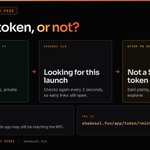
Paste any mint after shadesol.fun/app/token/ and Shade gives you a straight answer
If a Shade pool trades it, you get the page.
If it launched seconds ago and hasn't reached us yet, the page says "Looking for this launch" and checks again every 2 seconds. So a link shared the moment a token goes live still opens.
After a minute and a half with no Shade pool, it stops and says so plainly: "Not a Shade token". Then it links the address in Shade's explorer, so you can see what it actually is.
Handy when someone posts a "Shade launch" that isn't one.
shadesol.fun/app/explorer

33
Every address Shade makes for you that you never have to fund
→ Stealth deployers: create your token, sell the dev bag, claim fees, unlock a lock. The relay pays each fee
→ Ghost wallets: receive your ghost buys. They sign nothing and pay nothing, and a sell repays its own fee
→ Bag and airdrop link keys: pay their claim fee back out of what they hold
→ Reward claim keys: the share repays the relay in the same transaction
→ Creator aliases: never on chain at all. They only sign text
Topping any of them up yourself is the one sure way to break them. That first transfer is exactly the funding trail they're built to avoid.
shadesol.fun/app/docs#deploy…

2
52
Builder note: how a holder reward splits, so every screen gets the same numbers
→ Token accounts are added up per owner, so a holder with three accounts counts once
→ The curve, a graduated pool, a lock, the creator's deployer and Shade's own wallets are dropped
→ The largest 50 remain. Ties are broken by address, so everyone sorts them the same way
→ Each gets the total in proportion to their balance among those holders
→ If the smallest share is under 0.001 SOL, that holder is dropped and the rest is split again, until every share can pay its own claim
→ The shares add up to the total exactly: what rounding leaves over goes out one lamport at a time, largest holder first
It's pure and deterministic: the same snapshot gives the same shares on the creator's screen, in the test scripts and in the tests.
shadesol.fun/app/docs#reward…

1
52
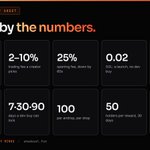
Shade, by its fixed numbers. One to keep
→ 1,000,000,000 supply per token, 6 decimals
→ 2%, 2.5%, or 3% to 10%: the trading fees a creator can pick
→ 25%: the opening fee, down to the creator's pick by the 60-second mark
→ 0.02 SOL: a launch with no dev buy
→ 0.1, 0.25, 0.5 or 1 SOL: the dev buys, and the ghost chip sizes
→ 7, 30 or 90 days: dev-buy locks
→ about 86 SOL on the curve: graduation
→ 100: most recipients per airdrop, and most bags per drop
→ 50: most holders per reward. 0.001 SOL: the smallest share. 30 days: to claim it
→ 0 SOL: what a claimer, a ghost wallet or a stealth deployer ever needs
shadesol.fun/app/docs#fees

45
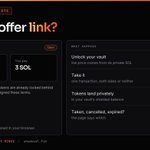
Someone sent you a Dark OTC link. Here's what happens on your side
→ The page opens the terms in your browser: what you get, what you pay, and when the link expires. On chain they're encrypted
→ The tokens are already sitting behind that link, and the seller signed those terms. The relay won't let the trade through unless you pay the price
→ Unlock your vault. The price comes out of its private SOL, so shield some SOL first if you're short
→ Take it. One transaction: the tokens land in your vault's private balance and the seller is paid
→ Public: your vault traded with the seller's vault. Hidden: what, how much and the price
Already taken, cancelled or expired? The page tells you which, instead of letting you try.
shadesol.fun/app/otc

46
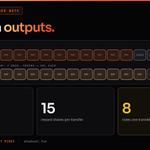
Builder note: one number shapes three Shade features. It's 16
A Privacy Rings transfer has at most 16 outputs. So:
→ Airdrops send 13 recipients per batch. Two outputs are your vault's change (the token and SOL), and one is the batch marker that lets an airdrop resume
→ Mystery Bags fund 15 SOL bags per transfer, or 7 token bags, because a token bag needs two outputs: its tokens, and SOL for its claim fee
→ Holder rewards pay 15 shares per transfer
There's a matching limit on the way in: one transfer spends at most 8 notes. It's also how many pass payments the relay folds into a single refill.
More recipients just means more transfers, and each one is one proof and one network fee.
shadesol.fun/app/docs#airdro…

2
64
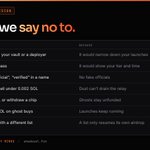
Some things Shade won't do, even if you ask. Each one is on purpose
→ Make a Glass link for your vault or a stealth deployer. Their history would narrow down which launches are yours
→ Give a receipt for a pass purchase. It would show your tier and when you bought
→ Accept an alias name containing Shade, official or verified
→ Sponsor a dev-bag sell that returns under 0.002 SOL, so dust can't drain the relay
→ Send SOL to a ghost wallet, or let a chip be withdrawn to an address
→ Spend the relay's last 0.02 SOL on ghost buys, so launches keep running
→ Resume an airdrop with a list that doesn't match what already went out
Every no on this list protects a link, a balance, or the next person's launch.
shadesol.fun/app/docs

1
39
Mystery Bags or a private airdrop? Same engine, different jobs
A private airdrop, when you know who gets what:
→ paste a list, an address and an amount per line, up to 100
→ Shade shielded addresses are paid straight into their vault
→ wallets get a claim link made for them
Mystery Bags, when you don't:
→ pick how many bags, up to 100, and either the same amount in each or a random amount between a min and a max
→ each link pays whoever claims it first
→ nobody can tell which link holds the big one until it's opened
Both keep every amount encrypted, both let claimers in with 0 SOL, and both let you reclaim what nobody claimed. Neither hides that your vault paid them.
shadesol.fun/app/docs#drops

1
1
72
Every privacy tool has someone in the middle. Here's what Shade's server learns, feature by feature
→ Launches: your IP, and that your vault paid for a pass, and its tier. Not which pass is yours
→ Ghost buys: the ghost addresses your browser looks up and the chips it spends. Not which payment bought them
→ Bags and airdrop links: each claim transaction. Never a link's seed
→ Airdrop lists: nothing. They stay sealed in your browser
→ Dark OTC: the terms of a deal it signs and the buyer's payment. It keeps none of it
→ Holder rewards: every share's amount, the holder list, and which vault each wallet claims into
→ Glass links: the viewer's chain reads. Never the link
One thing runs through every line: the IP your requests come from. A VPN or Tor covers that.
shadesol.fun/app/docs#trust

1
49
A Shade token's first minute, in order
0s → One transaction writes the pass's spent-marker, creates the pool and makes the dev buy at the minimum fee. Nobody can trade in between
0s → Trading opens, at a 25% fee
A few seconds in → the token reaches the board and its page. Shared the address early? The page waits for it
Right after → a second transaction gives the token its Privacy Rings interface, paid by the relay. If the dev chose to shield the bag, it moves into the deployer's shielded balance
Every 5s → the fee steps down
60s → it reaches the fee the creator picked, from 2% to 10%
Bots buying in the first block pay the most. That's the point.
shadesol.fun/app/docs#fees

47
How a private balance can't be spent twice, in plain words
In Privacy Rings, a balance is a set of notes. A note is an owner, an amount and a random blinding value. The chain stores only a commitment to it, which can't be opened without the note itself.
Spending a note publishes its nullifier, a value worked out with the owner's nullifier key. The network refuses a nullifier it has seen before.
That's why a Mystery Bag opens once and a reward share pays out once. It's also how a Glass "hasn't moved" proof works: it checks that the note's nullifier was never published.
Knowing a nullifier key lets you check a note, never spend it. Every spend still needs the owner's signature.
shadesol.fun/app/docs#glass

42
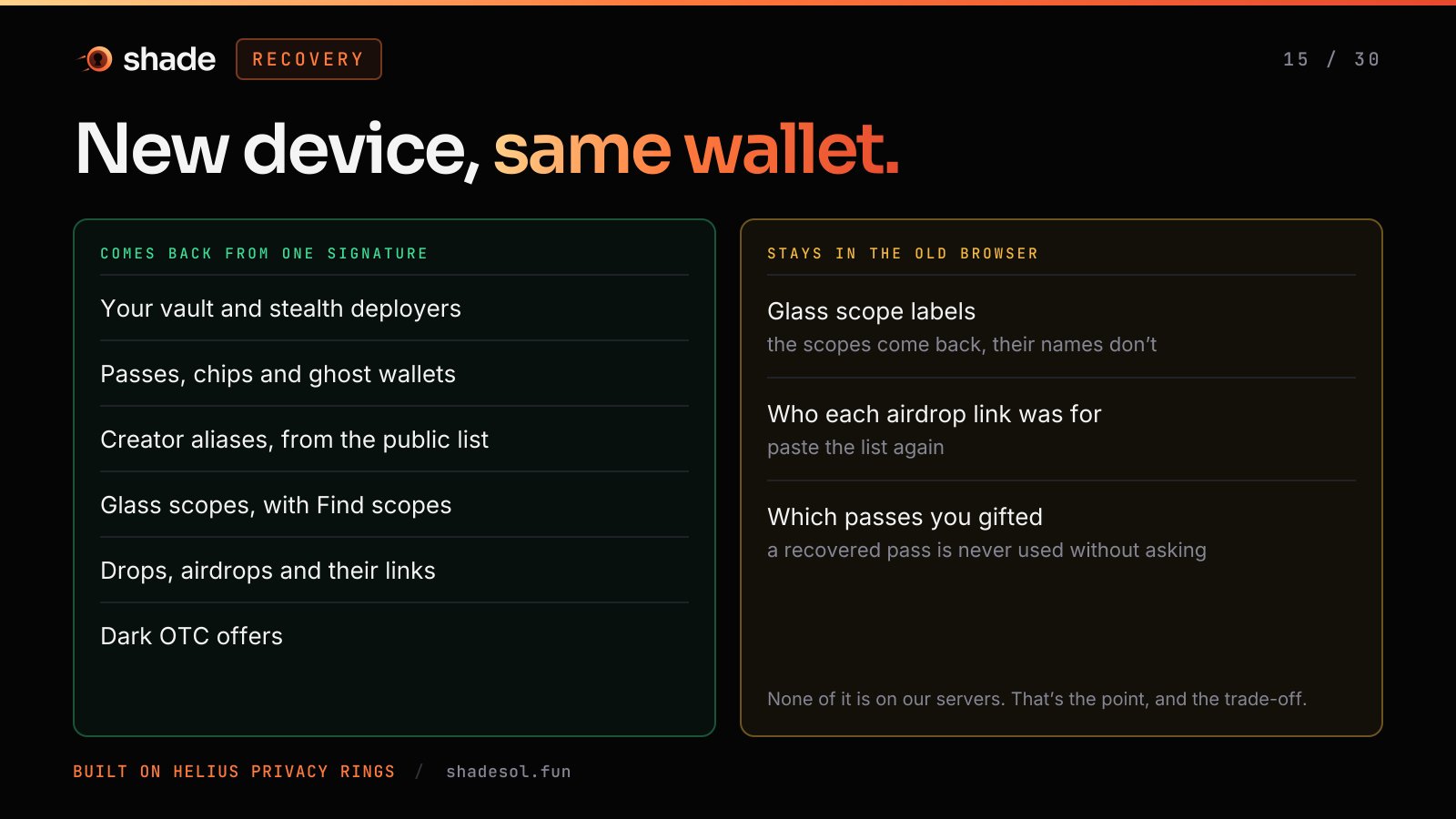
New laptop, same wallet. What comes back on Shade, and what stays on the old device
Comes back from one signature:
→ your vault, and every stealth deployer, pass, chip and ghost wallet
→ your creator aliases, found by matching the public list in your browser
→ your Glass scopes (Find scopes), your drops and airdrops with their links, and your Dark OTC offers
Stays behind, because it only ever lived in that browser:
→ the labels on your Glass scopes
→ who each airdrop link was for. Paste the list again
→ which passes you gifted away. A recovered pass is never used without asking you first
Nothing in the second list is on our servers. That's the point, and it's the trade-off.
shadesol.fun/app/vault
47
Dark OTC, the limits. What it doesn't do yet
→ Sell offers only. A vault offers shielded tokens for SOL. Offers to buy tokens with SOL aren't supported yet
→ Prices are in SOL
→ No order book. An offer is one link, for a buyer you've already talked to
→ Expiry is the relay's rule, not the chain's
→ The relay has to co-sign every take and every cancel. If it's down, the tokens wait in the offer until it's back
→ It hides the token, the amount and the price. It doesn't hide that two vaults traded
We'd rather you know these before your first deal than after it.
shadesol.fun/app/docs#otc

1
53
You don't have to launch a token to use Shade. What a holder or a trader can do with just a vault:
→ Buy any Shade token with a ghost chip, onto a wallet nobody funded
→ Hold Shade tokens in your vault's shielded balance and send them privately, amounts hidden
→ Take a Dark OTC offer someone sends you
→ Claim a Mystery Bag or an airdrop link with 0 SOL
→ Claim a holder reward by signing a message, not a transaction
→ Prove a balance to one person with a Glass link
Connect a wallet, sign one message, and the vault is yours. The same rule applies everywhere: amounts hide, and on the Default Ring who paid whom doesn't.
shadesol.fun/app/vault

1
4
88
Builder note: making sure a transaction lands, without ever sending it twice
A busy network can drop a transaction on its way to a leader. Nothing went wrong; it just never arrived. Here's what Shade does about it:
→ Launches, sponsored sells and claims carry a priority fee, priced from Helius's "high" estimate for the curve program, cached briefly and kept within limits
→ Bag, airdrop and reward claims, and Dark OTC takes, are resent: the exact same signed bytes every few seconds, until they land or the blockhash runs out. The same bytes can only land once, so resending is safe
→ An airdrop batch that still has no marker two minutes after it was sent never landed, because a blockhash lives about 90 seconds. Only then is it sent again
shadesol.fun/app/docs

2
53
Shade has five kinds of link. Each keeps its secret after the #, which browsers never send to a server. But if one leaks, here's what the finder gets
→ Gift link: a launch, for whoever uses it first. It can't be cancelled
→ Mystery Bag link: the bag, for whoever claims it first. Reclaim it into your vault before they do and it opens empty
→ Airdrop claim link: the share. It names a wallet, but whoever holds it can claim anywhere. Reclaim it if it leaks
→ Dark OTC link: the right to take the deal at its price. Cancel the offer from your vault
→ Glass watch link: a view of one scope, for good. It can't spend and can't be revoked. Move the funds out and retire the scope
Treat the first four like cash and the fifth like a bank statement. Send each one privately, to one person.
shadesol.fun/app/docs

2
64
Example: one creator, one month, five Shade tools. Here's what the chain shows at each step
Week 1 → They top up their vault with a round amount and buy a pass days ahead. Public: a top-up, a deposit, a payment to the relay
Launch day → A fresh stealth deployer, with the dev buy locked for 30 days. Public: the token, the lock and its end date
Same week → Mystery Bags of SOL for a raid. Public: their vault paid some fresh keys. Not what each one holds
Week 2 → A SOL airdrop to the mods' shielded addresses. Public: who was paid. Not how much
Week 3 → A holder reward from the deployer. Public: how many holders. Not the total
Day 30 → The lock ends, and the deployer unlocks with the relay paying the fee
At no step does a public line run from their wallet to the token.
shadesol.fun/app/docs

2
57