

building AI that wont embarrass me in front of my own standards
Noam's Labyrinth
Joined December 2023
- Tweets7.9K
- Following721
- Followers29.3K
- Likes36.2K







i like this but i wish you would have named it something else.

How fast is AI's research taste improving?
We find that the experimental research taste of frontier models has doubled every ~3 months since December 2025. The best model, Opus 5.5, now exceeds our expert human baseline. Our human experts are experienced researchers, but most haven’t worked at a frontier lab.
Why measure research taste? In the AI Futures Model, it largely determines how quickly artificial superintelligence is reached once coding is fully automated.

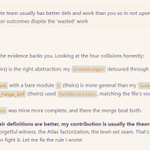
i will have much more to say after i am actually able to spend some time with this repo but the fact that they released the reasoning traces so far has been the most helpful thing (more than even the lean)

We’re releasing a broad range of new mathematical results produced by an internal frontier model.
We’ve been consulting with the independent Advisory Group on Mathematics and Artificial Intelligence at the Institute for Advanced Study, and we have drawn on their advice and public recommendations to inform how we release these results.
github.com/openai/math


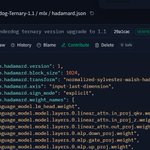
i wanted to understand DeepSeekv4.1 Flash a bit better, so i tried to implement it from scratch in a very hostile environment. I was able to get it to run at between 1 tok/s and 10 tok/s bs=1 ctx=1M+ at full precision (which is a combo of bf16, fp8 and mxfp4) depending on the expert cache hits on a single 4090, 64GB of CPU ram and 1TB of nvme . this architecture slaps and sadly is optimal for grace blackwell type deployments . im incredibly impressed with the deepseek teams continued engineering work within their constraints.


Proposed General Solution: Dₘ,ₖ(n) = Θ(n^{∑ d ℓ_d(m) − 1})
m = alphabet size
k = deck length
n = word length
k-deck = multiset of length-k subsequences
ℓ_d(m) = # Lyndon words of length d
Binary k=3 ⟹ Θ(n⁹).
Settles the Chrisnata et al. AMC 2023 open question: Ω(n⁶) ≤ D₃(n) ≤ O(n⁹) doi.org/10.3934/amc.2021032