Progress, policy, practice. Past: @InstituteGC, edtech VC, history of science DPhil. AI & tech optimist. Fan of universities, state capacity, đ. âĄď¸.
London, England
Joined May 2007
- Tweets3.4K
- Following1.1K
- Followers1K
- Likes12.1K

This matches my observations in other domains as well (sorry, Bluesky).
Iâm sure this one wonât make anyone angry. (But probably not here.)
daringfireball.net/2026/10/xâŚ
Alexander Iosad retweeted
It will never stop amazing me that people who consider themselves pro refugee, pro immigrant and general Pro Good Guys Of the Left sneeringly describe the half-dead Holocaust survivors who went to Israel after having been so failed by Europe as âsettler colonialistsâ
Americans discover âtell us onceâ.
(Given how DOGE went, not holding my breath for it to work).
(Britain still doesnât have anything like this).
đ¨ NOW: The Trump administration is launching a Super Intelligence site that will let Americans change their last name after marriage in ONE SINGLE FORM â which usually requires HOURS or DAYS to fix every government document
"You'll be able to change your name right on the platform."
"This would've taken weeks, multiple filings, different agency websites, if you even knew where to start."
This is perfect!
Saving Americans' time is INVALUABLE
Alexander Iosad retweeted
In lights of recents news, last 6 months of multi-agents research is interesting. Where model optimization looked like *chemistry* (optimizing for a recipe between craftmanship and science), multiagent-systems look like sociology (observing emerging behaviours, without real power over them)
anthropic.com/research/multiâŚ
This is also true for AI in government and public services â weâll need evals for everything, all the time â and is made harder by the present dysfunction in data sharing practices. Solving this is an underrated win.
Just spoke to one of the big data labeling businesses.
Few interesting insights:
- They predict the majority of their revenue will come from Fortune 1000 enterprises, not labs in a few years
- They believe every company will want to own their intelligence, but owning intelligence does not necessarily mean using open source models
- A companyâs evals will become their main proprietary IP given the improvement in agent performance after properly setting up & running internal eval environments
- Most enterprises havenât graduated from coding agents and itâs largely due to not having the proper eval infrastructure to make non-Eng agents performant
Alexander Iosad retweeted
Short Notes On: General Political Rhetoric on AI
1. As I predicted the other day, Labour MP Darren Jones (former chief sec to PM Starmer) has decided now is a good time to speak more publicly about his views on AI.
2. Iâll unpack those in a second, but first letâs pre-empt some of the criticism that will emerge. First, Jones has been talking about this for some time. His work as Chair of the Business and Trade Committee (prev BEIS Cttee, RIP) saw him examine many businesses and their AI workings. Second, he has also been calling for Labour to make AI a central part of their offering to the British people for a few years (Guardian screenshot below), which is more than most of the chump takes that have emerged on here from his fellow Parliamentarians in the last month. I donât agree with everything he says, but at least he has spent time thinking about articulating his ideas before writing/tweeting them.
3. So what is he pushing for? TL;DR, Jones is concerned about labour market impacts from AI. He talks of loss of jobs, loss of tax, welfare and so on. He notes the companies themselves are talking about this, but UK Govt isnât/doesnât look likely to at level necessary. This piece arrives as Labour Conference gets moving, and so is meant to âfocus the mindâ in No10/11 on this. It is also a thinly veiled dig on PM Andy Burnhamâs overall âMr Nice Guyâ approach because Jones is implying (correctly) that not doing anything, trying to please everyone, will have immense costs, and that Burnham will need to make some trade off.
4. Overall, I think the pieceâs central argument (not the Burnham slight) is actually a slightly dated and confused view, and Iâm again concerned by the delta between takes that are discussed at length on here by actual experts (economists in and outside of frontier companies are often tweeting about this stuff for free! - and whatâs ending up in British papers/political chat.)
5. Just in terms of actual concrete things, the UK Government has set up an AI Economics Institute (first Govt in the world to do this) modelled off our booming AISI. I expect to see some stuff coming out of it soon, and hopefully this lights a fire under some SW1 bums.
6. I agree, and have written about, the vacuum created for populist takes if you donât have an assertive government actioning and communicating actual positive AI achievements. âWe are using AI to reduce paperworkâ no one cares! Means nothing.
7. The Government - and other leaders too - need to understand that this technology is being pitched on a level of almost going to the moon in terms of what it can achieve and do - âitâs going to cure all disease/transform our society!â- and THAT is what justifies some of the perceived risks. However, too often Western policymakers lack logos and critically thymos in their strategies around this. So we get bad press releases and poorly articulated concrete examples of how this technology is working/why it hasnât quite worked yet (Apollo programme took a decade!)
8. Overall, Jones doesnât quite articulate this correctly, but what he and other Westminster folk are struggling to say is that no Prime Minister has yet stated, in clear but comprehensive terms, what exact vision of Britain they have where AI helps it be achieved. If the whole pitch is just stuff like âAI helps us make the shit parts of Britain - long NHS queues, office admin, planning etc - marginally less shit, but by the way it also involves trade offs such as personal data being sold/huge amounts of money flowing around/potential risks to achieve this marginal gainâ, thatâs not really v inspiring. You are teeing yourself up for valid criticism AND invalid demagoguery.
Exclusive:
Artificial intelligence could lead to âcracks in the very foundationsâ of Britainâs economy by costing jobs and overwhelming the welfare system, a former minister has warned
Darren Jones, who served as chief secretary to Sir Keir Starmer, said that there may not be âenough jobs to go roundâ if the government failed to âget ahead of the curveâ on AI
He argued that while AI could improve productivity and result in higher wages or a four-day week, it could also drive unemployment by replacing jobs
Writing in The Times, he said that this could ultimately lead to fewer people in work, a bigger welfare state and lower tax revenues to fund public spending
Jones argued that the government must ask the âbigger questionsâ, saying: âIf the pace of AI development is maintained, and businesses integrate it effectively, we could see cracks in the very foundations of the UK economy.
âIf, for example, there is a significant drop in demand for human workers and we have fewer people in work paying tax, how will we respond? The welfare system will not be able to support middle-class workers with good salaries and expensive mortgages if they find themselves out of work. So, what is the answer? What is our offer to young people if there simply are not enough jobs to go round?
'This potential drop in the tax take, and potential increase in economic inactivity and the welfare budget, would clearly be a disaster given the fiscal tightrope the government is having to walk. So, is the social contract fit for the future? If not, what should it look like? What should the Office for Budget Responsibility say about this in its ten-year economic forecast?'
thetimes.com/uk/politics/artâŚ
A few days late to it but @Samfrâs piece on the âcrisis of agencyâ is excellent, balanced, and timely.
In a nutshell: we should pay more attention to the gap between what young people want to do and are/feel able to do in their lives. And, you know. Do something about it.

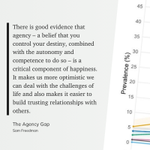
ALT There is good evidence that agency - a belief that you control your destiny, combined with the autonomy and competence to do so - is a critical component of happiness. It makes us more optimistic we can deal with the challenges of life and also makes it easier to build trusting relationships with others.
Come for the agency framing, stay for the sensible treatment of social-media impacts and the effect of schoolwork: samf.substack.com/p/the-agenâŚ
Pair with @JamesKanagâs research on agency and zero-sum thinking: politicalwhiteboard.substackâŚ
Alexander Iosad retweeted
Something very significant here - the government has permitted itself to very quickly publish a 7 page unformatted pdf that sets out its views, gets straight to the point and doesn't waste months of civil service time.
You can just do things.
One of the most significant government publications in decades.
With strong leadership from the PM, the powerhouse team in Number 10 North & work with colleagues across govt, we are going to set our country on different & better path.
gov.uk/government/publicatioâŚ
Tom as always is talking a lot of sense, but the point about people is spot on and risks getting lost in the (re)shuffle: it was hard yards, but DSIT always impressed me by how much attention they paid to recruitment â both who to hire and how.
Any startup founder/VC will tell you people are the biggest multiplier, and DSIT came closest to replicating this mindset in Whitehall. If its demise leads to similar practices being adopted in the rest of the civil service, it would be an incredible win for state capacity.
Great to speak with @tim about what it might take for the new DSIT MoG changes to work. Feels like a fork in the road moment for state capacity in technology! Some views from me in this well-researched piece, plus expanding a bit below:
1. Give the Cabinet Office AI Minister real authority to drive through the most ambitious work.
2. There is also a fantastic chance for @jreynoldsMP to immediately signal that he is seizing the opportunities of our tech future, and catalyse the confidence of a sector driving growth and investment in the country.
3. Lots of focus right now on structure, but people will matter above all else. What DSIT managed to do when it comes to attracting exceptional talent across research, AI, and entrepreneurship is exceptionally rare. Cabinet Office and DBIST should internalise what has been done here, and spread those best practices to make their departments purr!
4.) Spreading the AI brief across multiple departments will allow for some important areas to be prioritised, but it also strengthens the need for an effective No 10 AI operation, that can adjudicate between departments that end up in disagreement with one another. No 10 have assembled a great AI unit and tech team to address that, and their work continuing will be especially important.
Completely mad, completely predictable, but also just sad for a country that has the likes of @TheDataCity and @Beauhurst right there. And our AI ambitions will always be held back if the underlying official data is poor and/or out of date.
It's been interesting and puzzling to witness the problems with accuracy in UK economic statistics over the past few years. (See the links in the next tweet for more.) It seems that the Office for National Statistics, ONS, now struggles to effectively measure basic figures such as employment, trade, and inflation. This resulted in a quite scathing government report published last summer, where Robert Devereux, a former permanent secretary, concluded that "most of the well-publicised problems with core economic statistics are the consequence of ONSâs own performance."
There's a lot of discussion about the travails facing the UK these days (including this big piece in The Atlantic a few weeks ago[1]), and the problems with the ONS feel like an unsettling microcosm of diffuse decline in broader institutional competence.
Anyhow: at Stripe, we became curious about the UK's published entrepreneurship data. While we observe a boom in many parts of the world, official figures don't show a similar increase in the UK. In the latest Stripe Economics post, we dug into the data, and, as far as we can tell, the official figures are probably misleading. The good and the bad news (mostly good, I think!) is that the UK is almost certainly witnessing an unmeasured boom in entrepreneurship: stripeeconomics.com/p/is-theâŚ
UK-specific issues aside, I suspect that this measurement question is illustrative of forthcoming econometric challenges. Keeping the world's macro indicators up-to-date in response to the faster-than-usual changes wrought by AI will be both increasingly difficult and increasingly important in the coming years.
[1] theatlantic.com/magazine/202âŚ
My @InstituteGC colleagues have done some great work on this btw: institute.global/insights/ecâŚ
Alexander Iosad retweeted
Still lots of room to disagree, but I think people would do better to actually look at the whole reply Andy Burnham gave on HS2.
âOnce you do all of the under the hood engineering work to make this âjust workâ (e.g. across tools, integrations, compute environments, memory, security, etc.)â is the core organisational challenge for any company or institution going forward. Making institutional context legible is the holy grail of agentic, high-agency orgs.
Note also @karpathyâs remark in a later reply that âeveryone becomes a managerâ â that, too, is a paradigm shift that calls for a radically different default skill set in any workplace.
When cognitive labour is on tap, how do you tap into it?
This is a new paradigm for interacting with Claude that is significantly more "inline" with all the other human activity org-wide. Once you do all of the under the hood engineering work to make this "just work" (e.g. across tools, integrations, compute environments, memory, security, etc.), Claude basically joins the team in a seamless way - you can talk to it as you would talk to a person and it can help with a very large variety of workloads.
Imo this is the 3rd major redesign of LLM UIUX. The first paradigm was that the LLM is a website you go to, the second was that it is an app you download to your computer. This third one is that it is a self-contained, persistent, asynchronous entity with org-wide tools and context, working alongside teams of humans. It really takes a while to wrap your head around it, but it works and it is awesome.
Alexander Iosad retweeted
we're rebuilding the state from the inside and need a brilliant platform engineer to do it with us. up to ÂŁ200k. the most impactful work of your life. if that's you - or you know them - dm me. fellows.ai.gov.uk
âĄď¸ Breaking: the governmentâs job search assistant has a sense of humour.
Seriously though, this is great. Public services today are standardised, reactive and heavily rationed â the only way to deliver at any kind of scale in a 1950âs model.
This is how we get to services that are personalised and always on. Tools like this mean anyone can get help with their job search not the lucky few, at a fraction of the cost. For many, it might make the difference between entering our sticky welfare system and just getting a boost in the moment and moving on to bigger better things.