
Banking, Online bus ticketing, Ecom- Entrepreneurship, Logistics, Digital Public Infrastructure. Building https://xitter.cf/t.co/9SMms0itRi
Bangalore
Joined October 2009
- Tweets12.2K
- Following2.1K
- Followers1.3K
- Likes9.4K


Abey Zachariah retweeted

I know your point is about Indian VCs vs. US VCs. I am a US based VC that has invested in several Indian startups and founders from India are exceptionally good (as good as the ones in the US).
But there are fundamental structural problems of investing in India.
At exit, we need to sell shares, pay 12.5% tax, absorb FX losses and are subject to a few mutual funds setting the price which all corresponds easily to at least 30% dilution at exit. M&A is not an option at those valuations.
Even if you ignore all the above, just try setting up a bank account and custodian to hold your shares. The operational friction is high.
This further strengthens the argument that more of the investment dollars in Indian startups should come from investors based in India.
This has been the case with me for last 6 months at least. Nothing new here.

Sam Altman (CEO of OpenAI):
"You no longer need to write prompts."
In just 38 minutes, he explains how to use ChatGPT at a level that most people can't even imagine.
It's a talk he gave to Stanford students. A friend sent me the recording last night.
After watching it, I realized I was only taking advantage of about 15% of what this tool can really do.
Watch it in full and then follow me for more such insightful content
Abey Zachariah retweeted

Sequoia just made a bold claim:
They think the next $1T company will NOT be a software company.
Their take?
Services will be the new software.
Because SaaS companies have spent 25 years fighting over a smaller budget in comparison.
For every $1 companies spend on software → they spend about $6 on services.
For reference:
• A company might pay $10K a year for QuickBooks.
• And $120K for the accountant who closes the books.
AI has completely changed that.
Now, a company can sell the finished WORK instead of the tool.
Here's how the 3 models compare:
TRADITIONAL SAAS
• The customer buys access to software, and their own team runs it.
• Growth is capped by product + distribution.
TRADITIONAL SERVICES
• The customer buys people's time + expertise
• Growth is capped by hiring.
SERVICE-AS-A-SOFTWARE
• The customer buys a completed piece of work.
• Software handles most of the delivery, with the provider's team on decisions + exceptions.
• Growth is capped by how much of the work software can do reliably.
Something to keep an eye on.
This is brilliant.
For a second I thought this was about AI editing the image. Turns out AI fixed the actual road.


Abey Zachariah retweeted

Our open-weight voice models have officially crossed 500,000 downloads on Hugging Face!
Half a million downloads, and counting!
Huge thanks to everyone who's been using Veena and Maya-1. It's incredible to see our models reaching so many people around the world.
Abey Zachariah retweeted

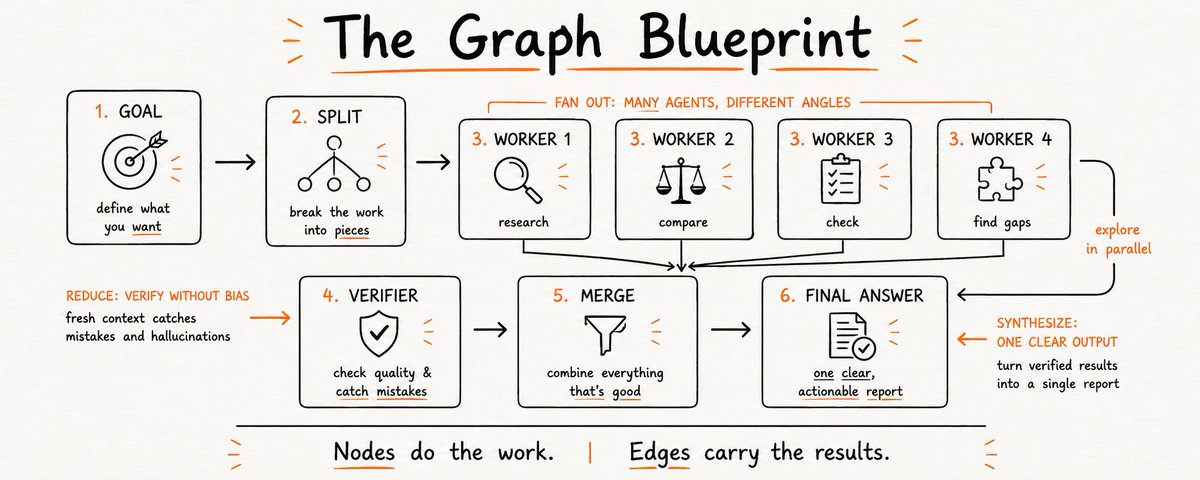
Google Brain founder, Andrew Ng:
"Prompting will be dead in 6 months, graphs are what's replacing it."
In 2 hours at Stanford he shows how to build agents that work and improve entirely on their own.
The first 10 minutes cover what most $500 courses never do. Bookmark this before your feed buries it.
Watch the lecture, then read the guide below on how to build a system that improves itself.

BBMP should charge such companies for providing such complex training ground for these robot companies.
@GBAChiefComm

Can Indian robots handle Bengaluru footpaths?
xTerra Robotics (@xTerraRobotics) and I answered that question with their Dhav-Hy wheeled quadruped.
If any of the quick comm/food delivery companies want to test this tech out for last mile, DM founder Aditya (@love_the_doing).

Abey Zachariah retweeted

High burn in insta maid/insta help/quick services isnt a company specific problem but a category issue.
Urban Company's Insta help posted revenue of 21 crore and loss of 174 crore in the second quarter.
So their three months burn is actually higher than one year of Snabbit, which posted net loss of Rs 167.75 crore on operating revenue of Rs 12.25 crore in FY26,
The third player in this category Pronto too has high burn.
Not sure how the unit economics will catch up unless customers are willing to pay more or players use this as training data for physical AI tasks (like what Pronto was trying to do). But that again is a privacy nightmare


Urban Company Q2 results: Loss widens to Rs 183 crore, revenue up 41% YoY
moneycontrol.com/news/busine…

Abey Zachariah retweeted
We’re releasing the world’s best Indic voice AI model, fully open-weight. 🇮🇳🇮🇳
With over 1.5 billion people and 22 official languages, the future of AI for India is voice-first.
Maya-2 officially outperforms ElevenLabs v3, Cartesia Sonic 3.5, and Bulbul v3 across Indian languages.
It will be completely free for every builder very soon.

Abey Zachariah retweeted

New on our Engineering blog: Creating in-house source control.
In May, we merged around 2,500 code changes per day. In September, we merged more than 30,000 per day. As a result, we became bottlenecked by developer infrastructure built for human (rather than agent) scale.
Here, we share how we built a new version control system—and fully migrated our monorepo from git—in five months: anthropic.com/engineering/re…

With AI, one can build in months companies that once took years to build. Smaller teams with sharper execution can give tough competition to incumbents that built their businesses with massive tech teams.
Managed a hack last night and now I hardly have to use terminal and am simply using only Claude Cowork. Now mostly dealing with business logic while Claude does the technical bit. This is the future of downstate where business people write in English and s/w gets built accordingly. No need to worry too much about technical details except occasional decisions. Good for non critical software for now. Core stuff still needs engineering bandwidth.
Abey Zachariah retweeted

You should expect the silicon chip companies to move up the stack as the application companies move down the stack.
In AI, it is increasingly true that everyone competes with everyone. Everyone will soon offer their own LPS, silicon, cloud and applications.
The question is what will the constraint be that you can build a long term market and margins around…
Is it distribution? Is it a data moat? Is it a physical constraint like power?

Today we are announcing our biggest bet yet on our own silicon.
Starting next calendar year, we will scale our Maia family to multi-gigawatt deployments, making it the primary inference system for our own product and services.
And we’re introducing Maia 300, which delivers 40% more tokens per watt compared to leading GPU-based systems.
We are already deploying Maia 200 across the US, Europe, and Australia, delivering up to 1.7x more tokens per watt across experiences in Teams and Copilot.
Our goal is to build on the full-stack efficiency gains we’ve already seen, while continuing to bring the latest innovations from across the ecosystem into our fleet.

Abey Zachariah retweeted

Technical moats are mostly over at this point. If you’re building something that is meant to be durable, the only moats now are:
• Proprietary data
• Network effects
• A physical component
Abey Zachariah retweeted

Palantir CEO Alex Karp explains why your business is essentially fucked if it's not sovereign in the AI era:
“What is a business? Why can you charge more than it costs you to produce? Because you have some unique way of doing something.”
“You need to advance your unique capability, learn from the world, and never, ever expose to anyone else how you’re doing it exactly.”
“The minute someone else can do any part of those things as well as you can, your pricing parity goes down, and at some point, your value goes down.”
"Normal software is built to force you to adopt something that's parasitic. They take every one of those things, turn it into a commodity, and sell it to everyone else."
"You talk to VCs, what they wanted to hear was, 'Clients will be unhappy, but they can't get rid of you.'"
"Sticky is a metaphor for parasitic."
"I get your data, I get it into something you can't get rid of. The thing turns into something I can sell to everybody else, who then can't get rid of it, and de facto, your multiple goes down and my multiple goes up, and all of us are happy, and hope at some point you realize you're sad... Hopefully after it's too sticky."
Via @ZetaGlobal @dsteinberg10000

Palantir CEO Alex Karp: Businesses no longer want to transfer their alpha to OpenAI or Anthropic
"Why are [LLMs] charging for tokens if it's so valuable?"
"If it was so valuable—let's say I can make you a billion dollars tomorrow. Wouldn't I say, 'I'll make you a billion dollars, and I want 30%?'"
"Look at our financials. The reason why everyone is chillaxing with bad financials and growth while losing money is: the client refuses to pay the true cost."
"The two places that actually make money—profit, free cash flow—are our application layer called ontology, and compute."
"We can get the frontier application to be exactly the same as a frontier model without the risk of transferring the alpha of your business to another."
Via @CNBC


Abey Zachariah retweeted

Chamath: Software IP Just Became Worthless
“I think that IP and software was effectively rendered worthless two days ago.
There have been people that decompiled the entire Big 5. What is the Big 5?
Adobe has five very, very important products in their product suite, and these folks basically decompiled it, distilled it, and published open source versions of these things.
I was so shocked because I was like, ‘Hold on a second. These are profound products that have existed and have had moats for years, and now they're just open source versions.’
If you think about it, when everything is headless, so when Elon makes his services headless, Benioff made Salesforce headless a few months earlier, when all of these things are headless and you can wrap them in agent tools and you can connect them via MCP to other experiences, the value of IP no longer exists in software. It doesn't exist.”
Abey Zachariah retweeted

Big setback to Masala Maker FBO Everest
Pre packed cumin powder has been declared Unsafe and recalled by the @fssaiindia
Pesticides found in the product.

