

Preserving every story in the world
Joined September 2026
- Tweets183
- Following2.3K
- Followers2.2K
- Likes1.4K






Leonidas at Thermopylae (1814): Courage, Sacrifice, and Historical Memory
Painted by French Neoclassical artist Jacques-Louis David, Leonidas at Thermopylae depicts the Spartan king and his companions preparing for their final stand against the Persian army in 480 BCE. Rather than showing the battle itself, David focuses on the tense moments before combat, when the warriors prepare themselves for what lies ahead.
During the invasion led by Persian king Xerxes I, Greek forces defended the narrow pass at Thermopylae. Leonidas commanded a contingent of Spartans, alongside other Greek fighters. Although the defenders were eventually defeated after the Persians discovered a route around the pass, their resistance became one of the most enduring stories of courage in ancient Greek history.
David places Leonidas near the centre of the composition, surrounded by warriors preparing their equipment, embracing companions, and exchanging gestures of farewell. The contrast between Leonidas’s composure and the movement around him creates an atmosphere of resolve and impending sacrifice.
The painting reflects the ideals of Neoclassicism through its idealised anatomy, carefully arranged figures, and references to ancient Greek culture. However, it should not be treated as a documentary record of Spartan life. Created more than two thousand years after the battle, it presents antiquity through the artistic and political concerns of early nineteenth-century Europe.
David worked on the painting over many years, completing it in 1814, during a period of dramatic political change in France. Its emphasis on duty, unity, and sacrifice resonated with themes that had become especially significant during the French Revolution and Napoleonic era.
#earthdata #art


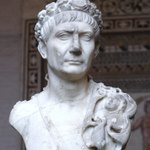
Trajan ruled the Roman Empire from 98 to 117 CE and became a model of the successful emperor in later Roman memory. His reign combined cooperation with senatorial elites, extensive building and territorial conquest. The empire reached its greatest geographical extent, but the gains were unevenly secure and depended on military violence, provincial resources and the labour of people far from Rome.

Mehmed II, who put an end to Constantinople
Mehmed II made the capture of Constantinople in 1453 the foundation of a new imperial order. His career combined sustained warfare, administrative concentration and an interest in the artistic languages of both the Islamic world and Renaissance Italy. His campaign against Vlad III also places him within the history of Wallachia: Ottoman expansion there depends on local dynastic politics as well as battlefield strength. Neither an uninterrupted sequence of victories nor a simple encounter between two religions adequately describes his reign.

Battle of Ascalon — the 1177 scene
Charles-Philippe Larivière · 1842–1844
Louis-Philippe commissioned this painting in 1842. Joconde dates it to around 1842, while Versailles gives 1842–1844. Its historical title names Ascalon and 18 November 1177; retain this as the museum’s wording rather than using the title alone to settle modern questions about the battle’s identification or date.

A study on ancient DNA published in *Cell* in 2021 reveals that modern Greeks share a significant degree of genetic affinity with Middle Bronze Age individuals from Logkas, northern Greece.
In certain qpAdm models, modern individuals from Thessaloniki can be modeled as having approximately 93–96% of their ancestry derived from the Logkas population, alongside a small proportion from other sources. This does not imply that "modern Greeks possess 96% ancient Greek DNA," but rather demonstrates substantial genetic continuity spanning roughly 4,000 years, alongside subsequent episodes of population admixture.

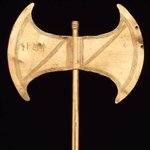
A 3,500-year-old gold axe... and an inscription that humanity has yet to decipher.
This is a ceremonial double-bladed axe from the Minoan civilization, discovered at Arkalochori on the island of Crete, Greece. Inscribed on the axe are characters belonging to Linear A—one of the world's most famous undeciphered ancient writing systems.
The ancients left behind a message. Regrettably, after millennia, we still do not know what they intended to convey.


The Temple of Isis – where the Egyptian goddess was worshipped across the Mediterranean world
Beneath the night sky, the stone columns and surviving ruins of the Temple of Isis evoke the widespread reach of the cult dedicated to one of ancient Egypt's most important goddesses. In Egyptian mythology, Isis was revered as the goddess of magic, protection, motherhood, healing, and rebirth, as well as the wife of Osiris and mother of Horus.
The worship of Isis was not confined to the Nile Valley. Over the centuries, her cult spread throughout the Greek and Roman worlds, establishing temples and communities of devotees across the Mediterranean region. This made Isis one of the most internationally influential Egyptian deities of the ancient world.
Temples dedicated to Isis were sites for rituals, processions, and offerings, as well as ceremonies centered on protection, life and death, and the hope for an afterlife. Today, the remaining ruins tell not only the story of a goddess but also reflect the ways in which Egyptian, Greek, and Roman civilizations once intersected and influenced one another.


The painting *Greece Expressing Gratitude* (1858) by Theodoros Vryzakis is a seminal work depicting the Greek War of Independence.
At the center of the painting stands the figure of Hellas—the personification of Greece—depicted as a young woman clad in classical white attire, wearing a laurel wreath, with arms outstretched and standing atop broken chains. This image symbolizes a Greece liberated from Ottoman rule, while evoking themes of victory, freedom, and national rebirth.
Surrounding Hellas are prominent figures of the Greek Revolution of 1821—including warriors, statesmen, intellectuals, and supporters of the independence movement such as Theodoros Kolokotronis, Laskarina Bouboulina, Georgios Karaiskakis, Papaflessas, Ioannis Kapodistrias, Alexandros Mavrokordatos, Rigas Feraios, Adamantios Korais, and Lord Byron. The scene does not depict a specific historical event exactly as it occurred; rather, it is a symbolic composition designed to bring together key figures who contributed significantly to Greek independence.
The composition follows a roughly pyramidal structure, with Hellas positioned at the highest, central point. The upper section features a bright sky, evoking a sense of the divine, while the lower section displays revolutionary figures alongside their weapons, uniforms, and traditional attire, highlighting the contrast between the reality of war and the image of a nation that has attained freedom.
The use of attire and forms reminiscent of ancient Greece also holds special significance. Vryzakis sought to connect the modern Greek nation with its ancient heritage, conveying a narrative of historical continuity: from ancient Greek civilization, through the period of lost independence, to the Revolution of 1821 and the formation of a new Greek state.

The painting depicts an event that took place in 1803 in the Souli/Epirus region, prior to the Greek War of Independence (1821–1829). In Greek tradition, this event is known as the "Dance of Zalongo": a group of Souli women, accompanied by their children, fled to Mount Zalongo and chose death over capture. Details of them singing and dancing before plunging to their deaths have become a celebrated part of Greek national memory, even though the accounts of the event later acquired a legendary quality

Artemis
Goddess of wild animals, the hunt and the protection of young life.
read full: aevumoravercel.vercel.app/


The Microsoft Store features a Microsoft Rewards app where you can complete tasks to earn points and redeem them for rewards—making it very easy for Windows users to participate. Notably, the program includes an option to donate to relief organizations and support special causes; I personally choose to dedicate all the points I earn to supporting them. I’ve just introduced you to a special, humanitarian initiative by @Microsoft
Of course, this is a small act of charity; if your financial resources are limited, you can still show your support using the points you earn through Microsoft.
#CharityFairy #windows #microsoft


The Legend of the Origin of Athens' Name
Legend has it that Athens was founded on a hill by Cecrops, a king who was half-man and half-snake. He named the settlement Cecropia. Under his rule, the city began to flourish. The gods grew envious of Cecropia's rising importance and felt it should be named after one of them. The two main rivals were Poseidon and Athena. Zeus instructed each to offer a gift to the city; the one who presented the better gift would win the city's patronage. Poseidon went first, striking a rock with his trident, and water gushed from the ground. The people were initially impressed, thinking they would never suffer drought again—only to discover the water was as salty as the sea over which Poseidon ruled. Athena then planted a seed in the ground. It instantly grew into an olive tree that would bear fruit. The people realized this would provide food, oil, wood, and an enduring symbol of peace. They declared her the winner, and the city was named after her.

