

/Animator // philosophy /History/ theology // @warriors// //shafii supremacist// student of knowledge// founder @Comicsmtaani
Scranton, PA
Joined August 2014
- Tweets65K
- Following3.6K
- Followers7.2K
- Likes27.6K




Pinned Tweet
As Ramadan is imminent heres a schedule my muslim mooties can use to finish the Quran every 7 days
tried and tested


Bs Take if you actually read arab history especially pre islamic arabic poetry you will notice that the Arabs possessed an elaborate moral vocabulary and a moral code which they inherited from the religious and moral tradition going back to Abraham and Ishmael. Even the pagan Arabs retained elements of that Abrahamic inheritance, albeit mixed with idolatrous practices and religious distortions.
Even in the Quran when the pagan arabs were asked who created the heavens and the earth, they would answer, "Allah." Their recognition of Allah did not make them monotheists in practice, but it demonstrates that their religious worldview was not entirely disconnected from the Abrahamic legacy.that existed before

This is actually not true. The idea that nature is humanity's adversary is a pagan philosophical idea, particularly in classical Greco-Roman thought, This is why the celebrations of birthdays are a big thing in the West.
They saw life as a fight against nature; each year alive was a “victory.”As one environmental historian notes, Western cultures long saw wild nature as an external enemy to be fought – “a struggle to maintain and defend the fragile culture against overpowering… nature”


People who assert this braindead take that morality is a resukt of human reason actually do not use their brain cells let me ask you
Suppose I reason today that anyone who refuses to comb their hair should be killed. I can construct an elaborate justification for it: perhaps I believe untidiness undermines social order, discipline and the moral fabric of society. I have reasoned my way towards a conclusion. Does that make my conclusion morally binding? Of course not. Thats ridicilous
The fact that human beings can construct rational justifications for their beliefs does not establish that those beliefs possess objective moral authority.
if morality is ultimately a product of human reason, what gives human reason the authority to establish universally binding moral obligations?
Why should your reasoning bind me? Why should mine bind you? And what happens when two people, or two societies, arrive at contradictory moral conclusions through reasoning?
Huwa manfikiria kweli
You cannot answer these questions merely by repeating that human beings possess reason. You have to explain why that reason has the authority to legislate morality in the first place.

Atheists have no businesss in being invollved in Law about the collective society or even talk about it they should actually be banned until they adopt a transcedence worldview this will always be my most extreme position
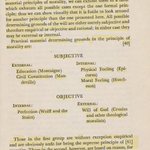
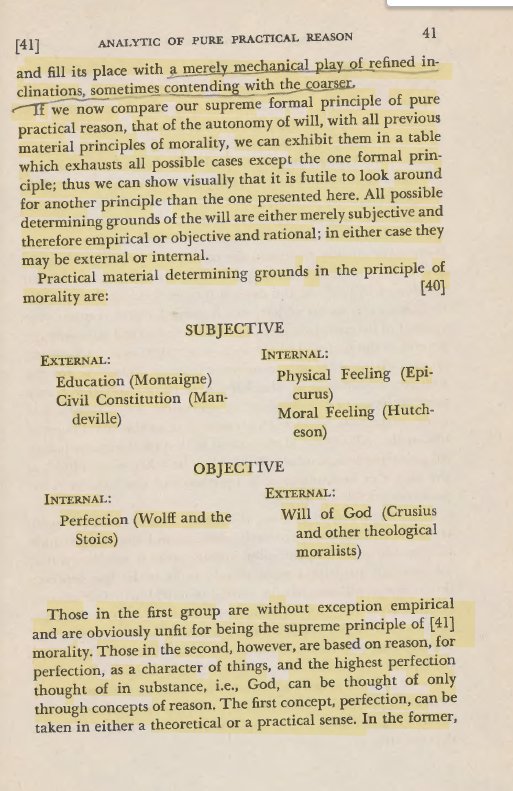
Immanuel kant talked about this in his book Critique of Practical Reason he said
“Those in the first group are without exception empirical and are obviously unfit for being the supreme principle of morality.”
(that is people who really on moral based system that come from human reason like all atheism)
And the 20th cnetury provided us with examples on why atheists shoukdnt be allowed im goverments with the likes of Stalin, Lenin and other communist leaders who presided over regimes that promoted militant state atheism and caused the largest death tolls ever in human history because of these
Stalin regime alone massacred 65 million people
People who say stuff like this whenever Scripture conflicts with modern law are often trying to present modern law as though it were morally neutral. But that is precisely the problem: modern law as concept itself is built upon moral assumptions. It has its own conception of justice, right and wrong, human dignity, and moral authority. Where did it get this assumptions from ? The Answer is from modern liberal philosopher kina john locke and them likes and where did they get them.from ? ,the scripture for example in the treatise of govermmets by locke
he bases his natural rights theory in theological assumptions about God, human nature and natural law. He was was very clear about this
And from a logical point of view the liberal cannot simply declare that Scripture has no business informing their law while pretending that the moral philosophy underpinning your Constitution is somehow exempt from scrutiny.
And if they insist on doing so the Question now shifts to why does moral framework of modern liberalism gets to inform legislation ? , while the moral framework of Scripture must be excluded from the conversation altogether. Which is a rather extraordinary intellectual contradiction which i wpikd define as Cope : how can you accept and retain moral principles inherited from a theological tradition(christianity) while simultaneously declaring that the very tradition informing those principles has no legitimate place in contemporary legal or moral discourse. @meshmwandishi
We talked about this in my lecture @SophistsKe because This what makes the claim of neutrality so questionable. if you ask me my theory on why chaps like this are so eager to frame scripture as incompatible with modern law is simply because it exposes modern law’s dependence on power rather than justice
Fun fact this actually not True
Constantine convened the Council of Nicaea specifically to address Christ’s divinity and settle the Arian controversy in thr chrostain world not to vote on or canonize the Bible. @CommunityNotes


Did you know that the 'holy bible' was pieced together by goverment officials in the 4th century, when Emperor Constantine summoned a bunch of bishops at the Council of Nicea and they voted on which books got included.
A lot of powerful texts were left out.
-Book of Enoch.
-Books that taught the power of your intuitions and embodiment.
-How the kingdom of heaven is within you.
-What true sovereignty.
The bible is a political text and it has for millenia, been used to justify violence in the name of, spreading the gospel.
In The Quran God actually makes this clear that Without the Soul , the body is no longer a living human being, but a physical structure devoid of the life that once animated it.
When talking about the advent of and creation of the human being he says
Thumma Sawwa Wa Nafakha Fīhi Min Rūĥihi (he fashioned the human being and then breathed the soul into him ]
And then he mentioned the mechanical abilities of the body such as hearing and seeing he says
Wa Ja`ala Lakumu As-Sam`a Wa Al-'Absar
And then after this God says but human beings are surely ungrateful
Because We have become so accustomed to the very conditions that make our existence possible that we cease to recognise their extraordinary nature. He says
Wal afida Qalīlāan Mā Tashkurūna

Fun fact The Jews actually did demand ifinite reparations from
Germany upto now germany jas paid over 90 billion dollars Holocaust reparations since signing the 1952 Luxembourg Agreement. It is one of the rare instances of sustained state reparations in modern history. Imagine if countries like namibia were paid that kind of money in reparations keep in mind namibia is the country where the first genocide of the 20th century was perpetrated by none other than germany...

Hamza K retweeted

there are lifepaths you could never conceptualize, let alone follow
imagine learning Arabic, moving to the UAE, dressing in your best Oscar Schindler 1938 German Industrialist cosplay, and selling (admittedly very nice) hunting rifles to oil sheiks for a 2,000x markup


Did you know that the Holy Spirit is not actually a white dove?
If you examine the ancient religious texts and the broader Semitic scriptural traditions, you will discover a rather interesting connection. The expression Rūḥ al-Qudus (روح القدس), translated as the Holy Spirit in the Qur'an, has linguistic parallels in both Biblical Hebrew and Aramaic as i found out in my readings
In Hebrew, the expression is Rūaḥ ha-Qōdeš (רוּחַ הַקֹּדֶשׁ), while in Syriac Aramaic it is Rūḥā d-Qudšā (ܪܘܚܐ ܕܩܘܕܫܐ).
Both expressions carry the meaning of the Spirit of Holiness or Holy Spirit. which means this a well known figure
However, what is particularly interesting is that when the Qur'an was revealed, God clarified the identity of this figure, which gives us a deeper appreciation of why the Qur'an describes itself as Muhaymin (مُهَيْمِنًا) over the previous Scriptures (Qur'an 5:48). In other words, the Qur'an does not merely affirm the existence of earlier revelations; it also serves as a guardian, witness and criterion over them, clarifying matters over which earlier communities differed.
In classical Islamic scholarship, al-Rūḥ al-Qudus is identified as none other than the Angel Gabriel (Jibrīl), the angel entrusted with conveying divine revelation to the Prophets.
The great Syrian scholar Jamāl al-Dīn al-Qāsimī discusses this identification in his Qur'anic commentary
i have talked about how influentials he was (teapaw.org/afro_hamza/status/2053…)
, The great Persian exegete Abū al-Barakāt al-Nasafī who preceeded him, likewise corroborates it, he said it is an established interpretation among the scholars of Tafsīr.
This interpretation is also found in the works of the great exegete al-Tabari, particularly in his commentary on Qur'an 16:102, where the Holy Spirit is identified as Gabriel.
So, while the expression Holy Spirit has a much older history in Hebrew and Aramaic religious literature, the Islamic exegetical tradition gives it a specific identification: the Holy Spirit is Angel Gabriel, the messenger through whom God conveys His revelation to humanity.
An interesting piece of comparative religious history that is often overlooked.
Recommended reading
The Spirit in the Christian Bible – St Andrews Encyclopaedia of Theology — biblical development of the concept.
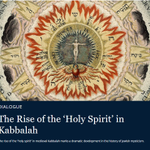
The Rise of the Holy Spirit in Kabbalah – Harvard Divinity Bulletin — Jewish understanding of Ru'aḥ ha-Qodesh.
Peter Laffoon – The Qur'anic Word Rūḥ (2023) — Islamic exegetical interpretations.
Al-Tabari's Tafsir on Qur'an 16:102 — classical identification of the Holy Spirit with Gabriel.


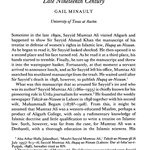
Fun fact his great grandfather and grandmother were very reverred islamic scholars ;shaykh Sayyid Mumtaz Ali and his wife Muhammadi Begum, . His book Huquq-e-Niswan and the journal Tehzeeb-e-Niswan that he started with his wife Muhammadi Begum are said to be pioneering works on women rights in east asia and in the 1900s
The magazine was published from Lahore, British India, under the auspices of Darul Isha'at. It’s later copies included upto 124 pages, which included poetry, news, editorials on socio-political issues of the time, and even entertainment.A significant portion of the magazine's issues has been digitized, with over nine hundred issues accessible online It is one of the most powerful and pioneering pieces of islamic non-fiction written for women for example look at this copy i have has tips for women how to keep hair shining and healthy in extreme heat.


