
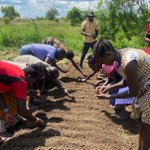




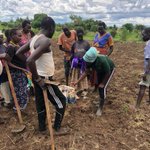
Lopapai farmers group in Napak, Karamoja trained on nursery bed management and set up their cabbage nursery with our Field Officer.
With quality seedlings, they are set for a healthy crop and bumper harvest.
Better harvests, improved food security and better farmer incomes.


Who knew even pests can be tricked?
Tuta absoluta, locally known as akasaanyi, has caused many losses in tomato farmers.
The pheromone trap👇🏿 gives the scent of a female Tuta luring the male for mating.
Once the male “arrives” it’s trapped and the mating cycle is stopped.


Best time to place the traps is before you see any signs of pest attack.
Early monitoring will help keep the pest populations below economic threshold levels.
Not staking your tomatoes is costing you money. Let me show you how 👇🏿
📌 Disease Prevention; Reduces fungal diseases (like blights).
📌 Pest Control; Avoids ground pests like slugs.
📌 Better Airflow; Leaves dry faster, preventing fungal growth.
Stake your tomatoes.


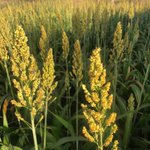
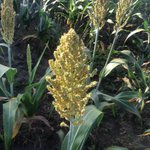
“Our sorghum is carrying at this height! We have never seen this.” Nabokat
farmers group in Loregae, Nakapiripirit.
26 farmers planted advanta hybrid sorghum.
We did 2 gardens; broadcasted one and one planted in rows.
We wanted to show that how you plant influences the yield


Seeing the difference in the ear size, most of the members said they would plant their sorghum in rows come next year.
This is the sorghum planted in rows.

More is not always better.
This farmer applied too much nitrogen in his maize at a young age.
This encouraged very tender, succulent stems that are highly susceptible to bacterial invasion.
Maize needs Nitrogen, yes.
But it needs it in the right rate, at the right time.


I would take you through how excess nitrogen causes soft stems but that’s too much science.
Let us, who know the science work with you so your money has the best return on investment.
Deal?
Colleagues the money has come 😃.
Alex a youth farmer in Kumbya, Mpigi district had lost all hope in his garden.
With our guidance, he made a turnaround.
Yesterday was his first harvest and he couldn’t believe he could harvest that much!
Have a good week.


Saving grain from the last season seems economical, but carries over pests, diseases, has low germination, lacks genetic purity of certified seed.
Plant good quality seed for the best results.
P.S; Moruita farmers group in Nakapiripirit, Karamoja in a training on good seed.


You wouldn’t build a house on a weak foundation.
For any crop, good seed is that foundation.
Moruita farmers group in Nakapiripirit, Karamoja during a training session on good seed 👇🏿.


Ahh the sight of these smiles is something!
These are members of Jordan farmers group in Nakapiripirit.
These smiles are sponsored by their first harvest from their demonstration garden over the weekend .
From us to you, have a good week.
Let’s go make more smiles 😃.


The fourth R to use of inputs is the right time.
Different growth stages need different nutrients.
There are critical times when those nutrient needs are very high such as;
📌 At planting.
📌 During rapid vegetative growth.
📌 During flowering and fruiting.


At Planting (Seedling Establishment); The primary need is for phosphorus (P) for root development and energy transfer.
When P is available, the plant will establish a strong root system that will support future growth.