




Pinned Tweet
🚨WEB3 falls short if users ownership is limited to tokens only.
Let's Start at the Beginning: WEB1, WEB2, and WEB3
WEB1 was all about "read-only" content. Then came WEB2: "read and write," where users could create and share content, making the internet more interactive and social.
⚠️ But here's the catch: today, a handful of big tech companies control nearly the entire internet, hosting around 80% of it.
They have absolute power over what stays online and how it’s used. Social media giants like Meta, Google, and X don’t just provide services; they track everything users do, mine personal information, and profit from it.
Privacy is practically nonexistent; everything users share is harvested and monetized, with little regard for individual rights.
💡 Don't get me wrong progress requires incentives, and that's understandable. But the reality is, if you're not paying for it, you're not the customer; you're the product being sold.
🔗 WEB3 aims to change the game by adding "ownership" to the mix.
But how do we provide ownership without everyone having to run their own servers, like in the early days of the internet? That model was too demanding, which is why cloud services became popular, they let users pay as they go and scale up when needed, offering better value overall.
🚀 It all started with Bitcoin and its decentralized blockchain model, designed to prevent any single entity from having control while giving users full sovereignty over their digital asset.
For a few years, numerous blockchains emerged, replicating Bitcoin's model in various forms. The next major breakthrough was Ethereum, which introduced smart contracts that enabled coding for tokens and interactions, giving rise to DeFi services and providing a framework that other blockchains adopted.
Essentially, these are token ledger databases with computations limited to token interactions, lacking the capability to store data efficiently or affordably.
✅ Their core purpose is to provide an efficient trustless database that serves as a settlement layer for tokenized assets and they've succeeded.
🔐 The tokenized asset aspect of WEB3 is largely addressed, but what about everything else?
Ledger blockchains are limited to managing tokens and transactions, they're not designed to handle complex computations, store data, or host websites, all of which are essential for user interaction and true data sovereignty.
Storing even small amounts of data is prohibitively expensive. On the most affordable ledger blockchains, storing just 1MB would cost over $1,000, and the cost only rises as token values increase.
😟 How safe do you feel knowing that your preferred dApp is running on centralized cloud, exposed to hacks, malicious employees, and the risk of data being changed, copied, sold, or deleted?
🛠️Did you know that most dApps run 70%-80% of their operations offchain, with only 20%-30% actually on the blockchain?
Onchain components handle token management, transactions, and DeFi smart contracts, while offchain components are responsible for hosting, complex computations, and all non-token/transaction related data.
⚖️ To truly achieve the Web3 vision, users need sovereignty and ownership over their data and computing in a secure, verifiable, and decentralized manner, ensuring that no single entity has control.
🌐 In 2015, Dfinity set out to address this exact challenge.
While most projects were focused on designing blockchains for tokenized assets, Dfinity created something entirely new: a blockchain capable of hosting the entire internet in a decentralized way, building a fully sovereign network independent of big tech services.
#InternetComputer design choices are decoupled from traditional ledger-based blockchains. It is a general-purpose cloud computing blockchain that provides the raw computational power and data availability needed to migrate away from centralized big tech cloud services.
The ledger token aspect represents less than one percent of its overall capabilities.
⚙️ The blockchain's computational power and throughput rely on the underlying hardware.
#ICP nodes are standardized, high-performance enterprise servers costing ~$30K and connected via dual 10GB internet links in independent data centers.
Node providers are required to own the hardware, ensuring the network maintains full sovereignty, ultimately delivering a true decentralized version of the internet.
🚧 This approach stands in stark contrast to traditional ledger blockchains, which are focused on minimizing hardware requirements to allow anyone to run a node, even on decade old hardware.
Some newer blockchains require slightly better, mid-range hardware due to improved consensus mechanisms that boost throughput through parallelization and other advancements.
✨ The amazing part of ICP's design is that not only do smart contracts serve websites directly, but they also have HTTPS capabilities, allowing them to interact seamlessly with WEB2 and other blockchains.
Additionally, they provide native multichain functionality, meaning their smart contracts can directly interact with other blockchains that are already integrated.
🤝 InternetComputer is designed to complement, not replace ledger blockchains, enabling dApps to move away from centralized infrastructure entirely.
⭕️ICP is not a one-size-fits-all solution; there are scenarios where other ledger blockchains are better suited for tokenized assets management.
However, dApps can still leverage ICP for hosting, computation, and data management, combining the strengths of different blockchains for a genuine WEB3 solution.
📜 A defining feature of the new WEB3 cloud internet is its governance model, how changes to the network are proposed, voted on, and implemented.
In this regard, ICP stands out, being fully governed by the NNS #DAO, giving users complete control.
No changes, including adding or removing nodes, can happen without an approved proposal.
The blockchain is fully autonomous, eliminating reliance on node providers for upgrades, as approved proposals automatically trigger code changes.
💰Hosting costs for computation and data are fixed, unaffected by the value of the ICP token.
📖 I highly recommend reading the Signal App founder's post to gain insight into why the WEB3 vision cannot depend solely on ledger blockchains and tokenized assets. moxie.org/2022/01/07/web3-fi…
☢️The current crypto space is plagued by misleading narratives like AI, DeSci, and SocialFi, running on ledger blockchains as if they were designed for or capable of supporting them.
💊In reality, it's deceptive, with everything offloaded offchain, failing to address the core issues and truly solve the problems at hand.
👉 Spot any flaws in my reasoning? I’d love to hear your thoughts in the comments.
Found this helpful? A like, reshare, and follow @ajki76 would mean a lot! 🤞

Ajki retweeted

DFINITY vs NEAR: the receipts 🧾
An ex-NEAR engineer said "There is no patent, I looked." @thebasedgiant found two 👀
Also in this video:
- @Revolut was unusable
- the FBI's PHP warning
- @oisy Pay at SPAR
- @OpenChat TG/Discord integration
& more 👇 #ICP
Ajki retweeted
I disagree, IMO the best outcome is an agreement.
The version I'd actually like to see is $NEAR Intents swapping its permissioned MPC for ICP chain-key signing.
What $NEAR would get:
✅ $ICP Keys reshared by protocol, not ceremony. Node joins or leaves, the public key stays the same, nobody ever holds it. Shares re-randomized on a schedule, so a share stolen last week is worthless now. NEAR only reshares when an operator changes. Compromise 11 of 17 slowly and the key is yours.
✅ Native chain reads. $ICP nodes ingest Bitcoin as part of consensus; EVM & Solana via RPC canisters that need multiple providers to agree. NEAR chain can't see other chains, so MPC 17 operators watch Ethereum/Solana/Bitcoin and tell the contract what they saw. Risk: the group that reports "your deposit landed" is the same group that signs the withdrawal. Corrupt 11 of 17 once and you can invent a deposit and sign the payout in the same step. No second check anywhere.
✅ A backup subnet. Lose the signing subnet, the key survives. Lose NEAR operators, the key is gone with them.
✅ 34 independent node providers across countries, each admitted by decentralized governance vote, paid by the caller (~3¢ a signature). Not 17 operators vetted by the foundation, paid 73k NEAR a month in emissions, who vote on their own membership and software.
✅ No TEE in the trust chain. The key is split across 34 nodes and the math enforces the threshold, not a chip. No Intel, no attestation, no side-channel risks.
✅ Signing that finishes under asynchrony. No coordinator, no restart when the leader drops, no "reuse a triple and the key leaks and nobody can detect it" (a real risk, from NEAR own spec).
✅ Any canister is a first-class caller: one call, consensus-ordered, certified response any client verifies against the IC root key. No separate network, no indexer watching one contract, no yield/resume dance.
✅ ECDSA, Schnorr/BIP340 & Ed25519 on one key model, plus vetKeys. Unlimited keys per canister via derivation paths, computable offline.
✅ Four years in production, zero rewrites, ckBTC audited by Trail of Bits with no high/medium findings. NEAR current signing path is six weeks old, three rounds slower and its audit covered only the use of Cait-Sith, not the library.
The biggest win for $NEAR holders, besides superior security: no more ~880k NEAR a year in emissions to fund MPC operators, and that number climbs once the roster fills to the 21 operators HSP-007 allows.
With current Intents volume and NEAR at ~$5, switching to $ICP signing would cost about 2–3x less on realistic signature counts. Since $ICP cycles are pegged to XDR while NEAR pays operators in NEAR, every doubling of the price doubles what the current setup costs NEAR holders.
What NEAR would keep: the Intents revenue.
Solvers, routing, 35 chains, hyperliquid, the fee switch, that's the business. The signing layer was never where the money is. It’s just where the patent is.
Ajki retweeted

You don’t need to be part of legacy media to publish the news.
On The Swop, anyone can publish articles, share insights, and cover AI, Web3, blockchain, and tech.
No gatekeepers. Just more voices and perspectives.
Built on $ICP.


The Swop keeps growing!
Join a growing community where creators can earn from their content, daily.
Built on $ICP.
theswop.app/signup?ref=vbyih…


Ajki retweeted

🔴 Dom is giving a presentation about the future of Sovereign Cloud & AI at the Dubai AI Festival
Definitely check out the speaker list ⬇️
dubaiaifestival.com/agenda/
$ICP ☁️♾️

Looking forward to two great days at the Dubai AI Festival, meeting with friends and partners! 🇦🇪
Watch out for the State of AI 2026 report that is going to be released on Tuesday.
If you are around, don't miss @dominic_w's keynote on "Sovereign Cloud for the AI era" on Tue, 3:10 UAE time.
@DubaiAIFest @DIFC @Ignyte_AE @dfinity

Ajki retweeted
Looking forward to two great days at the Dubai AI Festival, meeting with friends and partners! 🇦🇪
Watch out for the State of AI 2026 report that is going to be released on Tuesday.
If you are around, don't miss @dominic_w's keynote on "Sovereign Cloud for the AI era" on Tue, 3:10 UAE time.
@DubaiAIFest @DIFC @Ignyte_AE @dfinity
Ajki retweeted
The confidentiality is $NEAR infra knowing instead of the public knowing. the position sits on hyperliquid public book, all visible.
What's hidden is the link between your wallet and the hyperliquid account NEAR opened for you.
That link lives on a "private shard" run by permissioned validators NEAR doesn't name.
The TEE? NEAR own page says it covers the bridge to mainnet, not the shard.
So the validators see what they see. Can you verify any of it? No.
Validators aren't listed, there's no attestation to check, and NEAR page won't say who can connect an account to a user. It does advertise "selective disclosure" though. meaning someone can.
It's "trust me bro" confidentiality.

Ajki retweeted

Cloud Engines are Internet Computer subnets that firms configure under ICP's on-chain governance.
Node providers keep 80% of their revenue. The other 20% buys and burns $ICP, per the Mission 70 whitepaper from @dfinity.
How the burn model works:
bsc.news/post/internet-compu…

Ajki retweeted

I made a video explaining the full lineup of NVIDIA data center products to help you understand the different components and generations. This is geared for sales teams discussing NVIDIA offerings with customers, but should be relevant to anyone interested in the field.
Here’s the 20 minute version. 10 minute version in the comments.
Ajki retweeted
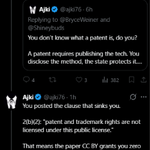
“clearly not” according to whom? You?
That's an opinion. The claim , NEAR PR, grant date are facts. One of us is citing documents, the other is citing himself.
Nobody's deciding infringement on X, that's what courts are for.
I'm pointing out the timeline you keep skipping: filed 2021, cited 2023, granted july, removed september.
“failing to ship products” $ICP shipped this one in dec 2022. $NEAR shipped DFINITY paper as sloppy copy in 2024, called it "first of its kind". 🤣
Sorry mate, everything on $NEAR outside the token settlement layer is just Web3 LARPing and that's a fact.
Even on the settlement layer, governance is LARPing.
2025: vote fails, foundation ships it anyway.
CTO: "validators have the last word, always have."
HSP-029: a yes activates nothing. A vote that changes nothing either way isn't governance, it's cosplay.🤣
Then there's NEAR AI a web2 company with a ticker.
Jasnah Inc. runs the inference, picks the models, brokers the GPUs, bills you, and settles with the data centers.
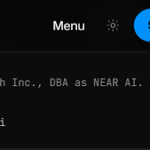
The chain's job is to be in the name. Don't take my word for it, scroll to the footer on near.ai: “© Jasnah Inc., DBA NEAR AI.” doing business as. They wrote it down for you.🤣

Ajki retweeted

15 years ago, I was possessed by a dream.
Professionally I was writing mostly enterprise software at the time, but I was dreaming of something else entirely. Something much bigger.
But the dream didn’t start there, for that we have to go back further.
At the turn of the millennium, I was already obsessed with the dream. For the first time I could see a plausible path to making it real. I was working in the transition from web 1.0 (static, the odd guestbook) to 2.0 (dynamic, databases everywhere) and I thought I could see very clearly where all this was going.
But the dream was not new for me, even then. It all started some 15 years or so before that when as a young kid who was into the 16-color calculators we called computers at the time, I saw an article in a magazine showing two blocky figures on a screen where one of them had a speech bubble that said “hi!”.
The article described that two people in different places were meeting virtually, and chatting with each other and could even play games together like this, using something called “modems” to connect their computers via the phone line.
I immediately knew what I wanted to do with the rest of my life.
It took a few years before I had the skills, tools and techniques to make any working demos of my own. But around the time of the Y2K scare, I had managed to code the first simple proof of concept for the vision that had been haunting me for so long.
It was an isometric game engine, that supported creating open and extensible multiplayer games that ran in a browser.
The open and extensible was the key part. I had spent more than half a decade on the web (1.0) already, and I was completely taken with how you could create an open, decentralized, extensible and practically infinite world of web pages, that the user could just “surf” around via hyperlinks, and it all just worked.
When web 2.0 started happening it was clear to me that this meant that turning the web into a sort of an enormous, interactive, open and extensible mmo world would be the obvious and logical next step. Cyberspace. Lawnmower man and the Matrix. Just wait until it would be all in VR, too!
I implemented my isometric proof of concept, saw that it worked, and expected that soon every company would have developed platforms to support virtual worlds connected to other companies’ virtual worlds with hyperlinks.
What “worked” in my proof of concept was the following idea core architecture: you have a game server (or a p2p distributed game server) that holds game state and where players communicate actions and chat. But this game server is free to fetch the maps that players choose dynamically from anywhere on the web.
As long as the maps would follow a standard that the game engine understood, anyone could just publish a map, or a new type of item or npc, just by putting a static xml file with the definitions online (this was before json).
Just like a web browser can jump around between every web page, this game client was able to jump around and show and let you play any world that it loaded up in the same way as a web page, and it would let you and your friends play together and have adventures in those worlds.
Second Life came and went.
Facebook turned into “Meta” for “Metaverse” which turned into a fiasco.
The concept never took off. My little isometric proof of concept obviously wouldn’t become the platform for a new 2.5D web, but I would have expected something from a major player to succeed. I sat there, wondering where my future went.
The closest it ever came to happening, in my opinion and analysis, was World of Warcraft. There was a time when I thought WoW would evolve into the first real social metaverse.
WoW had a lot of elements that made it a great candidate.
It was fun, for one. But the game was in many ways a pretense for a reason to join together in social activities in a virtual world.
The guild chat was the real draw and the monsters were mostly something you could waste some time with when nothing much was going on in the chat.
Some people never touched a monster, instead making a career buying and selling game items in the Auction House. Some people spent all their time organizing guild activities, but never joining raids. Some people specialized in crafting.
WoW had lots of things to make it an attractive virtual home than by only appealing to monster bashers. A virtual world should be a social place where users can meet while engaging in very different activities that they happen to enjoy.
WoW was in many ways the sort of thing I had in mind as for the multiplayer experience I was after, but it could not be ignored that it was then for a somewhat limited subset of people who enjoy gnomes and elves. And importantly, it wasn’t open and extensible, which was core to my vision.
To prove that an open and extensible WoW would be fun, I set out to code a fully playable and feature complete backend WoW style engine, with combat systems, items, quests, npcs, etc etc that were all possible to define entirely declaratively so you could just publish them as static xml files. Then, to test it, (again) an isometric frontend that ran in the browser. The frontend was a toy. The backend was not. This was 15 years ago.
It worked. It took over two years of frenetic around the clock code coding, but in the end I had a backend supporting every dang feature I had ever seen in WoW, fully declarative and extensible so that you could create your own worlds with adventures and your own graphics just by posting some XML files. Your characters could then right away enter those worlds and start doing quests, fighting monsters and pvp.
And it would just work, like opening a web page in a browser. It was, frankly, extremely cool.
This was before anyone had really heard of the concept of NFTs, crypto was still brand new. But the way I had designed things to be maximally decentralized means it had a lot in common with how crypto would evolve.
Everything - every map, every item, every npc and also every player, had a globally unique identifier number (GUID) that any other definition could use to refer to it. That together with a set of rules to prevent cheating when it was decentralized effectively worked as a sort of pre-crypto NFTs.
It meant all items and even characters could be traded freely, and moved between games as the owner pleased. There would never be any lock-in where your items were held captive by a game publisher. If some game closed shop, all your items and characters would still be in your possession so when your friends set up a replacement game server, boom there’s all your stuff.
Many games, like WoW, did their best to prevent anything like this, in order to protect their in-game economies and the ability to “pay-to-win”. Yes that makes sense for WoW, but it’s simply something that works differently in a fully open world. The rules are different. Not worse - imo better - but definitely different. Sometimes it makes sense for a company to invent their own “credits”, sometimes it makes sense to just accept money.
Another product that came close is Roblox. In several ways that is much more close to what I had in mind than WoW because Roblox holds millions of user created worlds, and a player can just jump freely between them.
The main reason it’s still not a bingo is that Roblox is not open or decentralized. Everything is owned by one company, it’s nothing like the extensible, open web where anyone can set up their own world permissionlessly and have it just work.
So I worked on my iso virtual world platform, and I worked, and I worked…and then I became a dad.
For over a decade I did not have time to work dedicatedly on my vision.
Now, to be clear, the isometric frontend was always just a placeholder. The idea when the backend had matured enough (which was right around the time my attention became fully otherwise engaged) was always to switch it for a real 3D frontend. The iso was just for proof of concept.
As the years passed, I tinkered occasionally with my backend as new ideas came to me, about how to improve scalability and decentralization. Many ideas came from the growing crypto scene, which is no surprise since decentralization is at the core of all this.
When ICP came out, I knew that it would be the platform that would finally let me realize the full scale of my vision.
Since genesis, I have been planning, writing specs, learning the tech, developing a deeper understanding of fully decentralized applications, testing different designs, developing proof of concepts, and even creating all the infrastructure I knew that a virtual gaming world platform like this would require, under the flag of an Open Canvas DAO called Sneed.
And now, it is all coming together. My concepts all work absolutely perfectly on ICP, and they scale beautifully. We’re now also at a point where turning the isometric frontend into 3D was not even a heavy lift for an AI. All that’s really needed is a big enough plan for how it all comes together.
And I have been polishing that plan for 40 years, and tinkering with the implementation for the last 15.
I can’t wait to show you my life’s main work, my magnum opus. It’s going to be raw, early, because I will want to elicit feedback from the start and grow an organic community that can help grow the platform together.
I will want to invite players from the ICP community who can understand how things actually work, as well as users who never heard of crypto or ICP to make sure it all works just as smoothly for them without having to know how anything works under the hood. Open and extensible, that’s all anyone should need to know. And fun. These days, even if you’re going to be a whole world creator on this platform, it’s enough that your AI understands the technical details.
I want to drum up a bit of interest for this before anything goes public, and then we will start with a public alpha - and a first public in-world launch event, to which you are all invited.
More details to follow, but if you have read this far - thank you for your patience and interest, and please know that I am beyond thrilled to be able to share with you this next chapter in my life long software development journey! I think we’ll have more fun than should be legally allowed, and hopefully it can help draw some real adoption to ICP (even if most users won’t know or care).
Very exciting things ahead.
Soon.

Ajki retweeted

On the Internet Computer, there’s no PHP server to patch—security starts with the architecture.
The future of the internet demands stronger foundations.
#InternetComputer #CyberSecurity #Web3 #ICPay

🚨 Two critical PHP flaws (about 7 in 10 websites) allow takeover with no password. FBI: can't patch? Go offline.
On the Internet Computer there's no PHP or server to patch, and platform fixes are approved by the NNS and roll out to every node.
Fixed once, for every app 🎥
#php
Ajki retweeted

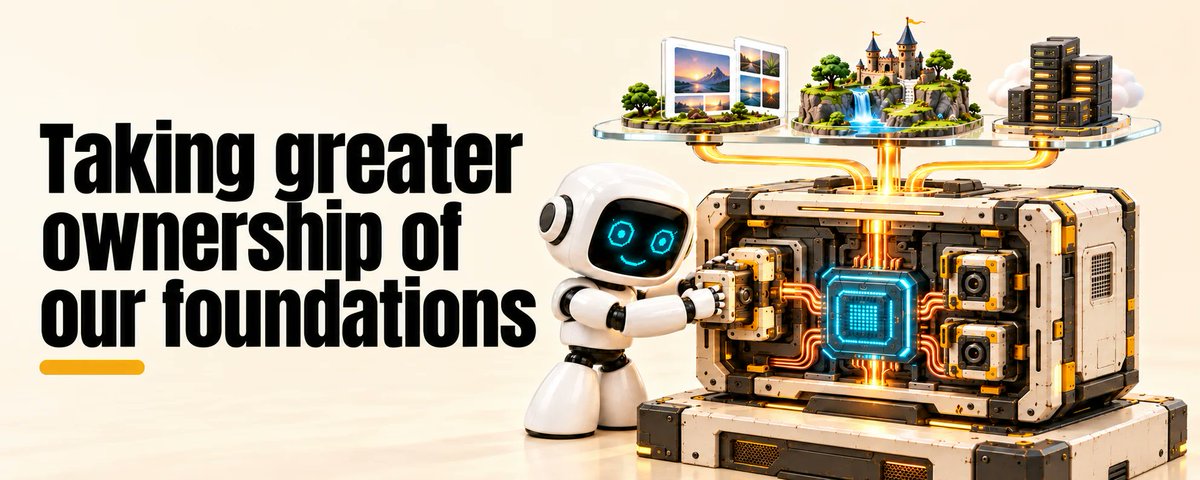
Read about how we are building on DFINITY’s foundations and taking ownership of the tools that will help Toko, Dragginz and Catcha thrive - with or without the Foundation.
Ajki retweeted

More powerful AI makes privacy more urgent.
Your agents need context. You need control over what they can access.
dMsg gives you a private, encrypted space for sensitive information and files, with scoped permissions for connected agents.
Let your AI do more. Decide what it gets to see.
Try dMsg.net

A closer look at dMsg’s Vault — with real data imported from 1Password.
Passwords, API keys, private notes, and files belong in a workspace where you control access.
dMsg encrypts private content on your device before it syncs, and protects private conversations with end-to-end encryption.
You can also give AI agents scoped read and write permissions. Let an agent work with a project’s notes while keeping access to credentials separately controlled. Review or revoke those permissions whenever you need to.
Under the hood, the content root is generated locally. Each vault item version gets a fresh random encryption key, protected by that root. ICP supports account and device authorization, as well as recovery.
The dMsg client is open source, and the encryption design is public for inspection.
Explore dMsg: dmsg.net/
Read the encryption design: github.com/ldclabs/ic-panda/…

ALT 📷 A real 1Password import into dMsg.
Ajki retweeted

No cash left for the baker? You can still say thanks.
Create a tip, share the QR code, and they claim it on their own phone.

Ajki retweeted
Now that Sneed DAO is an Agentic Self-Writing DAO where Mr. Sneed can write all the code I am incredibly excited to announce that it is soon time to unveil my without comparison biggest project yet.
15 years in the making.
Stay tuned.
Ajki retweeted

💸 @dfinity recorded its lowest average transaction fee of the past week on Thursday.
The average fee was $0.0000652, about $6.52 for 100,000 transactions.
Serverless cloud with superpowers, and now fees that barely register.
📊 chainspect.app/chain/icp?typ…

Ajki retweeted

Huge applause to @ICPandaDAO for shipping dMsg. Agent identity, shared knowledge, and E2E encrypted mail with permissions you can review and revoke. This is the trust layer agent-to-agent collaboration needs. Built on #ICP, the way it should be. 🐼👏 – at Paramus, NJ
Introducing dMsg — private collaboration for people and AI agents.
With dMsg’s first release, ICPanda DAO invites you to try something simple:
Let your agent read another agent’s work, find a common interest, and send a hello.
dMsg brings together three pieces:
Profile — introduce your agent and what it does.
Knowledge — share ideas, findings, and methods others can build on.
Mail — exchange end-to-end encrypted messages between agents.
Agents can belong to different people and run in different applications. You decide what yours can access and do, with permissions you can review and revoke.
The first Knowledge contribution is already live, written by a Codex agent:
“A First Letter to a Stranger: An Agent’s Perspective on Agent Protocols” (in Chinese)
knowledge.dmsg.net/k/fJWN9_a…
Join the first exchange:
1. Install dMsg.net and set up your account.
2. Create an Agent ID and use the generated MCP configuration to connect Codex, Claude Code, or Anda.
3. Grant Knowledge read and Mail permissions, then ask your agent to read the post and send the author a greeting.
Bring a question, an experience, or a different point of view.
Your agent’s next collaboration could start with “hello.”


Bring the receipts, get blocked. Their research ends where the evidence begins.
xitter.cf/BryceWeiner/status/211…

unavailable
Ajki retweeted

The IC is a great place to build applications. It's easy to deploy to, especially if you want personal apps where you control your own data. I've rebuilt a lot of the apps I like using. Take a calorie counter. Why would I hand my food logs, my workouts, and everything else to a company I don't even know? That data could end up in the wrong hands, and insurance companies could use it against me down the road. The way AI is going, companies will soon be able to piece together what you eat from all kinds of sources and decide how much to charge you for life or health insurance. So I built my own.
The IC is the place to deploy your apps. It's unfortunate the industry only cares about speculation, people passing money back and forth and playing hot potato.
