




Today's transfer-learning paper:
Learning Domain Trajectories with Flow Matching for Gradual Domain Adaptation
arxiv.org/abs/2610.30685

1
1
25
Illustrative example: A digit classifier trained on upright images must adapt to images rotated progressively through 15°, 30°, and 45°. FlowGDA learns local transport between successive domains while maintaining another connection to the labeled source representation. The local velocity field describes how features should move, while source-anchored transport and a semantic consistency loss encourage the identity of each digit to remain recognizable. Its two-stage sequential optimization stabilizes the learning process as adaptation progresses. Flow matching is an established technique; the paper's distinctive design is its combination with domain trajectories, source anchoring, and semantic preservation. 2/n
1
3
The authors report improvements over existing gradual domain adaptation methods, suggesting that learned continuous trajectories can be useful when distributions change substantially. The approach is particularly relevant when intermediate domains are meaningfully ordered and underlying class semantics remain reasonably stable. A central limitation is its dependence on a useful progression of domains and reliable semantic correspondence, leaving adaptation with emerging classes or unordered shifts less established. The theoretical and empirical scope should also be interpreted carefully: learning a continuous feature trajectory alone does not establish universal preservation of classification performance. Quantitative results and ablations require further verification because the full manuscript was inaccessible in this review. 3/n
1

Pooja Algikar retweeted
Reading Schrödinger, I find myself drawn to an almost Epicurean thought: curiosity may be the finest pleasure available to us. Something exists; I do not understand it; I want to know more. A simple sequence, and yet it can occupy a life. There is something quietly exhilarating about that thing. Everyone has lived with themselves all these years, and they still do not know the answer.
You think you do it for passion, for a goal, for whatever you hope will come of it. But maybe it doesn’t need to be for anything beyond the moment you’re in. Passion can fade; yesterday’s passion can become today’s act of will. And who knows, perhaps even the much-celebrated flow state is overrated. You can’t keep asking today to feel like yesterday.
So do it for the present. Give your attention to what’s in front of you, even when the feeling that brought you there has changed. This is the part of your life you actually get to live.
58
You boast about consciousness, yet all you do is villare, because, though your mind works, your heart is darkened by depravity, and without a pure heart there can be no full, right consciousness. And how importunate you are, how you foist yourself, how you mug! Lies, lies, lies!"
Dostoevsky
2
2
71
You can panic, plan, obsess, and overthink all you want, but eventually, you will realize that the only thing that truly matters is those moments spent sitting calmly, reading, and learning. The insights gained during these calm phases stay with you the longest; they shape your understanding, define your accumulated knowledge, and ultimately, they shape you.
1
88
Reading Schrödinger, I find myself drawn to an almost Epicurean thought: curiosity may be the finest pleasure available to us. Something exists; I do not understand it; I want to know more. A simple sequence, and yet it can occupy a life. There is something quietly exhilarating about that thing. Everyone has lived with themselves all these years, and they still do not know the answer.
tbh, not carrying physical notes has helped me keep much more in my head instead of constantly looking things up. and when i can’t recall something, i’ve learned to sit with the uncertainty for a while.
2
3
220
yesterday's transfer learning paper.
XPERT: Expert Knowledge Transfer for Effective Training of Language Models 🧵
arxiv.org/abs/2605.08842

1
2
135
The mechanism begins by passing text from multiple domains through a pretrained MoE model and recording its expert activation frequencies. XPERT scores each expert using its average activation across domains minus its activation variability, favoring experts that are consistently useful. It then stacks selected expert weight matrices into a tensor and applies Tucker decomposition, which extracts a compact, low-rank representation of their shared structure. To initialize a smaller model, it reconstructs the weights and uses importance-guided singular-value decomposition (SVD) to resize them to the target feed-forward dimensions. For example, knowledge extracted from OLMoE-7B initializes the feed-forward layers of a 570M-parameter Llama-style model, while its remaining parameters receive standard random initialization. 2/n
1
15
After pretraining on 5 billion tokens and subsequent fine-tuning, the 570M XPERT-OLMoE model achieves an average ROUGE-L of 18.50 across five dialogue evaluations, compared with 15.97 for training from scratch and 16.54 for distillation. In the reported Dolly fine-tuning comparison, XPERT reaches comparable ROUGE-L performance approximately 2.4 times sooner. Ablations show that replacing cross-domain expert selection, Tucker consolidation, or importance-guided resizing reduces downstream performance. The broader significance is that pretrained knowledge can be reused directly through selected parameter structures, potentially reducing the data and computation needed to train new models. The evidence currently covers two source MoE architectures and dense Llama-style targets of 270M–570M parameters; consistent expert activation remains an empirical indicator of transferability, not a causal guarantee. 3/n
17
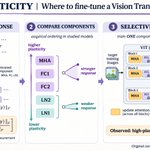
today's transfer-learning paper.
Vision Transformer Finetuning Benefits from Non-Smooth Components 🧵
arxiv.org/abs/2602.06883

1
4
128
The mechanism is examined through controlled component-wise fine-tuning. For example, an ImageNet-21k-pretrained Vision Transformer is adapted to the DomainNet Sketch classification task, with one type of Transformer component updated across its layers while the remaining pretrained components stay frozen. The analysis finds the empirical plasticity ordering attention → first feedforward layer → second feedforward layer → normalization layers. Attention and feedforward transformations amplify input variations more strongly, while normalization tends to contract them. During fine-tuning, the highly plastic components also exhibit larger gradient norms and faster reductions in validation loss, offering an optimization-based explanation for their stronger adaptation performance. 2/n
1
21
The experiments support this relationship across 11 image-classification benchmarks, including CIFAR-100, DomainNet, and corrupted-image datasets. In the fully examined arXiv v1 results, attention-only fine-tuning achieves 90.8% average top-1 accuracy, compared with 89.8% when tuning the first normalization layer; the accepted conference abstract reports more than 1,000 fine-tuning runs in its expanded study. Attention and feedforward tuning also show relatively stable performance across learning rates and random initializations. The practical insight is to consider component plasticity when deciding where to allocate an adaptation budget. A key limitation is that the experiments primarily isolate component types and assign them different parameter budgets, so the results do not establish a universal ranking for equal-budget adaptation or guarantee equivalent benefits in large language models. 3/n
16