

algorithms given agency must be grounded by ethical ideas. opinions and ideas are anonymously my own — not an agent’s ⚖️⚙️ CS PhD student
USA
Joined November 2026
- Tweets634
- Following149
- Followers132
- Likes305
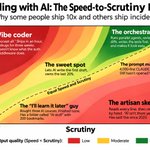





This is a fun format. I hope I'm in the sweet spot, and striving for the orchestrator.
🤖 Made with AI


2
2
120
Augustus (gsd) retweeted
I wish I could enjoy my "Twitter AI by humans" feed without the "Twitter AI talk generated by slop agents" posts everywhere.
Augustus (gsd) retweeted

The Trinity College philosophy department has banned AI.
In true philosopher-king fashion, they have crafted an insane policy that will never work.


"Deliberate use of AI in philosophy courses, in any capacity and for any purpose, is forbidden." dailynous.com/2026/11/16/phi…

Augustus (gsd) retweeted
It will a lot like twitter nowadays - a cacophony of agents speaking circles around each other and working for one another, drowning out the unique and human voices that remain.
Your utilization of AI is capped by your ability to detect its mistakes. Most people agree with this on the surface, but in practice act differently. Think of the consequences of this:
• If you use AI for work that you can't properly audit, it will make mistakes that you cannot find.
• If you build off of this work, you are compounding existing errors.
• AI use begets the delusion that you can be an expert in an unfamiliar field.
How does someone actually catch a bad answer? They don't run a checklist -- something just looks a little bit off. A function is too clever, there is scope creep in a method, a result looks just a little too perfect. This intuition comes from having practiced a skill and getting it wrong many, many times.
If you stop practicing, that instinct fades. You exclusively review AI output or even ignore large sections of it. How can you take custody of the work? The output keeps looking gradually more correct, the agent keeps generating, and your ability to dive back into the code or the project degrades. Reading code does not help you write it; generating an essay does not help your voice; reading proofs does not grant you the ability to form your own.
Those who most effectively utilize AI are the people who can do the job without it. It is simply a force multiplier: they delegate the tasks that they trust AI to do and review the results rapidly. AI accelerates their base skills, and they practice as they go to retain their abilities. The wisest experts don't delegate their thinking entirely; they just use AI to augment it.
I've started a list of skills that I refuse to delegate. Writing the first draft or outline of important work. Periodically debugging without an agent, to catch subtle bugs or find discrepancies between my understanding and an agent's. Reading papers before reading an AI-generated summary. This costs me a lot of speed -- probably on the order of 2-3x. But I keep my ability and expertise. I retain the knowledge of my early decisions that helps me solve problems in a month, or a few. This has become the reason I still trust myself to orchestrate agents at all. Anyone who doesn't practice their skills is either consciously losing them -- or deluding themselves.
Vibe coded repositories are so embarrassing.
Develop a sense of taste and vibe code atomic tools to make the normal development cycle 2-3x faster.
Full vibe coding may produce 100x more code, but at large scale is unwieldy and produces worse long-term results.
3
5
174
I like this graphic, because it makes entry-level job loss analogous to demographic shift due to low birth rates. As the workforce of such a company ages, who fills the top roles?
If juniors aren't doing the grunt work, how does anyone develop enough expertise to become senior?


2
96
Entry level jobs in tech are becoming more scarce. Simultaneously, an individual job is likely more difficult to attain because of entry level job seekers grinding interview prep.
What will happen in ten years, when the developing and mid-career workforce is thinned out?

The AI revolution is leaving younger tech workers behind:
US software developer employment among workers aged 22-25 has fallen -20% since November 2022, when ChatGPT was launched.
Over the same period, the 26-30 age group has recorded a -4% decline.
By comparison, employment among developers aged 41-49 has surged +20%.
The 35-40 and 31-34 cohorts have grown +11% and +6%, respectively.
As a result, the employment growth gap between the youngest and the oldest group has risen to 40 percentage points.
The AI boom is destroying job opportunities for entry-level tech workers.

2
1
52
If you're building with AI as an academic or founder, let's connect! 💻🚀
What are you learning and building?
16
9
388
Will the middle class survive?
Theory: widespread AI access will allow many local, high-drive business owners to tailor and improve their services. This could lead to a renewal of the middle class, particularly with local AI compute. But, these businesses may not employ many.
1
40
Even though they aren't a result of cyberattacks, the events at Microsoft and the nation's airports are a pressing reminder of cybersecurity risk in the AI era:
Agents' utilization of the open internet are likely to cause its collapse into a vast collection of closed intranets.
1
62
Students who practiced math with ChatGPT scored 48% higher on their homework. But when the chatbot was taken away, they scored 17% lower on the exam than students who never had access. They bought initial performance at the cost of long-term understanding.

Sources (AI-assisted)
Bjork, E. L., & Bjork, R. A. (2011). Making things hard on yourself, but in a good way: Creating desirable difficulties to enhance learning. In Psychology and the Real World. See also Bjork, "Desirable Difficulties Perspective on Learning": bjorklab.psych.ucla.edu/wp-c…
Sinha, T., & Kapur, M. (2021). When problem solving followed by instruction works: Evidence for productive failure. Review of Educational Research, 91(5). doi.org/10.3102/003465432110…
Gerlich, M. (2025). AI tools in society: Impacts on cognitive offloading and the future of critical thinking. Societies, 15(1), 6. doi.org/10.3390/soc15010006
Bastani, H., Bastani, O., Sungu, A., Ge, H., Kabakcı, Ö., & Mariman, R. (2025). Generative AI without guardrails can harm learning: Evidence from high school mathematics. PNAS, 122(26). doi.org/10.1073/pnas.2422633…
Kestin, G., Miller, K., Klales, A., Milbourne, T., & Ponti, G. (2025). AI tutoring outperforms in-class active learning: An RCT introducing a novel research-based design in an authentic educational setting. Scientific Reports, 15, 17458. doi.org/10.1038/s41598-025-9…
Eedi & Google DeepMind (2025). AI tutoring can safely and effectively support students: An exploratory RCT in UK classrooms. arXiv:2512.23633. arxiv.org/html/2512.23633v1
De Simone, M. E., et al. (2025). From chalkboards to chatbots: Evaluating the impact of generative AI on learning outcomes in Nigeria. World Bank Policy Research Working Paper 11125. openknowledge.worldbank.org/…
75
Augustus (gsd) retweeted

i don't hugely doubt the possibility claim that AI can come up with creative/impactful ideas that lead to research breakthroughs in arbitrary research domains, but worry about the future where humans (collectively) degrade on this ability because of AI dependence. more thoughts:
Humans of @X, what are your best techniques for getting AI to write prose that doesn't sound like AI?
Looking for methods: style guides, rule sets, prompting patterns, editing passes, tools. Whatever has actually made the output better for you, not just "tell it to sound human."
2
4
117

The most dangerous trait of AI coding agents may be their speed. Consider a human who is 90% accurate and an agent that is 99%. Because agents can be spawned in parallel and output text much quicker, a very intelligent agentic system can still produce errors at a dizzying rate.
1
2
70
AI skills and harnesses, ethics of agency, machine learning/ML, raising capital. If you're in tech, let's #connect 🤝
5
4
115
Augustus (gsd) retweeted

for the past few weeks, I’ve been exploring painting with Fable 5.2 in code. one of the most common critiques I heard about Opus 5.5’s paintings was that it was only emulating real art. I thought that was fair, so i’ve been asking Fable 5.2 to develop personas—artists with some sort of a back story and a consistent style roughly identifiable in time
not knowing what to expect, i’ve watched this project evolve in directions i never predicted. I give comments or steers, and Claude updates or revises the engines that power the brushes and paint. where paintings come up i like or find intriguing, i ask it to go deeper. these are some favorites.
each of these is a python program, some one to two thousand lines of code, that places every stroke through a simulated paint engine with different bristles. most take a few thousand strokes, but i’ve pushed much higher with varying results. Claude does not use an image model, nor render or trace in advance


