

Crypto Researcher. Building BeyondBlockchain. The context you need to make your own call.
Joined May 2020
- Tweets379
- Following634
- Followers564
- Likes998






Zcash still has less than 1% of Bitcoins market cap despite offering privacy. In future my bet is on people using Zcash but not sure about something as transparent as Bitcoin. Satoshi wanted to add privacy features. Zcash has privacy features. You do the math...
5
95
VC checks dried up and the era of mid-curve teams raising $15m on a notion doc is dead.
What happens next is decoupling.
The projects with real cash flows, actual users, and flawless execution will get scooped up by liquid funds who finally have to care about fundamentals.
1
4
94
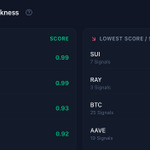
I am a little surprised that these coins have the strongest market sentiment ytd:
1. Avalanche (wasnt on my radar)
2. Chainlink
3. Uniswap
4. Arbitrum
On the other hand Sui has a difficult year. Do you agree?
Check the sentiment for other cryptos here: beyondblockchain.de/tools/se…

I first mentioned Solana on 15 January 2021 — Bull '21 tier, rank #64. How early were you? earlytosolana.com/?h=alkan_r…
Bullposted Solana at the right moment ;)

4
105
Crypto needs Mythos now. As a VC your job is going to provide the best AI security models to your portfolio companies.
5
74
Blowouts:
Terra ☑️
Celsius ☑️
FTX ☑️
3AC ☑️
BlockFi ☑️
Genesis Trading ☑️
Michael Saylor ⏳
Tom Lee ⏳
Then up only 🚀
4
120
alkan retweeted
The most impactful will be $BASE.
The latest interesting one was $ZAMA.
The most interesting unconfirmed ones are $TEMPO and whatever the Flashbots ticket will be.
The most interesting ones which very likely will launch a token are @hibachi_xyz @inconetwork and @0xMiden.
This is pure techno-optimism detached from physical and historical reality. The American lifestyle isn't just a result of high productivity...it's built on a foundation of global exploitation and resource extraction. You can’t 10x your way into a world where 8 billion people live like Americans when that very lifestyle requires a global underclass and more resources than the planet actually has. It’s a structural impossibility, not a software problem.
We need to 10x finding a better system than communism or capitalism which both are far from ideal systems. Communism makes everyone in the working class equally poor. Capitalism leads to imperialism to build wealth on the exploitation of other countries/regions.
People who profit from either system will defend that very system.

Stop worrying about AI, you should be more worried about lack of AI.
We really need to 10x human global productivity at 95%+ employment to satisfy demand for global consumers who just want the same quality of life as a median American today.
AI alone isn’t going to get us there, even at the current most optimistic projections.
3
130
alkan retweeted
The product in crypto isn't just code, it's also the token's ability to retain the community's attention and capital.
1.) L1 vs DeFi: L1 are sovereign economies with native and ecosystem value accrual mechanisms. They can play the long R&D game. DeFi projects however are service providers. If a service provider doesnt share the surplus, it's just a leaky bucket. We've seen governance-only tokens get nuked because, without a link to revenue, they're just vibes with no floor. Successful DeFi protocols such as Aave have introduced buybacks and will attach other revenue sharing models to the $AAVE token (despite some disputes with Aaave Labs). Uniswap sat on the fee switch for years and finally pivoted to rewarding holders.
2) You will agree that very soon technical parity is reaching a point where a cracked solo vibe coder can ship a protocol that matches a blue chip on tech but beats them on incentives. In contested markets, if you aren't using buybacks/fees to lock in your distribution, you're just a R&D lab for the person who's going to vibe you with a better token model and more community alignment.
=> In DeFi, the token has to be treaten as a core part of the product and users/communities won't be loyal to down-only token (Zcash is an exception~~). It doesn’t necessarily have to be buybacks, but I wouldn’t bet on long horizons either.
tech stocks are trading at such disgusting multiples that "building a data center in a field in Ohio" doesn't pump the stock anymore.
we’ve officially reached the "fuck it, let's put it in orbit" stage of the bubble.
Project Suncatcher is literally just admitting they ran out of Earth. we are $20 trillion away from NVDA announcing a GPU cluster on the dark side of the moon just to beat Q3 earnings.
the solar system is the new TAM. stay humble.
5
134
THE ERA OF CRYPTO IS ENDING SOON…
…and that’s a good thing!
I’ve spent every day of the last 8 years with this technology, and I absolutely cannot stand the word "Crypto"anymore. I associate it with Crypto Bros in Lamborghinis, NFTs, speculation, and scams. I couldn't care less whether Bitcoin is having a strong or a weak phase.
But what I do own is a vision for the technology behind it. We are currently witnessing something paradoxical that makes me incredibly happy and proud after all these years: We are experiencing Blockchain’s TCP/IP moment. The technology is FINALLY fading into the background, and we are talking about infrastructure, applications, and above all, utility!
Public interest in crypto is declining, but adoption by the world's largest companies is exploding. Here are just a few examples from recent weeks that show what the “invisible revolution” looks like:
Case Study Cloudflare: The Currency for the Agentic Web
@Cloudflare realized that the ad-supported internet model works as long as users consume content, watch ads, and pay with credit cards. However, with the transition to an Agentic Web - where autonomous AI agents act, interact, and use services independently - this model hits a structural wall. AI agents don’t consume ads, they don’t have bank accounts, and they operate at extremely high frequencies. Yet, they access APIs, use data, computing power, or models, often in interactions that might cost fractions of a cent.
Just as TCP/IP once enabled the global exchange of information without users ever having to think about the protocol, the Agentic Web needs an invisible, native payment infrastructure for machines. From this insight, the NET Dollar was born. This is explicitly not about speculation or a new asset for end-users, but a pure settlement instrument for automated micro-transactions.
The problem with classic payment systems becomes glaringly obvious here: If an AI agent needs to pay 0.001 cents for a single API query, credit card fees are not just inefficient, they are economically absurd. They are too expensive, too slow, and not programmable. The NET Dollar enables fully automated pay-per-use payments between machines. Global, 24/7, and with minimal costs. The blockchain here is not an end in itself, but a necessary technical tool to make this kind of settlement scalable and trustless in the first place. Just as no one "uses" TCP/IP on the internet, the underlying technology here disappears completely behind the application.
This paradigm shift is particularly evident in the introduction of x402, a new standard linked directly to HTTP status code 402 – Payment Required. The idea is radically simple: Payment becomes a native part of the request. An agent makes a request, pays automatically, and receives the answer with no login, no checkout, no human interaction. Value transfer becomes as natural as data transmission.
In this context, @coinbase plays a central role as an infrastructural enabler. Coinbase positions itself less as a classic exchange and more as a payment and settlement layer for the Internet of Agents, including wallet infrastructure, stable settlement, and developer tools that make machine-to-machine payments practical.
This example illustrates perfectly what the TCP/IP moment of crypto looks like. Not as a consumer product, not as a speculative asset, but as invisible infrastructure that enables entirely new forms of applications. Mass adoption in this context doesn't mean billions of people learning to use blockchains. It means blockchains disappearing into the background.
Case Study YouTube: The Infrastructure of the Creator Economy
The Creator Economy is at a similar turning point to the early internet. Platforms like @YouTube are no longer just media platforms; they are global employers for millions of creators. This is exactly where the obsolescence of classic payment infrastructure shows: International payouts take days, depend on banks, cut-off times, and local clearing systems, even though the underlying digital content is distributed globally in seconds.
That’s why YouTube has taken the first step of enabling payouts via @PayPal stablecoin $PYUSD for US creators. The crucial point here is not the stablecoin itself, but how it is used. YouTube holds no crypto assets, operates no wallets, and exposes itself to no volatility. Instead, the platform simply uses PayPal's more efficient payment rails in the background. For YouTube, it remains a pure infrastructure decision, comparable to switching from a slow network protocol to a faster one.
For creators, however, the experience changes fundamentally. Earnings can be paid out globally in near real-time, without classic bank waiting times, without intermediaries, and without the fragmentation of national payment systems. It is still measured in dollars and behaves identically to them, with one major difference: Money is no longer "wired," it is transmitted. Fast, direct, and programmable.
This is where the TCP/IP narrative becomes tangible. No one on YouTube thinks about which protocols transport videos. Likewise, creators shouldn't have to think about which payment systems run in the background. The blockchain here is neither product nor feature, but an invisible settlement layer that simply has better properties than the existing system. Just as email didn't replace traditional mail because users understood protocols, but because it was faster and more global, this new payment infrastructure replaces slow banking processes. And the best part? On the frontend, almost everything stays the same for the user, but the experience and utility get better: It feels like dollars, but moves like email.
Case Study Klarna: The Tokenization of Payments
Global payments are still based on infrastructure built for a different era. The SWIFT network connects banks worldwide but is slow, expensive, and highly fragmented. Fees in the triple-digit billions flow through this system annually, while transfers still take days, depend on cut-off times, and are barely programmable. End-users feel this inefficiency indirectly through costs, delays, and limited availability.
@Klarna is taking a radically different approach. Instead of incrementally optimizing the existing system, Klarna is building its own payment network with KlarnaUSD on the payment-optimized Tempo Blockchain. The key here is not the introduction of a new end-user product, but the tokenization of settlement itself. Money is no longer moved through a construct of correspondent banks and message formats, but transferred directly as digital value.
Tempo is being developed in collaboration with infrastructure partners like @stripe and @paradigm and is specifically optimized for payments: high throughput, low latency, and negligible transaction costs. The blockchain functions as a settlement layer, not a user interface. Here again, the TCP/IP principle applies: Technical complexity remains completely in the background.
To ensure this new infrastructure remains truly invisible to users, Klarna integrates wallet infrastructure from @privy_io. The user experience hardly changes. They see a balance, make payments, and receive statements without wallet setups, seed phrases, or other "crypto moments." In the background, however, runs a tokenized payment architecture that drives costs toward zero and enables settlement in near real-time.
This case illustrates how payments can evolve in the Post-SWIFT era. Not by introducing new apps or re-educating users, but by replacing outdated rails without a visible break in the frontend.
Klarna shows that the next phase of financial infrastructure is not loud, not speculative, and requires no explanation. It is invisible, programmable, and cost-minimal. This is exactly what the moment looks like when crypto stops being a "topic" and blockchain becomes the self-evident foundation for global value transfer.
In summary, a clear picture emerges from these case studies:
a) Decoupling of Brand and Technology: Terms like "Crypto," "Web3," or "DeFi" are disappearing from the corporate communications of major tech companies. Instead, they speak of "Stablecoins," "Payouts," or "Digital Wallets."
b) Focus on the US Dollar: It is no longer about the competition of thousands of new currencies (Bitcoin, Ether, Dogecoin) as a means of payment. It is about the tokenization of the US Dollar (PYUSD, KlarnaUSD, NET Dollar, USDT, USDC) or the Euro (EURC). The speculation of recent years is making way for non-speculative applications.
c) B2B instead of P2P: Future volumes will not come from users sending money to each other, but from companies (@Visa, @Mastercard, @Klarna) optimizing their internal settlement or machines (Cloudflare) paying machines.
Conclusion: Crypto dies as a brand, but Blockchain wins as a technology. The time will inevitably come when we no longer say "I'm paying with crypto." We will simply pay. Faster, cheaper, and more globally than ever before. And we won't even notice that a blockchain lies underneath. The phase of infrastructure and applications based on this revolutionary technology begins now. The time of crypto is ending soon, and that is a good thing for the maturity and adoption of the technology.

Hey @jessepollak, @wagmiAlexander, @0xgaut as an active Base user there’s one thing I’m really missing: being able to buy stocks like Google, Coinbase, Robinhood etc. directly onchain. Any chance we’ll see stock trading on Base soon? I keep my funds on Base and would rather not bridge elsewhere just to get stock exposure.
1
3
245
alkan retweeted
Just an outside opinion. I get the feeling that Aptos really wanted to position itself strongly around payments. Partnerships with PayPal and stablecoin issuers at least point in that direction, and the technology itself offers very low latency with high performance.
What, in my opinion, doesn’t reflect well on Aptos is how long $WLFI was pushed, even though most people, I think, had a rather critical view of that project. What I’m missing are killer native dApps on Aptos.
As an early Solana user, I was won over by Jupiter (which had a much better UX than Uniswap back then) and Phantom (which launched as the best wallet). Aptos also has wallets and DEXes, etc., but nothing that really stands out.
Aptos did manage to attract one of the major DeFi protocols with Aave, but it’s stagnating at around $3M TVL. Aave should be doing on Aptos at least what it achieved on Plasma. Just a few incentives aren’t enough for that, it needs more.
I wish there were a native neobank wallet, or even better, a crypto bank wallet on Aptos, where all assets are held in the form of an Aptos-native stablecoin (similar to $CASH on Phantom), but this one would already generate native yield just by holding it. Aptos could become the first payment blockchain with native stablecoin yield as default.
Partnerships with Aave, Chainlink, etc., already exist to my knowledge. That’s the direction I’d like to see Aptos heading, especially if it wants to keep focusing on payments, which, thanks to its ultra-low latency, would also make it super interesting for agents and agent-based payments